
Food Grade Gases Market Outlook: Size, Share, Trends, Growth Analysis, Competitive Landscape & Forecast, 2026-2033

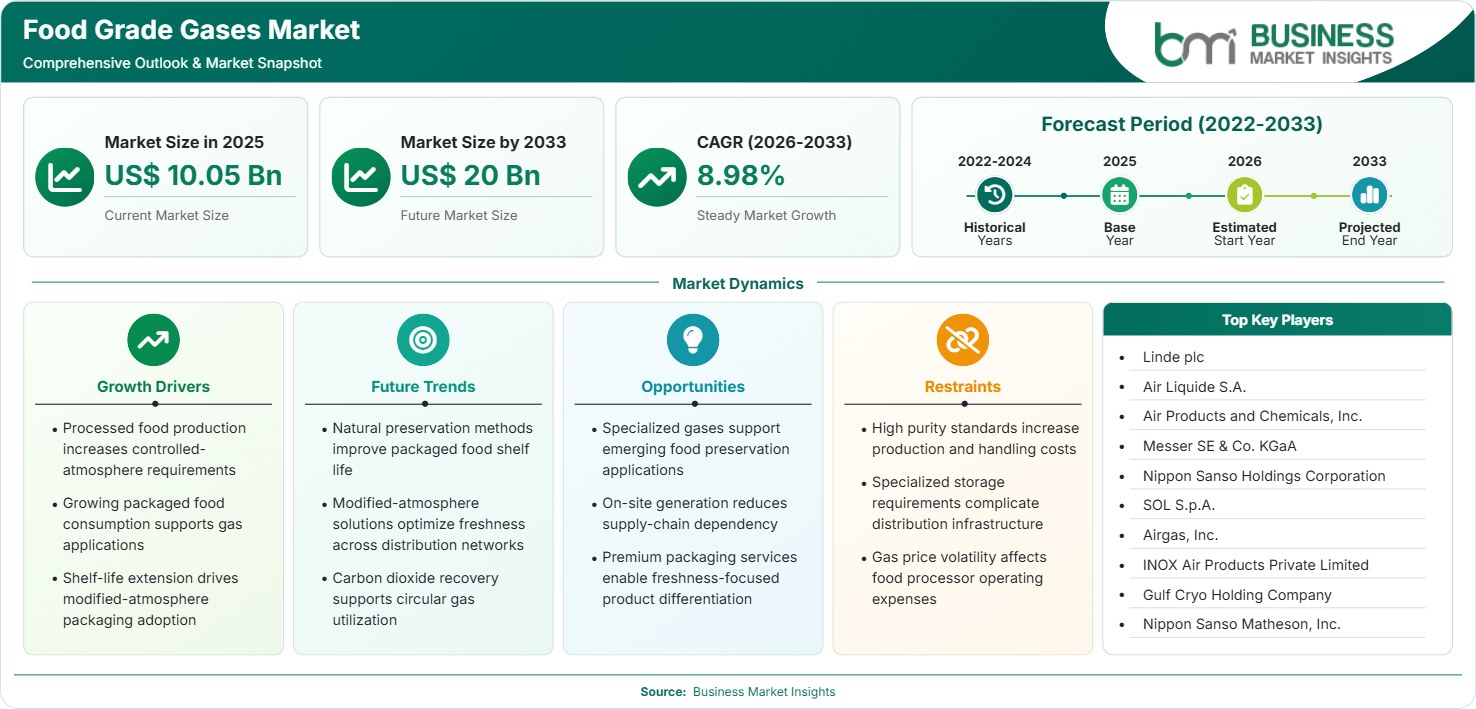
The Food Grade Gases Market size was valued at US$ 10.05 Billion in 2025 and is projected to reach US$ 20 Billion by 2033, growing at a CAGR of 8.98% during 2026–2033, driven by modified atmosphere packaging, cryogenic processing, beverage carbonation, food safety requirements, and shelf-life extension opportunities.

Report Coverage
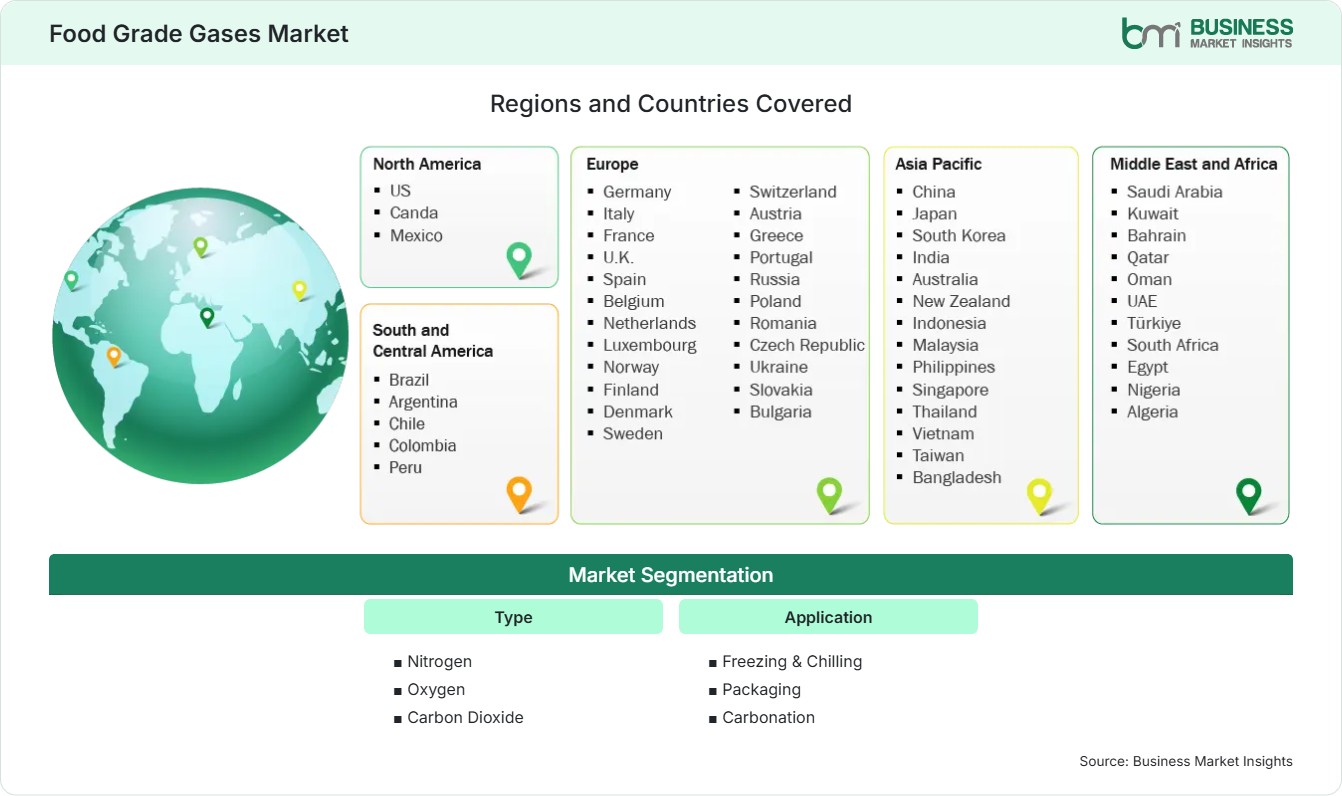
  • Type: Nitrogen, Oxygen, Carbon Dioxide
  • Application: Freezing & Chilling, Packaging, Carbonation
US$ 10.05 Bn Market size in 2025
US$ 20 Bn Market Size by 2033
8.98% CAGR, 2026 - 2033
2026-2033 Forecast Period

AI Overview

Food Grade Gases Market Summary

  • North America Region: North America holds a modeled market share of 28%–31% in 2025, growing at a CAGR of 7.8%–8.4% during 2026–2033. Demand is supported by sophisticated food processing, cold-chain infrastructure, beverage carbonation, packaged fresh foods, nitrogen applications, and strong quality-control practices. The US market benefits from established bulk-gas networks, large food manufacturers, retail packaging adoption, and advanced cryogenic processing, with a modeled 7.7%–8.3% CAGR during 2026–2033.
  • Fastest Growing Region: Asia Pacific represents a modeled 30%–33% share in 2025, expanding at 10.1%–10.8% CAGR during 2026–2033. Rising processed-food production, organized retail expansion, cold-chain investment, beverage manufacturing, and wider adoption of modified atmosphere packaging create substantial incremental demand across China, India, Japan, South Korea, and Southeast Asia.
  • Leading Segment: Nitrogen accounts for a modeled 47%–51% share in 2025, expanding at 8.7%–9.3% CAGR during 2026–2033. Its dominance reflects inerting, modified atmosphere packaging, cryogenic freezing, beverage dispensing, oxygen displacement, and broad compatibility with food preservation and processing requirements.
  • High Growth Segment: Packaging represents a modeled 41%–45% share in 2025, advancing at 9.4%–10.1% CAGR during 2026–2033. Growing demand for extended shelf life, premium fresh products, export distribution, reduced preservative use, and flexible gas mixtures supports investment in advanced packaging systems.
  • Key Market Opportunity: Producers can capture value by integrating certified gases, onsite generation, gas-mixing equipment, monitoring, analytics, and application engineering into bundled solutions that reduce logistics exposure while improving food safety and process consistency.
  • Major Market Players: Linde plc; Air Liquide S.A.; Air Products and Chemicals, Inc.; Messer SE & Co. KGaA; Nippon Sanso Holdings Corporation; SOL S.p.A.; Airgas, Inc.; INOX Air Products Private Limited; Gulf Cryo Holding Company; Nippon Sanso Matheson, Inc.
Strategic Insights

Food Grade Gases Market: Strategic Insights

Food Grade Gases Market Strategic Framework
FREE PDF
Request your free sample
Request free sample
Stakeholder View

Key Takeaways

  • Supply-chain in Food Grade Gases Market competitiveness is increasingly determined by the ability to coordinate gas production, purification, storage, transportation, cylinders, bulk tanks, and onsite generation rather than simply selling individual gas molecules. Long-term customer relationships, therefore, depend on reliability, technical service, and documented quality.
  • The most significant potential benefit is to be found in the areas of packaging and cryogenic processing, since the amount of gas used is directly linked to the shelf-life targets, the production throughput, temperature control, and the distance over which the product is distributed. Manufacturers who have high-volume packaging lines provide good opportunities for integrated gas and equipment contracts.
  • Innovation is now focusing on accurate gas blending, automated dosing, online monitoring, the generation of nitrogen on-site, and the development of formulations tailored to specific applications. Such technologies can reduce waste, enhance consistency, and enable processors to adjust gas composition to match product characteristics.
  • The investment case in the Asia Pacific region is the most attractive since food processing capacity, consumption of packaged food, beverage production, and modern retail infrastructure are all expanding at the same time. By making use of its local production and distribution facilities, it is possible to improve the economics of delivery and at the same time reduce reliance on distant supply points.
  • Investment strategies will tend to focus on expanding regional capacity, optimizing logistics, and making acquisitions that enhance the networks for carbon dioxide, nitrogen, dry ice, and food-grade specialty gases. Since scale is still important, this is because the level of production and the density of the distribution system affect delivered cost and service reliability.
Geographic Outlook

Food Grade Gases Market Regional Highlights

North America Food Grade Gases Market

North America represents 28%–31% share in 2025 and is modeled to grow at 7.8%–8.4% CAGR during 2026–2033. The regional Food Grade Gases Market benefits from mature packaged-food manufacturing, extensive cold-chain infrastructure, beverage carbonation, and sophisticated distribution networks. The US remains the principal demand center because of its large processed-food base and established gas suppliers.

  • The packaging includes modified atmosphere packaging because of the demand for fresh meat, seafood, dairy products, bakery items, prepared meals, and produce, which require controlled levels of oxygen and carbon dioxide throughout distribution.
  • Cryogenic processing involves the use of liquid nitrogen and carbon dioxide to achieve quick chilling and freezing, which in turn helps to improve productivity and enable better temperature control in operations dealing with meat, poultry, seafood, bakery products, and prepared foods.
  • With regard to beverages, carbon dioxide is still necessary for carbonated drinks, and nitrogen serves a role in dispensing, in inerting, in maintaining pressure, and in controlling oxidation for certain categories of beverage.
  • The infrastructure for supply consists of dense production and distribution networks, which enable suppliers to offer cylinders, microbulk, bulk liquids, and on-site systems in accordance with customers' consumption patterns.

US Food Grade Gases Market

The US accounts for a modeled 20%–23% of the global Food Grade Gases Market demand in 2025 and is projected to expand at 7.7%–8.3% CAGR during 2026–2033. Its market is supported by large-scale food manufacturing, retail-ready packaging, beverage production, meat processing, and established cold-chain systems.

  • In the field of food processing, companies that deal with meat, poultry, seafood, dairy products, bakery goods, and prepared foods have ongoing needs for nitrogen, carbon dioxide, and various gas mixtures at different stages of production.
  • The production of beverages continues to rely on carbonation and the dispensing of beverages, and the use of nitrogen for inerting helps to control the amount of dissolved oxygen and ensures that the quality of the product is maintained.
  • The use of on-site nitrogen generation allows large processors to produce nitrogen where their continuous consumption makes it more economical to generate it on-site than to have it delivered repeatedly in cylinders or in bulk.

Europe Food Grade Gases Market

Europe holds a modeled 25%–28% Food Grade Gases Market share in 2025, with a projected 7.4%–8.1% CAGR during 2026–2033. Germany, the UK, France, Italy, Spain, and the Netherlands provide substantial food-processing and beverage demand. Germany and France remain leading markets, while Poland and Spain provide comparatively strong growth opportunities.

  • Germany has a large-scale food-processing and industrial sector that meets the demand for nitrogen, carbon dioxide, cryogenic freezing, and protective-atmosphere packaging.
  • In France, applications in the areas of dairy, bakery, meat, wine, and ready-to-eat foods promote varied consumption throughout the fields of packaging and processing.
  • In Spain, there is a strong demand for controlled-atmosphere technologies because of seafood, meat, produce, beverages, and food manufacturing aimed at export.
  • In Poland, the expansion of the food manufacturing sector and the development of modern retail infrastructure lead to greater growth prospects in the areas of packaged-food preservation and cryogenic processing.

Asia Pacific Food Grade Gases Market

Asia Pacific Food Grade Gases Market holds a modeled 30%–33% share in 2025 and records the highest projected 10.1%–10.8% CAGR during 2026–2033. China, Japan, India, South Korea, Australia, and Southeast Asian markets form the regional demand base. China and Japan remain leading markets, while India, Indonesia, Vietnam, and Thailand provide higher growth opportunities.

  • China has large-scale manufacturing in the food and beverage sector for use in nitrogen, carbon dioxide, oxygen, cryogenic freezing, and modified atmosphere packaging.
  • In India, there are opportunities to develop organized food processing and to increase investment in cold chains, such as for bulk gases, the generation of nitrogen on-site, packaging mixtures, and the carbonation of beverages.
  • In Japan and South Korea, the high quality of packaged foods and the presence of advanced manufacturing environments lead to a demand for accurate gas compositions, automated dosing, and strong traceability.
  • In Southeast Asia, seafood, meat, fruit, ready-to-eat meals, and beverage production offer promising opportunities as companies modernize their packaging and distribution methods.

Rest of World Food Grade Gases Market

Rest of World Food Grade Gases Market represents a modeled 10%–13% share in 2025, with 8.0%–8.8% CAGR during 2026–2033. South and Central America benefit from meat, seafood, fruit, beverages, and agricultural exports requiring controlled preservation. Brazil and Mexico are leading demand centers, while Chile and Colombia offer growth opportunities.

  • In Latin America, producers who are export-oriented and deal in meat, seafood, fruit, and beverages are increasingly making use of packaging atmospheres and temperature-control technologies in order to maintain the quality of their products during long distribution periods.
  • In the Middle East, demand for carbon dioxide, nitrogen, dry ice, and gas mixtures is being met through beverage production, the distribution of imported food, and by expanding local processing.
  • In Africa, there are opportunities for decentralized gas supply and for applications in packaged food because of urbanization, investment in food processing, and improvements to the cold-chain infrastructure.
  • Investment at the regional level, such as local production plants, large-scale storage, cylinder distribution networks, and technical services, can lower the costs of delivery and enhance continuity for processors who are situated a long way from major gas hubs.
Global Market Geography
FREE PDF
Request your free sample
Request free sample
Segment Analysis

Food Grade Gases Market Segmentation

Type

The Type segment is led by nitrogen, which represents a modeled 47%–51% share in 2025 and is projected to grow at 8.7%–9.3% CAGR during 2026–2033. Carbon dioxide maintains strong demand through carbonation and preservation, while oxygen serves controlled packaging and specialized processing. The Food Grade Gases Market scope therefore spans both commodity-scale gases and application-specific mixtures.

  • Nitrogen: Nitrogen supports inerting, oxygen displacement, cryogenic freezing, packaging, beverage dispensing, and pressure stabilization, making it the broadest-use gas across food processing applications.
  • Oxygen: Oxygen is selectively used in modified atmosphere packaging, controlled processing, and applications where maintaining product appearance or supporting controlled biological activity is required.
  • Carbon Dioxide: Carbon dioxide supports beverage carbonation, chilling, freezing, preservation, inerting, and microbial-control applications, creating demand across food and beverage manufacturing.

Application

The Application segment is led by packaging, representing a modeled 41%–45% Food Grade Gases Market share in 2025 and projected to expand at 9.4%–10.1% CAGR during 2026–2033. Packaging demand is strengthened by fresh-food distribution, longer retail cycles, export requirements, and consumer preference for minimally processed products.

  • Freezing & Chilling: Cryogenic nitrogen and carbon dioxide provide rapid temperature reduction, helping processors control texture, moisture, throughput, and product quality across frozen and chilled foods.
  • Packaging: Nitrogen, carbon dioxide, oxygen, and tailored mixtures modify package atmospheres to slow oxidation, manage microbial activity, maintain appearance, and extend usable shelf life.
  • Carbonation: Food-grade carbon dioxide provides the carbonation required for soft drinks, sparkling water, beer, and other beverages while demanding controlled purity and reliable delivery.
Market Forces

Food Grade Gases Market Dynamics

Key Market Drivers

Expansion of Modified Atmosphere Packaging

One of the key factors in demand is modified atmosphere packaging, since the composition of gases directly affects oxidation, microbial activity, appearance, and shelf life. According to Linde, the main gases in MAP include carbon dioxide, nitrogen, and oxygen, which can be provided either as pure gases or mixed gases. Carbon dioxide and nitrogen are also mentioned by Airgas in applications of freezing, chilling, inerting, and MAP. The ability to provide MAP is important in the expansion of product lines by retailers. The Food Grade Gases Market trends are therefore increasingly connected to packaging-line automation, precise gas ratios, monitoring, and packaging-material compatibility rather than gas consumption alone. Suppliers that provide formulation support and equipment integration can improve customer retention while increasing recurring gas volumes.

Growth of Cryogenic Food Processing

Cryogenic technology is becoming relevant in situations where processors need fast freezing, precise temperature control, and increased productivity. Liquid nitrogen and carbon dioxide can deliver cooling quickly, enabling processors to freeze their products effectively without compromising product quality. Linde offers freezing and chilling solutions in addition to food gases, whereas Messer lists cooling applications in food processing. The Food Grade Gases Market growth benefits from expansion in frozen meals, seafood, meat, poultry, bakery products, and prepared foods. Investment is also supported by processors seeking compact freezing systems, reduced processing time, and better control over product characteristics. Equipment-linked gas contracts can increase recurring demand by connecting gas consumption directly with installed processing capacity.

Increasing Beverage Carbonation and Gas Management

While carbonation still constitutes one structural application of food-grade carbon dioxide, other gases, such as nitrogen, are increasingly finding applications in the areas of inerting, pressure stabilization, dispensing, and oxidation prevention. According to Messer, carbon dioxide has been used in beverages for over a century, while nitrogen applications include non-carbonated beverages and pressure stabilization. Similarly, Air Liquide provides food-grade carbon dioxide for beverage carbonation. Future Food Grade Gases Market trends will increasingly emphasize traceability, supply continuity, gas-quality certification, and automated delivery. These requirements favor suppliers able to coordinate production, storage, testing, transportation, and application support for beverage manufacturers operating multiple plants.

Key Market Opportunities

Onsite Nitrogen Generation for High-Volume Processors

The ability to generate nitrogen on-site means that one can decrease reliance on gas that is transported when consumption is both high and continuous. Using membrane and PSA technologies, nitrogen can be produced close to where it is needed, thus reducing the need to handle cylinders and lowering certain logistical demands. Air Liquide says that its membrane nitrogen systems can achieve purities ranging from 95% to 99.9% and are in use at over 2,000 sites in various industries. This option is most attractive to those processors who have steady requirements in the areas of packaging, inerting or beverage processing.

Integrated Gas and Packaging Solutions

The next chance is to combine the supply of gas with packaging equipment, gas mixing, sensors, technical trials, and process optimization. Since different products react in different ways to varying concentrations of oxygen and carbon dioxide, food manufacturers are increasingly asking for gas compositions that are tailored to specific applications. Air Products offers pure gases, pre-mixed food gases, supply systems, equipment, and Freshline services, which shows the commercial advantage of providing integrated solutions. To reach smaller processors, suppliers can provide standard packages while offering customized engineering to multinationals.

Expansion of Food Gas Infrastructure in Emerging Markets

In emerging markets, there are investment opportunities because food processing capacity is growing more rapidly than specialized gas infrastructure. In India, in Southeast Asia, in Latin America, in the Middle East and in some African areas, it is necessary to have local production and distribution to serve processors who are operating away from existing industrial-gas centres. SOL offers food-grade gas technologies for use in packaging, freezing, carbonation, and other similar applications, and Gulf Cryo has supply capabilities for the food and beverage sector in the Middle East markets. Investing in regional air-separation plants, bulk storage, cylinder fleets, and technical centers will reduce delivery distances and increase reliability.

Market Restraints and Challenges

Energy Intensity and Production Cost Exposure

Factor: Air separation, liquefaction, purification, compression, storage, and transportation require substantial energy and specialized infrastructure. Electricity and fuel costs, therefore, influence the economics of nitrogen and oxygen production, while carbon dioxide availability can depend on upstream industrial and fermentation sources. Impact: Higher production or logistics costs can pressure supplier margins and customer budgets, particularly for smaller processors with intermittent demand. The Food Grade Gases Market must consequently balance purity requirements with supply economics.

Carbon Dioxide Supply Disruptions and Quality Control

Factor: Food-grade carbon dioxide can depend on upstream production streams, and interruptions at source facilities can constrain availability for beverage and food processors. Impact: Shortages or inconsistent supply can disrupt carbonation schedules, packaging operations, and production planning, creating costs that exceed the gas purchase price. Supplier diversification, strategic storage, purification, certification, and regional production can reduce exposure. Quality assurance is equally important because gases used directly in food applications require controlled purity and traceability.

Company Analysis

Competitive Landscape

The competitive structure is characterized by integrated industrial-gas companies, regional specialists, distribution networks, and application-technology providers. Food Grade Gases Market analysis indicates that competitive differentiation increasingly depends on supply reliability, certified purity, application engineering, onsite production, equipment integration, and technical support.

Company Name

Overview

Products and Services relevant to this market

Linde plc

Global industrial-gas supplier with extensive production, distribution, engineering, and food-industry capabilities across major geographic markets.

Food-grade nitrogen, carbon dioxide, oxygen, MAP solutions, cryogenic freezing and chilling, supply systems, and application support.

Air Liquide S.A.

Global gases and technologies company serving food production, beverages, agriculture, and processing customers through integrated supply networks.

ALIGAL food-grade gases, MAP solutions, carbonation, freezing, chilling, inerting, equipment, and analytical traceability.

Air Products and Chemicals, Inc.

Industrial-gas company offering food gases, equipment, gas mixtures, and application technologies for processors and beverage producers.

Nitrogen, carbon dioxide, oxygen, food gas mixtures, CryoEase supply, onsite generation, MAP, freezing, and carbonation solutions.

Messer SE & Co. KGaA

Privately held specialist in industrial, medical, specialty, and food gases with strong European and international operations.

GOURMET food gases, nitrogen, carbon dioxide, oxygen, gas mixtures, freezing, packaging, cooling, and beverage applications.

Nippon Sanso Holdings Corporation

Global industrial-gas group with food and beverage applications supported through regional operating companies and technical expertise.

Nitrogen, carbon dioxide, oxygen, MAP, freezing, chilling, gas application technologies, and process support.

SOL S.p.A.

European industrial-gas company providing food-grade gases, equipment, technologies, and application services across multiple food sectors.

AliSOL gas mixtures, nitrogen, carbon dioxide, oxygen, MAP, freezing, chilling, carbonation, and gas-management equipment.

Airgas, Inc.

US-focused industrial-gas distributor and Air Liquide company with broad food and beverage delivery infrastructure.

Food-grade carbon dioxide, nitrogen, gas mixtures, dry ice, cylinders, microbulk, bulk supply, and onsite generation.

INOX Air Products Private Limited

Indian industrial-gas producer with extensive domestic manufacturing, distribution, and customer-service capabilities.

Nitrogen, carbon dioxide, oxygen, industrial gases, specialty mixtures, bulk delivery, and food and beverage gas supply.

Gulf Cryo Holding Company

Middle Eastern gas manufacturer and distributor serving food and beverage processors across multiple regional markets.

Food-grade nitrogen, carbon dioxide, oxygen, gas mixtures, dry ice, freezing, MAP, carbonation, and total gas management.

Nippon Sanso Matheson, Inc.

North American gas supplier offering industrial and specialty gases, equipment, gas management, and food-related gas solutions.

Food-grade nitrogen, carbon dioxide, gas mixtures, onsite generation, equipment, analytical services, and food packaging applications.

Trust & Transparency

Research Methodology

The market analysis combines proprietary research with secondary data from government agencies, company disclosures, regulatory filings, industry databases and expert interviews. Market estimates are validated through data triangulation, cross-market benchmarking and analyst review.

View Full Research Methodology

Questions Answered

Frequently Asked Questions

What does the Food Grade Gases Market Report help buyers evaluate?

The Market Report helps buyers evaluate demand drivers, geographic opportunities, gas types, applications, competitive positioning, technology trends, supply considerations, investment priorities, and the Food Grade Gases Market forecast direction of the industry through 2033.

What role does onsite nitrogen generation play in food processing?

Onsite nitrogen generation can provide a continuous supply near the point of use, potentially reducing cylinder movements and delivery frequency. It is particularly relevant where packaging, inerting, or processing creates stable recurring nitrogen consumption.

How can smaller food processors reduce food-grade gas logistics costs?

Smaller processors can evaluate cylinder bundles, microbulk systems, premixed gases, and shared distribution arrangements according to consumption volume. Choosing the correct delivery mode can reduce handling requirements and avoid excessive inventory while maintaining required purity.

Why is carbon dioxide important for beverage manufacturers?

Carbon dioxide provides carbonation and can also contribute to oxygen displacement and product-quality control. Beverage producers therefore require consistent purity, controlled pressure, reliable supply, and traceable handling throughout storage and delivery.

What determines the correct gas mixture for food packaging?

The appropriate mixture depends on food chemistry, respiration rate, oxidation sensitivity, microbial behavior, package permeability, storage temperature, and desired shelf life. Nitrogen, carbon dioxide, and oxygen can be combined at different concentrations depending on the product and packaging system.

Access the Full Food Grade Gases Market Report

Get segment-level forecasts, regional estimates, competitive benchmarking, company profiles and downloadable Excel datasets.

Access the full Food Grade Gases Market Report
350 pages PDF & Excel | 2026-10-05
Similar Research

Related Market Reports