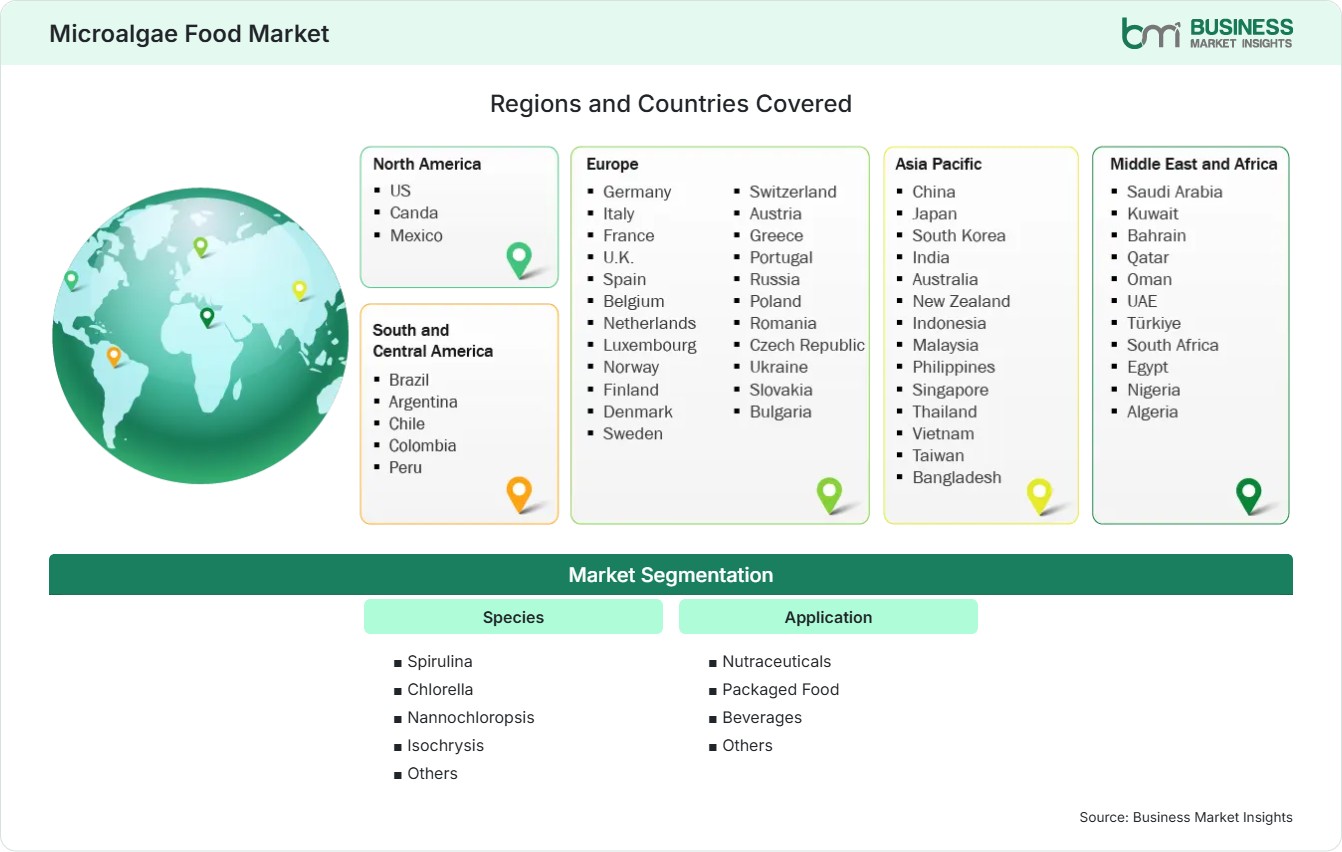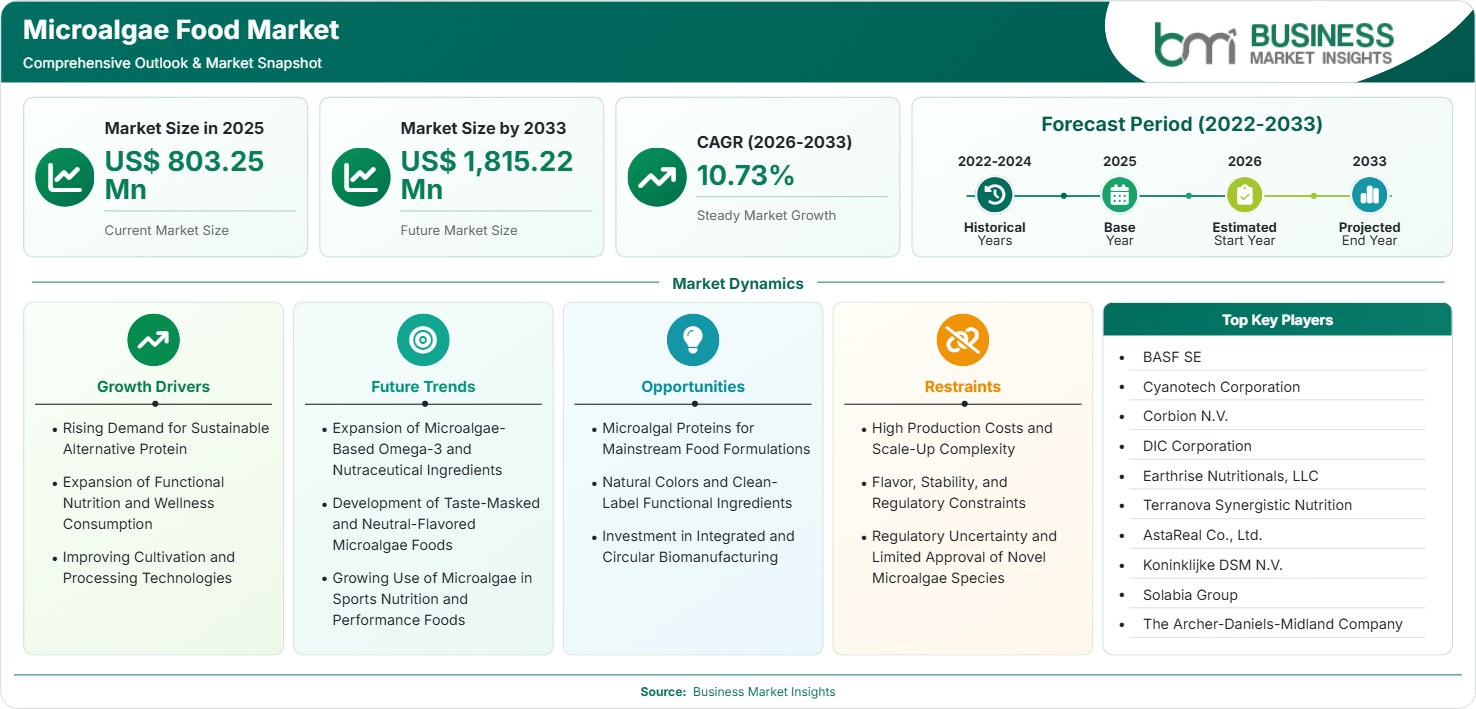
Microalgae Food Market Regional Highlights
North America Microalgae Food Market
North America Microalgae Food Market represents a leading regional market, supported by established nutraceutical channels, functional food innovation, premium dietary supplements, and sophisticated ingredient distribution. A modeled 2025 share of 35%–38% reflects strong commercialization, while the region is projected to expand at 9.5%–10.2% CAGR during 2026–2033. The United States accounts for most regional demand, with Canada providing additional opportunities through natural-health products and specialty nutrition.
- U.S. manufacturers and suppliers of the components are taking advantage of supplement distribution systems, the need for sports nutrition, and consumer awareness of Spirulina and Chlorella.
- The development of functional beverages is creating new opportunities in areas other than supplements, notably including smoothies, wellness drinks, protein drinks, and fortified drinks.
- North American companies increasingly emphasize ingredient traceability, standardized biomass, contaminant controls, and consistent sensory performance.
- The regional market also benefits from strong research commercialization links between ingredient producers, food manufacturers, and biotechnology developers, supporting innovations in extraction, and flavor management.
US Microalgae Food Market
The United States Microalgae Food Market constitutes approximately 80%–85% of North American demand in 2025, equivalent to roughly 28%–32% of global consumption on a modeled basis, and is projected to grow at 9.4%–10.3% CAGR during 2026–2033. The country has access to a highly developed diet supplement industry, health food supply chain, sports nutrition industry, and food industry R&D facilities. Big ingredient suppliers and algal specialists are able to launch standardized biomass and extract blends via existing channels.
- Sports nutrition creates a viable market opportunity because the use of algae components allows for protein, antioxidant, colorant, and micronutrient positioning.
- Growing demand for natural ingredients creates an opportunity to utilize Spirulina and Chlorella, especially among consumers that want natural food supplements.
- Marketing and sales in niche stores, online, and D2C creates opportunities for smaller algae players to access target consumers independently of standard supermarket distribution systems.
Europe Microalgae Food Market
Europe Microalgae Food Market maintains a substantial position, with a modeled 27%–30% share in 2025 and projected 10.8%–11.8% CAGR during 2026–2033. Germany, France, the Netherlands, and the United Kingdom form important commercial and technology centers, while France and the Netherlands provide strong biotechnology and ingredient-development capabilities. European growth is supported by sustainability-oriented food innovation, natural ingredients, and regulatory attention to novel foods.
- Germany is a significant contributor to the ingredients and functional food markets due to existing health product distribution and demand for nutritional formulations that have natural and plant-based ingredients.
- France has expertise in both food processing and biotechnology, offering possibilities for algae-based proteins, pigments, and functional components in high-quality nutrition and specialty foods.
- Netherlands benefits from existing food ingredients infrastructure and biotech networks for algae-based nutritional ingredients commercialization and processing and international distribution.
- The United Kingdom offers possibilities in specialized nutrition brands and functional foods and development of products based on research and algae ingredients sustainability and nutrition.
Asia Pacific Microalgae Food Market
Asia Pacific Microalgae Food Market is positioned as the fastest-expanding major region, with a modeled 23%–26% share in 2025 and 12.2%–13.2% CAGR during 2026–2033. Japan leads technologically, while China, South Korea, India, and Southeast Asian markets contribute expanding consumption and production opportunities. The region combines algae cultivation knowledge, food-processing capacity, large populations, and growing demand for functional nutrition.
- Japan represents a developed market for functional algae nutrition due to consumer awareness regarding functional ingredients, food processing, and utilization for supplements, beverages, and functional foods.
- China represents a high-scale potential market due to the increasing consumption of functional foods where the local cultivation of algae can be linked with existing food-processing facilities.
- India offers high-growth potential due to expansion of nutraceuticals, wellness products, and needs for cheap dense nutrients.
- Southeast Asian countries represent favorable climate and increasing health food consumption, which is the reason for integrated facilities of production of ingredients for regional manufacturers and for export.
- Regional manufacturers are increasingly investigating higher value extraction from algae other than selling dried biomass, including proteins, pigments, lipids, and other functional ingredients for specialized uses.
Rest of World Microalgae Food Market
Rest of World accounts for a modeled 8%–11% share in 2025, with 9.0%–10.0% CAGR during 2026–2033. South and Central America benefit from favorable cultivation conditions, agricultural biotechnology capabilities, and expanding interest in functional nutrition. Brazil and Mexico offer the strongest commercial bases, supported by large consumer markets and food-processing infrastructure.
Middle Eastern and African regions remain smaller, however, there is potential through wellness products, imports of functional ingredients, and nutrition. The Gulf region presents high-end consumer market opportunities, and South Africa represents a more advanced food and supplement market. Localized production may be more appealing with improvements in water-saving crop technologies and production control systems.
- Brazil provides the strongest South American opportunity through its large food industry, established agricultural biotechnology base, and expanding consumer interest in functional and naturally derived nutritional products.
- Mexico provides access to a large market for processed food and proximity to North American logistics, which will allow for formulation and distribution of ingredient products in the region.
- The Gulf markets are premium options for nutraceuticals and functional drinks, wherein the algae ingredients can be used in wellness products for health-oriented consumers.
- South Africa is an excellent platform for specialty nutrition and dietary supplements wherein formulation and distribution can take place in selected African countries.