
Food Ingredients Market Outlook: Size, Share, Trends, Growth Analysis, Competitive Landscape & Forecast, 2026-2033

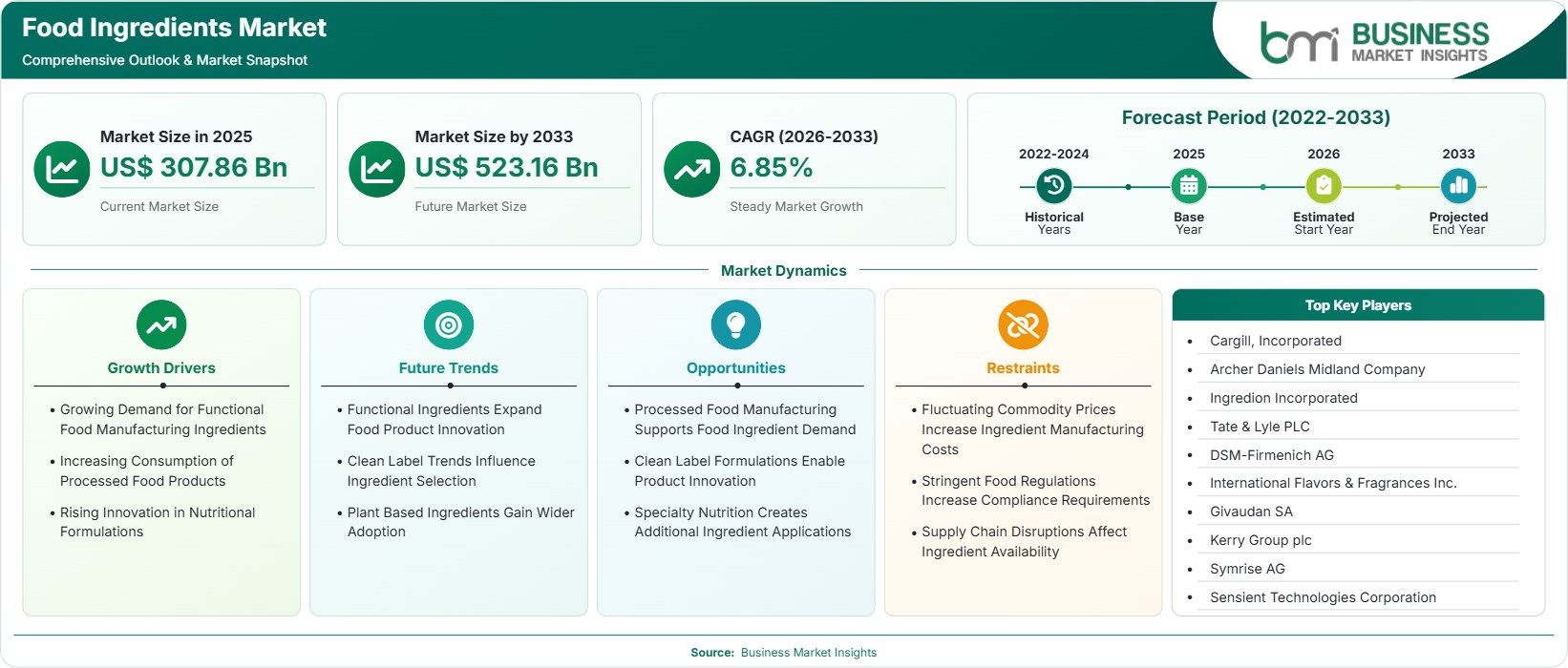
The Food Ingredients Market size was valued at US$ 307.86 Billion in 2025 and is projected to reach US$ 523.16 Billion by 2033, growing at a CAGR of 6.85% during 2026–2033, driven by clean-label demand, functional nutrition adoption, processed food innovation, natural ingredient sourcing, and expanding opportunities across health-focused formulations and emerging food manufacturing ecosystems.

Report Coverage
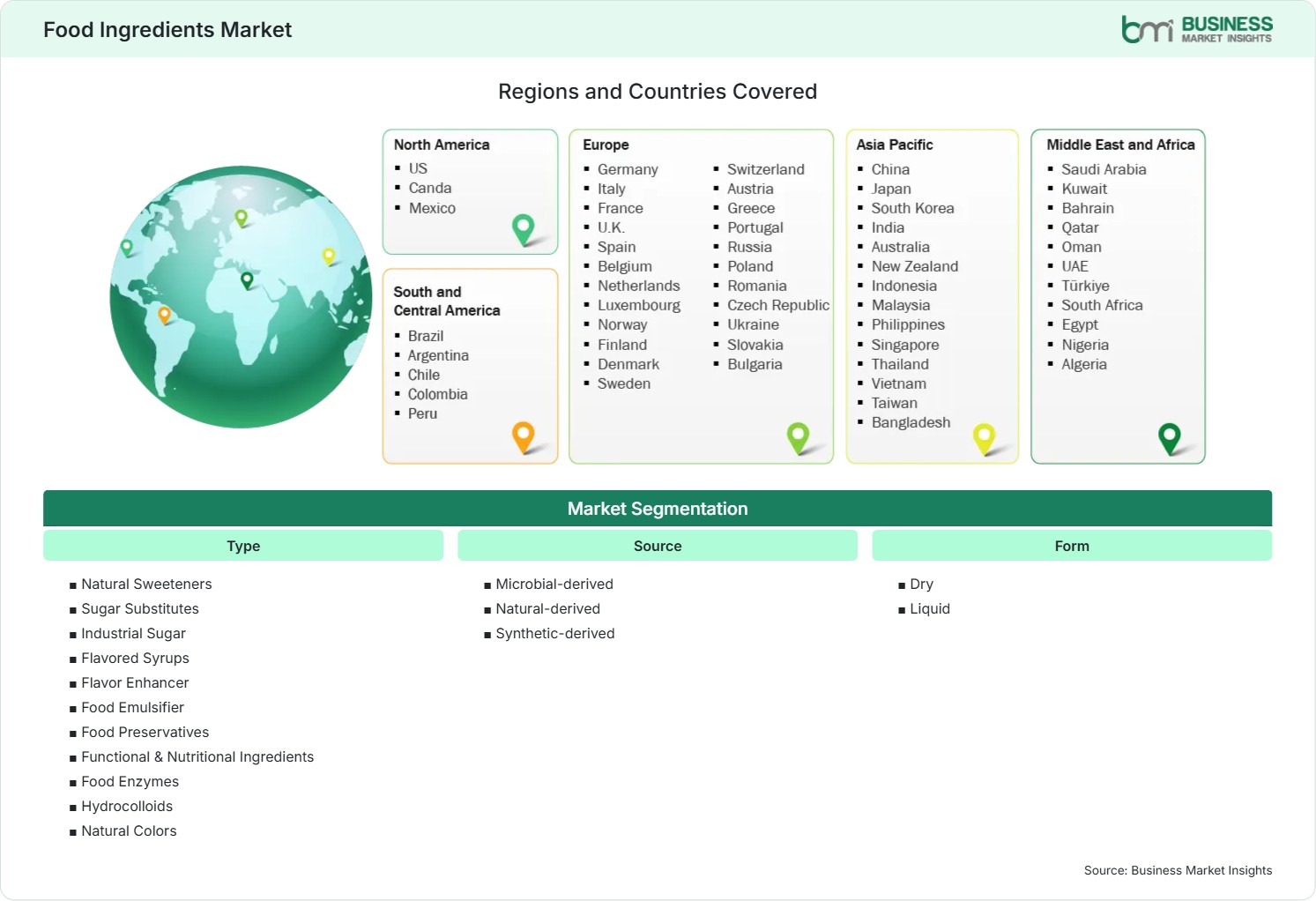
  • Type: Natural Sweeteners, Sugar Substitutes, Industrial Sugar, Flavored Syrups, Flavor Enhancer, Food Emulsifier, Food Preservatives, Functional & Nutritional Ingredients, Food Enzymes, Hydrocolloids, Natural Colors
  • Source: Microbial-derived, Natural-derived, Synthetic-derived
  • Form: Dry, Liquid
US$ 307.86 Bn Market size in 2025
US$ 523.16 Bn Market Size by 2033
6.85% CAGR, 2026 - 2033
2026-2033 Forecast Period

AI Overview

Food Ingredients Market Summary

  • North America Region: North America holds a market share of 32%–35% in 2025, growing with a CAGR of 6.2%–6.8% during 2026–2033. Demand for functional nutrition, clean-label formulations, protein enrichment, and advanced food processing technologies continues creating opportunities across consumer and industrial food applications globally. The U.S. market benefits from advanced ingredient innovation and health-oriented product launches, advancing at approximately 6.3%–6.9% CAGR.
  • Fastest Growing Region: Asia Pacific accounts for 27%–30% market share in 2025 and expands at a CAGR of 7.8%–8.5% through 2033. Rising disposable income, urbanization, packaged food consumption, and regional manufacturing investments support rapid adoption of specialty ingredients across diverse food categories.
  • Leading Segment: Functional & Nutritional Ingredients command 18%–21% market share in 2025 and advance at a CAGR of 7.2%–7.8%. Growing demand for fortified foods, immunity-support products, sports nutrition, and wellness-focused formulations strengthens ingredient innovation and commercial deployment.
  • High Growth Segment: Natural-derived ingredients represent 44%–47% market share in 2025 and register a CAGR of 7.6%–8.2%. Consumer preference for transparency, sustainability, and minimally processed ingredients accelerates investment in botanical, plant-based, and naturally sourced formulations.
  • Key Market Opportunity: Expansion of personalized nutrition, microbiome-focused products, and plant-based food innovation is creating substantial opportunities for ingredient manufacturers developing differentiated, science-backed formulations addressing evolving consumer wellness expectations worldwide.
  • Major Market Players: Cargill, Incorporated; Archer Daniels Midland Company; Ingredion Incorporated; Tate & Lyle PLC; DSM-Firmenich AG; International Flavors & Fragrances Inc.; Givaudan SA; Kerry Group plc; Symrise AG; Sensient Technologies Corporation.
Strategic Insights

Food Ingredients Market: Strategic Insights

Food Ingredients Market Strategic Framework
FREE PDF
Request your free sample
Request free sample
Stakeholder View

Key Takeaways

  • The chain of value is becoming more integrated since ingredient suppliers are now working directly with food manufacturers, retailers, and research institutions in order to speed up innovation, enhance the efficiency of sourcing, and improve their formulation capabilities.
  • The various functional nutrition areas such as fortified foods, plant-based proteins, digestive health products, and those designed to support immunity offer the greatest commercial opportunities since there is continuous consumer demand and a potential for premium pricing.
  • Precision fermentation, together with natural extraction techniques and the use of biotechnology to develop ingredients, is altering product innovation strategies in such a way that it leads to better nutritional performance, flavour profiles, and sustainability results.
  • Asia Pacific offers a compelling investment case due to rapid urbanization, growing middle-class populations, increasing packaged food consumption, and expanding domestic food manufacturing capacity.
  • The competitive landscape is still being shaped by strategic acquisitions and partnerships as companies look to obtain technological capabilities, take advantage of opportunities for regional expansion, and gain access to high-value specialty ingredient portfolios.
  • The sustainability credentials, systems for tracing ingredients, and practices concerning environmentally responsible sourcing are having an ever-increasing influence on the procurement decisions of multinationals in the food manufacturing and consumer goods sectors.
Geographic Outlook

Food Ingredients Market Regional Highlights

North America Food Ingredients Market

North America accounted for approximately 32%–35% of global revenue in 2025 and is projected to expand at a CAGR of 6.2%–6.8% through 2033. Strong innovation ecosystems, advanced food processing infrastructure, and consumer preference for health-oriented products support regional leadership. The Food Ingredients Market share remains substantial due to widespread adoption of specialty ingredients across bakery, dairy, beverage, and nutrition applications. Growing demand for clean-label products, sugar reduction solutions, and plant-based formulations continues driving investment and product development throughout the region.

  • The availability of regulatory support for ingredient transparency and for the disclosure of nutritional information is prompting manufacturers to reformulate their products by using natural sweeteners, preservatives, and functional compounds without losing consumer trust or failing to meet regulatory requirements.
  • The widespread use of functional foods and dietary supplements is increasing the demand for specialty enzymes, nutritional ingredients, and bioactive compounds in both the retail and institutional food sectors.
  • Food manufacturers are now putting more money into sustainable ingredient sourcing and traceability systems in order to enhance the resilience of their supply chains and meet the expectations of retailers and consumers.
  • There is a close collaboration between the suppliers of ingredients, universities, and food technology companies which enables the ongoing commercialization of new formulations and ingredients that enhance performance.
  • The number of premium food categories is still growing, which is opening up chances for the development of advanced flavour systems, texture modifiers, and specially designed ingredient mixes to meet changing consumer preferences.

US Food Ingredients Market

The United States represents approximately 74%–78% of North American revenue and advances at a CAGR of 6.3%–6.9% through 2033. The growth of the food production industry, investments in innovation, and growing demand for health-oriented products can drive the market expansion. The widespread use of protein enrichment, low-sugar products, and plant-based foods has a substantial impact on competitiveness in the region. There is a continuous development of scientific solutions aimed at wellness, digestion, and personalized nutrition.

  • The growing demand by consumers for functional beverages is causing greater use of vitamins, probiotics, botanical extracts, and nutritional fortification systems in a number of different product categories.
  • The growth of plant-based food production is increasing the demand for alternative proteins, natural flavours, hydrocolloids, and ingredients used for texture optimization.
  • The major food manufacturers are speeding up their clean-label reformulation initiatives in order to keep up with changes in how consumers are purchasing products and with the requirements of retailers.
  • Investments in precision fermentation and biotechnology are helping to develop next-generation ingredients that have better nutritional and sustainability characteristics.

Europe Food Ingredients Market

Europe held approximately 28%–31% market share during 2025 and is expected to grow at a CAGR of 6.0%–6.6% through 2033. High food safety regulations, sustainability goals, and consumers’ desire for natural ingredients aid regional development. Germany is still at the forefront of national markets with a CAGR of 6.1% to 6.7%, whereas Poland is emerging among the fastest-growing nations with a CAGR of 7.0% to 7.6%. Producers focus on using natural colors and clean-label emulsifiers.

  • The various regulatory measures which promote healthier formulations are leading to the increased use of sugar substitutes, natural sweeteners, and ingredients for nutritional enhancement in the food industry.
  • The increasing demand for organic and premium foods is leading to greater need for naturally derived flavours, preservatives, and special ingredient systems.
  • The suppliers of ingredients are putting their money into sustainable manufacturing methods in order to meet their environmental goals and corporate commitments to sustainability.
  • The growing demand for plant-based foods is still promoting innovation in the areas of protein alternatives, texture systems, and functional ingredient platforms.
  • Increasingly, regional food manufacturers are using biotechnology and fermentation technologies in order to enhance the performance of their ingredients and improve production efficiency.

Asia Pacific Food Ingredients Market

Asia Pacific accounted for approximately 27%–30% of revenue in 2025 and is forecast to register the fastest CAGR of 7.8%–8.5% through 2033. China leads regional demand with sustained investment in food processing modernization, while India records one of the strongest growth trajectories at approximately 8.3%–8.9%. Rising urbanization, increasing disposable incomes, and expanding packaged food consumption support Food Ingredients Market growth. Investments in manufacturing capacity and localized ingredient production continue strengthening regional competitiveness.

  • The quick growth in the consumption of convenience foods is creating a great demand for flavour systems, preservatives, emulsifiers, and ingredients which improve texture.
  • The government's support of the food processing industry is leading to an expansion of capacity and the uptake of advanced ingredient technologies in emerging economies.
  • As people become more conscious about their health, their use of nutritional fortification, protein enrichment, and functional ingredient solutions is increasing.
  • Suppliers of ingredients on an international scale are setting up production facilities in regional areas in order to enhance supply security and better meet the demands of local markets.
  • The increasing demand for premium and specialty foods is leading to the creation of new ingredient ranges that are designed to meet local tastes and preferences.

Rest of World Food Ingredients Market

The Rest of World region represents approximately 10%–13% of global revenue and is projected to expand at a CAGR of 6.5%–7.1% through 2033. The benefits that South and Central America have are abundant resources, as well as in food processing. An increase in demand for nutritional products is being observed in the Middle East and Africa. The biggest market in this region is Brazil, while there is growth potential for Saudi Arabia.

  • Spending on domestic food manufacturing facilities is leading to greater demand for ingredient localization and regional sourcing capabilities.
  • The expansion of retail networks together with modern distribution infrastructure is helping to promote wider use of processed and packaged food products.
  • Programs supported by the government are promoting the use of fortified ingredients and functional nutrition solutions.
  • International producers of ingredients are still reinforcing their partnerships with local food manufacturers in order to enhance their market penetration and distribution efficiency.
  • The increasing demand for flavor systems, preservatives, and special food ingredients is due to the growing size of the tourism, hospitality, and foodservice sectors.
Global Market Geography
FREE PDF
Request your free sample
Request free sample
Segment Analysis

Food Ingredients Market Segmentation

Type

The Type segment accounted for approximately 41%–44% market share in 2025 and is projected to expand at a CAGR of 6.9%–7.4% through 2033. Product diversification, changing dietary preferences, and increasing demand for healthier formulations continue shaping segment performance. The Food Ingredients Market scope within this category continues expanding as manufacturers seek ingredient solutions that improve nutrition, flavor, texture, stability, and shelf-life while meeting clean-label requirements and regulatory expectations.

  • Natural Sweeteners: Growing consumer preference for natural sugar alternatives supports adoption across beverages, bakery products, dairy formulations, and nutritional foods seeking reduced sugar content without compromising taste profiles.
  • Honey: Widely utilized for natural sweetness, antimicrobial properties, and premium product positioning across beverages, bakery applications, confectionery products, and health-oriented food formulations.
  • Molasses: Increasing use in bakery products, animal nutrition, and specialty food manufacturing supports demand due to flavor enhancement capabilities and natural mineral content.
  • Date Palm: Rising popularity in clean-label formulations and plant-based products supports utilization as manufacturers address consumer demand for minimally processed sweetening solutions.
  • Sugar Alcohol: Expanding use in reduced-calorie foods, confectionery products, and diabetic-friendly formulations supports market adoption due to favorable functional and sweetness characteristics.
  • Stevia: Strong demand from beverage and nutritional product manufacturers continues driving adoption as consumers increasingly seek natural, low-calorie sweetening alternatives.
  • Coconut Sugar: Growing preference for alternative sweeteners and organic food products supports utilization across premium food and beverage applications worldwide.
  • Agave Nectar: Increasing penetration within health-conscious consumer segments strengthens demand across beverages, snacks, and natural food formulations requiring alternative sweetening systems.
  • Sugar Substitutes: Manufacturers increasingly incorporate artificial and high-intensity sweeteners to support calorie reduction strategies while maintaining flavor consistency and formulation efficiency.
  • Aspartame: Continues maintaining relevance across low-calorie beverages and processed foods due to established functionality and cost-effective sweetness performance.
  • Ace. K: Frequently combined with complementary sweeteners to optimize flavor delivery and support reduced-sugar product development initiatives across multiple food categories.
  • Saccharin: Utilized in specific beverage and tabletop sweetener applications where long shelf life and high sweetness intensity remain important requirements.
  • Sucralose: Strong demand persists across beverages, dairy products, and nutritional formulations because of stability characteristics and broad formulation compatibility.
  • Industrial Sugar: Essential for large-scale food production, contributing sweetness, texture development, fermentation support, and preservation functionality across numerous food categories.
  • Flavored Syrups: Increasing demand from beverage, dessert, and foodservice sectors supports growth through flavor customization and product differentiation opportunities.
  • Flavor Enhancer: Food manufacturers continue utilizing advanced flavor enhancement solutions to improve sensory profiles while reducing sodium, sugar, and artificial additive usage.
  • Food Emulsifier: Broad application across bakery, dairy, and processed foods supports demand through improved texture stability, ingredient dispersion, and product consistency.
  • Food Preservatives: Rising requirements for shelf-life extension, food safety, and distribution efficiency continue supporting adoption across global food manufacturing operations.
  • Functional & Nutritional Ingredients: Strong interest in health-focused products supports increased utilization of vitamins, minerals, proteins, probiotics, and specialty nutritional compounds.
  • Food Enzymes: Growing application in processing optimization, texture improvement, and production efficiency strengthens demand across multiple food manufacturing industries.
  • Hydrocolloids: Widely used to improve viscosity, texture control, moisture retention, and formulation stability across processed food and beverage products.
  • Natural Colors: Expanding replacement of synthetic colorants continues supporting growth as manufacturers respond to clean-label preferences and regulatory developments.

Source

The Source segment represented approximately 34%–37% market share in 2025 and is forecast to advance at a CAGR of 7.1%–7.7% through 2033. Consumer expectations regarding sustainability, transparency, and ingredient origin continue influencing procurement decisions. The Food Ingredients Market trends increasingly favor naturally sourced and biotechnology-enabled solutions that support clean-label positioning while delivering functional performance and formulation flexibility.

  • Microbial-derived: Fermentation-based ingredient production is gaining traction due to scalability, consistency, sustainability benefits, and growing demand for innovative nutritional compounds.
  • Natural-derived: This leading category benefits from strong consumer trust, clean-label preferences, and increasing use of botanical, plant-based, and minimally processed ingredients.
  • Synthetic-derived: Despite evolving consumer preferences, synthetic ingredients remain important in applications requiring cost efficiency, formulation stability, and precise functional performance.

Form

The Form segment accounted for approximately 19%–22% market share in 2025 and is projected to register a CAGR of 6.4%–7.0% through 2033. Processing requirements, transportation efficiency, storage stability, and end-use application characteristics significantly influence adoption patterns. Manufacturers increasingly optimize ingredient delivery formats to improve operational flexibility while maintaining quality consistency across food production environments.

  • Dry: Preferred for extended shelf life, transportation efficiency, formulation versatility, and compatibility with large-scale manufacturing processes across diverse food categories.
  • Liquid: Increasingly utilized where rapid incorporation, uniform dispersion, flavor delivery, and process efficiency are critical to food and beverage production outcomes.
Market Forces

Food Ingredients Market Dynamics

Key Market Drivers

Rising Demand for Functional and Fortified Food Products

Consumers increasingly seek foods delivering health benefits beyond basic nutrition, supporting strong demand for functional ingredients. The rising prevalence of lifestyle-related health concerns has accelerated the adoption of protein enrichment, probiotics, vitamins, minerals, dietary fibers, and bioactive compounds. Food manufacturers are investing heavily in formulations addressing immunity, digestive health, cognitive wellness, and sports nutrition. Food Ingredients Market growth is increasingly linked to nutritional innovation as brands differentiate products through scientifically supported health claims. Expanding consumer willingness to pay premium prices for wellness-oriented products further strengthens demand for advanced ingredient systems across developed and emerging economies. Healthcare cost awareness continues to reinforce preventive nutrition trends globally.

Expansion of Processed and Convenience Food Consumption

The need for processed, ready-to-eat, and convenience foods is growing due to urbanization, the increasing number of two-income households, and changes in lifestyle. As a result of this trend, producers of food ingredients are seeing greater use of preservatives, emulsifiers, flavour systems, texture modifiers, and nutritional additives which are needed in large-scale food production. In developing countries there is a quick expansion of modern retail and the consumption of packaged foods, leading to continuous demand for speciality ingredients. Food processing companies are placing more emphasis on keeping product quality, consistency, and shelf life in mind while at the same time meeting changing consumer expectations. The growth of online grocery channels and the foodservice industry also plays a part in increasing the use of ingredients across a variety of food categories and distribution methods.

Advancements in Biotechnology and Ingredient Innovation

Technological developments in precision fermentation, enzyme engineering, microbial cultivation, and ingredient extraction are transforming product development capabilities. Biotechnology enables manufacturers to create ingredients with improved nutritional profiles, functionality, and sustainability characteristics. Research investments continue accelerating the commercialization of alternative proteins, natural flavor compounds, and next-generation sweeteners. Food Ingredients Market trends indicate increasing reliance on science-based innovation to address regulatory requirements, environmental concerns, and changing dietary preferences. Enhanced production efficiency and ingredient customization capabilities allow manufacturers to support diverse application requirements while improving resource utilization and reducing environmental impacts throughout the value chain.

Key Market Opportunities

Personalized Nutrition and Consumer-Specific Formulations

The growing adoption of personalized health approaches presents substantial opportunities for ingredient manufacturers. Advances in digital health, nutritional analytics, and consumer data platforms are enabling customized food formulations tailored to individual dietary requirements. Companies developing targeted nutritional ingredients for age-specific, health-specific, and lifestyle-specific applications are positioned to capture premium value. Food Ingredients Market Forecasts increasingly reflect demand for precision nutrition solutions addressing metabolic health, immunity, digestive wellness, and active lifestyles. Ingredient suppliers capable of providing scientific validation, formulation flexibility, and scalable production capabilities are expected to benefit from long-term expansion opportunities within personalized nutrition ecosystems.

Plant-Based Food Innovation and Alternative Proteins

Interest on the part of consumers in sustainable and plant-based diets is still generating promising opportunities in various ingredient areas. Demand for alternative proteins, plant-based texturizers, natural flavours, hydrocolloids, and systems for nutritional fortification is growing quickly. Food manufacturers are now needing more advanced ingredient solutions that are able to mimic the traditional sensory qualities while at the same time helping to achieve sustainability goals. The development of new technologies for protein extraction, fermentation, and the improvement of ingredient functionality is leading to the emergence of new commercial opportunities. Companies that have knowledge of plant-based ingredients and formulation science are likely to strengthen their competitive standing as the global uptake of alternative food products speeds up in both the retail and foodservice sectors.

Emerging Market Manufacturing Expansion

Economies that are in the process of developing are quickly boosting their investments in food processing infrastructure, which in turn provides opportunities for producing ingredients regionally and for localising the supply chain. The expansion of middle-class populations, higher consumption of packaged foods, and favourable industrial policies all lead to increased demand. When manufacturers set up production plants and distribution networks in areas experiencing rapid growth, they can enhance their ability to respond to market needs, lower their logistics costs, and strengthen their ties with customers. The growing emphasis by regulators on nutritional fortification and food quality standards also helps to boost the demand for ingredients. There are likewise long-term possibilities in the area of developing local flavours, creating formulations that are specific to a culture, and offering ingredient solutions that are sourced locally and designed for emerging consumer markets.

Market Restraints and Challenges

Volatility in Agricultural Raw Material Supply

Factor: Food ingredient production remains highly dependent on agricultural commodities including sugar crops, grains, fruits, botanical extracts, and specialty plants. Climate variability, water scarcity, extreme weather events, and geopolitical disruptions can affect availability and pricing. Impact: Manufacturers face challenges maintaining cost stability, production planning, and long-term supply agreements. Fluctuating input costs may reduce profitability and increase pressure on pricing strategies. Supply chain disruptions can also affect inventory management and customer fulfillment performance. Companies increasingly invest in supplier diversification, sustainable sourcing programs, and risk management strategies to mitigate agricultural supply uncertainty while maintaining operational continuity.

Complex Regulatory Compliance and Labeling Requirements

Factor: Regulatory frameworks governing food additives, nutritional claims, ingredient approvals, and labeling standards differ significantly across regions. Continuous policy updates require substantial investments in compliance management, testing, and documentation. Impact: Product development timelines may lengthen while regulatory costs increase. Companies operating across multiple jurisdictions must adapt formulations and labeling practices to meet varying requirements. Smaller manufacturers often face greater resource constraints in navigating compliance obligations. Regulatory complexity can delay market entry, limit innovation speed, and increase commercialization risks for new ingredient technologies and emerging food formulation approaches..

Company Analysis

Competitive Landscape

The competitive environment reflects ongoing consolidation, innovation, and portfolio diversification. Food Ingredients Market analysis indicates that leading participants are emphasizing natural ingredient development, biotechnology investments, sustainability initiatives, and strategic acquisitions to strengthen global market positions.

Company Name

Overview

Products and Services Relevant to This Market

Cargill, Incorporated

Global agribusiness and ingredient supplier serving food, beverage, nutrition, and industrial sectors through extensive production and distribution networks.

Sweeteners, starches, texturizers, cocoa ingredients, proteins, emulsifiers, and specialty food formulation solutions.

Archer Daniels Midland Company (ADM)

Major agricultural processing company with strong capabilities in nutrition, ingredient innovation, and global sourcing operations.

Plant proteins, sweeteners, flavors, colors, starches, fibers, and nutritional ingredient systems.

Ingredion Incorporated

Specialized ingredient manufacturer focused on texture, nutrition, and clean-label formulation technologies.

Starches, sweeteners, hydrocolloids, texturizers, plant proteins, and specialty formulation solutions.

Tate & Lyle PLC

Global provider of ingredient technologies supporting healthier and reduced-sugar food products.

Sweeteners, fibers, texturants, stabilizers, and nutritional ingredient systems.

DSM-Firmenich

Science-based company combining nutrition, health, and flavor expertise across global food markets.

Vitamins, enzymes, cultures, nutritional fortification systems, flavors, and functional ingredients.

International Flavors & Fragrances Inc. (IFF)

Leading developer of flavor, health, and bioscience solutions for food and beverage manufacturers.

Flavors, enzymes, cultures, texturants, probiotics, and specialty ingredient technologies.

Givaudan SA

Global flavor and taste solutions provider serving food, beverage, and nutrition applications.

Flavor systems, taste modulation technologies, botanical extracts, and natural ingredient solutions.

Kerry Group plc

International taste and nutrition company focused on innovation-driven ingredient development.

Functional ingredients, flavor systems, nutritional solutions, proteins, and preservation technologies.

Symrise AG

Producer of flavor, fragrance, and nutrition solutions supporting diverse food applications worldwide.

Natural flavors, nutritional ingredients, extracts, taste enhancement solutions, and specialty systems.

Sensient Technologies Corporation

Specialized ingredient company known for color, flavor, and extract technologies.

Natural colors, flavor systems, botanical extracts, preservation ingredients, and specialty formulations.

Trust & Transparency

Research Methodology

The market analysis combines proprietary research with secondary data from government agencies, company disclosures, regulatory filings, industry databases and expert interviews. Market estimates are validated through data triangulation, cross-market benchmarking and analyst review.

View Full Research Methodology

Questions Answered

Frequently Asked Questions

What does the Food Ingredients Market Report typically evaluate?

The Food Ingredients Market Report generally assesses market size, segmentation, regional performance, competitive dynamics, technology developments, regulatory influences, investment trends, and future growth opportunities affecting ingredient manufacturers and food producers.

What industries are the largest consumers of food ingredients?

Bakery, dairy, beverages, confectionery, processed foods, snacks, and nutritional products represent major application sectors. Rising demand for convenience foods and health-oriented formulations continues expanding ingredient consumption across these industries.

How does biotechnology affect ingredient manufacturing?

Biotechnology enables precision fermentation, efficient enzyme production, and development of specialty nutritional compounds. These technologies improve consistency, sustainability, scalability, and product functionality while reducing reliance on conventional resource-intensive production methods.

Which ingredient categories are experiencing the strongest demand growth?

Functional and nutritional ingredients, natural sweeteners, plant-based proteins, food enzymes, hydrocolloids, and natural colors are among the fastest-growing categories. These ingredients support health-focused formulations and premium food product development.

What factors are influencing ingredient innovation in the food industry?

Consumer demand for healthier products, clean-label preferences, sustainability objectives, and advances in biotechnology are driving innovation. Manufacturers are focusing on natural ingredients, nutritional enhancement, and improved sensory performance to differentiate products in competitive markets.

Access the Full Food Ingredients Market Report

Get segment-level forecasts, regional estimates, competitive benchmarking, company profiles and downloadable Excel datasets.

Access the full Food Ingredients Market Report
350 pages PDF & Excel | 2026-09-08