
Ferrovanadium Market Outlook: Size, Share, Trends, Growth Analysis, Competitive Landscape & Forecast, 2026-2033

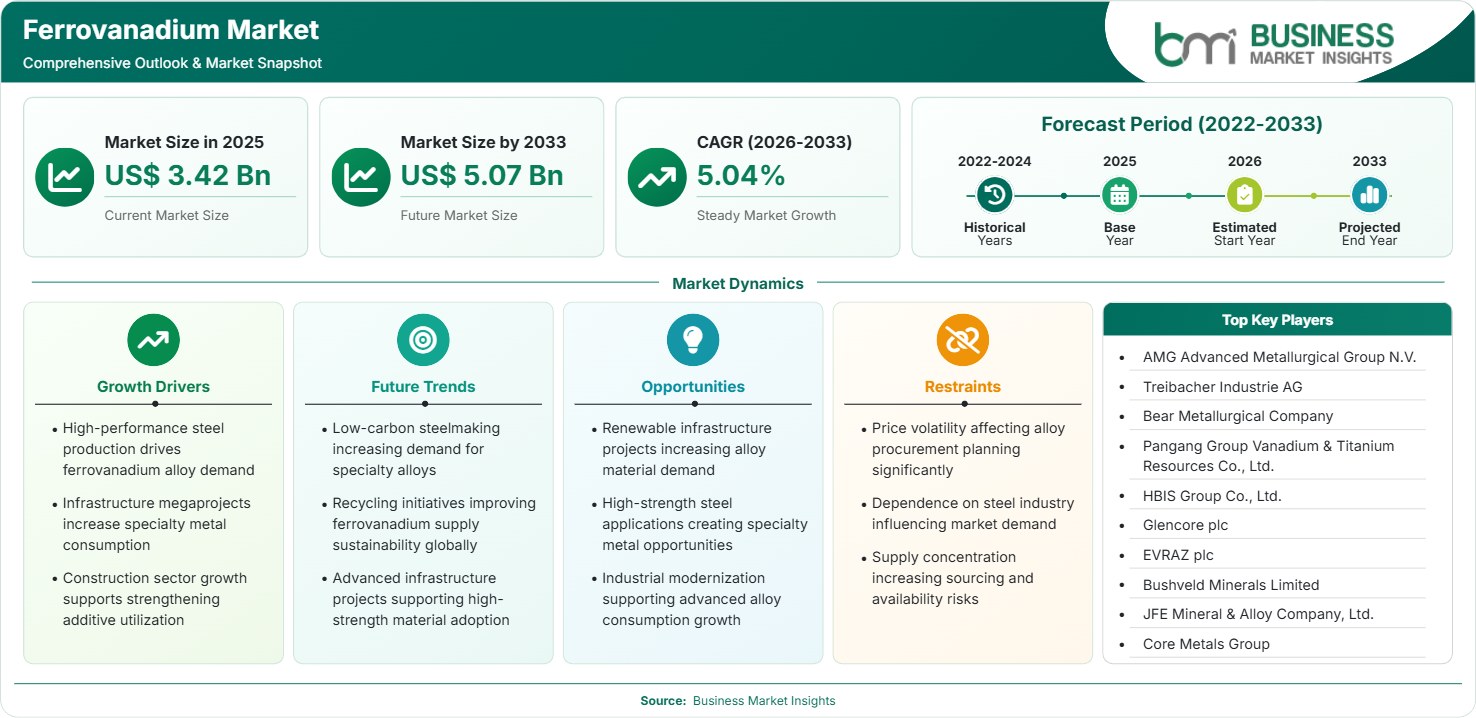
The Ferrovanadium Market size was valued at US$ 3.42 Billion in 2025 and is projected to reach US$ 5.07 Billion by 2033, growing at a CAGR of 5.04% during 2026–2033, driven by alloy demand, high-strength steel, lightweighting, infrastructure renewal, and aerospace requirements.

Report Coverage
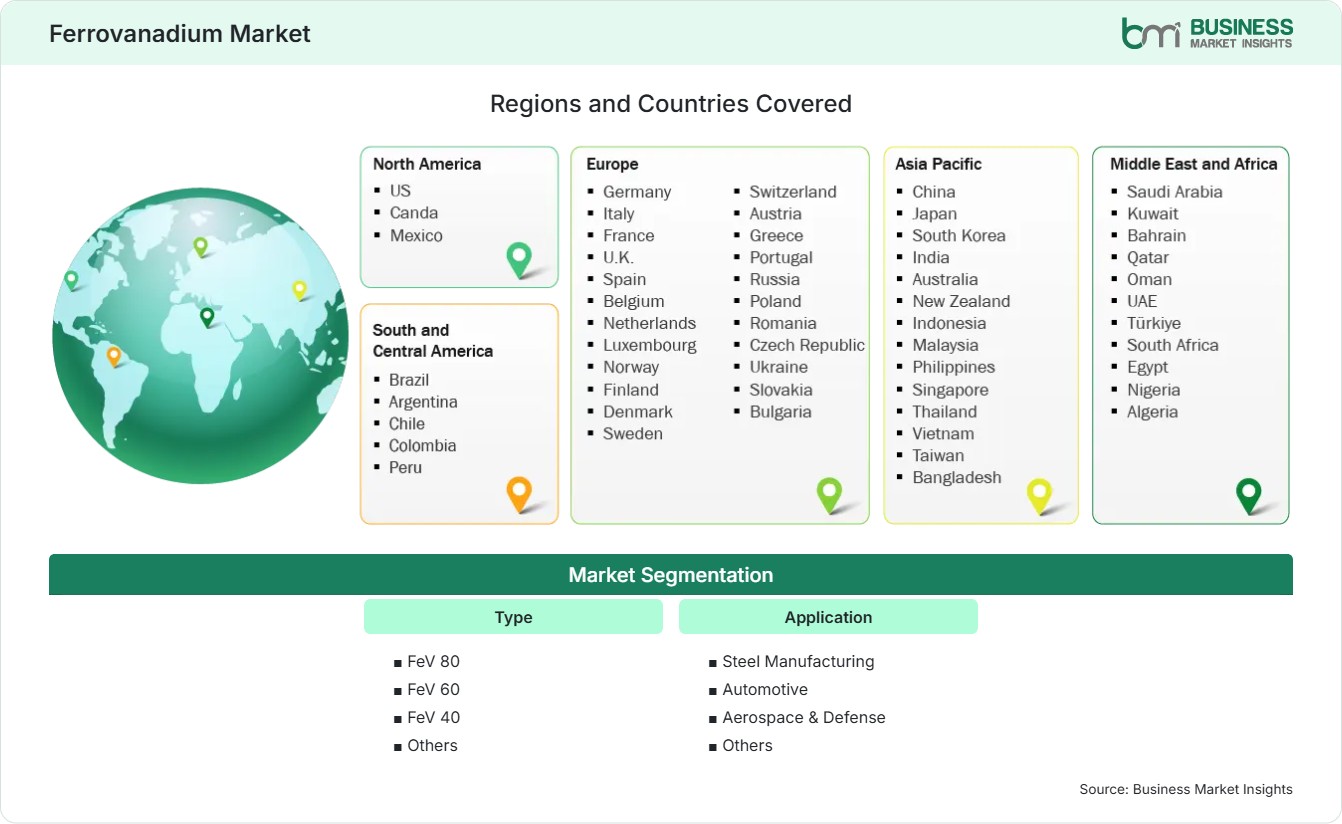
  • Type: FeV 80, FeV 60, FeV 40, Others
  • Application: Steel Manufacturing, Automotive, Aerospace & Defense, Others
US$ 3.42 Bn Market size in 2025
US$ 5.07 Bn Market Size by 2033
5.04% CAGR, 2026 - 2033
2026-2033 Forecast Period

AI Overview

Ferrovanadium Market Summary

  • North America: 18%–22% Ferrovanadium Market share in 2025, 4.2%–4.8% CAGR during 2026–2033, supported by steel resilience, aerospace, recycling, localization, infrastructure, and specialty alloys. US analysis indicates a 4.0%–4.6% CAGR during 2026–2033, supported by automotive lightweighting, defense procurement, infrastructure renewal, and strategic-material sourcing requirements.
  • Fastest Growing Region: Asia Pacific: 46%–50% share in 2025, 5.5%–6.1% CAGR during 2026–2033, supported by steel output, rebar, industrial investment, automotive production, and alloy capacity.
  • Leading Segment: Steel Manufacturing: 70%–74% share in 2025, 4.8%–5.3% CAGR during 2026–2033, supported by microalloyed steels, structural applications, rebar specifications, high-strength plate, pipeline materials, and controlled alloy chemistry.
  • High Growth Segment: Aerospace & Defense: 7%–10% Ferrovanadium Market share in 2025, 5.8%–6.5% CAGR during 2026–2033, supported by titanium alloys, high-temperature components, military platforms, aircraft structures, qualification, and lightweighting.
  • Key Market Opportunity: Integrated vanadium recovery, premium FeV grades, and geographically diversified feedstock can improve supply security while serving aerospace, automotive, infrastructure, and specialty steel customers.
  • Major Market Players: AMG Advanced Metallurgical Group N.V.; Treibacher Industrie AG; Bear Metallurgical Company; Pangang Group Vanadium & Titanium Resources Co., Ltd.; HBIS Group Co., Ltd.; Glencore plc; EVRAZ plc; Bushveld Minerals Limited; JFE Mineral & Alloy Company, Ltd.; Core Metals Group.
Strategic Insights

Ferrovanadium Market: Strategic Insights

Ferrovanadium Market Strategic Framework
FREE PDF
Request your free sample
Request free sample
Stakeholder View

Key Takeaways

  • The value chain spans feedstock, recovery, alloy conversion, certification, distribution, and qualification, making processing reliability critical.
  • Structural steels, automotive components, aerospace alloys, and defense materials create differentiated demand, with premium grades offering stronger value capture.
  • Producers are improving recovery, impurity control, recycling, and integration while customers prioritize chemistry consistency, traceability, and secure sourcing.
  • Asia Pacific combines the largest steelmaking base with expanding specialty alloy consumption, while North America offers localized supply and recycling opportunities.
  • Recent activity emphasizes integrated assets, operating efficiency, and strategic control of feedstock, with developers evaluating mine and processing linkages.
Geographic Outlook

Ferrovanadium Market Regional Highlights

North America Ferrovanadium Market

North America holds a 18%–22% Ferrovanadium Market share in 2025 and is projected to expand at a 4.2%–4.8% CAGR during 2026–2033. Demand is anchored by specialty steel, transportation, aerospace, and defense applications. Domestic supply security has become more important as buyers evaluate trade exposure and material availability. Recycling and secondary recovery support regional resilience, while infrastructure renewal sustains alloy demand. Premium FeV grades benefit from aerospace qualification requirements and tighter quality controls across strategic manufacturing programs.

  • Domestic sourcing: Buyers emphasize dependable regional supply, recycling, inventory strategies, and multiple qualified suppliers.
  • Automotive demand: Lightweighting and stronger steels support vanadium additions in structural and safety-critical components.
  • Aerospace qualification: Certified programs require consistent chemistry, traceability, and process control.
  • Infrastructure renewal: Bridges, pipelines, energy infrastructure, and construction steels provide recurring demand.

US Ferrovanadium Market

The US accounts for 55%–60% of North American demand in 2025 and is projected to grow at a 4.0%–4.6% CAGR through 2033. Automotive, aerospace, defense, construction, and specialty steel buyers shape demand. Procurement strategies increasingly emphasize resilience, domestic processing, and diversified imports. Premium alloy specifications favor suppliers able to maintain consistent chemistry, delivery schedules, and documentation. Recycling-based vanadium recovery can complement primary supply by reducing exposure to imported feedstock and supporting circular-material objectives.

  • Aerospace and defense: Certified programs support demand for consistent vanadium inputs in aircraft and defense systems.
  • Infrastructure: High-strength construction steel and pipelines provide recurring alloy consumption.
  • Recycling: Secondary recovery diversifies supply and reduces waste.
  • Procurement resilience: Buyers balance price with inventory security, qualification depth, and trade exposure.

Europe Ferrovanadium Market

Europe represents a 20%–24% Ferrovanadium Market share in 2025 and is projected to register a 4.6%–5.2% CAGR during 2026–2033. Germany and Italy remain important steel and engineering centers, while France supports aerospace and defense demand. Germany is estimated to grow at 4.7%–5.2% and Italy at 4.5%–5.0% during the period. European decarbonization programs favor efficient alloy use, recycling, and higher-value steel grades, while trade exposure encourages diversified supply and tighter material traceability.

  • Germany: Automotive manufacturing, engineering steels, and industrial equipment sustain demand for controlled alloy chemistry.
  • Italy: Specialty steel, machinery, automotive components, and construction support steady FeV consumption.
  • France: Aerospace and defense provide premium demand requiring qualification and traceability.
  • Sustainability: Recycling and energy efficiency increasingly influence supplier selection.

Asia Pacific Ferrovanadium Market

The Asia Pacific Ferrovanadium Market accounts for about 46%–50% of the demand forecast by 2025 and is anticipated to witness a 5.5%–6.1% CAGR over 2033. China is the leader in both usage and production, whereas India, Japan, and South Korea are responsible for diversified applications in steel manufacturing and engineering. Growth of the Chinese market is estimated at 5.5%–6.1% CAGR, India's at 6.0%–6.6%, and South Korea's at 5.2%–5.8%. Expanding construction, automotive production, rebar standards, and specialty steel capacity reinforce regional demand.

  • China: Large steel capacity creates the region’s deepest demand pool, while operating rates influence pricing.
  • India: Infrastructure, automotive expansion, and higher-strength steel adoption support increased vanadium use.
  • Japan and South Korea: Automotive, shipbuilding, machinery, and specialty steel sustain demand for consistent grades.
  • Regional integration: Proximity between feedstock, alloy processing, and steelmaking can reduce logistics exposure.

Rest of World Ferrovanadium Market

Rest of World accounts for 8%–12% of the Ferrovanadium Market share in 2025 and is expected to grow at a 4.4%–5.0% CAGR by 2033. South America will benefit from vanadium resources and from increasing interest in downstream processing. Brazil is an important source market and steel market, while Chile and Peru represent smaller specialty markets. Demand from South and Central America is determined by construction, energy infrastructure, and industrial investments, while local resource development may diversify supply possibilities.

Steel manufacturing, infrastructure development, and vanadium resource projects in the Middle East and Africa are among the key contributors to this market. South Africa is an upstream contributor, while Saudi Arabia and the UAE represent downstream contributions towards steel in the region. The CAGR for South Africa is projected at 4.6%–5.2%, for Saudi Arabia at 5.0%–5.6%, and for Brazil at 4.8%–5.3% during 2026–2033.

  • Brazil: Vanadium resources and steelmaking support regional supply opportunities.
  • South Africa: Established mining and processing support ferroalloy production.
  • Saudi Arabia and UAE: Infrastructure and industrial diversification support high-strength steel demand.
  • Resource development: Central Asian and African projects can diversify upstream supply.
Global Market Geography
FREE PDF
Request your free sample
Request free sample
Segment Analysis

Ferrovanadium Market Segmentation

Type

The Market Scope of the Ferrovanadium Market is determined by type structure, dominated by FeV 80, which holds 62%–66% market share in 2025 and is expected to witness a CAGR of 5.0%–5.5% in 2026–2033. High vanadium content facilitates better alloying, and low-quality Ferrovanadium caters to cost-sensitive formulas.

  • FeV 80: Preferred for efficient alloying and premium steel applications, it supports consistent vanadium addition, lower material handling requirements, and demanding chemistry specifications across structural and specialty steels.
  • FeV 60: Serves steelmakers balancing alloy performance with input economics, supporting construction, engineering, and industrial grades requiring moderate vanadium concentration.
  • FeV 40: Addresses applications requiring lower concentration and controlled alloying economics, particularly where cost management and chemistry flexibility influence procurement.

Application

Steel Manufacturing is expected to command an application market share of 70%-74% of the Ferrovanadium Market in 2025 and record a CAGR of 4.8%-5.3% for the period 2026-2033. Aerospace & Defense is the fastest-growing application market, with a market share of 7%-10% and a CAGR of 5.8%-6.5% supported by high-performance alloys and qualification-driven demand.

  • Steel Manufacturing: Microalloyed rebar, structural steel, pipeline products, plate, and engineering grades use vanadium to improve strength and performance while enabling efficient material utilization.
  • Automotive: High-strength steels support lightweighting, crash performance, and structural efficiency, creating demand across chassis, body structures, suspension components, and safety-related applications.
  • Aerospace & Defense: Titanium and specialty alloy systems benefit from vanadium’s contribution to strength and thermal performance, supporting aircraft, propulsion, defense platforms, and demanding qualification programs.
Market Forces

Ferrovanadium Market Dynamics

Key Market Drivers

Microalloyed steel demand raises vanadium intensity in critical grades

The use of vanadium microalloying technology by steel producers improves mechanical properties such as strength, toughness, and grain size control, and material thickness and efficiency. Crude steel production was estimated at 1,850.3 million tonnes in 2025, according to Worldsteel. Crude steel production in China and India was 1,125.7 million tonnes, with India's production up 10.4%. Such volumes justify the requirement for vanadium microalloyed steel in construction steel, rebars, pipes, automobile parts, and engineered items. Vanadium microalloys are in demand in the aerospace and defense industries due to qualification programs that focus on performance reliability. Such conditions form the basis of the Ferrovanadium Market growth and strengthen procurement requirements.

Infrastructure and transportation investment expands high-strength steel use

Infrastructural renovation increases the need for high-strength construction materials, where greater strength leads to reduced weight, enhanced durability, or material efficiency. Vanadium micro-alloyed steel can be used in bridges, railroads, pipelines, power structures, and commercial and industrial buildings, provided that its performance characteristics justify the cost of alloying. The same approach is being followed in the automobile industry, where the objective is to achieve higher-strength steels while reducing weight. Aerospace and military uses back this trend through rigorous material testing and traceability. The effect on demand is not consistent since the economics of alloy depend upon the cost of steel, engineering design, and regional practices. However, the increasing use of high-strength steel is building a solid demand base. Ferrovanadium market trends are independent of any end-user application; they are related to infrastructure spending and production cycles.

Supply-chain localization strengthens demand for regional processing capacity

Strategic materials policy and procurement diversification prompt the buyer to consider regional/local control of processing facilities. The goal is to minimize risks such as high-concentration feedstock supply, logistical risk, trade limitations, and unpredictable feedstock supply. North American and European buyers consider factors such as recycling, tolling, buffer stocks, and qualified suppliers. Asia Pacific has an advantage in an integrated ecosystem comprising mining, vanadium extraction, ferroalloys, and steel production. Such developments are advantageous for the processing plant investment near consumer markets and for vanadium extraction technology from secondary resources.

Key Market Opportunities

Premium FeV grades can capture value from qualification-intensive applications

Aerospace, defense, specialty automotive, energy infrastructure, and engineering applications may be able to leverage a premium price point where performance and quality control are more valued than simply buying at the lowest possible price. Manufacturers who can prove their specification control and quality management are consistent enough to meet the needs of performance-sensitive buyers can pursue these higher-value contracts. This enables management of FeV 80 production and refinery controls, and the provision of technical documentation to help qualify customers. Premium products also mitigate alloy variations that impact the final steel properties. Analytical labs and traceability can then help with customer retention and pricing integrity. Ferrovanadium Market Forecasts should consider this shift in quality.

Vanadium recovery from secondary materials can improve supply resilience

The concept of secondary vanadium recovery offers an option to increase the availability of raw materials without being limited solely to the development of new mining resources. Vanadium-bearing industrial wastes, catalysts, slags, and other substances represent recoverable resources, provided that appropriate chemistry, collection economics, and technical feasibility are in place. In addition to increasing material supply, recovery projects can reduce waste liabilities and optimize resource utilization, generating additional positive impacts. The economic model is based on feedstock consistency, transport logistics, recovery ratio, energy needs, and purification costs in subsequent stages. Recovery projects can also increase sourcing flexibility from the regional perspective in connection with industrial operations. Strategic customers can encourage such projects via offtake deals, qualification schemes, and investments.

Integrated mine-to-alloy platforms can reduce exposure to feedstock volatility

Vertical integration may enhance supply chain visibility by linking vanadium resources, intermediate manufacturing, ferroalloy manufacturing, and customer certification into a single coherent value chain. Developers in Kazakhstan, Africa, South America, and Australia have explored various ways to monetize vanadium resources through multiple product options rather than a single intermediate. This affords some degree of flexibility between ferrovanadium, vanadium chemistry, and energy storage, depending on relative economics. Integration may also help lower transaction costs and ensure quality control, albeit with concerns regarding capital intensiveness and project execution. For existing producers, partnerships and acquisitions may offer access to vanadium resources and technologies without having to build all the links themselves. The best opportunity for the Ferrovanadium Market lies where there are guaranteed customers.

Market Restraints and Challenges

Feedstock and price volatility can compress ferroalloy producer margins

Factor: Vanadium feedstock availability and pricing can change with steel production, mining output, recovery rates, inventories, and regional trade conditions. Producers that purchase intermediate materials without integrated upstream resources can face rapid cost changes that are difficult to pass through immediately. Impact: Margin compression can delay maintenance, reduce operating rates, or discourage capacity investment when selling prices fall faster than conversion costs. The issue is particularly relevant for smaller processors with limited purchasing power and weaker inventory flexibility. Long-term contracts, diversified suppliers, recycling inputs, and disciplined inventory management can reduce exposure, but they cannot eliminate commodity-cycle risk. This restraint can therefore influence project economics and supplier concentration across regional markets.

Trade restrictions and logistics disruptions can affect regional availability

Factor: The supply chain for ferrovanadium spans multiple borders, exposing both the producer and the customer to risks posed by tariffs, sanctions, logistics capacity constraints, changes in customs procedures, and other geopolitical factors. An example of a policy change that might affect the supply chain is a change in tariffs on Brazilian ferrovanadium in the United States in 2026. Impact: There may be increases in landed cost, longer delivery periods, a requirement to qualify new sources as alternatives, and diversion of product by the producer. This impact may be compounded by the limited availability of qualified sources, especially in high-specification grades.

Company Analysis

Competitive Landscape

Ferrovanadium Market analysis indicates competition is shaped by feedstock access, conversion technology, grade consistency, recycling, geography, and steelmaker relationships. Integrated producers manage raw-material exposure, while specialists differentiate through quality.

Company Name

Overview

Products and Services relevant to this market

AMG Advanced Metallurgical Group N.V.

Critical-materials producer with vanadium recycling capabilities.

Ferrovanadium, vanadium recovery, recycling, and processing.

Treibacher Industrie AG

Austrian specialty materials and ferroalloy producer.

Ferrovanadium, specialty ferroalloys, powders, and catalysts.

Bear Metallurgical Company

US specialty metals producer serving alloy markets.

Ferrovanadium, specialty ferroalloys, and vanadium products.

Pangang Group Vanadium & Titanium Resources Co., Ltd.

Chinese vanadium producer integrated with steel operations.

Vanadium products, ferrovanadium, vanadium pentoxide, and processing.

HBIS Group Co., Ltd.

Large Chinese steel group with integrated vanadium-bearing steel.

Vanadium-bearing steel, specialty steel, and engineering materials.

Glencore plc

Diversified resources group with South African vanadium operations.

Ferrovanadium, vanadium pentoxide, mining, and processing.

EVRAZ plc

Steel and mining group with vanadium production capabilities.

Ferrovanadium, vanadium products, specialty steels, and processing.

Bushveld Minerals Limited

South African vanadium company with mining and processing.

Vanadium products, ferrovanadium materials, vanadium pentoxide, and mining.

JFE Mineral & Alloy Company, Ltd.

Japanese specialty metals and alloy supplier.

Ferroalloys, specialty materials, and metallurgical products.

Core Metals Group

North American ferroalloy supplier with sourcing support.

Ferrovanadium, ferroalloys, specialty metals, and distribution.

Trust & Transparency

Research Methodology

The market analysis combines proprietary research with secondary data from government agencies, company disclosures, regulatory filings, industry databases and expert interviews. Market estimates are validated through data triangulation, cross-market benchmarking and analyst review.

View Full Research Methodology

Questions Answered

Frequently Asked Questions

How can buyers reduce supply-chain risk?

Buyers can diversify among qualified suppliers, maintain strategic inventories, establish regional sourcing options, use longer-term contracts, and evaluate routes for recycled feedstock. Multiple qualified sources reduce switching risk.

Which industries can create premium demand for ferrovanadium?

Aerospace, defense, specialty automotive, energy infrastructure, and engineering can support premium demand where qualification, consistency, traceability, and performance matter more than lowest-cost procurement.

Why is ferrovanadium important in high-strength steel?

Vanadium supports precipitation strengthening and grain refinement, increasing strength and performance. This can enable thinner or more efficient designs in structural, automotive, pipeline, and engineering steels.

How does the Ferrovanadium Market Report assess vanadium recycling?

Recycling supplements mined feedstock by recovering vanadium from industrial residues and secondary materials. Economics depend on feedstock chemistry, collection costs, recovery yield, purification, energy use, and qualification for alloy production.

What determines the preferred ferrovanadium grade for steelmaking?

Grade selection depends on vanadium addition, steel chemistry, process efficiency, impurity limits, and economics. FeV 80 suits efficient alloying where higher concentration is valuable; lower grades fit chemistry flexibility and cost-sensitive uses.

Access the Full Ferrovanadium Market Report

Get segment-level forecasts, regional estimates, competitive benchmarking, company profiles and downloadable Excel datasets.

Access the full Ferrovanadium Market Report
350 pages PDF & Excel | 2026-10-12
Similar Research

Related Market Reports