
EVTOL Aircraft Market Outlook: Size, Share, Trends, Growth Analysis, Competitive Landscape & Forecast, 2026-2033

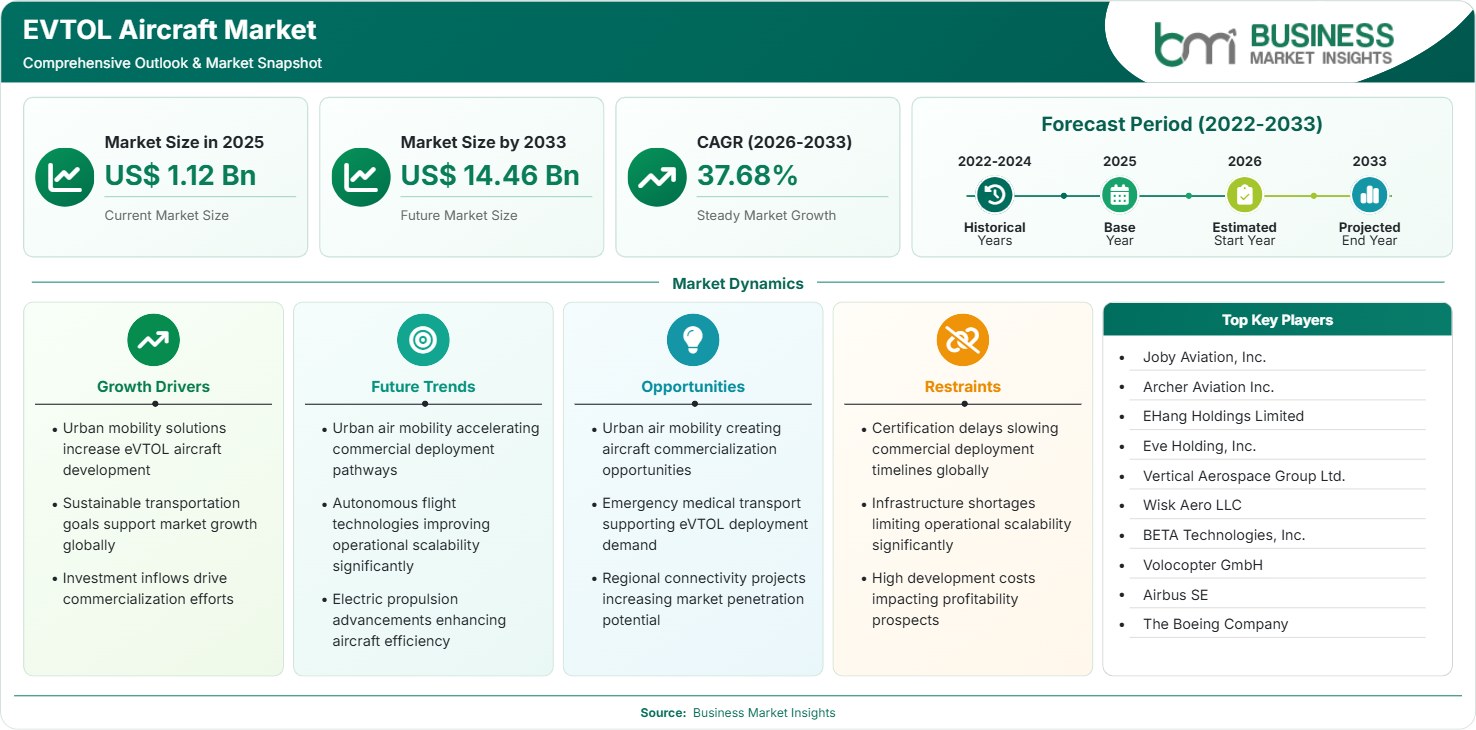
The EVTOL Aircraft Market size was valued at US$ 1.12 Billion in 2025 and is projected to reach US$ 14.46 Billion by 2033, growing at a CAGR of 37.68% during 2026–2033. Key growth drivers include urban air mobility development, aerospace electrification, defense modernization programs, battery innovation, supportive certification pathways, and increasing investment in sustainable short-range aviation networks.

Report Coverage
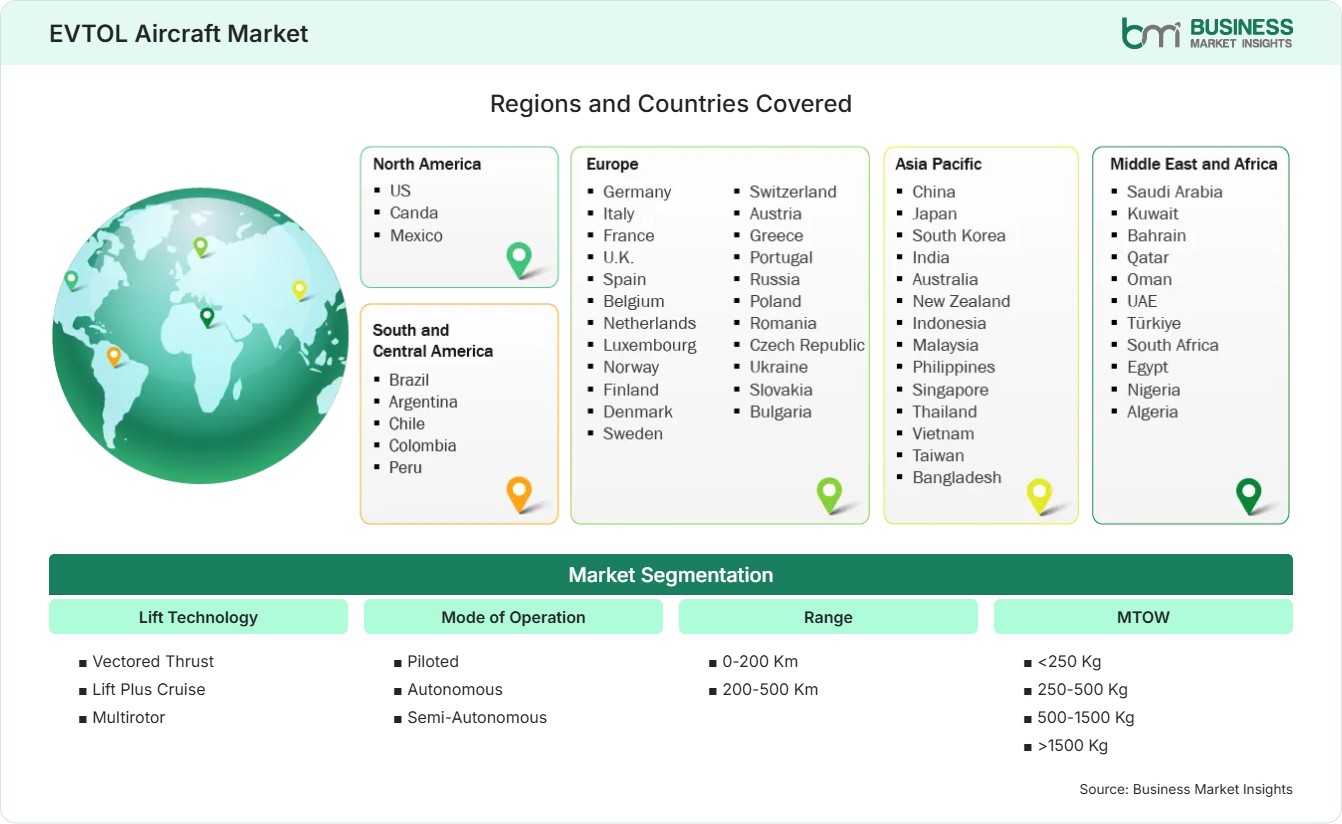
  • Lift Technology: Vectored Thrust, Lift Plus Cruise, Multirotor
  • Mode of Operation: Piloted, Autonomous, Semi-Autonomous
  • Range: 0-200 Km, 200-500 Km
  • MTOW: <250 Kg, 250-500 Kg, 500-1500 Kg, >1500 Kg
  • Propulsion Type: Battery-Electric, Hybrid-Electric, Hydrogen-Electric
US$ 1.12 Bn Market size in 2025
US$ 14.46 Bn Market Size by 2033
37.68% CAGR, 2026 - 2033
2026-2033 Forecast Period

AI Overview

EVTOL Aircraft Market Summary

  • North America Region: North America holds a market share of 38%–42% in 2025, growing with a CAGR of 35%–38% during 2026–2033 due to strong aerospace ecosystems, FAA certification initiatives, urban mobility pilots, defense procurement interest, advanced battery deployment, and substantial venture funding supporting commercialization programs. The U.S. remains the regional leader, supported by certification progress, defense adoption, and commercial air mobility investments, advancing at 36%–39% CAGR.
  • Fastest Growing Region: Asia Pacific accounts for 24%–28% EVTOL Aircraft Market share in 2025 and is anticipated to expand at 40%–44% CAGR during 2026–2033 driven by smart-city investments, favorable regulatory testing frameworks, autonomous aviation acceptance, infrastructure expansion, tourism applications, and national advanced air mobility development programs.
  • Leading Segment: Commercial applications represent a 48%–52% share in 2025 and are expected to register 36%–39% CAGR through 2033. Growth is supported by urban air taxi deployment, airport connectivity services, premium mobility demand, sustainability targets, infrastructure investment, and expanding operator partnerships.
  • High Growth Segment: Autonomous operation holds a 16%–20% share in 2025 and is projected to achieve 42%–46% CAGR through 2033. Increasing AI-enabled flight systems, autonomous certification efforts, operational cost optimization, safety enhancement technologies, and smart transportation integration are accelerating adoption.
  • Key Market Opportunity: Large-scale integration of advanced air mobility corridors connecting airports, city centers, and suburban zones presents substantial revenue potential through passenger transport, emergency response operations, and logistics network optimization worldwide.
  • Major Market Players: Joby Aviation, Inc.; Archer Aviation Inc.; EHang Holdings Limited; Eve Holding, Inc.; Vertical Aerospace Group Ltd.; Wisk Aero LLC; BETA Technologies, Inc.; Volocopter GmbH; Airbus SE; The Boeing Company.
Strategic Insights

EVTOL Aircraft Market: Strategic Insights

EVTOL Aircraft Market Strategic Framework
FREE PDF
Request your free sample
Request free sample
Stakeholder View

Key Takeaways

  • The value chain is expanding beyond aircraft manufacturing to include vertiports, charging infrastructure, battery suppliers, software providers, air traffic management systems, and mobility service operators.
  • Commercial passenger transportation and emergency medical services provide the strongest near-term revenue opportunities due to growing interest in time-sensitive urban and regional connectivity solutions.
  • Autonomous flight technologies are attracting increasing R&D investments as developers seek improved operational efficiency, reduced pilot dependency, and higher aircraft utilization rates.
  • Asia-Pacific offers a compelling investment case through smart-city initiatives, supportive regulatory experimentation, and large population centers experiencing severe transportation congestion.
  • Strategic partnerships between aerospace manufacturers, automotive companies, airlines, and infrastructure providers continue to shape funding activity and commercialization pathways.
  • Dual-use applications supporting both civil and defense missions are emerging as important mechanisms for accelerating certification, testing, and operational deployment.
Geographic Outlook

EVTOL Aircraft Market Regional Highlights

North America EVTOL Aircraft Market

North America accounted for 38%–42% EVTOL Aircraft Market share in 2025 and is projected to expand at 35%–38% CAGR during 2026–2033. The region benefits from established aerospace manufacturing capabilities, strong venture capital investment, FAA engagement with advanced air mobility programs, and growing defense sector participation. Commercial demonstration projects, airport connectivity initiatives, and infrastructure planning efforts continue to accelerate deployment. Multiple aircraft developers are based in the region, strengthening certification progress, ecosystem development, and commercialization readiness throughout the forecast period.

  • FAA regulatory engagement is reducing commercialization uncertainty while encouraging testing programs, infrastructure planning, and investment across passenger and logistics applications.
  • Strong venture financing supports product development, manufacturing expansion, software innovation, and ecosystem partnerships essential for scaling deployment activities.
  • Defense agencies continue assessing advanced mobility platforms for logistics, surveillance, training, and operational support missions.
  • Airline and infrastructure partnerships are accelerating route development, vertiport planning, and customer adoption strategies.

US EVTOL Aircraft Market

The United States represents approximately 78%–82% of regional revenue within North America and is anticipated to record 36%–39% CAGR through 2033. Strong activity from leading aircraft developers, extensive flight testing programs, military collaborations, and airport integration initiatives support market expansion. Federal aviation authorities continue progressing certification frameworks while state and municipal governments explore advanced mobility deployment. Investments in manufacturing facilities, battery technologies, and autonomous systems reinforce the nation’s leadership position within the broader ecosystem.

  • Leading manufacturers are advancing certification programs while expanding pilot production operations and supplier ecosystems.
  • Defense partnerships support aircraft testing, logistics evaluations, and operational readiness activities that contribute to technology maturation.
  • Urban transportation agencies are evaluating future integration scenarios for sustainable mobility solutions.
  • Infrastructure developers are pursuing vertiport networks connected to major metropolitan transportation corridors.

Europe EVTOL Aircraft Market

Europe captured a 27%-31% share of the EVTOL aircraft market in 2025 and is projected to grow at a 34%-37% CAGR in 2026-2033. Europe benefits from sustainable objectives, aerospace engineering expertise, and regulatory oversight through the European Aviation Safety Agency framework. Germany leads the regional adoption drive, while the United Kingdom is proving to be the fastest-growing region, with growth figures surpassing regional estimates.

  • EASA certification engagement provides structured pathways supporting commercialization and operational safety validation.
  • Germany remains the leading regional market due to concentration of aerospace capabilities and technology developers.
  • The United Kingdom demonstrates strong momentum through advanced testing programs and infrastructure planning initiatives.
  • Sustainability commitments encourage public and private investment in low-emission transportation alternatives.

Asia Pacific EVTOL Aircraft Market

The Asia Pacific region accounted for 24%–28% of the market in 2025 and is expected to grow at a CAGR of 40%–44% through 2033, positioning it as the fastest-growing region in the market. Some factors driving the region's growth include rapid urbanization, the need for congestion management, investments in smart cities, and government support for advanced air mobility. Presently, the region holds the lead in market development owing to progress in autonomous aviation in China, and Japan stands as one of the fastest-growing countries.

  • China leads deployment activities through significant investments in autonomous flight technologies and commercial demonstration projects.
  • Japan benefits from supportive policy initiatives, aerospace innovation, and infrastructure readiness programs.
  • High metropolitan population density creates favorable conditions for premium urban air mobility services.
  • Smart-city initiatives increasingly incorporate advanced aviation solutions within future transportation planning.

Rest of World EVTOL Aircraft Market

The Rest of World region's share in the EVTOL aircraft market was estimated at 7%-11% in 2025 and is likely to grow at a 38%-42% CAGR from 2026 to 2033. Middle Eastern nations have been working to develop corridors for advanced air mobility systems and urban transportation solutions. Opportunities in the South & Central American markets are emerging across tourism, regional connectivity, and remote transportation segments. Leading countries in the region at present are the UAE and Saudi Arabia.

  • The UAE is advancing commercial demonstration activities supported by transportation modernization objectives.
  • Saudi Arabia is investing heavily in future mobility infrastructure linked to large-scale urban development programs.
  • Tourism-focused applications provide attractive revenue opportunities across several emerging markets.
  • Geographic accessibility challenges support demand for regional transportation alternatives in remote locations.
  • Public-private partnerships remain essential for infrastructure funding and operational ecosystem development.
Global Market Geography
FREE PDF
Request your free sample
Request free sample
Segment Analysis

EVTOL Aircraft Market Segmentation

Lift Technology

Lift technology accounted for around 100% of the industry deployment architecture, with multirotor and lift cruise being key types in prototype certification. This segment is expected to grow at a CAGR of 37%–40% through 2033, driven by efficiency, safety, reliability, and economic optimization efforts by manufacturers. The scope of the EVTOL Aircraft Market is widening as the search for unique aircraft architectures intensifies.

  • Vectored Thrust: Combines vertical lift and forward propulsion through thrust-vectoring systems, enabling higher cruise speeds and longer operational range while supporting premium passenger transport and regional mobility missions.
  • Lift Plus Cruise: Utilizes dedicated lift rotors and separate cruise propellers, offering efficiency advantages, simplified control architectures, and suitability for urban transportation routes requiring optimized endurance performance.
  • Multirotor: Gains traction in short-distance urban mobility operations due to mechanical simplicity, reduced maintenance requirements, high redundancy levels, and favorable safety characteristics during low-altitude operations.

Mode of Operation

Mode of operation remains a critical differentiator, impacting the certification process, operations economics, and commercialization. The EVTOL Aircraft Market segment is benefiting from rapid progress in artificial intelligence, autonomous navigation, and flight automation. Autonomous vehicles will continue to outperform the entire market, with a 42%-46% CAGR, while piloted vehicles remain ahead in deployment.

  • Piloted: Currently dominates commercial readiness initiatives because regulatory authorities maintain established certification procedures and safety frameworks supporting passenger operations with onboard pilots.
  • Autonomous: Attracts significant investment due to scalability potential, reduced operational costs, enhanced fleet utilization, and continuous progress in AI-enabled flight management systems.
  • Semi-Autonomous: Serves as an intermediate deployment model, combining pilot oversight with advanced automation capabilities that improve safety, efficiency, and operational flexibility across transportation applications.

Range

Range capability affects route economics, infrastructure, and business models. Presently, most aircraft are designed with urban and peri-urban transportation needs in mind. But with increased battery energy density, there are plans to expand use in regional transportation roles. There will be faster adoption of such aircraft in the forecast period.

  • 0-200 Km: Supports urban air taxis, airport shuttle services, tourism operations, and emergency response missions where rapid transportation and frequent flight cycles are operational priorities.
  • 200-500 Km: Addresses regional transportation requirements by connecting metropolitan clusters, underserved communities, and business destinations while expanding commercial revenue opportunities for operators.

MTOW

Maximum Take-Off Weight categories determine payload capability, passenger capacity, difficulty of the certification process, and application potential. The middle-weight airplanes enjoy maximum commercial attention at the moment thanks to good economic balance and versatility in their missions. Larger types are under consideration for logistics, military, and regional transportation missions that demand greater payload capacity and performance.

  • <250 Kg: Primarily utilized for lightweight cargo, surveillance, inspection, and niche autonomous missions requiring compact aircraft designs and lower operational complexity.
  • 250-500 Kg: Supports limited passenger and specialized operational roles where efficiency, flexibility, and lower infrastructure requirements remain critical decision factors.
  • 500-1500 Kg: Represents a major commercialization category, accommodating multiple passengers while maintaining operational efficiency suitable for urban and regional transportation networks.
  • >1500 Kg: Targets high-capacity missions, military requirements, cargo transport, and advanced regional mobility services demanding enhanced payload and endurance performance.

Propulsion Type

The performance of propulsion technology affects sustainability, operational costs, infrastructure needs, and regulations. The battery-electric propulsion system is the most developed technology at this stage due to its maturity and lower emissions. Hybrid and hydrogen propulsion systems are gaining more interest due to their extended operating range.

  • Battery-Electric: Dominates current development programs owing to zero direct emissions, lower maintenance complexity, favorable urban deployment characteristics, and strengthening charging infrastructure investments.
  • Hybrid-Electric: Provides extended operational range while reducing reliance on charging networks, making it attractive for regional connectivity and specialized mission profiles.
  • Hydrogen-Electric: Emerging as a long-term opportunity for higher endurance operations through improved energy density potential and alignment with decarbonization objectives.

Application

Application diversity is increasing due to improved aircraft capabilities and the evolution of regulatory routes. Deployments in the commercial sector accounted for about 48%-52% of the market share in 2025 and are estimated to grow at a CAGR of 36%-39 % through 2033. The EVTOL Aircraft Market trends include rising usage in passenger transport, military missions, and emergency services.

  • Commercial: Focuses on passenger transportation, airport connectivity, tourism services, and regional mobility solutions designed to reduce travel time and improve transportation accessibility.
  • Military: Supports logistics, reconnaissance, personnel transport, and mission flexibility requirements where vertical mobility capabilities provide measurable operational advantages.
  • EMS: Enables rapid emergency response, medical evacuation, and healthcare accessibility improvements, particularly in congested urban areas and geographically challenging environments.
Market Forces

EVTOL Aircraft Market Dynamics

Key Market Drivers

Urban Congestion Driving Advanced Air Mobility Adoption

Urbanization and traffic congestion have created a need for alternative modes of transport to reduce time spent moving around the metropolis. With urban populations growing continuously, according to the United Nations' urbanization forecasts, current transportation networks are under great pressure. Developers of aircraft, cities, and transportation agencies are currently looking into establishing aerial mobility routes that will connect the airports, business areas, and suburban areas. The EVTOL Aircraft Market growth increasingly depends on operators' ability to offer faster point-to-point mobility than traditional ground transportation. As city planners pursue integrated mobility ecosystems, advanced air transportation solutions are gaining strategic relevance for both public and private stakeholders seeking to mitigate congestion and improve productivity.

Regulatory Progress Supporting Commercial Certification

North American, European, and certain Asia-Pacific aviation regulatory bodies are making significant progress towards establishing certification frameworks for electric vertical takeoff and landing aircraft. This is reducing uncertainty for manufacturers, investors, operators, and infrastructure providers. The process of standardization with regard to airworthiness, pilot training, autonomy, and low-level traffic management continues to advance. More collaboration between governments and industry participants will eliminate hurdles to commercialization and provide greater assurances of safety. Accomplishments in certification can be regarded as major milestones in regard to investments and clients' trust.

Defense and Public Sector Adoption Expanding Use Cases

Organizations such as militaries and government agencies have shown interest in using electric vertical takeoff and landing aircraft for logistics, surveillance, personnel transport, emergency services, and other humanitarian services. The involvement of stakeholders in the defense industry provides much-needed testbed opportunities, revenue streams, and validation opportunities for manufacturers. There are various benefits associated with public-sector funding, including infrastructure development and technology demonstration, which would also benefit the wider commercial ecosystem. More emphasis on flexibility, sustainability, and quick implementation of solutions is highly consistent with ongoing trends in electric airplanes. EVTOL Aircraft Market growth is also supported by the creation of diversified demand bases, driven by the dual-use nature of the products, thereby reducing dependence on a single end user.

Key Market Opportunities

Development of Integrated Vertiport Infrastructure Networks

The growth in vertiport ecosystems is among the biggest commercial opportunities in advanced air mobility. Proper development of this technology requires well-located areas where the vehicle can take off and land and be connected to the current transportation network. Opportunities in infrastructure development include not only the infrastructure itself but also the charging system, digital traffic management, maintenance, and passenger services. Companies such as airports, property developers, mobility operators, and energy providers are exploring partnership strategies to build an ecosystem. Deployment will provide significant recurring revenue, improved access to the service, and increased efficiency for future transportation operators.

Autonomous Fleet Operations and Mobility Services

Self-driving operations have the potential to transform economies by reducing dependence on pilots, optimizing fleet performance, and building scalable transportation systems. With advancements in AI systems and digital flight controls, increased automation is possible. Commercial operators are exploring opportunities in passenger transport, logistics, and connectivity more broadly by leveraging an automated fleet. EVTOL Aircraft Market Forecasts shows that automation is recognized as one of the main sources of profit creation for the industry. Continued technological progress and regulatory acceptance could significantly accelerate adoption across multiple application categories.

Expansion into Regional Connectivity and Cargo Transport

Apart from city passenger transport, the companies have also turned their attention to regional transport and logistics. There is a large number of unaddressed routes without transport solutions, making air transport an effective means of connecting communities, industrial zones, and logistics centers. The logistics may be simpler in terms of certification than passenger services; therefore, it will be easier to start earning revenue earlier. Regional transport solutions will also help address accessibility issues in remote areas. It will allow for the expansion of the market and income sources through investments in aircraft design and efficient propulsion systems.

Market Restraints and Challenges

Battery Performance Constraints and Economic Impact

Factor: Despite recent advances, current battery technology still has limitations in energy density, charging time, and cost-effectiveness. Impact: These limits directly affect range, capacity, utilization rates, and an operation's profitability. Although research in battery technology is still ongoing, commercial implementation of new technology should be done with the limits of existing technology in mind. To maintain reliable operations, operators might need more efficient charging facilities, an additional fleet, or a different route structure. High raw material prices could also negatively impact the implementation of battery technology.

Infrastructure Gaps and Airspace Integration Complexity

Factor: The commercial application of the technology depends on investments in the following elements: vertiports, charging stations, a digital traffic management system, and a regulatory integration framework. Impact: Possible delays in the readiness of such infrastructure could delay service introduction, increase project costs, and narrow the project's operational scope. Another point is that airspace integration presents its own challenges because advanced mobility solutions must coexist with current flights. Local permissions and financial issues may also play an important role in terms of deployment. Synchronization between all stakeholders will be necessary.

Company Analysis

Competitive Landscape

The competitive environment remains highly dynamic, characterized by certification races, manufacturing scale-up initiatives, strategic partnerships, and technology differentiation. EVTOL Aircraft Market analysis indicates that aircraft developers are increasingly focusing on battery optimization, autonomous capabilities, air traffic integration, and infrastructure partnerships to establish first-mover advantages in commercial deployment.

Company Name

Overview

Products and Services relevant to this market

Joby Aviation, Inc.

U.S.-based advanced air mobility developer focused on commercial passenger transport and large-scale air taxi network deployment supported by strategic aviation partnerships.

Battery-electric eVTOL aircraft, flight operations software, air taxi services, fleet management solutions, aircraft manufacturing, and commercialization support services.

Archer Aviation Inc.

Developer of urban air mobility platforms emphasizing scalable manufacturing, commercial certification, and strategic partnerships with airlines and infrastructure stakeholders.

Electric aircraft platforms, urban mobility solutions, passenger transport aircraft, operational systems, manufacturing support, and advanced mobility ecosystem services.

EHang Holdings Limited

Pioneer in autonomous aerial mobility technologies with strong focus on passenger-grade autonomous flight systems and smart-city mobility integration.

Autonomous eVTOL aircraft, passenger mobility systems, aerial sightseeing solutions, command-and-control platforms, and intelligent aviation services.

Eve Holding, Inc.

Advanced air mobility company leveraging aerospace expertise and global aviation relationships to support future commercial deployment.

Electric aircraft development, urban mobility services, software platforms, fleet operation tools, and ecosystem integration solutions.

Vertical Aerospace Group Ltd.

Aircraft developer concentrating on sustainable aviation technologies and commercial passenger transport applications across urban and regional markets.

Electric aircraft platforms, passenger mobility systems, aerospace engineering services, and advanced transportation solutions.

Wisk Aero LLC

Autonomous aviation specialist focused on next-generation self-flying passenger aircraft and scalable mobility operations.

Autonomous eVTOL aircraft, flight automation technologies, air mobility systems, and autonomous fleet operation solutions.

BETA Technologies, Inc.

Aviation technology company developing electric aircraft and charging infrastructure supporting passenger and cargo transport operations.

Electric aircraft, charging networks, logistics mobility platforms, aviation infrastructure solutions, and operational support services.

Volocopter GmbH

Early-stage urban air mobility pioneer emphasizing commercial passenger operations, tourism, and city transportation services.

Multirotor aircraft, air taxi platforms, mobility services, passenger transport solutions, and integrated operational systems.

Airbus SE

Global aerospace leader investing in advanced air mobility development through research, innovation, and prototype programs.

Advanced air mobility platforms, aerospace technologies, flight systems, engineering services, and aviation infrastructure integration.

The Boeing Company

Major aerospace manufacturer exploring next-generation mobility technologies through strategic investments and advanced aviation programs.

Autonomous flight technologies, mobility platforms, aerospace engineering services, and advanced aircraft development solutions.

Trust & Transparency

Research Methodology

The market analysis combines proprietary research with secondary data from government agencies, company disclosures, regulatory filings, industry databases and expert interviews. Market estimates are validated through data triangulation, cross-market benchmarking and analyst review.

View Full Research Methodology

Questions Answered

Frequently Asked Questions

What are the biggest challenges facing commercial deployment?

Key challenges include certification complexity, infrastructure development requirements, battery limitations, airspace integration issues, public acceptance considerations, and substantial capital requirements for scaling commercial operations and manufacturing capacity.

What insights does an EVTOL Aircraft Market Report provide to investors?

A Market Report helps investors evaluate growth prospects, competitive positioning, certification progress, infrastructure readiness, technology trends, funding activity, and emerging commercial opportunities across global advanced air mobility ecosystems.

Which region offers the strongest long-term growth potential?

Asia Pacific presents the strongest long-term opportunity due to rapid urbanization, smart-city initiatives, supportive testing programs, and growing investment in advanced transportation systems. China and Japan are particularly influential in regional development.

How does battery technology influence industry development?

Battery performance directly impacts aircraft range, payload capacity, operating economics, charging requirements, and route feasibility. Improvements in energy density and charging efficiency remain central to broader commercialization and service expansion efforts.

What are the primary applications driving demand for eVTOL aircraft?

Commercial air mobility, emergency medical transportation, defense logistics, surveillance operations, regional connectivity, and tourism services are the major application areas. Commercial passenger transport currently represents the largest revenue-generating segment due to growing investments in urban mobility ecosystems.

Access the Full EVTOL Aircraft Market Report

Get segment-level forecasts, regional estimates, competitive benchmarking, company profiles and downloadable Excel datasets.

Access the full EVTOL Aircraft Market Report
350 pages PDF & Excel | 2026-11-10
Similar Research

Related Market Reports