
Aircraft Actuator Market Outlook: Size, Share, Trends, Growth Analysis, Competitive Landscape & Forecast, 2026-2033

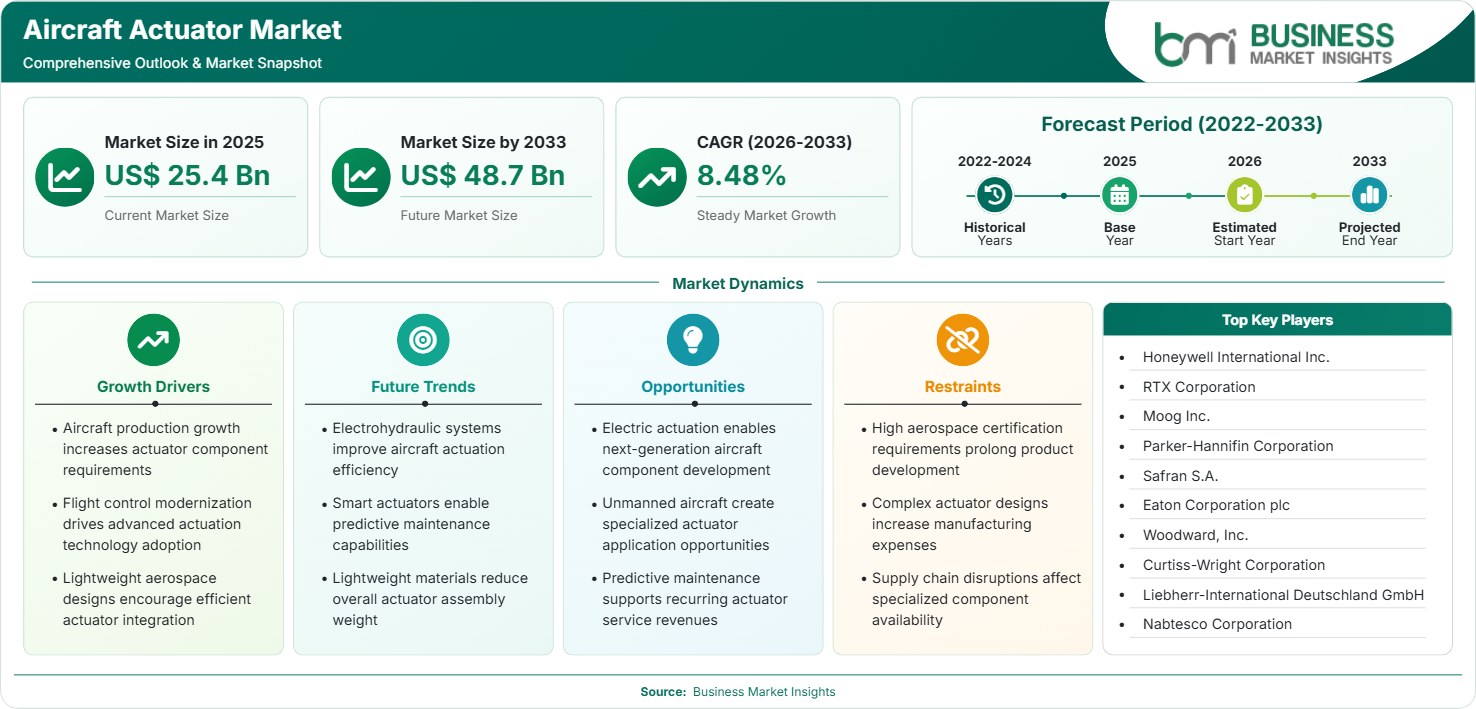
The Aircraft Actuator Market size was valued at US$ 25.4 Billion in 2025 and is projected to reach US$ 48.7 Billion by 2033, growing at a CAGR of 8.48% during 2026–2033, driven by aircraft production, fleet modernization, flight-control electrification, defense procurement, and aftermarket demand for reliable actuation systems.

Report Coverage
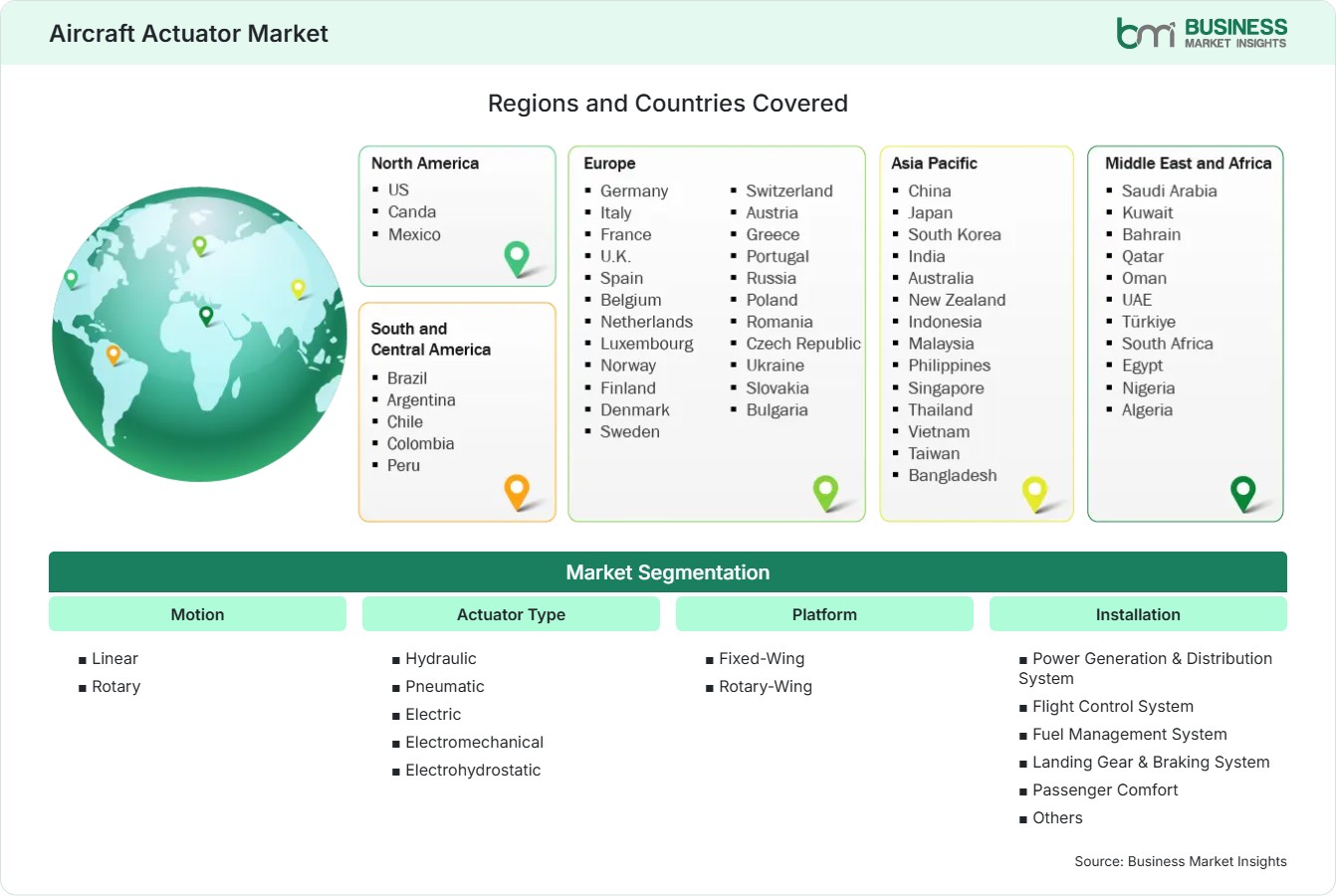
  • Motion: Linear, Rotary
  • Actuator Type: Hydraulic, Pneumatic, Electric, Electromechanical, Electrohydrostatic
  • Platform: Fixed-Wing, Rotary-Wing
  • Installation: Power Generation & Distribution System, Flight Control System, Fuel Management System, Landing Gear & Braking System, Passenger Comfort, Others
  • End-User: OEM, Aftermarket
US$ 25.4 Bn Market size in 2025
US$ 48.7 Bn Market Size by 2033
8.48% CAGR, 2026 - 2033
2026-2033 Forecast Period

AI Overview

Aircraft Actuator Market Summary

  • North America Region: North America holds an estimated 35%–39% Aircraft Actuator Market share in 2025, with a modeled CAGR range of 7.8%–8.6% during 2026–2033, supported by aerospace manufacturing, defense modernization, and advanced actuation integration. The US market benefits from commercial aircraft production, military platform upgrades, and established actuator suppliers, with a modeled CAGR of 8.0%–8.8% through 2033.
  • Fastest Growing Region: Asia Pacific accounts for an estimated 22%–26% share in 2025, with a modeled CAGR range of 10.0%–11.2% during 2026–2033, supported by fleet expansion, indigenous aerospace manufacturing, defense programs, and maintenance infrastructure investments.
  • Leading Segment: Hydraulic actuators represent an estimated 38%–43% share in 2025, with a modeled CAGR range of 7.4%–8.3% during 2026–2033, supported by established flight-control architectures, high-load applications, certification maturity, and replacement requirements across commercial and military aircraft.
  • High Growth Segment: Electric actuators represent an estimated 14%–18% Aircraft Actuator Market share in 2025, with a modeled CAGR range of 10.5%–12.0% during 2026–2033, supported by more-electric aircraft architectures, weight reduction, energy efficiency, and electrification of auxiliary aircraft functions.
  • Key Market Opportunity: Aircraft electrification, regional fleet expansion, unmanned platforms, and predictive maintenance create opportunities for lightweight actuators, integrated electronics, modular architectures, and aftermarket service solutions across established and emerging aerospace supply chains.
  • Major Market Players: Honeywell International Inc., RTX Corporation, Moog Inc., Parker-Hannifin Corporation, Safran S.A., Eaton Corporation plc, Woodward, Inc., Curtiss-Wright Corporation, Liebherr-International Deutschland GmbH, and Nabtesco Corporation.
Strategic Insights

Aircraft Actuator Market: Strategic Insights

Aircraft Actuator Market Strategic Framework
FREE PDF
Request your free sample
Request free sample
Stakeholder View

Key Takeaways

  • The value chain connects aerospace OEMs, system integrators, actuator manufacturers, precision component suppliers, electronics providers, certification organizations, and MRO companies. Long qualification cycles encourage durable supplier relationships and create barriers to entry for new participants.
  • Electric, electromechanical, and electrohydrostatic solutions provide opportunities in applications requiring reduced hydraulic dependence, system integration, and improved energy management. Their adoption depends on aircraft architecture, safety assessment, power availability, and certification requirements.
  • Actuator development is moving toward integrated sensing, electronic control, lightweight materials, improved thermal management, and condition-monitoring capabilities. These technologies support more precise operation and can improve maintenance planning when validated through aircraft-specific reliability programs.
  • Asia Pacific offers opportunities for suppliers supporting commercial fleet expansion, defense manufacturing, indigenous aircraft programs, and MRO development. Local partnerships and certification capabilities are important for accessing government-supported and international aerospace programs.
  • Consolidation and portfolio realignment are reshaping the actuation supply chain. Safran's acquisition of Collins Aerospace's flight control and actuation activities in 2025 illustrates the strategic importance of integrated actuation capabilities.
  • Aftermarket performance depends on repair capability, replacement-part availability, technical documentation, and customer support. Suppliers that combine reliable products with responsive maintenance services can strengthen relationships throughout aircraft operating lifecycles.
Geographic Outlook

Aircraft Actuator Market Regional Highlights

North America Aircraft Actuator Market

North America holds an estimated 35%–39% Aircraft Actuator Market share in 2025, with a modeled CAGR of 7.8%–8.6% from 2026–2033. The region benefits from aerospace OEM concentration, defense procurement, mature MRO capabilities, and advanced actuator manufacturing. US demand spans commercial aircraft, military platforms, rotorcraft, and unmanned systems. Suppliers compete through certification, integration expertise, platform coverage, and aftermarket support. Production expansion and aircraft modernization sustain demand for hydraulic, electric, and electromechanical actuation solutions across multiple installation categories.

  • Commercial aircraft production supports recurring demand for qualified actuation systems, while delivery schedules influence procurement timing and supplier capacity planning.
  • Defense modernization programs require precision actuation for flight controls, landing gear, weapon-system interfaces, and specialized military aircraft applications.
  • Established aerospace clusters support engineering collaboration, qualification testing, component sourcing, and long-term contracts with OEMs and tier-one integrators.
  • Aftermarket demand is influenced by aircraft utilization, component removal rates, repair turnaround, and the availability of approved replacement parts.
  • Electrification initiatives encourage development of advanced electric and electrohydrostatic solutions for selected aircraft functions and next-generation platforms.

US Aircraft Actuator Market

The US accounts for an estimated 30%–34% of the global Aircraft Actuator Market in 2025 and is modeled to grow at 8.0%–8.8% during 2026–2033. Its demand base combines commercial aircraft manufacturing, military procurement, business aviation, and extensive MRO operations. Major aerospace suppliers maintain capabilities across hydraulic, pneumatic, electric, and electromechanical technologies. Federal defense investment, aircraft modernization, and domestic manufacturing initiatives support demand. Supply-chain qualification and production continuity remain important considerations for manufacturers serving safety-critical aircraft systems.

  • Commercial aerospace programs create demand for actuators used in flight controls, landing gear, braking, and aircraft utility systems.
  • Defense procurement supports specialized actuation requirements for military aircraft, helicopters, unmanned platforms, and advanced flight-control architectures.
  • Domestic manufacturing capabilities facilitate engineering development, qualification, integration, and aftermarket support for established aerospace platforms.
  • Aircraft maintenance activity creates recurring demand for replacement units, repair services, technical support, and inventory management.

Europe Aircraft Actuator Market

Europe represents an estimated 27%–31% Aircraft Actuator Market share in 2025, with a modeled CAGR of 7.5%–8.4% through 2033. Airbus-related production, European defense modernization, and advanced aerospace engineering support regional demand. France and Germany remain important aerospace manufacturing centers, while the United Kingdom contributes through aircraft systems, defense, and industrial supply chains. France is modeled at 7.8%–8.7% CAGR and Germany at 7.6%–8.5%. Lightweight actuation, more-electric aircraft development, and regulatory requirements influence technology investment and supplier selection.

  • France benefits from aerospace manufacturing capabilities, defense programs, and established actuation and flight-control system suppliers.
  • Germany supports demand through aircraft production, engineering, precision manufacturing, and aerospace component supply chains.
  • The United Kingdom contributes through defense aviation, aircraft systems integration, and specialized aerospace manufacturing capabilities.
  • European aircraft electrification programs create development opportunities for electric and electrohydrostatic actuation technologies.
  • Certification requirements and sustainability objectives influence product development, materials selection, and manufacturing process improvements.

Asia Pacific Aircraft Actuator Market

The Asia Pacific region has an estimated market share of 22%-26% and is projected to grow at a CAGR of 10.0%-11.2% through 2033, making it the fastest-growing regional market. The development of commercial aviation, the purchase of military aircraft, the domestic aerospace industry, and the construction of MRO facilities will drive growth. China and Japan have already developed their industries, whereas India and Southeast Asia will continue to develop manufacturing capacity. India is expected to grow at a 11.0%-12.4% CAGR, and China at a 10.2%-11.5% CAGR.

  • China supports actuator demand through commercial aviation, military aircraft development, aerospace industrial capabilities, and domestic supply-chain development.
  • India offers opportunities through aircraft manufacturing, defense-indigenization initiatives, MRO expansion, and increasing participation in global aerospace supply chains.
  • Japan contributes advanced manufacturing, aerospace engineering, precision components, and established industrial technology capabilities.
  • Southeast Asian aviation expansion creates opportunities for component suppliers, maintenance providers, and aircraft system specialists.
  • Regional suppliers increasingly require certification, quality management, and reliable delivery capabilities to participate in international aerospace programs.

Rest of World Aircraft Actuator Market

South and Central America are a developing demand base that relies on commercial air transport, regional aircraft operations, defense needs, and maintenance activities. Brazil is an aerospace manufacturing hub, while regional fleet upgrades present aftermarket market opportunities. The region is forecasted to grow at 6.5% - 7.5% CAGR in the Aircraft Actuator Market from 2026 – 2033.

The Middle East and Africa are characterized by commercial aircraft fleet growth, defense procurements, aviation infrastructure development, and aircraft maintenance facilities development. The region is forecast to grow at an 8.0%-9.2% CAGR, with the United Arab Emirates and Saudi Arabia driving regional aviation opportunities.

  • Brazil supports regional aerospace manufacturing and aircraft maintenance demand, creating opportunities for qualified actuator suppliers and component specialists.
  • Gulf aviation hubs support demand through fleet expansion, aircraft maintenance, aviation infrastructure, and defense-related aviation investment.
  • South Africa provides aerospace engineering, defense, and maintenance capabilities that support selected actuator applications.
  • Aircraft fleet utilization and operating conditions influence replacement demand, component servicing, and technical support requirements.
  • Regional supply chains may benefit from partnerships with global manufacturers, approved repair organizations, and local aerospace integrators.
Global Market Geography
FREE PDF
Request your free sample
Request free sample
Segment Analysis

Aircraft Actuator Market Segmentation

Motion

The Motion category contains actuation devices in linear and rotary form, used for flight control, landing gear, brakes, and utility systems of aircraft. This segment accounted for about 58%–63% of the Aircraft Actuator Market in 2025 and is projected to expand at a CAGR of 8.0%–8.8% through 2026–2033. Force/torque, installation issues, reliability, and maintenance needs impact product choice.

  • Linear: Linear actuators support controlled movement in flight controls, landing gear, seating, and utility systems. Demand is influenced by precision, load capacity, compact design, and system reliability.
  • Rotary: Rotary actuators deliver angular movement for aircraft control and utility applications. Adoption depends on torque requirements, installation space, operating environment, and integration with aircraft control systems.

Actuator Type

The Actuator Type segment covers hydraulic, pneumatic, electric, electromechanical, and electrohydrostatic technologies. Hydraulic products remain important in high-load aircraft applications, while electric and hybrid architectures gain attention for selected more-electric designs. The segment represented an estimated 90%–94% of the addressable Aircraft Actuator Market in 2025 and is modeled to grow at 8.1%–8.9% through 2033.

  • Hydraulic: Hydraulic actuators provide high force density and established performance in flight-control and landing applications. Demand is supported by installed aircraft fleets, proven architectures, and replacement requirements.
  • Pneumatic: Pneumatic actuators serve selected aircraft utility and control functions. Adoption depends on system architecture, compressed-air availability, pressure requirements, reliability, and integration with aircraft equipment.
  • Electric: Electric actuators support electrification initiatives and selected aircraft functions. Demand is influenced by weight reduction, control precision, power-management considerations, and the development of more-electric aircraft.
  • Electromechanical: Electromechanical actuators integrate electric motors, mechanical transmission systems, and control electronics. Their application depends on force requirements, redundancy, thermal performance, and certification suitability.
  • Electrohydrostatic: Electrohydrostatic actuators combine localized hydraulic power with electrical control. They can support distributed actuation architectures where hydraulic efficiency, installation flexibility, and system integration influence design decisions.

Platform

The Platform Segment consists of Fixed Wing and Rotary Wing. Fixed Wing platforms contribute around 72% - 77% market share of the Aircraft Actuator Market in 2025, driven by the demand from Commercial Aircraft, Business Jets, Transport, and Military Aircraft. The segment is projected to grow at 8.0% - 8.7%. Rotary-wing applications remain important for helicopters, where compact design, reliability, and specialized flight-control requirements influence actuator procurement.

  • Fixed-Wing: Fixed-wing aircraft use actuators in flight controls, landing gear, braking, thrust-related systems, and aircraft utility applications. Demand is linked to production, modernization, and maintenance cycles.
  • Rotary-Wing: Rotary-wing aircraft require actuation solutions for flight-control systems, landing functions, and specialized helicopter equipment. Adoption depends on weight, reliability, vibration resistance, and installation requirements.

Installation

The Installation Segment consists of aircraft systems such as power generation & distribution, flight control, fuel handling, landing gear and brakes, passenger comfort, and others. Flight control and landing applications are considered significant demand drivers, since they involve validation of performance and reliability. The segment is forecast to grow at a CAGR of 8.1% - 8.9% in the Aircraft Actuator Market between 2026 - 2033.

  • Power Generation & Distribution System: Actuation supports selected power-management and distribution functions. Demand depends on aircraft electrical architecture, equipment integration, reliability requirements, and maintenance accessibility.
  • Flight Control System: Flight-control actuators enable controlled movement of aircraft surfaces. Adoption is influenced by safety requirements, precision, redundancy, force output, and compatibility with flight-control architectures.
  • Fuel Management System: Fuel-management actuators support selected valves and control mechanisms. Demand depends on fuel-system architecture, environmental durability, leakage prevention, and reliable operation under varying flight conditions.
  • Landing Gear & Braking System: Landing-gear and braking applications require dependable movement and force transmission. Demand is supported by aircraft deliveries, replacement requirements, qualification standards, and maintenance cycles.
  • Passenger Comfort: Passenger comfort applications include seat adjustment and related cabin mechanisms. Demand is influenced by cabin design, airline refurbishment, passenger experience objectives, and actuator compactness.
  • Others: Other applications cover specialized aircraft functions requiring controlled mechanical movement. Adoption depends on platform architecture, system-specific reliability requirements, integration constraints, and qualification procedures.

End-User

The end-user segment includes both OEM and Aftermarket demand. OEM demand depends on aircraft manufacturing timelines, platform qualification, and supplier contracts. Aftermarket demand includes installed fleet volume, operational intensity, replacement needs, repairs, and inventory availability. The OEM application accounted for 61%–66% of the share in 2025, and the segment is forecast to grow by 8.0%–8.8% between 2026 and 2033 in the Aircraft Actuator Market.

  • OEM: OEM customers purchase qualified actuators for aircraft production and system integration. Demand depends on aircraft deliveries, platform development, certification, production schedules, and supplier performance.
  • Aftermarket: Aftermarket demand includes replacement units, repair services, overhaul, and technical support. Growth is influenced by fleet age, aircraft utilization, maintenance intervals, and availability of approved components.
Market Forces

Aircraft Actuator Market Dynamics

Key Market Drivers

Expansion of Commercial Aircraft Production and Fleet Modernization

The development of commercial aircraft requires actuators for flight controls, landing gear, brakes, and utility systems. The Aircraft Actuator Market growth depends on aircraft deliveries, backlog conversion, and renewals. Global aviation demand presents an opportunity for procurement despite production problems stemming from limited capacity and spare parts availability. IATA's outlook for the aviation industry can serve as a guideline for tracking passenger demand and the operating environment affecting aircraft usage. Newly launched aircraft will require certified parts, and demand for maintenance will come from existing fleets. Companies with platform approvals and manufacturing capacity can enter both the first-time and replacement markets.

Adoption of More-Electric Aircraft Architectures

Aircraft system electrification is creating engineering opportunities for electric, electromechanical, and electrohydrostatic actuators. The Aircraft Actuator Market trends landscape is influenced by efforts to reduce hydraulic dependence, improve energy management, and distribute actuation functions more efficiently. Electrical architectures can be used to enable selected applications when the availability of power, heat dissipation, reliability, and control are aligned with the aircraft design needs. Not all applications will utilize electric actuators, however, as many flight control tasks still require specialized technologies and redundant designs. Manufacturers are incorporating motor, power electronics, sensors, and mechanical drive systems into a single solution. Platform-level design considerations, rather than actuator design, will determine whether these systems become commercially viable. Certification, environmental qualification, electromagnetic compatibility, and lifetime considerations are among the factors that will play an important role.

Defense Modernization and Unmanned Aircraft Development

Modernized defense increases the need for actuators for fighters, transport planes, helicopters, drones, and dedicated military aircraft. Procurement demands reliable actuators in tough vibration, temperature, shock, and operational environments. The suppliers are judged according to their qualifications, secure manufacturing, reliability, and integration capabilities. Drones are an area where small, lightweight actuators can be applied. The particular needs will depend upon the aircraft, its missions, the control system used, and the environment in which the operations take place. Government procurement schedules will affect the timing of income flows, whereas defense procurement may include domestic manufacturing or special licensing agreements. The suppliers that already have links within the program get the chance to modernize and sustain.

Key Market Opportunities

Electric Actuation for Next-Generation Aircraft

Electrical and electromechanical technologies represent an avenue for potential growth, given increasingly electric aircraft architectures and improved system efficiencies. This is because electrical actuation involves integrating power electronics, motors, control systems, thermal management, and safety architecture into the design considerations. Suppliers can develop modular designs of selected flight control, utility, and cabin applications. The advent of new aircraft segments, such as advanced air mobility aircraft and UAVs, will provide additional opportunities for design-in, although their commercial viability will depend upon certification and program management. Aircraft Actuator Market Forecasts should be considered alongside aircraft programs, power system advances, and qualification efforts. Firms that have capabilities in both actuation and electronics should be able to exploit their system-level benefits relative to component prices.

Aftermarket Repair, Replacement, and Predictive Maintenance

The existing aircraft fleet generates ongoing requirements for actuator maintenance, repairs, and replacement. Operators need access to a reliable supply of spare parts, as actuator malfunctions and lengthy repairs may affect aircraft availability and maintenance activities. Opportunities for suppliers include repair capability, replacement programs, stock control, and technical support. Digital technology and condition-based maintenance could help determine wear characteristics and ensure maintenance is provided in good time; however, this will depend on the availability of aircraft data and regulatory clearance. The opportunity will vary depending on the platform's age, the actuator's complexity, the operating environment, and the maintenance policy. Actuator manufacturers with repair centers could benefit from their OEM know-how and after-sales support.

Localized Aerospace Manufacturing and Supply Chain Partnerships

Aerospace manufacturing development in emerging markets creates opportunities for actuator suppliers, precision-machining companies, electronics manufacturers, and engineering service providers. India, China, and some Southeast Asian countries are enhancing their aerospace industry capabilities through domestic programs, investments in industrial infrastructure, and collaborations with foreign companies. However, beyond the benefits of lower costs, the process entails more due to the need for process control, traceability, and product qualification in actuator manufacturing. Manufacturers can use technology transfer, joint ventures, approved suppliers, and component specialization to establish their regional manufacturing operations. The example of the Indian aerospace industry highlights the opportunities arising in global supply chains from domestic aircraft and military programs. Market entry is possible only if certification, intellectual property, production capacity, and customer willingness are considered.

Market Restraints and Challenges

High Certification Costs and Lengthy Qualification Requirements

Factor: Actuators in aircraft are safety-sensitive parts that must be designed and manufactured in accordance with very strict standards for performance, durability, environmental conditions, and system integration. Qualification procedures include engineering, testing, documentation, and conformity assessment and depend on the specific application and type of aircraft. Impact: High development and certification costs for the equipment may pose barriers for small vendors. The electrical and electrohydraulic architectures may require further system-level validation regarding power management, thermal performance, redundancy, and control electronics. Moreover, suppliers should have quality systems and production processes that ensure consistent performance throughout the products' life cycle. This puts large companies with engineering expertise, financial resources, and strong customer relations in an advantageous position.

Supply Chain Complexity and Reliability Constraints

Factor: Aircraft actuators use specialized materials, precision parts, seals, motors, electronics, hydraulic components, and a manufacturing process that meets specific requirements. Delays or changes in the supply chain or supplier approval can affect the availability of manufacturing and repair. Impact: Any manufacturing delays may delay production schedules, increase inventory needs, and create issues for aircraft deliveries or maintenance schedules. The aerospace industry requires traceability and reliable performance, making it difficult to replace parts without re-approval. Modern electric actuation systems may face challenges related to power electronics, thermal management, rare-earth metals, and manufacturing technologies. Suppliers can mitigate this risk by using dual-sourcing, inventory planning, process automation, and closer collaboration with sub-tier suppliers. Nonetheless, redundancy will make operation more costly and require further qualification.

Company Analysis

Competitive Landscape

The Aircraft Actuator Market analysis covers established aerospace system manufacturers, actuation specialists, and diversified industrial technology companies. Competitive differentiation centers on certification experience, product reliability, aircraft platform coverage, engineering integration, manufacturing scale, and aftermarket support. The following companies represent a balanced selection of active market participants identified through industry sources.

Company Name

Overview

Products and Services relevant to this market

Honeywell International Inc.

Aerospace technology supplier with capabilities across aircraft systems, control technologies, and aftermarket services.

Aircraft actuation technologies, flight-control systems, aircraft systems integration, and maintenance support.

RTX Corporation

Diversified aerospace and defense group operating Collins Aerospace, a major aircraft systems supplier.

Flight-control actuation, hydraulic and mechanical actuation systems, aircraft systems, and aftermarket support.

Moog Inc.

Precision motion-control and aerospace technology company serving commercial and defense applications.

Flight-control actuators, electromechanical actuation, precision motion control, and aerospace engineering services.

Parker-Hannifin Corporation

Motion and control technology manufacturer with established aerospace hydraulic and electromechanical capabilities.

Hydraulic actuation, aircraft systems, motion-control components, and aerospace fluid and electromechanical solutions.

Safran S.A.

Aerospace group with capabilities spanning flight controls, actuation, electronics, and defense systems.

Hydraulic, mechanical, and electromechanical actuation, flight-control systems, and integrated aerospace technologies.

Eaton Corporation plc

Power management and aerospace technology company serving aircraft systems and industrial applications.

Aircraft hydraulic systems, actuation-related components, aerospace fluid management, and power management technologies.

Woodward, Inc.

Control systems manufacturer with expertise in aerospace actuation and engine control applications.

Electromechanical actuation, control systems, aircraft stabilization applications, and aerospace control technologies.

Curtiss-Wright Corporation

Diversified engineering company providing motion control and aerospace and defense solutions.

Actuation-related control systems, precision motion technologies, aerospace components, and engineered systems.

Liebherr-International Deutschland GmbH

Aerospace system supplier with capabilities in flight controls, landing gear, and aircraft systems.

Flight-control actuation, landing gear systems, electromechanical technologies, and aircraft system integration.

Nabtesco Corporation

Japanese motion-control manufacturer serving aerospace and industrial applications.

Precision actuation, aircraft control mechanisms, motion-control systems, and aerospace component technologies.

Trust & Transparency

Research Methodology

The market analysis combines proprietary research with secondary data from government agencies, company disclosures, regulatory filings, industry databases and expert interviews. Market estimates are validated through data triangulation, cross-market benchmarking and analyst review.

View Full Research Methodology

Questions Answered

Frequently Asked Questions

What does the Aircraft Actuator Market Report examine?

The Market Report examines market size, growth outlook, motion technologies, actuator types, aircraft platforms, installation categories, end-user groups, regional dynamics, competitive participants, and emerging opportunities. How does aircraft electrification influence actuator design? Aircraft electrification encourages manufacturers to develop electric and electromechanical actuation solutions for suitable applications. Design priorities include energy efficiency, weight, thermal management, power electronics, control precision, and compliance with aircraft safety and qualification requirements.

Why are aftermarket services important for aircraft actuator manufacturers?

Aftermarket services support aircraft availability through replacement components, repair, overhaul, technical assistance, and inventory management. Effective support can reduce maintenance delays and provide operators with access to qualified parts throughout the aircraft lifecycle.

How do electric actuators differ from hydraulic actuators in aircraft applications?

Electric actuators use electrical power and motor-driven mechanisms, while hydraulic actuators rely on pressurized fluid to generate movement. The appropriate technology depends on load requirements, power availability, thermal management, safety architecture, and aircraft system design.

What factors influence aircraft actuator selection for new aircraft programs?

Aircraft manufacturers evaluate force and torque requirements, weight, reliability, redundancy, operating environment, integration complexity, and certification requirements. Selection also depends on the aircraft's hydraulic and electrical architecture, lifecycle maintenance objectives, and supplier qualification status.

Access the Full Aircraft Actuator Market Report

Get segment-level forecasts, regional estimates, competitive benchmarking, company profiles and downloadable Excel datasets.

Access the full Aircraft Actuator Market Report
350 pages PDF & Excel | 2026-09-23
Similar Research

Related Market Reports