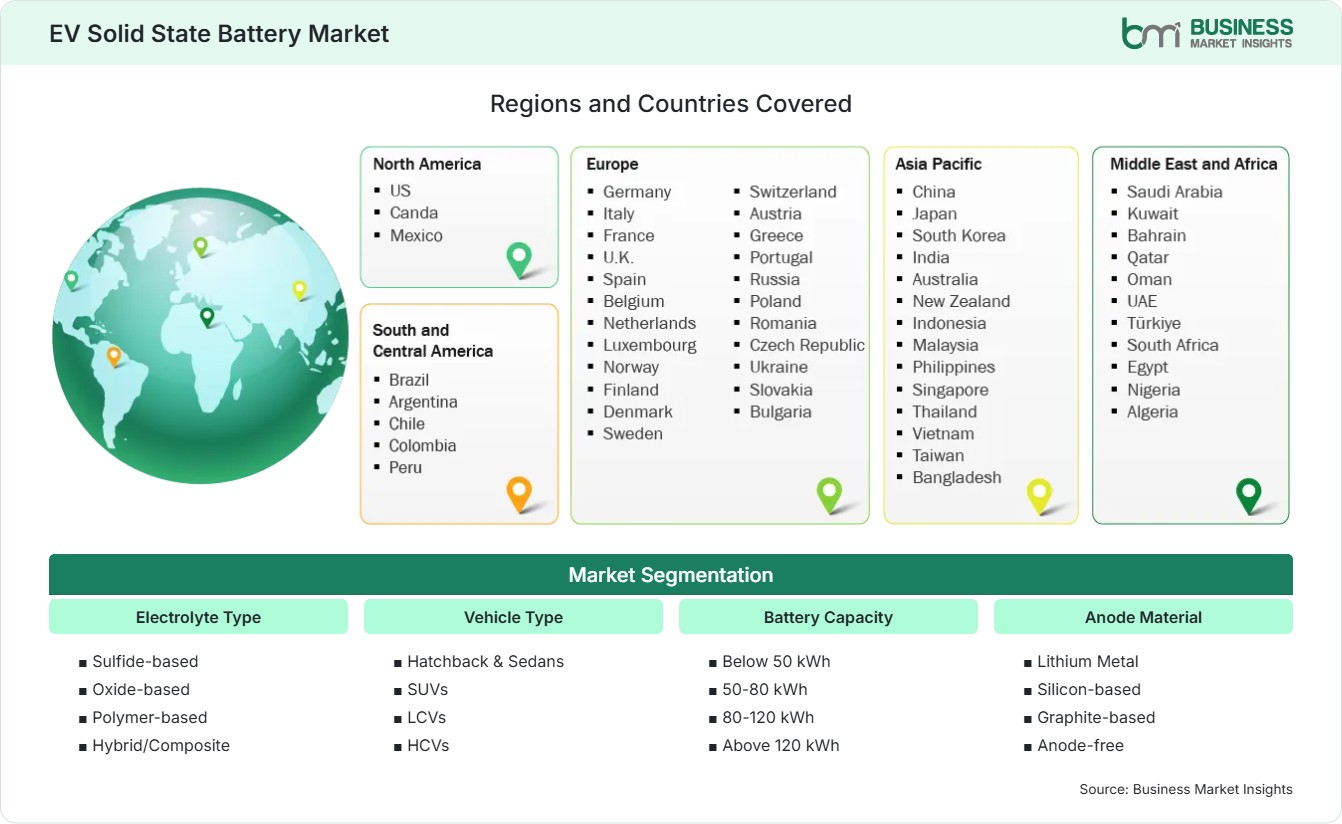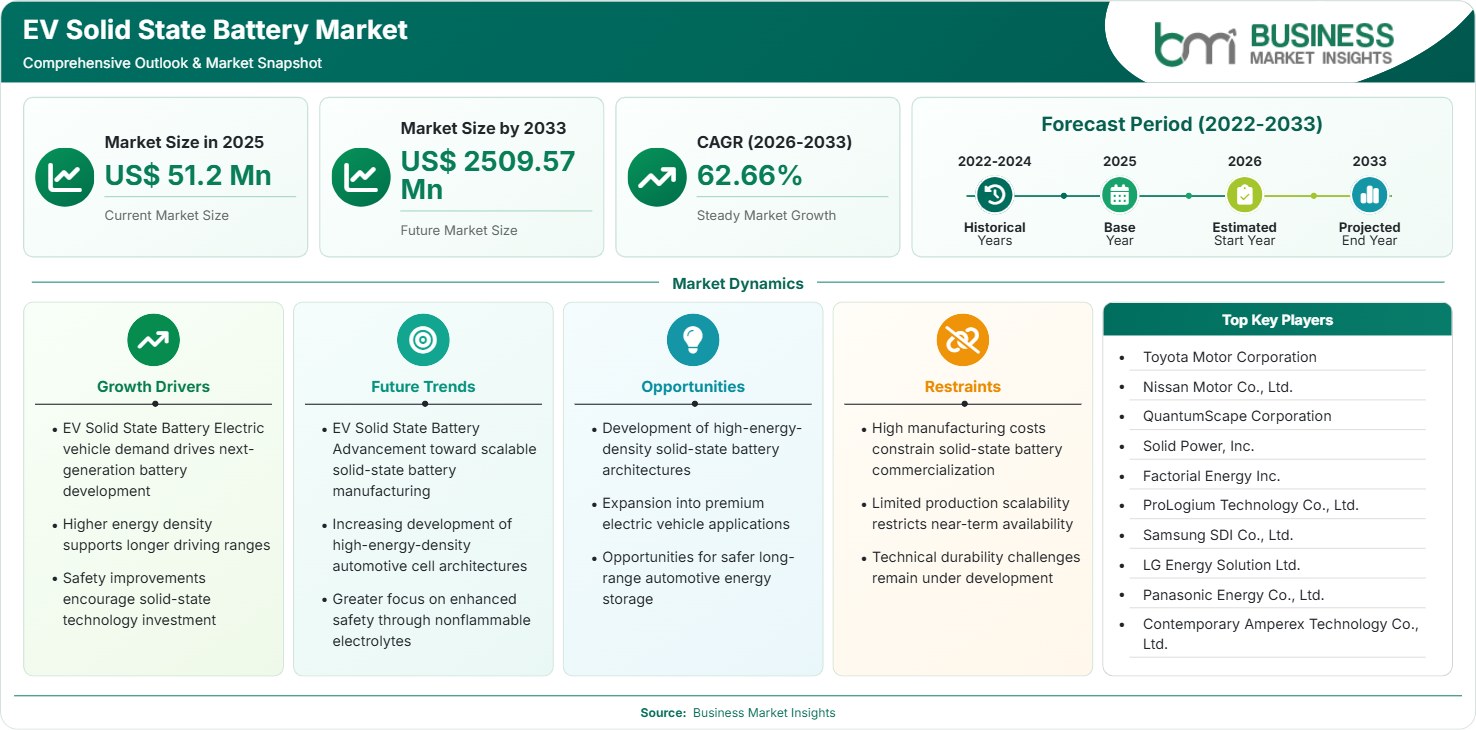
EV Solid State Battery Market Regional Highlights
North America EV Solid State Battery Market
The North America market represents a modeled 18%–22% share in 2025 and a 59%–64% CAGR during 2026–2033. The region benefits from automotive engineering depth, venture-backed battery developers, domestic manufacturing incentives, and increasing localization of strategic battery supply chains. The EV Solid State Battery Market share is supported primarily by the United States, while Canada contributes through battery-material and vehicle manufacturing investments.
- Advanced manufacturing equipment, solid electrolytes, pilot lines, and qualification services are now in demand throughout the emerging ecosystem as US automobile manufacturers and battery developers place a priority on domestic production.
- Initiatives relating to manufacturing at the federal and state levels are promoting local battery capacity, decreasing reliance on overseas supply chains, and thus improving the investment appeal of domestic solid-state development programs.
- Premium manufacturers of electric vehicles are currently testing solid-state technology, even though the cells cost more initially because of the greater range, quicker charging, improved safety, and the overall different performance of the vehicles.
- Technology companies are now entering into partnerships with car manufacturers to lower the risks involved in commercialization by testing the cells under conditions typical of use in automobiles rather than depending entirely on figures obtained in laboratory tests.
US EV Solid State Battery Market
The US EV Solid State Battery Market accounts for a modeled 72%–78% share of North American demand in 2025 and is projected to grow at 58%–63% CAGR during 2026–2033. Domestic development is supported by technology companies, established automakers, battery manufacturers, and government-backed localization initiatives.
- QuantumScape and Factorial Energy are important domestic development platforms, and automotive partnerships offer routes to real-world validation and eventual commercial deployment.
- Investment in the manufacture of domestic batteries strengthens the ecosystem that supports the availability of materials, equipment, testing, quality control, and recycling, and thus reduces the obstacles to future solid-state production.
- Because customers are willing to take on the higher battery costs during the early stages in return for greater range and charging advantages, premium and performance electric vehicle programs offer a viable route for commercialization.
Europe EV Solid State Battery Market
Europe EV Solid State Battery Market holds a modeled 16%–20% share in 2025 and is projected to expand at 57%–62% CAGR during 2026–2033. Germany and France are leading markets, while the United Kingdom and Italy offer additional technology and vehicle opportunities.
- Germany has a dense network of original equipment manufacturers and partnerships that link car makers with leading battery developers, thus speeding up the testing of next-generation cells.
- France is becoming a center for manufacturing and research and development, with ProLogium working on its strategy for expanding in Europe and intending to set up a facility of gigawatt scale in Dunkirk.
- European car manufacturers are placing a greater emphasis on energy density, safety, and charging performance as the features that distinguish premium electric vehicles.
- It is still strategically important to localize batteries as manufacturers want greater control over supply, intellectual property, production quality, and compliance with regulations.
Asia Pacific EV Solid State Battery Market
Asia Pacific EV Solid State Battery Market holds a modeled 48%–53% share in 2025 and is projected to achieve 65%–70% CAGR during 2026–2033. China leads regional demand and manufacturing scale, while Japan and South Korea remain major technology centers.
- Because of its huge demand for electric vehicles and its extensive ability in the manufacture of batteries, China has the ideal conditions to carry out rapid pilot production, to develop its suppliers, and to commercialize its technology.
- Japan has strong research capabilities in the field of solid-state technology and expertise in automotive engineering, which is why it is important to the commercialization programs that focus on safety, durability, and the precision of manufacturing.
- Because South Korea has companies that are leaders in battery making, investments in all-solid-state technology, in pilot production, in the development of materials, and in customer validation programs.
- The fact that there is regional competition causes battery companies to reduce their development cycles and, at the same time, improve yield, material utilization, and compatibility with existing lithium-ion production assets.
Rest of World EV Solid State Battery Market
Rest of World EV Solid State Battery Market represents a modeled 9%–13% share in 2025 and a 55%–61% CAGR during 2026–2033. Latin America is developing through rising EV adoption and increasing vehicle imports, while the Middle East and Africa markets remain earlier-stage but offer long-term premium mobility opportunities
- Brazil offers one of the region's best opportunities for the growth of EV sales, due to a wider range of models becoming available, increased investment in charging infrastructure, and rising consumer awareness of the cost advantages of operating such vehicles.
- Since premium vehicles in the Middle East have higher prices, they can quickly adopt new battery technologies because this allows for a greater tolerance of the costs associated with emerging technologies.
- The trade routes that are linked to the southeast, together with Chinese exports of vehicles, can help increase awareness of solid-state technology in developing markets as the availability of electric vehicles expands.
- The rate at which advanced battery technologies move beyond their use in premium vehicles will depend on local assembly, the charging infrastructure, and the electrification of the fleet.