
Ethernet Storage Market Outlook: Size, Share, Trends, Growth Analysis, Competitive Landscape & Forecast, 2026-2033

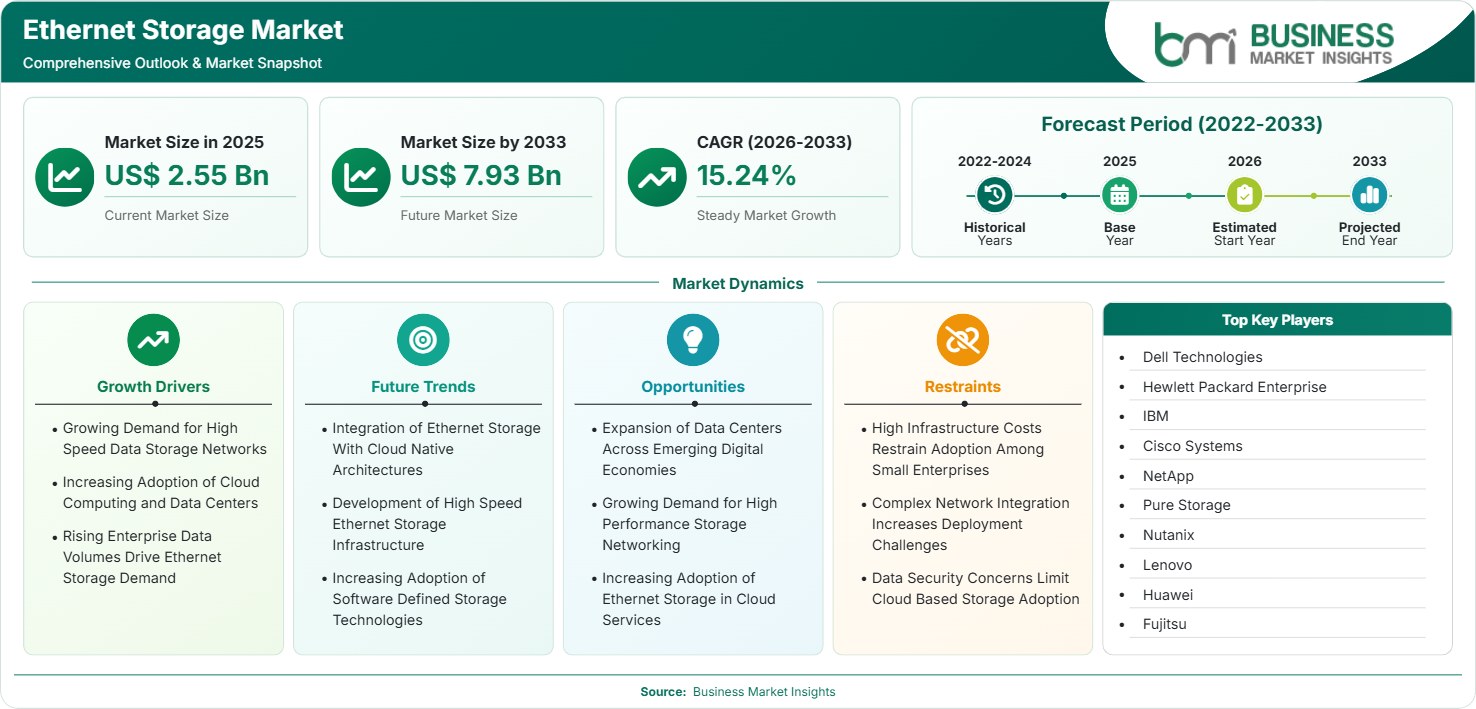
The Ethernet Storage Market size was valued at US$ 2.55 billion in 2025 and is projected to reach US$ 7.93 billion by 2033, growing at a CAGR of 15.24% during 2026–2033, driven by rising enterprise data volumes, cloud infrastructure expansion, high-speed networking requirements, and increasing demand for scalable storage connectivity.

Report Coverage
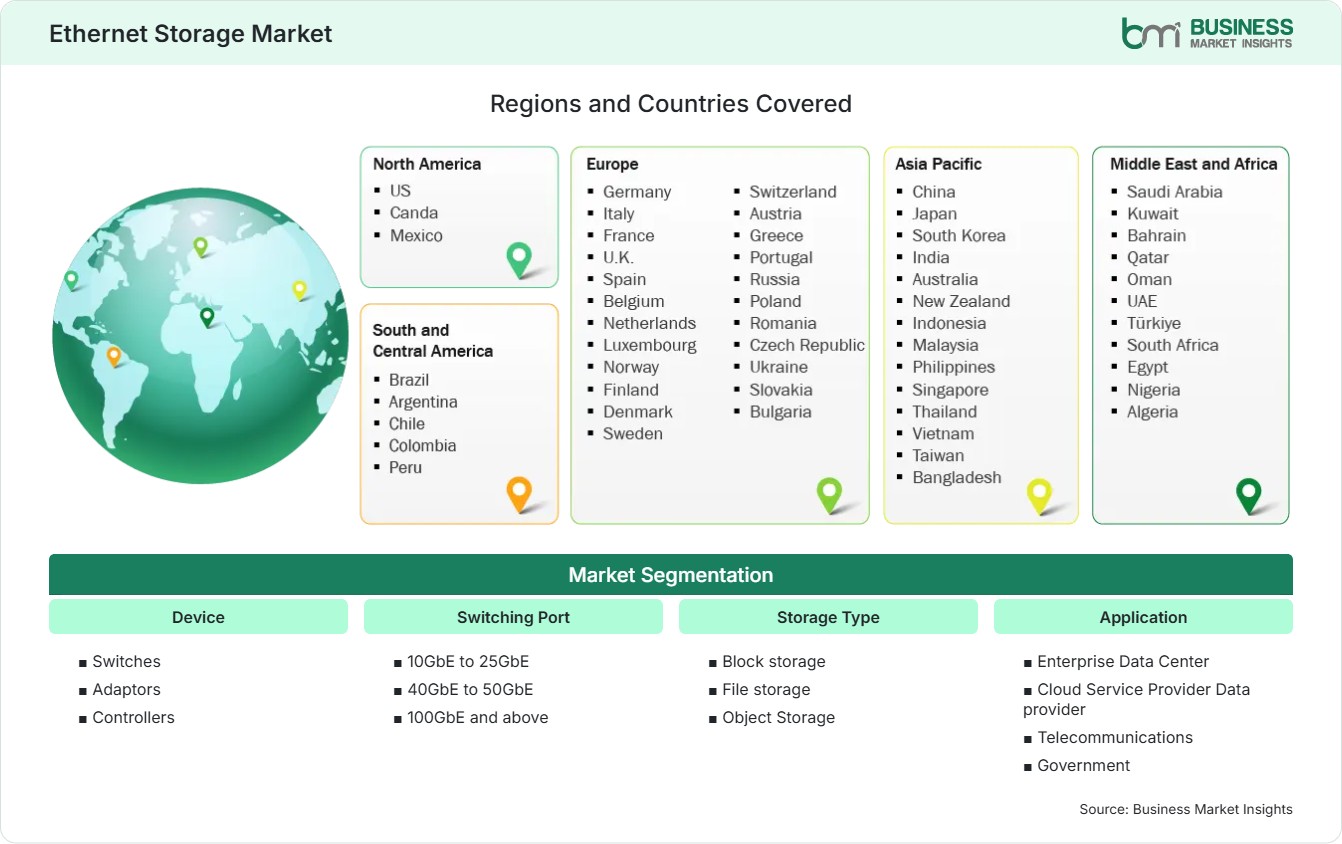
  • Device: Switches, Adaptors, Controllers
  • Switching Port: 10GbE to 25GbE, 40GbE to 50GbE, 100GbE and above
  • Storage Type: Block storage, File storage, Object Storage
  • Application: Enterprise Data Center, Cloud Service Provider Data provider, Telecommunications, Government
US$ 2.55 Bn Market size in 2025
US$ 7.93 Bn Market Size by 2033
15.24% CAGR, 2026 - 2033
2026-2033 Forecast Period

AI Overview

Ethernet Storage Market Summary

  • North America Region: North America , 38%–42% share (2025) , 14.5%–15.5% CAGR (2026–2033) , Strong cloud infrastructure, hyperscale data centers, enterprise digitization, and high-speed networking investments support adoption, while AI workloads create opportunities for higher-bandwidth storage architectures.
  • Fastest Growing Region: Asia Pacific , 17.0%–18.5% CAGR (2026–2033) , Data center expansion, cloud adoption, digital transformation, AI infrastructure, and increasing enterprise data generation create strong opportunities for Ethernet-connected storage deployments.
  • Leading Segment: Enterprise Data Center , 34%–38% share (2025) , 14.8%–15.8% CAGR (2026–2033) , Enterprise modernization, virtualization, AI workloads, and growing storage requirements encourage adoption of high-performance Ethernet infrastructure across private and hybrid data centers.
  • High Growth Segment: 100GbE and above , 18.0%–20.0% CAGR (2026–2033) , AI clusters, high-performance computing, cloud workloads, and bandwidth-intensive applications create demand for faster Ethernet connectivity and lower-latency storage networking architectures.
  • Key Market Opportunity: Data center modernization, cloud-native infrastructure, AI workloads, and emerging digital economies are creating opportunities for high-speed Ethernet storage architectures that offer scalability, interoperability, simplified deployment, and efficient resource utilization.
  • Major Market Players: Dell Technologies, Hewlett Packard Enterprise, IBM, Cisco Systems, NetApp, Pure Storage, Nutanix, Lenovo, Huawei, Fujitsu
Strategic Insights

Ethernet Storage Market: Strategic Insights

Ethernet Storage Market Strategic Framework
FREE PDF
Request your free sample
Request free sample
Stakeholder View

Key Takeaways

  • The Ethernet Storage Market ecosystem spans Ethernet switch manufacturers, storage system vendors, network adapter suppliers, controllers, data center operators, cloud providers, and enterprise IT teams, creating opportunities for integrated infrastructure offerings.
  • Enterprise data centers and cloud service providers represent important demand centers as organizations consolidate infrastructure, modernize storage architectures, and require scalable connectivity for increasingly distributed workloads.
  • Higher-speed Ethernet, software-defined networking, disaggregated infrastructure, and improved network management are reshaping storage architectures and enabling more flexible allocation of compute and storage resources.
  • Asia Pacific offers compelling expansion potential as cloud adoption, data center construction, digital transformation, and AI infrastructure investment accelerate across major technology markets.
  • Strategic investment is increasingly focused on data center infrastructure, networking technologies, storage platforms, and integrated solutions capable of supporting demanding enterprise and cloud workloads.
  • Interoperability and deployment simplicity are becoming important competitive differentiators as enterprises seek to integrate Ethernet storage into existing infrastructure without creating unnecessary operational complexity.
Geographic Outlook

Ethernet Storage Market Regional Highlights

North America Ethernet Storage Market

North America holds a 38%–42% share in 2025 and is projected to grow at a 14.5%–15.5% CAGR through 2033. The Ethernet Storage Market share reflects strong enterprise IT spending, mature cloud infrastructure, and extensive data center capacity. Demand is supported by AI infrastructure development, virtualization, and modernization of legacy storage environments. The US remains the primary contributor, while Canada provides additional opportunities through cloud adoption and data center development.

  • Enterprise modernization is supporting replacement of legacy storage architectures with scalable Ethernet-connected infrastructure capable of supporting distributed applications and demanding workloads.
  • Cloud providers continue investing in high-performance infrastructure, creating opportunities for Ethernet storage technologies that can support flexible resource allocation and efficient data movement.
  • AI and analytics workloads are encouraging enterprises to reconsider network architectures as storage systems must deliver higher throughput and predictable performance.
  • Strong vendor presence enables organizations to access integrated networking, storage, and infrastructure solutions, supporting adoption across large enterprises and data center operators.

US Ethernet Storage Market

The US represents approximately 34%–38% of global market value in 2025 and is projected to expand at a 14.7%–15.7% CAGR through 2033. The Ethernet Storage Market benefits from advanced cloud adoption, extensive enterprise data center infrastructure, and strong investment in AI computing. Hyperscale operators and technology-intensive enterprises are increasing demand for high-speed connectivity between compute and storage resources. The country's established technology ecosystem also supports innovation in Ethernet networking, storage systems, and software-defined infrastructure.

  • Hyperscale data center development is increasing demand for networking architectures capable of connecting large-scale compute and storage environments efficiently.
  • Enterprise adoption of AI and advanced analytics is encouraging investment in infrastructure designed to manage high-performance workloads and expanding data requirements.
  • Cloud-native application development is supporting demand for flexible storage networking that can scale with changing workload requirements.

Europe Ethernet Storage Market

Europe accounts for a 24%–28% share in 2025 and is expected to record a 13.8%–14.8% CAGR through 2033. Germany, the UK, and France are leading contributors due to established enterprise technology infrastructure and data center activity. The Netherlands and Ireland also provide important opportunities because of their data center ecosystems and cloud connectivity. Data sovereignty requirements, digital transformation, and demand for efficient infrastructure are encouraging organizations to modernize storage environments and adopt scalable networking architectures.

  • Germany's industrial digitization and enterprise modernization initiatives support demand for storage infrastructure capable of managing increasingly connected operational environments.
  • The UK benefits from strong cloud adoption and established data center infrastructure, supporting continued investment in high-performance networking and storage technologies.
  • France offers opportunities through enterprise digital transformation and growing demand for infrastructure that supports cloud applications and data-intensive workloads.
  • Ireland and the Netherlands remain important data center markets, creating opportunities for Ethernet storage deployments associated with cloud and digital infrastructure.

Asia Pacific Ethernet Storage Market

Asia Pacific represents a 20%–24% share in 2025 and is projected to grow at a 17.0%–18.5% CAGR through 2033. China, Japan, South Korea, and Australia are major contributors, while India and Southeast Asia offer strong expansion opportunities. Cloud adoption, digital transformation, AI infrastructure, and data center construction are increasing demand for scalable storage networking. Regional growth is supported by rising enterprise data volumes and continued investments in telecommunications and digital services.

  • China's expanding cloud ecosystem and data center infrastructure support demand for high-speed networking technologies across enterprise and service-provider environments.
  • India's digital transformation is generating substantial data growth, creating opportunities for scalable storage infrastructure as organizations modernize IT environments.
  • Japan and South Korea benefit from advanced technology ecosystems and strong demand for infrastructure supporting AI, analytics, telecommunications, and enterprise applications.
  • Southeast Asian markets offer expansion opportunities as cloud providers and technology companies establish additional data center capacity to serve rapidly digitizing economies.

Rest of World Ethernet Storage Market

South and Central America account for an estimated 7%–10% share in 2025, while the Middle East and Africa contribute approximately 5%–8%. Combined growth is projected at a 13.5%–15.5% CAGR through 2033. Brazil and Mexico lead Latin American demand, while Saudi Arabia, the UAE, and South Africa represent important opportunities. Data center expansion, cloud migration, telecommunications modernization, and government digitization are supporting infrastructure investment.

The Ethernet Storage Market growth outlook across these regions depends on data center availability, enterprise technology spending, cloud adoption, and network modernization. Gulf economies are investing heavily in digital infrastructure, while Latin American organizations increasingly adopt cloud-based services. Africa presents longer-term opportunities as connectivity improves and digital services expand.

  • Brazil's expanding digital economy and cloud adoption are creating demand for modern storage infrastructure across enterprises, financial services, telecommunications, and public-sector organizations.
  • Mexico benefits from growing data center activity and cloud adoption, supported by increasing enterprise digitization and proximity to major technology markets.
  • Saudi Arabia and the UAE are investing in advanced digital infrastructure, creating opportunities for high-performance storage networking within expanding cloud and data center ecosystems.
  • South Africa provides a regional technology hub for data center and cloud services, supporting opportunities for Ethernet storage adoption as enterprise infrastructure modernizes.
Global Market Geography
FREE PDF
Request your free sample
Request free sample
Segment Analysis

Ethernet Storage Market Segmentation

Device

The Device segment is projected to expand at a 14.5%–16.0% CAGR through 2033 as enterprises and service providers modernize networking infrastructure. Switches, adaptors, and controllers each support different layers of storage connectivity. The Ethernet Storage Market scope is influenced by demand for higher throughput, improved interoperability, and scalable infrastructure capable of supporting cloud, AI, and enterprise workloads.

  • Switches: Ethernet switches provide the connectivity foundation for storage networks, supporting data movement between servers, storage systems, and network infrastructure across enterprise and cloud environments.
  • Adaptors: Ethernet adaptors connect servers and storage platforms to network infrastructure, supporting higher throughput, workload optimization, and efficient communication across modern data center environments.
  • Controllers: Controllers manage storage connectivity and data operations, helping improve performance, reliability, resource allocation, and integration across enterprise storage architectures.

Switching Port

The Switching Port segment is projected to grow at a 15.0%–17.0% CAGR through 2033 as data-intensive workloads increase bandwidth requirements. Higher-speed Ethernet is becoming more relevant for AI, analytics, cloud, and high-performance computing. The Endometriosis Treatment Market scope rule does not apply here; Ethernet Storage Market adoption is shaped by throughput, latency, scalability, and infrastructure modernization requirements.

  • 10GbE to 25GbE: These port speeds remain relevant for enterprise environments requiring improved connectivity for virtualization, cloud applications, and storage workloads without immediate migration to higher-speed infrastructure.
  • 40GbE to 50GbE: These technologies support intermediate high-performance requirements and provide connectivity options for organizations modernizing infrastructure while balancing performance and deployment costs.
  • 100GbE and above: High-speed ports support bandwidth-intensive environments such as AI, analytics, high-performance computing, and large-scale cloud infrastructure requiring rapid data movement.

Storage Type

The Storage Type segment is expected to grow at a 14.5%–16.0% CAGR through 2033 as organizations manage diverse data formats and application requirements. Block, file, and object storage each address distinct use cases. Ethernet Storage Market trends increasingly favor flexible infrastructure that can support multiple storage models across hybrid cloud, private data center, and service-provider environments.

  • Block storage: Block storage supports performance-sensitive enterprise applications and virtualized workloads requiring predictable access, low latency, and flexible allocation of storage resources.
  • File storage: File storage enables shared access to structured data and supports collaboration, content management, enterprise applications, and workloads requiring familiar file-based data organization.
  • Object Storage: Object storage supports large-scale unstructured data, cloud-native applications, backups, archives, and analytics workloads requiring scalable capacity and metadata-rich data management.

Application

The Application segment is projected to expand at a 14.8%–16.5% CAGR through 2033 as data-intensive workloads spread across enterprise, cloud, telecommunications, and public-sector environments. Each application category has distinct performance and scalability requirements. Ethernet storage adoption is increasingly linked to infrastructure modernization, workload consolidation, and the need for efficient data movement across distributed computing environments.

  • Enterprise Data Center: Enterprise data centers adopt Ethernet storage to modernize infrastructure, support virtualization, manage growing data volumes, and improve connectivity between compute and storage resources.
  • Cloud Service Provider Data provider: Cloud service providers require scalable storage networking to support multi-tenant workloads, distributed applications, rapid resource allocation, and expanding customer data requirements.
  • Telecommunications: Telecommunications operators use high-performance storage infrastructure to support network operations, edge computing, digital services, analytics, and increasingly distributed workloads.
  • Government: Government organizations require reliable storage networking for public services, secure data management, digital transformation, and large-scale information processing across centralized and distributed infrastructure.
Market Forces

Ethernet Storage Market Dynamics

Key Market Drivers

Growing Demand for High Speed Data Storage Networks

The growing size and sophistication of enterprise workloads are driving the need for faster interconnects between storage and compute assets. Existing infrastructure may struggle with performance issues when enterprises run AI applications, sophisticated analytics, virtualization, and distributed computing workloads. Ethernet-based storage networking offers enterprises the benefit of existing infrastructure architecture with the ability to boost bandwidth and optimize the use of resources. In light of the focus on application responsiveness and operational efficiency, there is a rising trend towards storage networking that offers higher speeds. This is motivating vendors to develop new offerings in this domain.

Increasing Adoption of Cloud Computing and Data Centers

With cloud migration and expansion of the data center, the demand for storage infrastructure that will scale along with the changing workload is on the rise. Cloud needs scalability through flexible interconnections for computing, storage, and networking resources, especially as applications become increasingly distributed. The Ethernet network technology, with its extensive implementation base, has the capability to serve these environments in addition to providing interoperability with the legacy systems. The data centers are embracing architectures that focus on resource pooling, virtualization, automation, and software-driven management. In this environment, as enterprises move their workloads from private data centers to cloud infrastructures, the storage networking should support flexible deployment and consistent performance.

Rising Enterprise Data Volumes Drive Ethernet Storage Demand

Organizations are collecting increasingly diverse information through application software, device connectivity, e-transactions, analysis, and automation processes. Managing such a variety of data will require a scalable infrastructure for storing it, but without technology isolation within the organization. Using the Ethernet-based approach, an organization can interconnect storage resources via scalable networks and use centralized and distributed workloads. Enterprises are thus analyzing infrastructure in terms of its capability to support future workloads rather than only the current demands.

Key Market Opportunities

Expansion of Data Centers Across Emerging Digital Economies

The development of data centers in emerging digital economies is opening new opportunities for Ethernet storage vendors. Businesses in these markets are increasingly adopting cloud applications, digital platforms, and data-intensive services, creating demand for modern infrastructure. New data centers often provide an opportunity to deploy advanced networking architectures without the constraints associated with legacy environments. Vendors can benefit by offering integrated solutions that combine storage, switching, management, and security capabilities. Partnerships with cloud providers, telecommunications companies, and local infrastructure operators can further accelerate adoption. Markets with expanding digital economies may also benefit from solutions that emphasize scalability and operational simplicity, supporting a positive Ethernet Storage Market forecast as digital infrastructure investments continue to expand.

Growing Demand for High Performance Storage Networking

High-performance computing, artificial Intelligence, analytics, and demanding enterprise applications are driving the need for efficient compute-storage communications. This represents an opportunity for vendors who can provide networking technology tuned for high throughput, low latency, and workload scalability. faster ethernet technologies can enable infrastructure upgrades while remaining compatible with existing networking architectures. Vendors of storage products can also add value through software that is optimized, automated, and monitored. As workloads become more complex, there will be a growing preference for infrastructure that can allocate resources dynamically.

Increasing Adoption of Ethernet Storage in Cloud Services

Cloud service providers represent an important opportunity because their infrastructure must support diverse workloads while maintaining flexibility and operational efficiency. Ethernet storage can facilitate scalable architectures where storage and compute resources are connected through high-performance network infrastructure. Cloud providers can also use Ethernet-based approaches to support infrastructure disaggregation, resource pooling, and workload mobility. The growth of hybrid and multi-cloud environments further increases the importance of interoperable networking and storage technologies. Vendors that develop solutions compatible with cloud-native architectures can strengthen their position through partnerships and infrastructure integrations.

Market Restraints and Challenges

High Infrastructure Costs Restrain Adoption Among Small Enterprises

Factor: Deploying modern Ethernet storage infrastructure can require investment in switches, adaptors, controllers, cabling, storage systems, software, and specialized implementation expertise. Impact: Smaller enterprises may delay adoption when available budgets are directed toward more immediate technology priorities. The total cost of modernization can also increase when organizations need to upgrade multiple infrastructure components simultaneously. Businesses with modest workloads may not perceive sufficient benefits to justify replacing existing systems, particularly when legacy infrastructure remains operational. Vendors can address the challenge through modular solutions, managed services, flexible financing, and simplified deployment models that reduce upfront capital requirements and make modern infrastructure more accessible.

Complex Network Integration Increases Deployment Challenges

Factor: Integrating Ethernet storage into existing data center environments can involve complex interactions between networking, storage, virtualization, security, and application infrastructure. Impact: Deployment complexity may extend implementation timelines, increase configuration requirements, and create operational risks for organizations with limited specialized expertise. Compatibility considerations can become particularly important when enterprises operate infrastructure from multiple vendors or maintain legacy systems alongside newer architectures. Successful deployment may require careful architecture planning, testing, monitoring, and ongoing optimization. Vendors that provide validated architectures, automation tools, centralized management, and professional services can reduce integration challenges and improve customer confidence in large-scale Ethernet storage deployments.

Company Analysis

Competitive Landscape

The Ethernet Storage Market analysis indicates a competitive environment spanning enterprise infrastructure, networking, storage systems, cloud platforms, and data center technologies. Leading participants are strengthening their positions through integrated offerings, high-speed networking capabilities, software-defined infrastructure, and solutions designed for AI and cloud workloads.

Company Name

Overview

Products and Services relevant to this market

Dell Technologies

Global technology infrastructure provider serving enterprises, cloud operators, and data centers.

PowerEdge servers, PowerSwitch networking, PowerStore storage, and infrastructure solutions supporting Ethernet-connected environments.

Hewlett Packard Enterprise

Enterprise technology company providing servers, networking, storage, and hybrid cloud infrastructure.

HPE Alletra storage, Aruba networking, ProLiant servers, and data center infrastructure supporting modern storage architectures.

IBM

Global technology company with extensive enterprise infrastructure and hybrid cloud capabilities.

IBM FlashSystem, IBM Storage solutions, networking integrations, and hybrid cloud infrastructure for enterprise workloads.

Cisco Systems

Major networking technology provider with extensive data center networking capabilities.

Nexus data center switches, Ethernet networking, infrastructure management, and connectivity technologies supporting storage environments.

NetApp

Data infrastructure company specializing in enterprise storage and hybrid cloud solutions.

ONTAP, AFF, FAS, and cloud storage solutions supporting Ethernet-connected enterprise and hybrid cloud environments.

Pure Storage

Data storage technology company focused on modern all-flash and cloud storage platforms.

FlashArray, FlashBlade, Evergreen architecture, and storage management solutions designed for high-performance environments.

Nutanix

Enterprise cloud software and infrastructure company focused on hybrid multicloud environments.

Nutanix Cloud Infrastructure, storage services, virtualization, and software-defined infrastructure supporting distributed workloads.

Lenovo

Global technology company providing enterprise servers, storage, networking, and data center solutions.

ThinkSystem servers, storage systems, networking infrastructure, and integrated solutions for enterprise data centers.

Huawei

Global technology provider offering enterprise computing, storage, networking, and data center infrastructure.

OceanStor storage, CloudEngine switches, networking solutions, and data center infrastructure supporting high-performance workloads.

Fujitsu

Global technology company providing enterprise IT infrastructure and data center solutions.

ETERNUS storage, PRIMERGY servers, networking capabilities, and integrated infrastructure services for enterprise environments.

Trust & Transparency

Research Methodology

The market analysis combines proprietary research with secondary data from government agencies, company disclosures, regulatory filings, industry databases and expert interviews. Market estimates are validated through data triangulation, cross-market benchmarking and analyst review.

View Full Research Methodology

Questions Answered

Frequently Asked Questions

How can emerging economies create new opportunities?

Emerging economies are expanding cloud services, digital platforms, telecommunications infrastructure, and data centers. These developments create opportunities to deploy modern storage networking architectures as organizations build or modernize infrastructure.

What is limiting adoption among smaller enterprises?

High infrastructure costs, integration complexity, specialized expertise requirements, and the need to upgrade multiple components can discourage smaller enterprises from investing in advanced Ethernet storage infrastructure.

Why is high-speed Ethernet important for storage?

High-speed Ethernet enables efficient data movement between storage and compute resources, helping organizations address performance requirements associated with demanding applications, distributed workloads, analytics, and AI infrastructure.

Which application represents a major opportunity?

Enterprise data centers and cloud service providers represent major opportunities because they require scalable infrastructure capable of supporting virtualization, distributed applications, AI workloads, and rapidly changing storage requirements.

What factors are driving the Market?

According to Ethernet Storage Market report, the market is driven by increasing enterprise data volumes, cloud computing adoption, data center expansion, AI workloads, and the need for faster communication between compute and storage resources.

Access the Full Ethernet Storage Market Report

Get segment-level forecasts, regional estimates, competitive benchmarking, company profiles and downloadable Excel datasets.

Access the full Ethernet Storage Market Report
350 pages PDF & Excel | 2026-08-05