
Enteral Feeding Devices Market Outlook (2022-2033)

Historic Data: 2022 - 2024   |   Base Year: 2025   |   Forecast Period: 2026-2033
Report Content: Market Scope, Market Segmentation, Market Dynamics, and Competitive Analysis

Report Coverage:
  • Product (Giving Sets, Enteral Feeding Pumps, Enteral Feeding tubes, Enteral Feeding Bags, Percutaneous Endoscopic Gastrostomy Device, Low Profile Gastrostomy Device, Other Products)
  • Age Group (Adults, Pediatrics)
  • Indication (Alzheimer
  • End User (Hospitals, Home Care)

No. of Pages: 400
Report Code: BMIPUB00032659
Category: Life Sciences
Enteral Feeding Devices Market
Buy Now

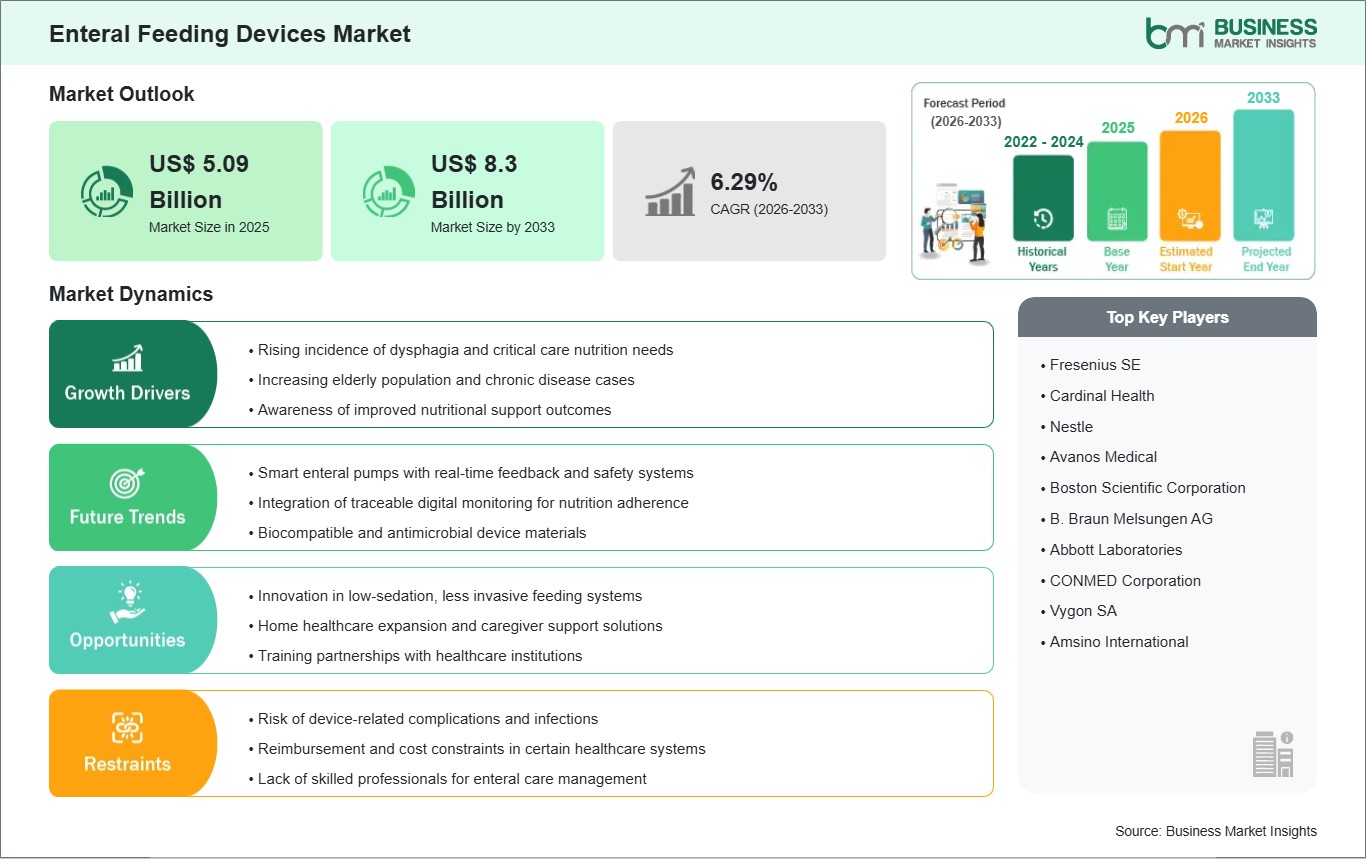
The Enteral Feeding Devices Market size is expected to reach US$ 8.30 billion by 2033 from US$ 5.09 billion in 2025. The market is estimated to record a CAGR of 6.29% from 2026 to 2033.

Executive Summary and Global Market Analysis:

Enteral feeding devices are medical devices that are capable of delivering nutrition directly into the gastrointestinal tract. These devices are used for patients who are unable to consume food orally due to various reasons such as diseases, surgeries, or swallowing disorders. Feeding tubes (nasogastric, gastrostomy), enteral feeding pumps, giving sets, and related consumables are included in this category of devices. All of them are ensuring a safe and controlled nutrient delivery under medical supervision. The technology is essential for clinical nutrition, as it reduces the number of complications caused by inadequate oral intake and thus improves patient outcomes in hospitals, nursing homes, and home care settings.

The enteral feeding devices market across the globe is growing steadily, along with demographic factors such as an increase in the aging population and the rise in the occurrence of chronic diseases that include cancer, neurologic disorders, and gastrointestinal disorders, which all contribute to the inability to eat normally. Moreover, technological advancements—like smart pumps with real-time monitoring, portable designs, and enhanced safety features—are making devices more functional and patients more comfortable in all healthcare settings. Additionally, the trend of moving toward home healthcare is increasing, as the devices are becoming more user-friendly, integrating with telehealth services and thus, extending their market reach beyond traditional hospitals.

In terms of regions, North America has the largest market share owing to the presence of an advanced healthcare infrastructure and high adoption. On the other hand, the Asia Pacific is predicted to be the fastest-growing region owing to factors such as increasing healthcare investments and demographic changes. The competition in the market is characterized by the well-known medical device makers who are concentrating on the opening of new markets and the development of their products, as well as new applications in the areas of both clinical and home care needs in different parts of the world.

Enteral Feeding Devices Market - Strategic Insights:

global-market-strategic-framework
Get more information on this report

Enteral Feeding Devices Market Segmentation Analysis:

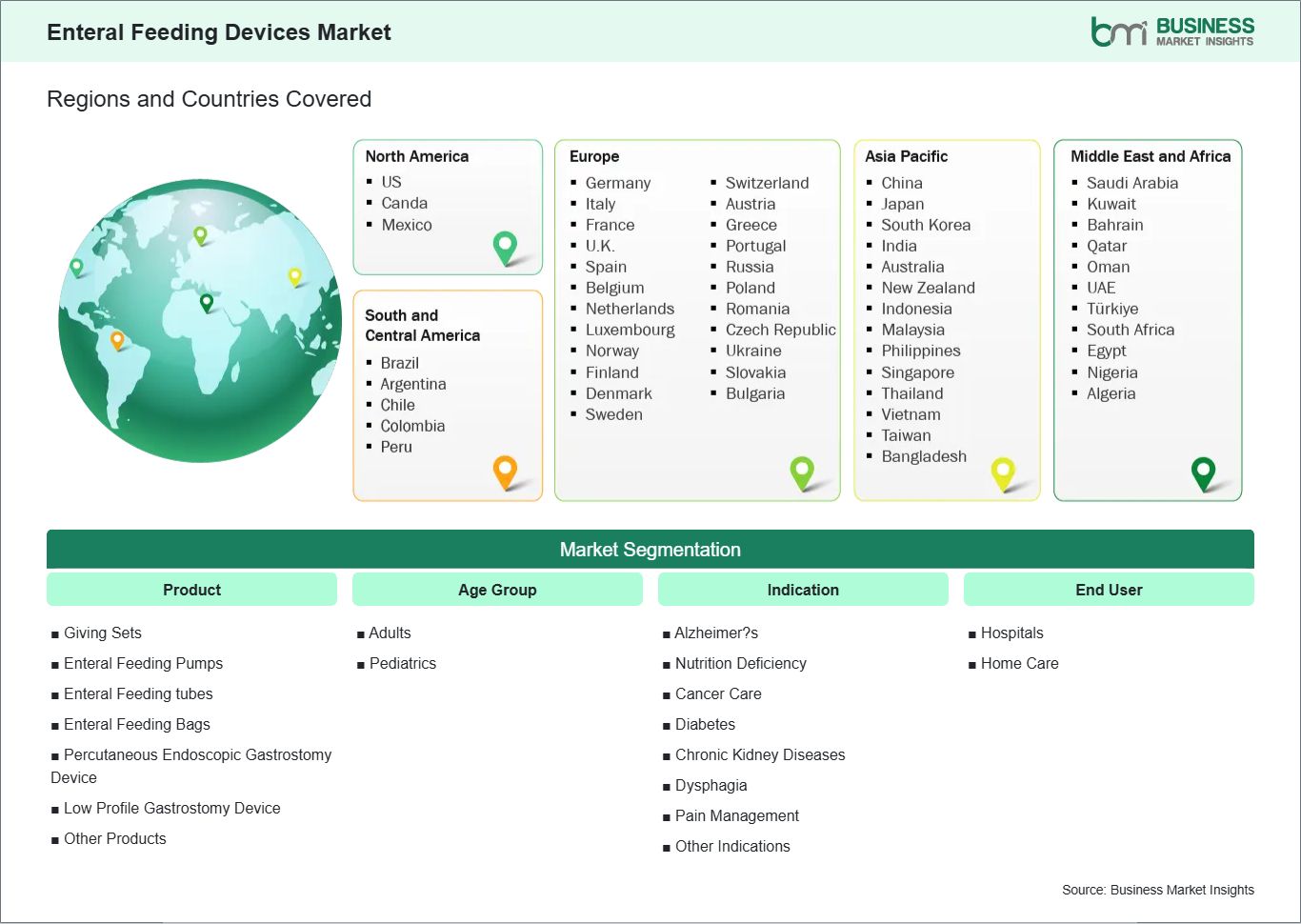
Key segments that contributed to the derivation of the enteral feeding devices market analysis are product, age group, indication, and end user.

  • By product, the enteral feeding devices market is categorized into giving sets, enteral feeding pumps, enteral feeding tubes, enteral feeding bags, percutaneous endoscopic gastrostomy device, low profile gastrostomy device, other products. The enteral feeding pumps segment held the largest share of the market in 2025.
  • By age group, the market is bifurcated into adults, pediatrics. The adults segment held a larger share of the market in 2025.
  • By indication, the market is segmented into Alzheimer’s, nutrition deficiency, cancer care, diabetes, chronic kidney diseases, dysphagia, pain management, other indications. The cancer care segment held the largest share of the market in 2025.
  • By end user, the enteral feeding devices market is segmented into hospitals, home care. The hospitals segment dominated the market in 2025.
Enteral Feeding Devices Market Drivers and Opportunities:

Rising Prevalence of Chronic Diseases and Aging Population

One of the main factors leading the growth of the enteral feeding devices market is the swiftly rising number of chronic diseases, along with the world's aging population, who need enteral nutrition support. Cancer, stroke, neurological disorders, and gastrointestinal diseases, among others, usually cause swallowing problems or poor oral intake, thus requiring feeding tubes and pumps for proper nutrition. As an example, the medical field has a great need for such patients who require supportive care and where enteral feeding helps to improve their conditions, and at the same time, they do not have to be dependent on riskier alternatives like parenteral nutrition. Moreover, the elderly are a very fast-growing population group; by the year 2050, there will be 2.1 billion people aged 60 and above worldwide, which will lead to a rise in the occurrence of swallowing problems and the need for a chronic disease diet that is assistive in the long term. The use of Enteral Feeding Devices is increasing in different healthcare settings, like hospitals, long-term care facilities, and home care, as a result of the demographic transition. Also, the improved technology of these devices is another factor that has made their design more user-friendly and, at the same time, comfortable for the patient.

Technological Innovation and Connected Devices

One of the main areas where the enteral feeding devices market can grow is through new technologies, particularly the addition of smart, connected features and portable solutions. The manufacturers are increasingly incorporating IoT-enabled sensors, real-time monitoring, and remote connectivity into feeding pumps and systems, and allowing clinicians and caregivers to track nutritional delivery, detect occlusions, and adjust feeding parameters from a distance. Smart devices can be connected to electronic health records (EHRs) or patient apps, which will help in the analysis of trends and personalized care—very important in home healthcare and telehealth models where clinical supervision is limited. For instance, the new smart pumps send feeding logs and alerts to caregivers, which improves adherence and safety outside traditional clinical settings. On top of this, innovation in small, wearable feeding pumps also allows for patient mobility and better quality of life, which in turn, attracts the market growth in outpatient and long-term home care. Such advances give a great advantage to the manufacturers that are focusing on the connected, data-driven solutions, as they will be able to capture the expanding demand in the value-based and remote healthcare delivery sectors.  

Enteral Feeding Devices Market Size and Share Analysis:

By product, the enteral feeding devices market is categorized into giving sets, enteral feeding pumps, enteral feeding tubes, enteral feeding bags, percutaneous endoscopic gastrostomy device, low profile gastrostomy device, other products. The enteral feeding pumps segment held the largest share of the market in 2025. Pumps consistently lead due to their precision in controlled nutrient delivery, advanced safety features (alarms, programmable flow), and widespread use across clinical and home care settings, making them essential for complex and long-term nutritional support.

By age group, the market is bifurcated into adults, pediatrics. The adults segment held a larger share of the market in 2025. The adult segment dominates because of the high prevalence of chronic conditions (e.g., cancer, neurological and gastrointestinal disorders) and an aging global population that frequently requires enteral nutrition, driving higher demand relative to pediatric usage.

By indication, the market is segmented into Alzheimer’s, nutrition deficiency, cancer care, diabetes, chronic kidney diseases, dysphagia, pain management, other indications. The cancer care segment held the largest share of the market in 2025. It is a leading indication, as cancer and its treatments often cause severe malnutrition, swallowing difficulties, and increased metabolic needs, making enteral feeding crucial for maintaining nutritional status and supporting treatment outcomes.

By end user, the enteral feeding devices market is segmented into hospitals, home care. The hospitals segment dominated the market in 2025. Hospitals hold the largest market share because they provide acute and critical care, where enteral feeding devices are frequently used under professional supervision for postoperative, ICU, and complex chronic care patients.

Enteral Feeding Devices Market Report Highlights:

Report Attribute Details
Market size in 2025 US$ 5.09 Billion
Market Size by 2033 US$ 8.3 Billion
Global CAGR (2026 - 2033)6.29%
Historical Data 2022 - 2024
Forecast period 2026-2033
Segments Covered By Product
  • Giving Sets
  • Enteral Feeding Pumps
  • Enteral Feeding tubes
  • Enteral Feeding Bags
  • Percutaneous Endoscopic Gastrostomy Device
  • Low Profile Gastrostomy Device
  • Other Products
By Age Group
  • Adults
  • Pediatrics
By Indication
  • Alzheimer
By End User
  • Hospitals
  • Home Care
Regions and Countries Covered North America
  • US
  • Canada
  • Mexico
Europe
  • Belgium
  • Austria
  • Finland
  • Denmark
  • Greece
  • Poland
  • Romania
  • Russia
  • Ukraine
  • Czech Republic
  • Slovakia
  • Bulgaria
  • Italy
  • Luxembourg
  • Germany
  • Switzerland
  • France
  • Netherlands
  • Norway
  • Portugal
  • Spain
  • Sweden
  • United Kingdom
Asia-Pacific
  • Australia
  • China
  • India
  • Japan
  • South Korea
  • Indonesia
  • Malaysia
  • Philippines
  • Singapore
  • Thailand
  • Vietnam
  • Bangladesh
  • New Zealand
  • Taiwan
South and Central America
  • Brazil
  • Argentina
  • Peru
  • Chile
  • Colombia
Middle East and Africa
  • Bahrain
  • Kuwait
  • Oman
  • Qatar
  • Saudi Arabia
  • United Arab Emirates
  • Turkiye
  • South Africa
  • Egypt
  • Algeria
  • Nigeria
Market leaders and key company profiles
  • Fresenius SE
  • Cardinal Health
  • Nestle
  • Avanos Medical
  • Boston Scientific Corporation
  • B. Braun Melsungen AG
  • Abbott Laboratories
  • CONMED Corporation
  • Vygon SA
Get more information on this report

Enteral Feeding Devices Market Report Coverage and Deliverables:

The " Enteral Feeding Devices Market Size and Forecast (2022–2033)" report provides a detailed analysis of the market covering below areas:

  • Enteral feeding devices market size and forecast at global, regional, and country levels for all the key market segments covered under the scope
  • Enteral feeding devices market trends, as well as market dynamics such as drivers, restraints, and key opportunities
  • Enteral feeding devices market analysis covering key market trends, global and regional framework, major players, regulations, and recent market developments
  • Industry landscape and competition analysis covering market concentration, heat map analysis, prominent players, and recent developments for the enteral feeding devices market
  • Detailed company profiles, including SWOT analysis

Enteral Feeding Devices Market Geographic Insights:

The geographical scope of the enteral feeding devices market report is divided into five regions: North America, Asia Pacific, Europe, Middle East & Africa, and South & Central America. The enteral feeding devices market in Asia Pacific is expected to grow significantly during the forecast period.

The Asia-Pacific enteral feeding devices market is segmented into China, Japan, South Korea, India, Australia, New Zealand, Indonesia, Malaysia, the Philippines, Singapore, Thailand, Vietnam, Taiwan, Bangladesh, and the Rest of Asia. The Asia-Pacific enteral feeding devices market is experiencing robust growth due to a mix of demographic, healthcare, and economic factors. The aging population in countries like China, Japan, and India is increasing the prevalence of chronic diseases like stroke, neurological disorders, cancer, and gastrointestinal diseases, where enteral feeding is the only option to support nutrition. This demographic condition is coupled with increasing healthcare budgets and developing medical facilities, which include more ICU beds and clinical nutrition protocols that promote early enteral nutrition in acute care settings. China is a major contributor to the regional demand due to its large population and greater acceptance of clinical practices.

Moreover, the rising accessibility and affordability of healthcare services, such as the local production of feeding tubes and pumps, are medical devices that help in the proliferation of the market to community hospitals and home care. Besides that, the rising knowledge of medical professionals about the advantages of enteral nutrition, together with the government health support policy, is gradually bringing about the wider use of the product in both the urban and rural areas, thereby making Asia-Pacific the fastest-growing market worldwide in this respect.

global-market-geography
Get more information on this report

Enteral Feeding Devices Market Research Report Guidance:

  • The report includes qualitative and quantitative data in the Enteral Feeding Devices Market across product, age group, indication, end user, and geography.
  • The report starts with the key takeaways (chapter 2), highlighting the key trends and outlook of the enteral feeding devices market.
  • Chapter 3 includes the research methodology of the study.
  • Chapter 4 further includes ecosystem analysis.
  • Chapter 5 highlights the major industry dynamics in the enteral feeding devices market, including factors that are driving the market, prevailing deterrents, potential opportunities, as well as future trends. Impact analysis of these drivers and restraints is also covered in this section.
  • Chapter 6 discusses the enteral feeding devices market scenario, in terms of historical market revenues, and forecast till the year 2031.
  • Chapters 7 to 11 cover Enteral Feeding Devices Market segments by product, age group, indication, end user, and geography across North America, Europe, Asia Pacific, Middle East and Africa, and South and Central America. They cover the market revenue forecast and factors driving the market.
  • Chapter 12 describes the competitive analysis along with the heat map analysis for the key players operating in the market.
  • Chapter 13 describes the industry landscape analysis. It provides detailed descriptions of business activities such as market initiatives, new developments, mergers, and joint ventures globally, along with a competitive landscape.
  • Chapter 14 provides detailed profiles of the major companies operating in the enteral feeding devices market. Companies have been profiled on the basis of their key facts, business descriptions, products and services, financial overview, SWOT analysis, and key developments.
  • Chapter 15, i.e., the appendix is inclusive of a brief overview of the company, list of abbreviations, and disclaimer.

Enteral Feeding Devices Market News and Key Development:

The enteral feeding devices market is evaluated by gathering qualitative and quantitative data post primary and secondary research, which includes important corporate publications, association data, and databases. A few of the key developments in the enteral feeding devices market are:

  • In September 2023, Cardinal Health announced the US launch of its Kangaroo OMNI Enteral Feeding Pump, designed to help provide enteral feeding patients with more options to meet their personalized needs throughout their enteral feeding journey. Kangaroo OMNI is the first and only attitude-independent enteral feeding system in the US designed to deliver thick, homogenized, and blended formulas.
  • In November 2025, Alcresta Therapeutics, Inc., a leading commercial-stage company focused on developing and commercializing novel enzyme-based products, announced that the US Food and Drug Administration (FDA) had cleared expanded use of RELiZORB to now include patients of all ages, including neonates and infants. RELiZORB is a digestive enzyme cartridge designed to mimic the function of pancreatic lipase to provide nutritional support for enterally-fed patients. To meet the feeding needs of neonates and infants, this expansion for RELiZORB also broadens its compatibility, allowing for use with both infant formulas and pasteurized human milk.

Key Sources Referred:

  • World Health Organization (WHO)
  • Centers for Disease Control and Prevention (CDC)
  • Institute for Health Metrics and Evaluation
  • OECD Health Statistics
  • World Development Indicators and Health Statistics
  • Company websites
  • Company annual reports
  • Company investor presentations

The List of Companies - Enteral Feeding Devices Market

  • Fresenius SE,
  • Cardinal Health,
  • Nestle,
  • Avanos Medical,
  • Boston Scientific Corporation,
  • B. Braun Melsungen AG,
  • Abbott Laboratories,
  • CONMED Corporation,
  • Vygon SA,
  • Amsino International
Frequently Asked Questions
How big is the Enteral Feeding Devices Market?

The Enteral Feeding Devices Market is valued at US$ 5.09 Billion in 2025, it is projected to reach US$ 8.3 Billion by 2033.

What is the CAGR for Enteral Feeding Devices Market by (2026 - 2033)?

As per our report Enteral Feeding Devices Market, the market size is valued at US$ 5.09 Billion in 2025, projecting it to reach US$ 8.3 Billion by 2033. This translates to a CAGR of approximately 6.29% during the forecast period.

What segments are covered in this report?

The Enteral Feeding Devices Market report typically cover these key segments-

  • Product (Giving Sets, Enteral Feeding Pumps, Enteral Feeding tubes, Enteral Feeding Bags, Percutaneous Endoscopic Gastrostomy Device, Low Profile Gastrostomy Device, Other Products)
  • Age Group (Adults, Pediatrics)
  • Indication (Alzheimer
  • End User (Hospitals, Home Care)

What is the historic period, base year, and forecast period taken for Enteral Feeding Devices Market?

The historic period, base year, and forecast period can vary slightly depending on the specific market research report. However, for the Enteral Feeding Devices Market report:

  • Historic Period : 2022 - 2024
  • Base Year : 2025
  • Forecast Period : 2026-2033
  • Who are the major players in Enteral Feeding Devices Market?

    The Enteral Feeding Devices Market is populated by several key players, each contributing to its growth and innovation. Some of the major players include:

  • Fresenius SE,
  • Cardinal Health,
  • Nestle,
  • Avanos Medical,
  • Boston Scientific Corporation,
  • B. Braun Melsungen AG,
  • Abbott Laboratories,
  • CONMED Corporation,
  • Vygon SA,
  • Amsino International
  • Who should buy this report?

    The Enteral Feeding Devices Market report is valuable for diverse stakeholders, including:

    • Investors: Provides insights for investment decisions pertaining to market growth, companies, or industry insights. Helps assess market attractiveness and potential returns.
    • Industry Players: Offers competitive intelligence, market sizing, and trend analysis to inform strategic planning, product development, and sales strategies.
    • Suppliers and Manufacturers: Helps understand market demand for components, materials, and services related to concerned industry.
    • Researchers and Consultants: Provides data and analysis for academic research, consulting projects, and market studies.
    • Financial Institutions: Helps assess risks and opportunities associated with financing or investing in the concerned market.

    Essentially, anyone involved in or considering involvement in the Enteral Feeding Devices Market value chain can benefit from the information contained in a comprehensive market report.

    Available Report Formats

    pdf-format excel-format pptx-format
    Buy Now

    Customization Form

    Please tell us your area of interest
    (Market Segments/ Regions and Countries/ Companies)