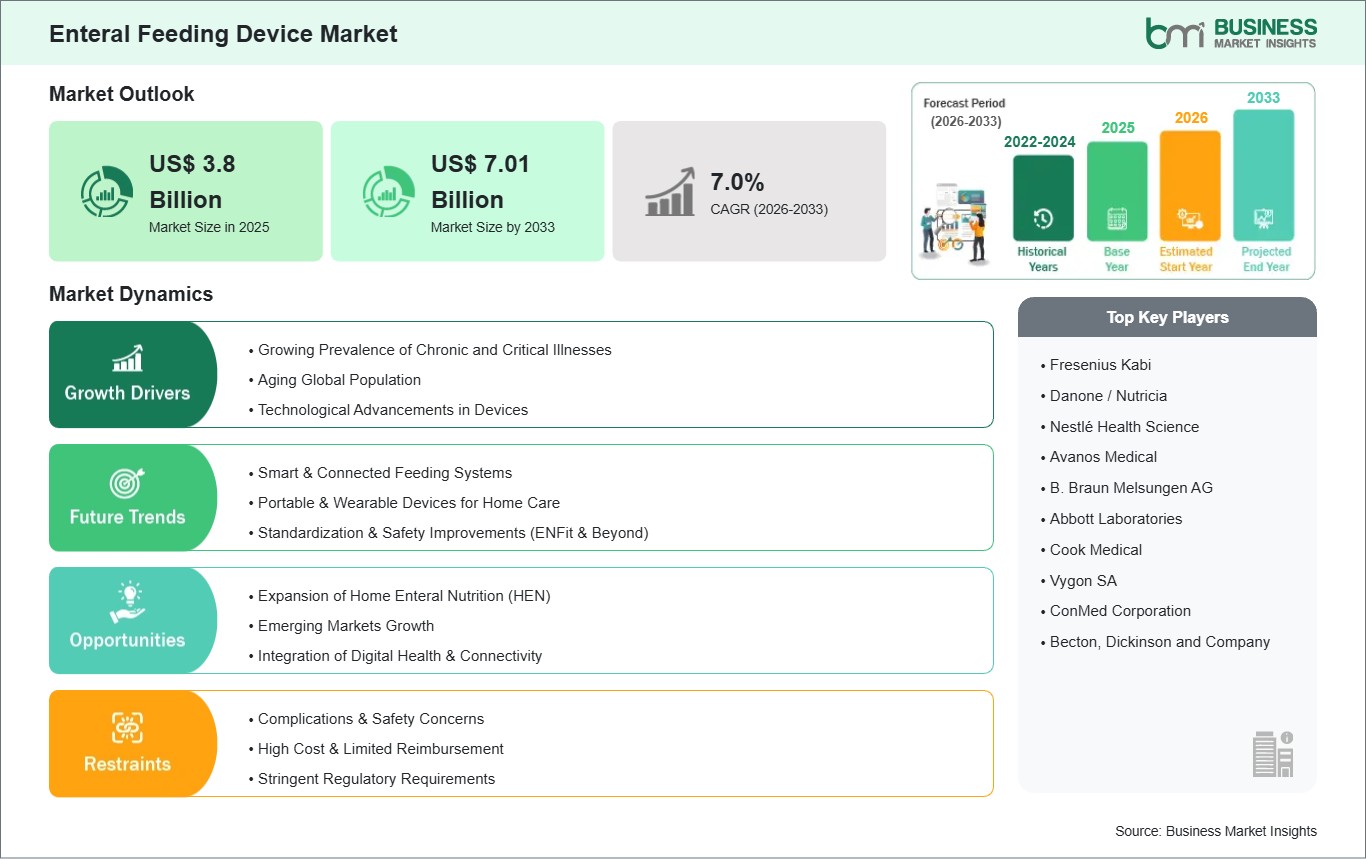
The Enteral Feeding Device Market size is expected to reach US$ 7.01 Billion in 2033 from US$ 3.8 Billion in 2025. The market is estimated to record a CAGR of 7.0% from 2026 to 2033.
The Global Enteral Feeding Device market (a subset of Medical Devices) continues to grow, mainly due to the increasing number of people with chronic diseases, neurological conditions, cancers, and gastrointestinal conditions that limit their ability to eat normally. Increased life expectancy and more critical care patients (including premature births) result in increased competition for an ever-increasing pool of long-term enteral nutrition options. Examples include advanced portable feeding pumps, new-generation low-profile tubes, and improved connector safety features (e.g., ENFit). While most of the market remains hospital-based, at-home care continues to expand rapidly due to reduced expense and patient preference for home care. North America remains the largest user of these products, thanks to established healthcare systems and high use of enteral nutrition products, followed closely by Europe. Asia-Pacific is also expected to experience the greatest growth as healthcare access continues to improve, to new levels of awareness about nutritional support, and increasing numbers of manufacturers launching new enteral feeding products.

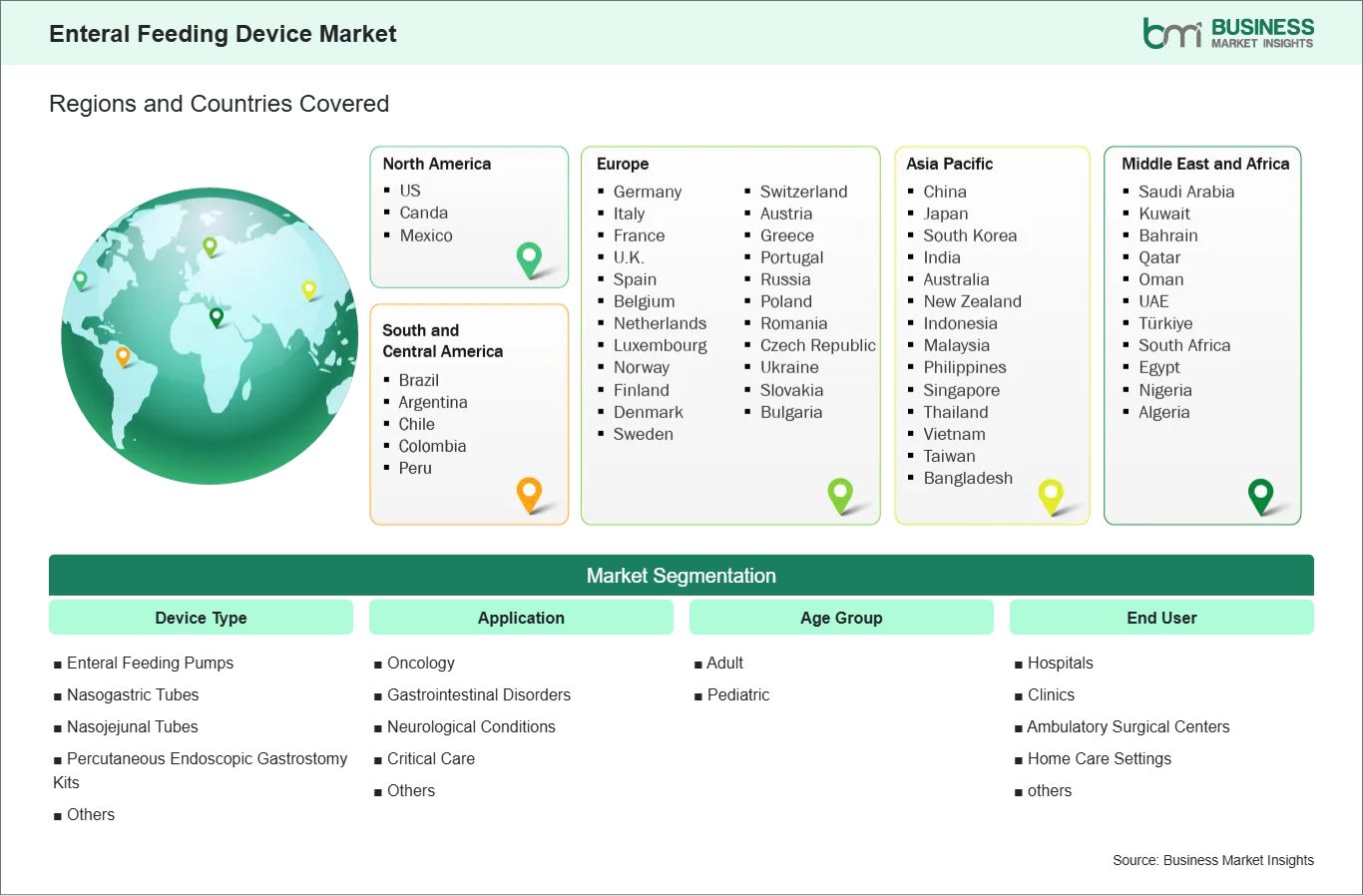
Key segments that contributed to the derivation of the Enteral Feeding Device market analysis are device type, application, age group, and end user.
The global enteral feeding device market is driven by an increase in the incidence of chronic or life-threatening diseases that prevent patients from taking in the proper amount of nutrition through the mouth. Chronic or life-threatening disease states such as cancer, trauma, neurodegenerative disease (e.g. Alzheimer's, Parkinson's, etc.), and GI disease usually require enteral feeding for a short- or long-term alternative source of nutrition. An increased demand for enteral feeding devices exists also due to the increasing global aging population that is more likely to experience dysphagia, malnutrition, and extended hospital stays. Enteral feeding has also been preferred clinically to parenteral feeding because of the lower cost associated with enteral feeding; a reduced incidence of infection due to enterally feeding patients; and a better ability to maintain gut function and integrity/immunity in patients when using enteral feeding. With continuing emphasis on evidence-based practices and cost containment by today's healthcare systems, standardization of enteral feeding devices as part of the clinical environment will continue within hospital settings, oncology and critical care units, and long-term care facilities. The increased survival rate for both premature infants and critically ill patients has caused an increased need for specialized enteral feeding options within both pediatric and neonatal settings. As noted, the combination of these drivers will create sustained and predictable demand for enteral feeding devices in both acute and chronic care settings.
The enteral feeding device market has potential for growth because of the rapid growth of the home healthcare and ambulatory care sectors worldwide. Healthcare systems are moving to provide care outside of hospitals to save money, reduce hospital-acquired infections, and create a better quality of life for patients. As a result of these trends, there is increasing demand for enteral feeding devices that are portable, easy to use and "smart," meaning that the patient or their caregiver will have the ability to operate them safely when using at home. With the introduction of new technologies such as lightweight feeding pumps, rechargeable batteries, remote monitoring functions, and simplified methods for replacing feeding tubes, there is considerable potential for growth in this segment of the industry. Many emerging markets in Asia-Pacific, Latin America and the Middle East are fueling this growth because of a significant improvement in their healthcare infrastructure and increasing healthcare-related spending and growing awareness about the importance of clinical nutrition. Additionally, the growing emphasis on improving patient safety in the regulatory environment (such as through the implementation of standardized connectors such as ENFit) will provide new opportunities for companies to replace or upgrade older systems. Companies that invest in developing new, differentiated products, integration of digital technology and localized manufacturing are likely to have a competitive advantage in these fast-growing regions. Companies that establish strategic partnerships with home care providers and nutrition companies will also be in a better position to accelerate the growth of their market penetration and long-term revenue growth.
By device type, the enteral feeding device market is segmented into enteral feeding pumps, nasogastric (ng) tubes, nasojejunal (nj) tubes, percutaneous endoscopic gastrostomy (peg) kits, others. The enteral feeding pumps segment dominated the market in 2024. These are developed to provide very specific, managed and ongoing nutritional support. There are various devices available in hospital settings and home care for use with critically ill and long-term patients and are essential for delivering precise dosages, creating a safer environment for the patient, and lowering the chance of complications, such as aspiration or being underfed.
By application, the market is segmented into oncology, gastrointestinal disorders, neurological conditions, critical care, and others. The critical care segment held the largest share of the market in 2024. There is a high number of ICU patients who can't eat normally, ICU staff must be closely monitored by a physician or Nurse Practitioner while they are receiving enteral nutrition for conditions such as serious injury, surgery recovery, brain diseases, and multi-organ failure.
By age group, the enteral feeding device market is bifurcated into adult and pediatric. The adult segment dominated the market in 2024. A significant number of adults and elderly people have chronic diseases, such as cancer, cerebrovascular disease (stroke), and gastrointestinal diseases. As the number of elderly people increases globally, there will be an increase in demand for enteral feeding products for long-term use.
By end user, the market is segmented into hospitals, clinics, ambulatory surgical centers, home care settings, and others. The hospitals segment held the largest share of the market in 2024. There are several factors supporting this segment’s including an advanced infrastructure, a high volume of patients, and the number of trained healthcare professionals available to support the use of enteral feeding products. Most enteral feeding procedures, including PEG placements and critical care nutrition, occur in hospitals.

| Report Attribute | Details |
|---|---|
| Market size in 2025 | US$ 3.8 Billion |
| Market Size by 2033 | US$ 7.01 Billion |
| Global CAGR (2026 - 2033) | 7.0% |
| Historical Data | 2022-2024 |
| Forecast period | 2026-2033 |
| Segments Covered | By Device Type
|
|
Regions and Countries Covered
| |
| North America | US, Canada, Mexico |
| Europe | Belgium, Austria, Finland, Denmark, Greece, Poland, Romania, Russia, Ukraine, Czech Republic, Slovakia, Bulgaria, Italy, Luxembourg, Germany, Switzerland, France, Netherlands, Norway, Portugal, Spain, Sweden, United Kingdom |
| Asia-Pacific | Australia, China, India, Japan, South Korea, Indonesia, Malaysia, Philippines, Singapore, Thailand, Vietnam, Bangladesh, New Zealand, Taiwan |
| South and Central America | Brazil, Argentina, Peru, Chile, Colombia |
| Middle East and Africa | Bahrain, Kuwait, Oman, Qatar, Saudi Arabia, United Arab Emirates, Turkiye, South Africa, Egypt, Algeria, Nigeria |
| Market leaders and key company profiles |
|
The "Enteral Feeding Device Market Size and Forecast (2022 - 2033)" report provides a detailed analysis of the market covering below areas:
The geographical scope of the Enteral Feeding Device market report is divided into five regions: North America, Asia Pacific, Europe, Middle East & Africa, and South & Central America. The Enteral Feeding Device market in Asia Pacific is expected to grow significantly during the forecast period.
The Asia-Pacific Enteral Feeding Device market is segmented into China, Japan, South Korea, India, Australia, New Zealand, Indonesia, Malaysia, the Philippines, Singapore, Thailand, Vietnam, Taiwan, Bangladesh, and the Rest of Asia. The Asia-Pacific market for enteral nutrition is growing rapidly due to developing health systems, increasing expenditure on healthcare and greater awareness of clinical nutrition in both developed and developing countries in the region. China, Japan, India and South Korea are experiencing a growing incidence of chronic diseases, cancer, neurological conditions and gastrointestinal disorders which significantly increases the demand for enteral feeding consultation services. The aging population in this region is also contributing to the continuing development of this market particularly in Japan and China. The number of patients who survive following critical illness and premature births is also increasing which has further driven the increased use of enteral feeding devices in Intensive Care Units (ICUs) and Neonatal Units (NUs). Government programs aimed at supporting the development of hospitals, improving access to insurance coverage and developing local manufacturers of medical devices are currently also assisting this market to grow. Home Health Care is emerging as a high-growth area as it has lower costs than traditional hospital based therapy and patients prefer to receive treatment at home. Additionally, local manufacturers providing low-cost products and the increasing adoption of safety standards, including ENFit Connectors, are expected to improve the penetration of enteral feeding devices throughout Asia-Pacific.

The Enteral Feeding Device market is evaluated by gathering qualitative and quantitative data post primary and secondary research, which includes important corporate publications, association data, and databases. A few of the key developments in the enteral feeding device market are:
The Enteral Feeding Device Market is valued at US$ 3.8 Billion in 2025, it is projected to reach US$ 7.01 Billion by 2033.
As per our report Enteral Feeding Device Market, the market size is valued at US$ 3.8 Billion in 2025, projecting it to reach US$ 7.01 Billion by 2033. This translates to a CAGR of approximately 7.0% during the forecast period.
The Enteral Feeding Device Market report typically cover these key segments-
The historic period, base year, and forecast period can vary slightly depending on the specific market research report. However, for the Enteral Feeding Device Market report:
The Enteral Feeding Device Market is populated by several key players, each contributing to its growth and innovation. Some of the major players include:
The Enteral Feeding Device Market report is valuable for diverse stakeholders, including:
Essentially, anyone involved in or considering involvement in the Enteral Feeding Device Market value chain can benefit from the information contained in a comprehensive market report.
Please tell us your area of interest
(Market Segments/ Regions and Countries/ Companies)