
Engineering Plastics Market Outlook: Size, Share, Trends, Growth Analysis, Competitive Landscape & Forecast, 2026-2033

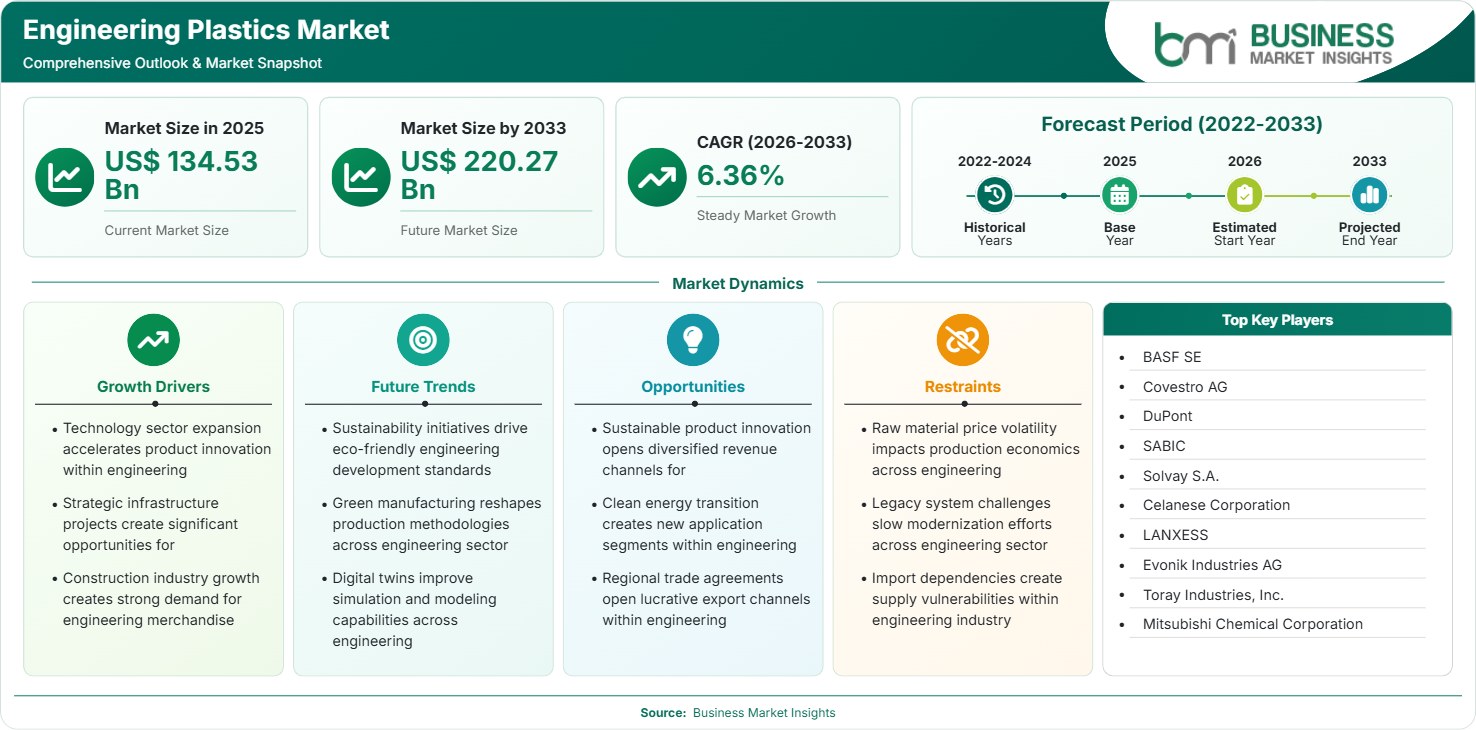
The Engineering Plastics Market size was valued at US$ 134.53 Billion in 2025 and is projected to reach US$ 220.27 Billion by 2033, growing at a CAGR of 6.36% during 2026–2033. Rising electric vehicle production, expanding electronics manufacturing, lightweight material adoption, sustainable polymer innovations, and increasing industrial automation continue creating profitable opportunities across high-performance engineering plastic applications worldwide.

Report Coverage
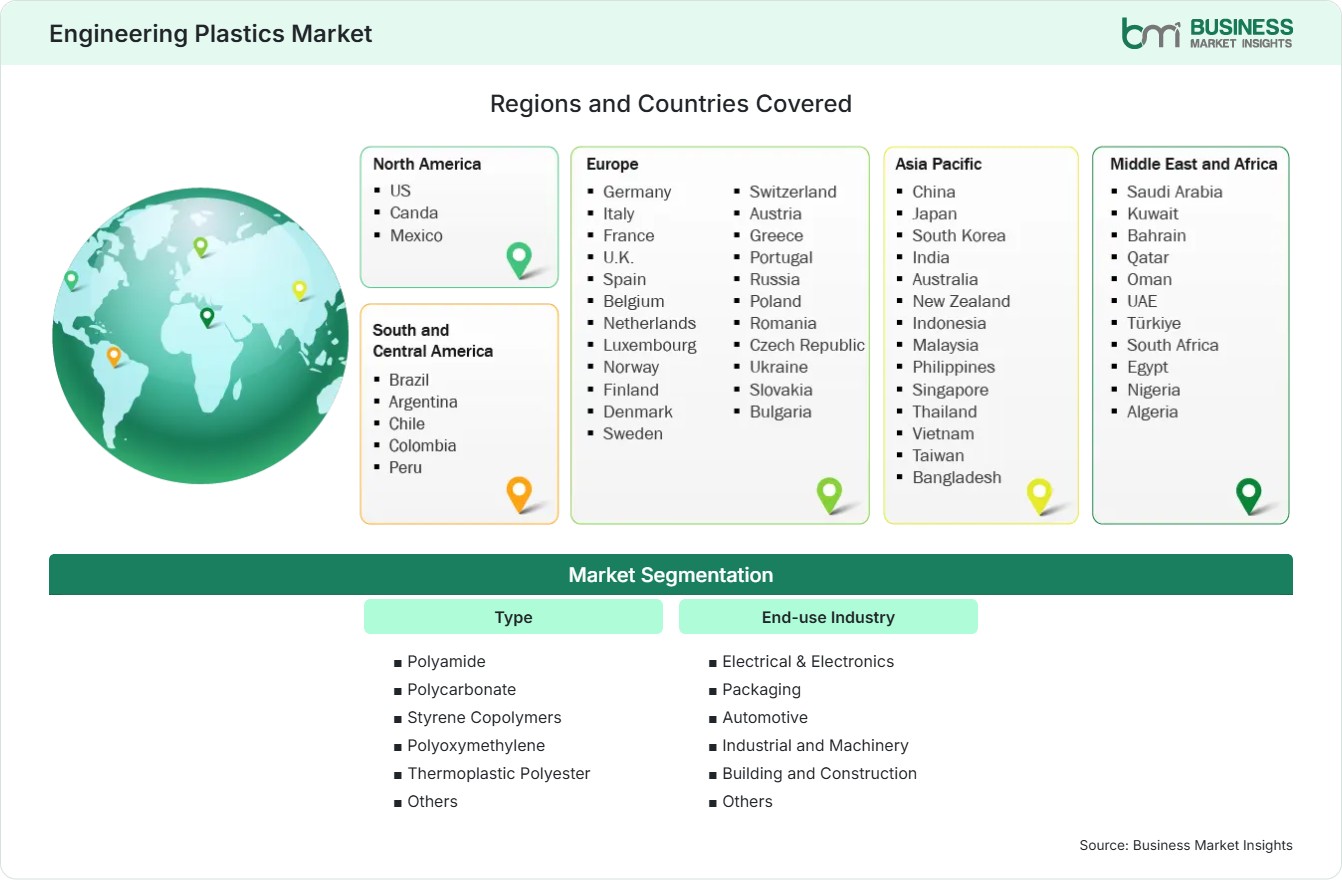
  • Type: Polyamide , Polycarbonate , Styrene Copolymers , Polyoxymethylene , Thermoplastic Polyester, Others
  • End-use Industry: Electrical & Electronics, Packaging, Automotive, Industrial and Machinery, Building and Construction, Others
US$ 134.53 Bn Market size in 2025
US$ 220.27 Bn Market Size by 2033
6.36% CAGR, 2026 - 2033
2026-2033 Forecast Period

AI Overview

Engineering Plastics Market Summary

  • North America Region: North America holds a 23%–26% share in 2025, growing with a 5.5%–5.9% CAGR during 2026–2033. Demand is supported by automotive electrification, aerospace modernization, electronics production, and recycled polymer innovation, while industrial reshoring creates attractive manufacturing investment opportunities across advanced engineering materials. The U.S. dominates regional demand with nearly 76%–80% of North American consumption and is projected to expand at 5.6%–6.0% CAGR, supported by semiconductor manufacturing and electric mobility investments.
  • Fastest Growing Region: Asia Pacific accounts for a 43%–46% share in 2025 while advancing at a 7.1%–7.6% CAGR during 2026–2033. Expanding electronics manufacturing, automotive production, industrial automation, rising disposable incomes, and government-backed manufacturing initiatives accelerate engineering plastic consumption throughout developing regional economies.
  • Leading Segment: Polyamide represents 29%–33% of the Engineering Plastics market share in 2025 and progresses with a 6.2%–6.7% CAGR during 2026–2033. Superior wear resistance, lightweight characteristics, chemical durability, and extensive automotive, machinery, and electrical applications continue strengthening long-term commercial demand worldwide.
  • High Growth Segment: Electrical & Electronics contributes 27%–31% share in 2025 while recording a 7.2%–7.8% CAGR during 2026–2033. Miniaturized electronics, semiconductor investments, advanced connectors, high-temperature insulation requirements, and expanding consumer electronics manufacturing consistently stimulate premium engineering plastic utilization across global markets.
  • Key Market Opportunity: Expanding adoption of recyclable engineering polymers, bio-based resin technologies, electric vehicle components, and high-performance lightweight materials enables manufacturers to strengthen profitability while addressing sustainability regulations and evolving industrial performance requirements.
  • Major Market Players: BASF SE, Covestro AG, Celanese Corporation, DuPont de Nemours, Inc., LANXESS AG, SABIC, Solvay SA, Arkema S.A., Mitsubishi Engineering-Plastics Corporation, LG Chem Ltd.
Strategic Insights

Engineering Plastics Market: Strategic Insights

Engineering Plastics Market Strategic Framework
FREE PDF
Request your free sample
Request free sample
Stakeholder View

Key Takeaways

  • The industry value chain is becoming increasingly integrated as resin producers, compounders, molders, OEMs, and recycling companies collaborate to improve raw material availability, product customization, and circular material utilization across multiple industrial sectors.
  • Electrical and electronics manufacturing, alongside electric vehicle production, presents the strongest long-term commercial opportunity because miniaturization, thermal management, insulation performance, and lightweighting requirements continue expanding advanced polymer consumption.
  • Innovation is increasingly focused on bio-based engineering plastics, recycled-content compounds, carbon-fiber reinforcement, flame-retardant formulations, conductive polymers, and digital material simulation tools that accelerate product development while improving sustainability performance.
  • Asia Pacific continues representing the most compelling regional investment destination as expanding manufacturing ecosystems, government industrial policies, electronics exports, and automotive production collectively sustain above-average demand growth throughout the forecast period.
  • Strategic acquisitions, joint ventures, and capacity expansion projects remain central competitive strategies as manufacturers seek regional manufacturing resilience, improved specialty polymer portfolios, enhanced recycling capabilities, and stronger customer relationships across high-growth application industries.
  • Future competitive differentiation will increasingly depend on lifecycle sustainability, advanced material engineering, localized production capabilities, regulatory compliance, and application-specific polymer development supporting next-generation mobility, electronics, and industrial automation systems.
Geographic Outlook

Engineering Plastics Market Regional Highlights

North America Engineering Plastics Market

North America accounted for 23%-26% of total demand in 2025 and is expected to see a 5.5%-5.9% CAGR during 2026-2033. The market here enjoys an advantage in terms of automotive engineering, aerospace engineering, medical devices, and high-tech electrical equipment manufacturing. Investments by industry players in lightweight vehicle parts, sustainable polymers, and semiconductors help consolidate the Engineering Plastics Market share. Recycled engineering plastics and high-performance materials are gaining in popularity among manufacturers because they comply with environmental guidelines.

  • Automotive OEMs continue replacing conventional metals with reinforced engineering plastics to reduce vehicle weight, improve fuel efficiency, and enhance electric vehicle battery protection while supporting stricter emission regulations across North America.
  • Semiconductor fabrication expansion and electronics manufacturing investments generate sustained demand for high-temperature engineering plastics used in connectors, housings, insulation systems, and precision electronic assemblies requiring excellent dimensional stability.
  • Aerospace manufacturers increasingly adopt advanced engineering polymers for lightweight interior components, structural applications, and electrical systems, improving operational efficiency while reducing maintenance requirements and supporting sustainability objectives.
  • Growing industrial automation, robotics deployment, and smart manufacturing facilities accelerate engineering plastic consumption in gears, bearings, conveyor systems, and machine components exposed to demanding operating environments.
  • Circular economy initiatives encourage investment in mechanical and chemical recycling technologies, enabling manufacturers to introduce recycled-content engineering plastics without compromising durability, thermal resistance, or product reliability.

US Engineering Plastics Market

The US accounts for 76% - 80% of North American demand in 2025 and is estimated to grow at a CAGR of 5.6% - 6.0% through 2033. Substantial investments in electric vehicles, semiconductors, aerospace technology, and industrial automation will ensure continued innovation in materials. Government incentives, increased capacity for domestic production, and extensive research facilities enable polymer manufacturers to introduce innovative engineering plastics.

  • Electric vehicle manufacturing investments increase demand for lightweight battery enclosures, thermal management components, connectors, and structural parts manufactured using advanced engineering polymers with enhanced flame-retardant characteristics.
  • The expansion of domestic semiconductor fabrication facilities supports growing consumption of ultra-pure engineering plastics used in wafer processing equipment, cleanroom systems, fluid handling, and precision manufacturing applications.
  • Aerospace and defense industries maintain consistent demand for high-performance polymers capable of delivering lightweight construction, chemical resistance, and long service life under challenging operational environments.
  • Industrial reshoring strategies encourage domestic machinery production, increasing engineering plastic adoption across precision mechanical components requiring low friction, corrosion resistance, and high dimensional stability.

Europe Engineering Plastics Market

Europe accounted for a 22%–25% share of the worldwide market in 2025 and will register a CAGR of 5.4%–5.8% between 2026 and 2033. Sustainability regulations, vehicle electrification, advanced industrial manufacturing, and recycling laws have continued to drive the uptake of engineering polymers. Germany is the leading consumer in the region due to the presence of automotive and machinery industries, while Poland has been experiencing rapid growth with a CAGR of 6.4%–6.8%CAGR, driven by industrial investment, electronics manufacturing growth, and expanding production capabilities.

  • Germany remains the largest regional Engineering Plastics market through advanced automotive engineering, industrial equipment manufacturing, and continuous research into high-performance thermoplastics supporting lightweight mobility solutions.
  • Poland emerges as the fastest-growing national market, benefiting from increasing foreign direct investment, expanding electronics production, and modern manufacturing infrastructure supporting specialty polymer demand.
  • European sustainability legislation accelerates commercialization of recyclable engineering plastics, bio-based feedstocks, and low-carbon manufacturing technologies throughout automotive, packaging, and industrial value chains.
  • Renewable energy installations create additional opportunities for engineering plastics used in electrical insulation, wind turbine components, photovoltaic systems, and grid modernization infrastructure.
  • Increasing automation across manufacturing facilities supports higher consumption of durable engineering polymers in motion systems, industrial robotics, and precision mechanical assemblies.

Asia Pacific Engineering Plastics Market

The Asia Pacific market share was around 43%-46% of global demand in 2025 and is expected to see the fastest growth among all regions, at a CAGR of 7.1%-7.6% through 2033. The China region is considered the largest market for Engineering Plastics owing to the availability of various manufacturing industries in the automobile, electronics, and industrial sectors, whereas India is the fastest-growing country at a CAGR of 8.1%-8.6%, supported by expanding domestic manufacturing, infrastructure development, and favorable industrial policies encouraging the adoption of advanced materials.

  • China continues to dominate regional demand through its integrated manufacturing ecosystem, strong consumer electronics exports, and expanding electric vehicle production requiring advanced engineering polymers across multiple applications.
  • India records the strongest growth momentum owing to production-linked incentive programs, increasing industrial automation, expanding automotive manufacturing, and rapidly growing electrical equipment production.
  • Japan and South Korea sustain premium engineering plastic demand through semiconductor manufacturing, advanced electronics, robotics, and high-value industrial machinery production requiring superior polymer performance.
  • Rising disposable incomes and urbanization stimulate appliance, consumer electronics, and mobility demand, strengthening engineering plastic consumption across regional manufacturing industries.
  • Regional investments in polymer production capacity and downstream compounding facilities improve supply chain resilience while supporting increasing domestic and export-oriented manufacturing activities.

Rest of World Engineering Plastics Market

The Rest of World accounted for 9%–11% of global consumption in 2025 and will grow at a CAGR of 5.8%–6.3% between 2025 and 2033. In South & Central America, key factors contributing to growth include increased automotive manufacturing, packaging, and industrial development, with Brazil continuing to lead. In the Middle East & Africa region, growth factors include increased demand from diversified industries, infrastructure development, and petrochemicals, with Saudi Arabia leading the strongest regional growth driven by downstream manufacturing expansion.

  • Brazil maintains regional leadership through expanding automotive assembly, consumer goods manufacturing, and packaging industries utilizing engineering plastics for lightweight and durable product applications.
  • Saudi Arabia records the highest regional growth as downstream petrochemical investments, industrial diversification initiatives, and manufacturing localization increase engineering polymer production and domestic consumption.
  • Infrastructure development projects across the Gulf Cooperation Council countries stimulate engineering plastic demand within electrical systems, construction materials, and industrial equipment manufacturing.
  • Expanding healthcare, food packaging, and consumer appliance industries across Latin America encourage greater utilization of engineering plastics offering chemical resistance, durability, and long operational performance.
  • International manufacturers continue establishing regional distribution networks and compounding facilities to improve supply availability, shorten delivery timelines, and address evolving customer requirements across emerging industrial markets.
Global Market Geography
FREE PDF
Request your free sample
Request free sample
Segment Analysis

Engineering Plastics Market Segmentation

Type

The Type category covered the basic material requirements across various industry verticals, with the share of Polyamide at 29%-33% in 2025 and expected to grow at a CAGR of 6.2%-6.7% during 2026-2033. Material selection is becoming dependent on their resistance to heat, mechanical strength, chemicals, and sustainability. The Engineering Plastics Market scope is steadily growing, as companies develop specialized materials to meet new performance criteria.

  • Polyamide: Widely utilized in automotive under-the-hood components, electrical connectors, gears, and industrial machinery because of exceptional wear resistance, mechanical strength, thermal stability, and compatibility with reinforced composite formulations.
  • Polycarbonate: Preferred for transparent, impact-resistant applications including lighting systems, electrical housings, medical devices, safety equipment, and glazing solutions where optical clarity and dimensional stability remain critical.
  • Styrene Copolymers (ABS and SAN): Extensively adopted across consumer electronics, appliance housings, automotive interiors, and industrial products due to balanced impact strength, processability, surface finish quality, and cost-effective manufacturing characteristics.
  • Polyoxymethylene: Selected for precision engineering applications including gears, bearings, fasteners, conveyor systems, and fuel handling components because of excellent dimensional stability, low friction, fatigue resistance, and moisture tolerance.
  • Thermoplastic Polyester: Increasingly deployed in electrical connectors, automotive electronics, industrial sensors, and high-temperature assemblies requiring outstanding dielectric properties, chemical resistance, mechanical durability, and long-term operational reliability.

End-use Industry

The End-use Industry category shows higher adoption in advanced manufacturing industries, with the Electrical & Electronics industry holding the largest market share in 2025 at 27%–31%, and is projected to grow at a 7.2%–7.8% CAGR from 2026 to 2033. The higher trend towards miniaturization, electrification, industrial automation, and performance-oriented materials continues to drive the Engineering Plastics Market trends, while manufacturers prioritize lightweight, flame-retardant, and recyclable engineering polymers for next-generation industrial applications.

  • Electrical & Electronics: Strong demand originates from connectors, circuit breakers, switches, semiconductor equipment, cable insulation, and electronic housings requiring superior electrical insulation, heat resistance, precision molding, and long-term reliability.
  • Packaging: Engineering plastics support high-performance packaging solutions demanding enhanced barrier protection, chemical resistance, durability, lightweight construction, and compatibility with automated filling, sealing, and distribution systems.
  • Automotive: Vehicle manufacturers increasingly integrate engineering plastics into battery enclosures, fuel systems, structural components, interior modules, and thermal management assemblies to improve efficiency, safety, and emissions performance.
  • Industrial and Machinery: Advanced polymers are extensively used in bearings, gears, pumps, conveyor components, valves, and automation equipment where durability, corrosion resistance, reduced maintenance, and dimensional accuracy improve operational productivity.
  • Building and Construction: Engineering plastics gain wider adoption in electrical conduits, piping systems, insulation products, structural fittings, window profiles, and architectural components requiring long service life, weather resistance, and installation flexibility.
Market Forces

Engineering Plastics Market Dynamics

Key Market Drivers

Automotive Lightweighting and Vehicle Electrification

Global automotive manufacturers are accelerating the replacement of conventional metal components with engineering plastics to reduce vehicle weight, improve energy efficiency, and extend electric vehicle driving range. According to the IEA, cumulative electric vehicle sales surpassed 17 million units in 2024, driving demand for lightweight battery housings, connectors, thermal management systems, and structural components. All such innovations will support the Engineering Plastics market in driving demand from applications requiring excellent weight-to-strength performance, flame resistance, and dimensional stability. Glass-reinforced varieties, heat-resistant plastics, and environmentally friendly plastics for use in future transportation modes are being developed by various plastic material suppliers. Recent innovations in plastic manufacturing have made it possible to economically produce complex automotive parts.

Expansion of Electrical and Electronics Manufacturing

The rapid growth of semiconductor fabrication, consumer electronics, industrial electronics, and telecommunications infrastructure continues driving engineering plastics consumption worldwide. Engineered plastics offer superior dielectric qualities, heat resistance, chemical resistance, and dimensional stability that are crucial for connectors, switches, circuit breakers, and precision electronics assembly. The development of semiconductor production plants in the US, Europe, South Korea, Taiwan, India, and Southeast Asia boosts demand for premium-quality materials capable of performing in harsh production environments. The growing use of artificial intelligence infrastructure, next-generation data centers, automation, and smart consumer products increases future opportunities for engineered plastics producers to develop unique compounds with improved insulation, flame resistance, and miniaturization.

Industrial Automation and Advanced Manufacturing Adoption

There is an increasing use of robotics, automated manufacturing processes, and machines in manufacturing industries, leading to a consistent demand for engineering plastics that can be used for long periods without failure. Engineering plastics enhance machinery efficiency through reduced friction, corrosion resistance, improved fatigue strength, and increased service life. Firms implementing Industry 4.0 manufacturing systems will need to use polymer-based components for gears, bearings, conveyors, actuators, and sensor housings that deliver reliable performance under all operating conditions. Increased capital investments in upgrading factories across the Asia Pacific, North America, and Europe regions increase demand for engineering plastics.

Key Market Opportunities

Development of Circular Economy and Recyclable Engineering Polymers

Global sustainability objectives are encouraging manufacturers to invest in recyclable engineering plastics, mechanically recycled compounds, and chemically recycled feedstocks without sacrificing mechanical performance. Auto-makers, electronics companies, and heavy machinery makers have begun demanding recycled-content materials to meet environmental goals and remain compliant with evolving regulations. The development of better sorting, purification, and closed-loop recycling techniques opens up several business possibilities in the engineering plastics industry. According to the Engineering Plastics Market Forecasts, companies that can provide quality-tested, sustainable engineering polymers will gain a market edge. The collaboration among resin makers, recyclers, and OEMs is expected to drive the commercial success of premium circular engineering materials during the forecast period.

Growing Demand from Renewable Energy Infrastructure

The growing renewable energy industry offers great potential for engineering plastics in wind power, solar energy, batteries, and grid upgrades. Engineering plastics offer a variety of advantages, including lightweight, corrosion resistance, electrical resistance, and the durability required by renewable energy technologies operating in extreme conditions. Engineering plastics are used in components of wind turbines, connectors for photovoltaic systems, battery management systems, and power distribution equipment. Government funding for the infrastructure of the renewable energy industry in Europe, North America, Asia Pacific, and the Middle East continues to drive demand for engineering plastics for renewable energy applications.

High-Performanceto expands for Medical and Healthcare Applications

Engineering plastics have become more prevalent in medical device production due to their biocompatibility, sterilizability, dimensional stability, and light weight. The range of applications continues to widen, including surgical devices, diagnostic equipment, drug-delivery devices, laboratory devices, and medical electronics. Increased investment in health care, an aging population, and the growing need for minimally invasive surgeries contribute to greater potential for the development of new materials. The plastic companies are developing specialized engineering plastics for medical applications that meet all applicable regulations and safety standards. The increased spending on healthcare infrastructure in emerging markets also offers bright prospects for suppliers of engineering polymer materials for medical applications.

Market Restraints and Challenges

Volatility in Petrochemical Feedstock Costs

Engineering plastics depend heavily on petrochemical feedstocks derived from crude oil and natural gas, making raw material pricing highly sensitive to energy market fluctuations, geopolitical disruptions, and supply chain constraints. Factor: Frequent volatility in feedstock prices increases production costs and creates uncertainty for manufacturers negotiating long-term supply agreements. Impact: Higher material costs reduce profit margins, complicate pricing strategies, and may encourage end users to delay procurement or consider alternative materials where performance requirements permit. Manufacturers increasingly pursue supply diversification, long-term sourcing contracts, and recycled raw materials to reduce exposure, although complete insulation from commodity price volatility remains difficult across global engineering plastics production networks.

Stringent Environmental Compliance and Processing Complexity

Environmental regulations governing emissions, recycling requirements, chemical safety, and waste management continue to become more demanding across major industrial economies. Factor: Compliance with evolving sustainability standards requires substantial investment in cleaner manufacturing technologies, advanced recycling systems, and regulatory certification processes. Impact: Smaller manufacturers often face higher compliance costs, slower product commercialization, and increased operational complexity, potentially reducing competitiveness. Additionally, several advanced engineering plastics require specialized processing equipment and technical expertise, increasing capital expenditure for converters and limiting adoption among cost-sensitive manufacturers despite the materials' superior long-term performance characteristics.

Company Analysis

Competitive Landscape

The Engineering Plastics Market analysis reflects competition centered on product innovation, application-specific polymer development, sustainable material portfolios, recycling capabilities, and global manufacturing footprints. Leading participants continue investing in high-performance engineering polymers, localized production, and strategic partnerships to address growing demand from automotive, electronics, industrial machinery, and electrical applications.

Company Name

Overview

Products and Services Relevant to this Market

BASF SE

Global chemical manufacturer with an extensive engineering plastics portfolio, strong R&D capabilities, and manufacturing facilities supporting automotive, industrial, and electronics industries.

Ultramid®, Ultradur®, specialty polyamides, PBT compounds, engineering polymer compounds, application engineering, technical support, and sustainable material solutions.

Covestro AG

Leading supplier of high-performance polymer materials focused on circularity, lightweight solutions, and advanced engineering applications across global manufacturing industries.

Polycarbonate resins, polycarbonate blends, specialty engineering plastics, mobility materials, electronics materials, and sustainable polymer technologies.

Celanese Corporation

Global specialty materials company offering broad engineered material solutions supported by advanced polymer science and worldwide manufacturing operations.

Acetal polymers, nylon compounds, PBT, LCP, PPS, engineered thermoplastics, custom compounding, and technical material solutions.

DuPont de Nemours, Inc.

Technology-driven materials company serving automotive, electronics, healthcare, and industrial customers through continuous polymer innovation and application engineering.

Zytel® polyamides, Delrin® acetal technologies, high-performance polymers, specialty resins, and engineering support services.

LANXESS AG

Specialty chemicals producer recognized for reinforced engineering plastics serving transportation, industrial equipment, and electrical component manufacturers worldwide.

Durethan® polyamides, Pocan® PBT, reinforced thermoplastics, lightweight material solutions, and customized engineering compounds.

SABIC

Global diversified chemicals company supplying engineering thermoplastics with integrated production capabilities and strong regional manufacturing presence.

LNP™ compounds, Lexan™ polycarbonate, Noryl™, Valox™, engineering resins, specialty compounds, and sustainable material offerings.

Solvay SA

Advanced materials producer specializing in high-performance polymers supporting demanding industrial, aerospace, automotive, and electronics applications.

Specialty polyamides, high-performance thermoplastics, engineering polymers, advanced composites, and technical consulting services.

Arkema S.A.

Global specialty materials company emphasizing innovative polymers, bio-based materials, and sustainable performance solutions for industrial markets.

High-performance polyamides, specialty engineering polymers, advanced resins, lightweight materials, and application development services.

Mitsubishi Engineering-Plastics Corporation

Japanese engineering plastics manufacturer supplying precision polymer materials for automotive, electronics, and industrial manufacturing sectors.

Polycarbonate compounds, polyester resins, engineering plastic alloys, specialty compounds, and customized polymer formulations.

LG Chem Ltd.

Diversified chemical manufacturer with growing engineering plastics capabilities supporting automotive, consumer electronics, and industrial customers globally.

ABS, engineering polymers, specialty compounds, automotive plastics, electronic materials, and customized resin development solutions.

Trust & Transparency

Research Methodology

The market analysis combines proprietary research with secondary data from government agencies, company disclosures, regulatory filings, industry databases and expert interviews. Market estimates are validated through data triangulation, cross-market benchmarking and analyst review.

View Full Research Methodology

Questions Answered

Frequently Asked Questions

Why is Asia Pacific expected to remain the fastest-growing regional market?

Asia Pacific benefits from strong automotive production, electronics manufacturing, industrial automation, government-supported manufacturing expansion, and continuous investments in polymer production capacity, creating sustained long-term demand for engineering plastics.

What does the Engineering Plastics Market Report primarily evaluate?

The Market Report evaluates market size, growth drivers, competitive landscape, regional opportunities, technological developments, segmentation, investment trends, and strategic developments shaping demand across major end-use industries.

How are sustainability initiatives influencing product development?

Manufacturers are accelerating investments in recyclable engineering plastics, bio-based polymers, low-carbon production processes, and circular economy solutions to satisfy regulatory requirements and customer sustainability objectives while maintaining material performance.

Which end-use industry is expected to generate the highest demand during the forecast period?

The electrical and electronics industry is projected to remain the leading demand generator due to increasing semiconductor manufacturing, consumer electronics production, electric mobility, and advanced electrical infrastructure requiring high-performance polymer materials.

What are the primary applications of engineering plastics across industries?

Engineering plastics are extensively used in automotive components, electrical and electronic devices, industrial machinery, packaging solutions, construction products, and medical equipment where durability, heat resistance, and lightweight performance are essential.

Access the Full Engineering Plastics Market Report

Get segment-level forecasts, regional estimates, competitive benchmarking, company profiles and downloadable Excel datasets.

Access the full Engineering Plastics Market Report
350 pages PDF & Excel | 2026-08-17