
Thermoformed Plastics Market Outlook: Size, Share, Trends, Growth Analysis, Competitive Landscape & Forecast, 2026-2033

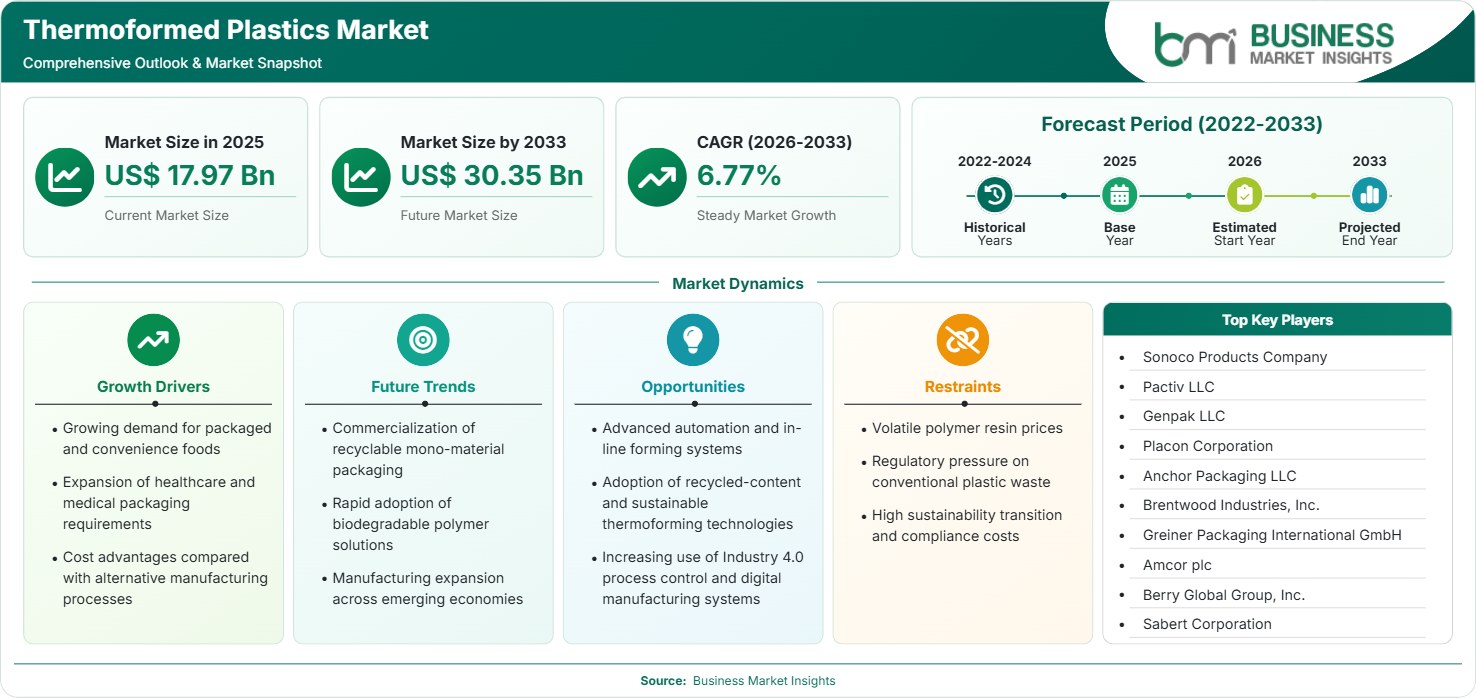
The Thermoformed Plastics Market size was valued at US$ 17.97 Billion in 2025 and is projected to reach US$ 30.35 Billion by 2033, growing at a CAGR of 6.77% during 2026–2033. Rising demand for lightweight packaging, healthcare disposables, recyclable materials, food-service applications, and industrial component replacement is accelerating adoption, while sustainable polymers and advanced thermoforming technologies create long-term commercial opportunities.

Report Coverage
  • Plastic Type: Polyethylene, Polypropylene, Polystyrene, Polyvinyl Chloride, Acrylonitrile Butadiene Styrene, Biodegradable Polymers
  • Thermoforming Type: Vacuum Snapback, Thin Gauge Thermoforming, Thick Gauge Thermoforming, Plug Assist Forming
  • Application: Healthcare & Medical, Food Packaging, Electrical & Electronics
US$ 17.97 Bn Market size in 2025
US$ 30.35 Bn Market Size by 2033
6.77% CAGR, 2026 - 2033
2026-2033 Forecast Period

01 AI Overview

Thermoformed Plastics Market Summary

  • North America Region: North America holds a market share of 34%–37% in 2025, growing with a CAGR of 5.8%–6.3% during 2026–2033. Growth is supported by food packaging innovation, medical device demand, high automation, recycling infrastructure, and sustainable packaging investments across manufacturing sectors and consumer applications. US maintains regional leadership through advanced packaging production, healthcare consumption, and automation investments, expanding at an estimated CAGR of 5.9%–6.4%.
  • Fastest Growing Region: Asia Pacific accounts for 28%–31% share in 2025 and is expected to expand at a CAGR of 7.8%–8.4% during 2026–2033. Industrialization, packaged food consumption, healthcare expansion, export manufacturing, and polymer processing investments support strong demand across emerging economies and regional supply chains.
  • Leading Segment: Polyethylene represents 28%–32% share in 2025 and advances at a CAGR of 6.2%–6.8% during 2026–2033. Strong packaging compatibility, cost efficiency, chemical resistance, processing flexibility, and widespread food-contact approvals sustain extensive adoption across commercial and industrial applications globally.
  • High Growth Segment: Biodegradable polymers account for 8%–11% share in 2025 and are projected to grow at a CAGR of 9.1%–10.2% during 2026–2033. Sustainability mandates, compostable packaging demand, retailer commitments, regulatory pressure, and circular economy initiatives accelerate penetration into multiple end-use industries.
  • Key Market Opportunity: Expanding demand for recyclable and bio-based thermoformed packaging solutions creates opportunities for converters, polymer suppliers, and brand owners seeking regulatory compliance, lower environmental impact, and premium product differentiation.
  • Major Market Players: Sonoco Products Company, Pactiv LLC, Genpak LLC, Placon Corporation, Anchor Packaging LLC, Brentwood Industries, Inc., Greiner Packaging International GmbH, Amcor plc, Berry Global Group, Inc., Sabert Corporation.
02 Strategic Insights

Thermoformed Plastics Market: Strategic Insights

Thermoformed Plastics Market Strategic Framework
FREE PDF
Request your free sample
Request free sample
03 Stakeholder View

Key Takeaways

  • The industry value chain increasingly integrates resin suppliers, sheet manufacturers, thermoformers, recyclers, and brand owners to improve material efficiency and circularity outcomes.
  • Healthcare packaging, medical trays, and premium food packaging categories offer attractive upside due to stringent hygiene requirements and expanding global healthcare expenditure.
  • Product innovation is shifting toward mono-material structures, recycled-content packaging, lightweight formats, and biodegradable alternatives designed for regulatory compliance.
  • India, Vietnam, Indonesia, and Mexico present compelling investment cases owing to manufacturing expansion, consumption growth, and favorable packaging demand fundamentals.
  • Strategic acquisitions continue as packaging suppliers seek geographic expansion, specialty forming capabilities, and sustainability-focused product portfolios.
  • Increased adoption of Industry 4.0 process control systems is improving throughput, quality consistency, and operating margins across thermoforming operations.
04 Geographic Outlook

Thermoformed Plastics Market Regional Highlights

North America Thermoformed Plastics Market

North America accounted for 34%–37% of global demand in 2025 and is expected to register a 5.8%–6.3% CAGR through 2033. The Thermoformed Plastics Market share remains supported by advanced packaging infrastructure, strong healthcare demand, and widespread adoption of recycled-content packaging. Large food-service networks and pharmaceutical packaging requirements create stable consumption. Investment in automation and sustainability initiatives continues to improve production competitiveness across the region.

  • Food packaging applications drive sustained consumption as retailers prioritize convenience formats and extended shelf-life packaging solutions.
  • Healthcare packaging demand benefits from expanding diagnostic testing, pharmaceutical distribution, and sterile device packaging requirements.
  • Recycled PET adoption is increasing due to corporate sustainability commitments and evolving regulatory expectations.
  • Manufacturing automation improves productivity and supports cost-efficient large-scale production capabilities.
  • Strong converter-brand partnerships accelerate commercialization of innovative packaging formats.

US Thermoformed Plastics Market

The United States represents 72%–76% of North American Thermoformed Plastics Market demand and is projected to expand at 5.9%–6.4% CAGR. High packaged food consumption, healthcare spending, and institutional food-service activity sustain market expansion. Producers continue investing in automation, recycled-content packaging, and advanced forming technologies. Domestic manufacturing capabilities support product innovation and reliable supply chain performance.

  • Pharmaceutical packaging requirements support premium thermoformed tray and blister packaging adoption.
  • Food delivery and convenience packaging formats remain important consumption drivers across urban markets.
  • Sustainability commitments encourage increasing utilization of recycled polymers and material-lightweighting strategies.
  • Investment in manufacturing modernization enhances throughput, quality control, and operational flexibility.

Europe Thermoformed Plastics Market

Europe held 25%–28% share in 2025 and is forecast to advance at a 5.6%–6.1% CAGR. Stringent sustainability regulations, recycling targets, and circular economy policies influence product development strategies. Germany remains the leading regional market, while Poland and selected Central European countries demonstrate faster manufacturing growth. Demand remains strongest across food packaging, healthcare, and consumer goods packaging applications.

  • Germany leads regional production supported by advanced packaging technology and industrial manufacturing capabilities.
  • France and Italy maintain strong demand from food processing and consumer packaged goods sectors.
  • Poland records comparatively stronger growth due to manufacturing expansion and export-oriented packaging production.
  • Circular economy regulations accelerate recycled-content and recyclable thermoformed product development.
  • Healthcare packaging requirements provide stable demand for specialized thermoformed components.

Asia Pacific Thermoformed Plastics Market

Asia Pacific represented 28%–31% share in 2025 and is expected to achieve the fastest growth at 7.8%–8.4% CAGR. The Thermoformed Plastics Market growth outlook benefits from industrialization, rising disposable incomes, expanding packaged food demand, and healthcare infrastructure development. China remains the largest market, while India exhibits the strongest growth among major economies. Regional production capacity expansion strengthens supply chain efficiency.

  • China leads regional consumption through extensive manufacturing, packaging conversion, and export activities.
  • India demonstrates accelerated growth driven by healthcare investment and packaged food demand.
  • Southeast Asian economies attract production relocation and packaging industry investments.
  • E-commerce expansion stimulates demand for protective and lightweight packaging formats.
  • Rising middle-class consumption supports sustained growth in packaged consumer products.

Rest of World Thermoformed Plastics Market

Rest of World accounted for 9%–12% share in 2025 and is anticipated to grow at a 6.3%–7.0% CAGR. South and Central America benefit from food processing investments and packaging modernization. The Middle East and Africa gain momentum from industrial diversification, healthcare development, and consumer goods manufacturing expansion.

  • Brazil remains the leading South American market supported by packaged food production growth.
  • Mexico serves as a regional manufacturing hub benefiting from export-oriented industrial activity.
  • Saudi Arabia advances through industrial diversification and packaging sector investments.
  • UAE attracts packaging technology investment linked to logistics and consumer industries.
  • Healthcare and food applications continue generating stable demand across developing markets.
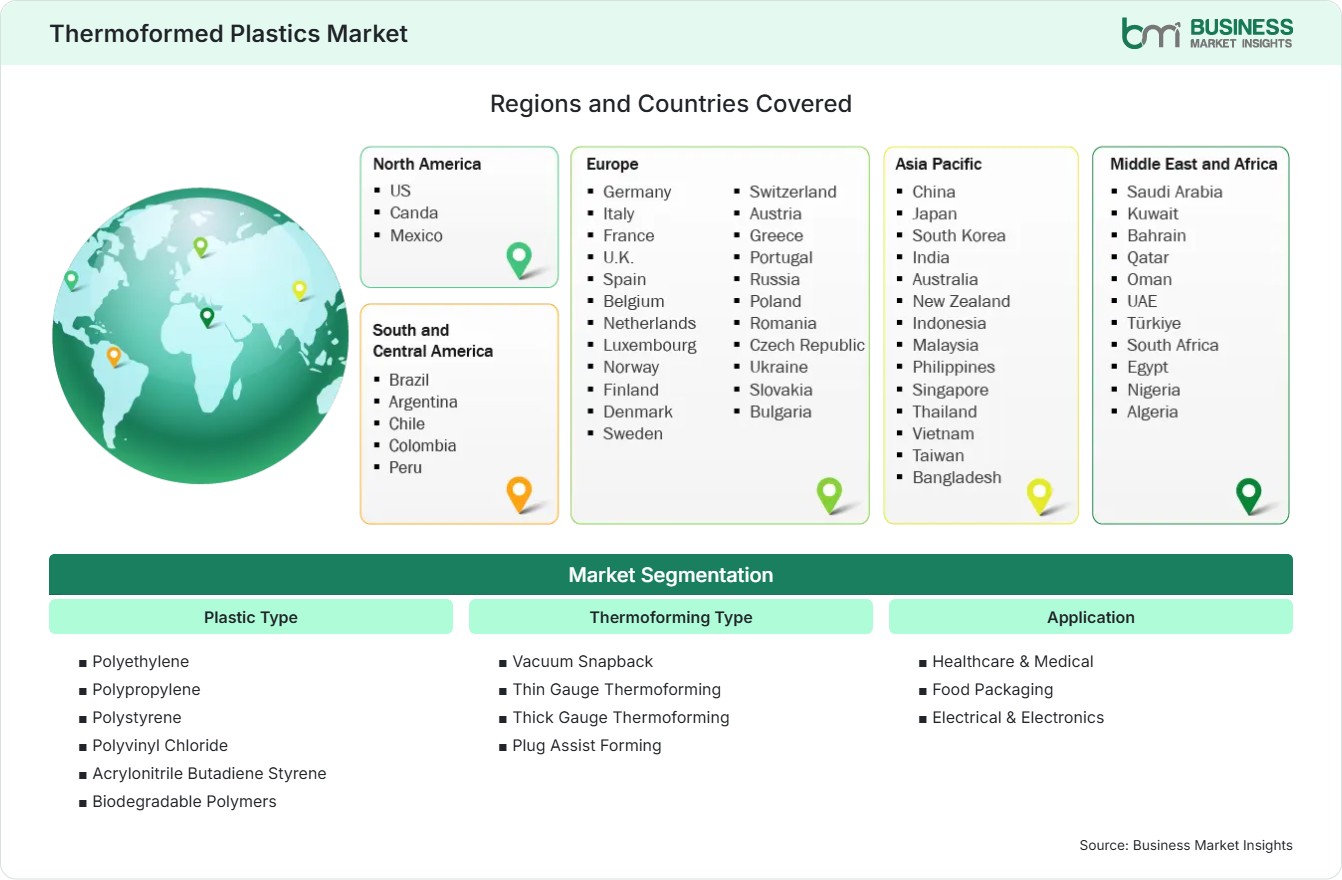
Global Market Geography
FREE PDF
Request your free sample
Request free sample
05 Segment Analysis

Thermoformed Plastics Market Segmentation

Plastic Type

Plastic Type held the largest Thermoformed Plastics Market scope, accounting for material selection across packaging and industrial applications. The segment represented approximately 54%–58% market share in 2025 and is expected to grow at 6.5%–7.0% CAGR. Demand reflects performance requirements, regulatory compliance, cost optimization, recyclability expectations, and evolving sustainability objectives.

  • Polyethylene: Widely used in food packaging and containers due to flexibility, moisture resistance, affordability, and strong processability in high-volume manufacturing environments.
  • Polypropylene: Gains adoption in rigid packaging applications requiring heat resistance, dimensional stability, lightweight performance, and improved product protection.
  • Polystyrene: Maintains presence in disposable packaging and food-service products where formability and cost efficiency remain important purchasing factors.
  • Polyvinyl Chloride: Preferred in specialized packaging applications needing transparency, durability, and chemical resistance under controlled industrial conditions.
  • Acrylonitrile butadiene styrene: Utilized in durable components, electronics housings, and industrial parts because of strength, impact resistance, and aesthetic versatility.
  • Biodegradable polymers: Benefit from sustainability goals and increasing demand for compostable packaging alternatives aligned with environmental commitments.

Thermoforming Type

Thermoforming Type represented approximately 24%–28% share in 2025 and is expected to grow at 6.8%–7.3% CAGR. Adoption patterns depend on product geometry, production volume requirements, quality expectations, and tooling economics. Continuous innovation is expanding operational efficiency across diverse packaging and industrial manufacturing applications.

  • Vacuum Snapback: Enhances material distribution and part detail quality, supporting packaging applications requiring improved dimensional consistency.
  • Thin Gauge Thermoforming: Extensively used in disposable packaging, trays, and consumer goods applications because of efficiency and high-speed production capabilities.
  • Thick Gauge Thermoforming: Supports industrial components, transport equipment, and durable products requiring structural integrity and longer operating life.
  • Plug Assist Forming: Improves wall thickness consistency and enables production of deeper, more complex shapes for specialty applications.

Application

Application categories accounted for 16%–20% share in 2025 and are projected to expand at 7.0%–7.6% CAGR. The Thermoformed Plastics Market trends across applications reflect increasing demand for convenience packaging, healthcare safety standards, and protective electronic component packaging solutions.

  • Healthcare & Medical: Uses include surgical trays, diagnostic packaging, medical device transport systems, and sterile barrier solutions.
  • Food Packaging: Remains the dominant application due to convenience foods, retail packaging requirements, and product protection needs.
  • Electrical & Electronics: Expanding use in protective packaging, component handling trays, and transportation solutions supporting electronics manufacturing.
06 Market Forces

Thermoformed Plastics Market Dynamics

Key Market Drivers

Growing Demand for Packaged and Convenience Foods

Global consumption of packaged foods, fresh food packaging, and take-away food options is growing in developed as well as developing countries. Increased urbanization and lifestyle changes, along with organized retailing, help in the growing adoption of thermoformed trays, containers, and clamshell packaging. Packaging material that offers better logistics efficiency along with safety for the products is preferred by food manufacturers. Retailers also give importance to aesthetic packaging forms. These factors collectively support long-term Thermoformed Plastics Market growth across food and beverage applications. Demand remains particularly strong in Asia Pacific and North America where convenience-oriented consumption patterns continue strengthening.

Expansion of Healthcare and Medical Packaging Requirements

Healthcare expenditure growth and increasing production of medical devices support rising demand for sterile packaging solutions. Thermoformed trays provide protection, organization, and transport efficiency for equipment and pharmaceutical products. The aging population in many economies has also led to increased use of health services. Product integrity remains a focus for regulatory authorities, which facilitates the implementation of specialized medical packaging systems. Companies keep coming up with improved packaging materials that are compatible with sterilization and traceability procedures. Such efforts create good market conditions and foster innovation in product development.

Cost Advantages Compared with Alternative Manufacturing Processes

Thermoforming delivers lower tooling costs and shorter development cycles than several competing plastic conversion methods, particularly for medium-volume production programs. Manufacturers gain advantages from flexible manufacturing processes, adaptable designs, and efficient material utilization. Improvements in automation techniques make operations more economical and productive. The increasing use of recycled materials adds to cost optimization initiatives. Economic benefits make the solution more attractive to consumer goods producers, health care providers, and industrial manufacturers seeking cost-effective manufacturing processes.

Key Market Opportunities

Commercialization of Recyclable Mono-Material Packaging

Package manufacturers are looking at packaging forms that can fit into their recycling streams. Mono-material thermoforms provide better opportunities for recycling and help companies fulfill their sustainability goals. There is a surge in investment activity in recycled PET, polypropylene, and polyethylene packages meant for food and consumer goods uses. Thermoformed Plastics Market Forecasts indicate continued interest from converters and retailers pursuing circular economy targets. Firms manufacturing high-performing recyclable materials stand to gain from changes in the regulatory landscape and shifts in consumer tastes. It is likely that the use will increase due to continued improvement in collection systems and recycling technology worldwide.

Rapid Adoption of Biodegradable Polymer Solutions

Environmental regulations and corporate sustainability commitments are increasing demand for bio-based and compostable packaging formats. Thermoforming technology is becoming increasingly adaptable with the new generation of biodegradable resin compounds. This has the potential to create avenues for premium product differentiation and environmentally friendly market segmentation. Further innovations in the process have improved the mechanical and process characteristics, as well as commercial viability. In light of policymakers encouraging plastic waste reduction, the demand for thermoformed products is set to rise.

Manufacturing Expansion Across Emerging Economies

Rising consumer expenditure, urbanization, and industrial development across Asia, Latin America, and parts of the Middle East are creating new demand centers. International packers have begun expanding their production footprints to locations closer to their end markets. Positive demographics and rising consumption of packaged products enhance the ability to estimate demand trends for the future. Investment in local health care infrastructure and the manufacture of drugs adds strength to business prospects. Companies that can build regional manufacturing hubs are poised to benefit from future growth.

Market Restraints and Challenges

Volatile Polymer Resin Prices

Factor: Thermoforming operations depend heavily on petrochemical-derived resins whose prices fluctuate with crude oil, energy, and feedstock market conditions. Impact: Uncertainty due to raw material price volatility, margin pressure, and difficulty negotiating contracts over extended periods are other factors that pose problems. Smaller manufacturers are at greater risk because they lack the purchasing power of multinational companies. More and more companies depend on strategic purchasing and recycling efforts to manage cost concerns. The instability in prices of resins is one of the key issues faced by the industry.

Regulatory Pressure on Conventional Plastic Waste

Factor: Governments and regulatory authorities continue strengthening waste reduction policies, recycling requirements, and environmental compliance obligations. Impact: The producers must incur further investment in respect of material changes, certification, and sustainability reporting. The brand owners are demanding that packaging material be either recyclable or biodegradable. Those companies that fail to reorient their product lines will face restrictions in terms of access to the market and competition. Despite the positive impact of this legislation on innovation, the cost of compliance poses difficulties for businesses.

07 Company Analysis

Competitive Landscape

Thermoformed Plastics Market analysis indicates competition is centered on packaging innovation, sustainability capabilities, healthcare applications, material expertise, and manufacturing scale.

Company Name

Overview

Products and Services relevant to this market

Sonoco Products Company

Global packaging manufacturer serving consumer, industrial, and healthcare markets.

Thermoformed trays, protective packaging, medical packaging solutions, and specialty containers.

Pactiv LLC

Major foodservice and food packaging supplier with broad manufacturing presence.

Food containers, trays, clamshell packaging, and thermoformed packaging systems.

Genpak LLC

Leading provider of food packaging solutions across North America.

Thermoformed food containers, hinged packaging, and specialty trays.

Placon Corporation

Packaging specialist focused on sustainability and recycled materials.

PET thermoformed packaging, retail packaging, and custom packaging solutions.

Anchor Packaging LLC

Manufacturer serving foodservice and retail packaging markets.

Thermoformed containers, trays, lid systems, and merchandising packaging.

Brentwood Industries, Inc.

Diversified manufacturer with engineered plastics expertise.

Thermoformed industrial products, packaging components, and custom solutions.

Greiner Packaging International GmbH

European packaging company focused on circular economy initiatives.

Thermoformed cups, food packaging, and sustainable packaging formats.

Amcor plc

Global packaging leader with extensive innovation capabilities.

Rigid and flexible packaging, thermoformed packaging, and recyclable solutions.

Berry Global Group, Inc.

Large-scale plastics manufacturer serving multiple industries globally.

Thermoformed packaging products, containers, healthcare packaging, and specialty plastics.

Sabert Corporation

Food packaging company emphasizing convenience and sustainability.

Thermoformed containers, catering packaging, trays, and foodservice solutions.

10 Trust & Transparency

Research Methodology

The market analysis combines proprietary research with secondary data from government agencies, company disclosures, regulatory filings, industry databases and expert interviews. Market estimates are validated through data triangulation, cross-market benchmarking and analyst review.

View Full Research Methodology

11 Questions Answered

Frequently Asked Questions

What does the Thermoformed Plastics Market Report typically cover?

It generally evaluates market size, competitive positioning, technology developments, application trends, regional demand patterns, sustainability initiatives, and forecast growth opportunities.

What makes thermoforming attractive compared with alternatives?

The process offers lower tooling costs, rapid product development cycles, design flexibility, and cost-effective production for numerous packaging and industrial applications.

Why are biodegradable polymers gaining importance?

Regulatory pressure, consumer sustainability preferences, and corporate environmental commitments are encouraging adoption of compostable and bio-based thermoformed materials.

Which region is expected to grow the fastest?

Asia Pacific is projected to record the highest growth due to industrialization, healthcare expansion, packaged food demand, manufacturing investment, and rising consumer spending across key economies.

What factors are creating demand for thermoformed plastic products?

Demand is primarily supported by packaged food consumption, healthcare packaging requirements, lightweight product design, lower tooling costs, and increasing adoption across industrial and consumer applications.

Access the Full Thermoformed Plastics Market Report

Get segment-level forecasts, regional estimates, competitive benchmarking, company profiles and downloadable Excel datasets.

Access the full Thermoformed Plastics Market Report
350 pages PDF & Excel | 2026-08-26