
Recycled Plastic Market Outlook: Size, Share, Trends, Growth Analysis, Competitive Landscape & Forecast, 2026-2033

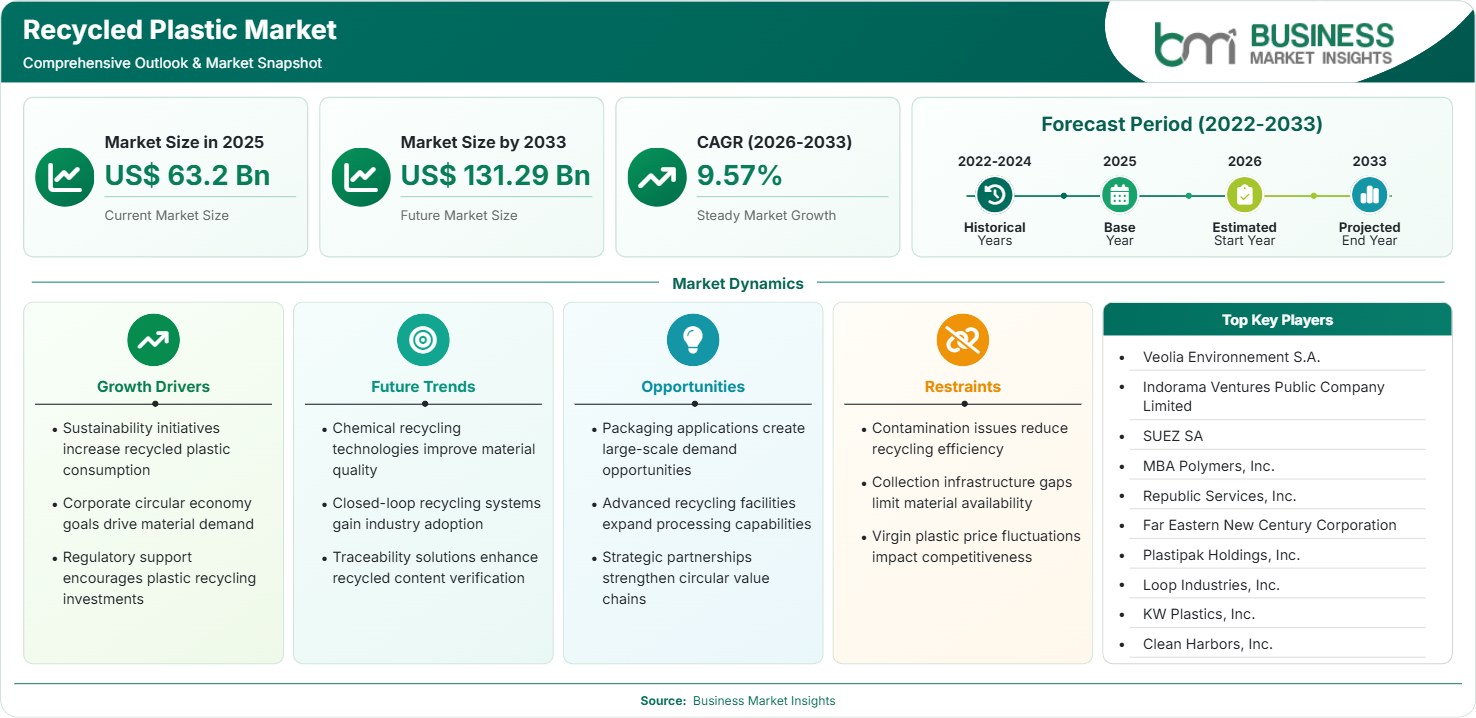
The Recycled Plastic Market size was valued at US$ 63.2 Billion in 2025 and is projected to reach US$ 131.29 Billion by 2033, growing at a CAGR of 9.57% during 2026–2033, driven by circular economy policies, recycled-content mandates, packaging demand, advanced sorting technologies, and expanding sustainability investments across consumer goods, automotive, and construction industries.

Report Coverage
  • Type: Polyethylene Terephthalate , High-density Polyethylene , Polypropylene , Low-density Polyethylene , Others
  • Source: Plastic Bottles, Plastic Films, Polymer Foam, Others
  • Application: Non-Food Packaging, Food Packaging, Construction, Automotive, Others
US$ 63.2 Bn Market size in 2025
US$ 131.29 Bn Market Size by 2033
9.57% CAGR, 2026 - 2033
2026-2033 Forecast Period

AI Overview

Recycled Plastic Market Summary

  • North America Region: North America holds market share of 29%–32% in 2025, growing with a CAGR of 8.4%–9.0% during 2026–2033, supported by recycled-content legislation, corporate sustainability targets, collection infrastructure upgrades, food-grade resin demand, and investment in advanced mechanical recycling technologies across industries. Brief U.S. analysis: Strong packaging demand and state-level regulations support adoption, with CAGR estimated at 8.6%–9.2% through 2033.
  • Fastest Growing Region: Asia Pacific holds market share of 37%–40% in 2025, growing with a CAGR of 10.5%–11.2% during 2026–2033, supported by manufacturing expansion, urbanization, waste-management modernization, packaging production growth, circular economy investments, and increasing recycled polymer consumption.
  • Leading Segment: Polyethylene Terephthalate (PET) holds market share of 34%–37% in 2025, growing with a CAGR of 9.8%–10.4% during 2026–2033, supported by beverage packaging recycling, food-contact approvals, bottle-to-bottle initiatives, brand sustainability commitments, and well-established collection systems globally.
  • High Growth Segment: Food Packaging holds market share of 21%–24% in 2025, growing with a CAGR of 10.8%–11.5% during 2026–2033, supported by regulatory mandates, consumer preference for sustainable packaging, recycled-content commitments, traceability improvements, and food-grade resin innovations.
  • Key Market Opportunity: Expanding certified food-grade recycling capacity creates opportunities for converters, resin suppliers, and brands seeking compliance with recycled-content regulations while strengthening circular supply chains and reducing dependence on virgin polymers.
  • Major Market Players: Veolia Environnement S.A., Indorama Ventures Public Company Limited, SUEZ SA, MBA Polymers, Inc., Republic Services, Inc., Far Eastern New Century Corporation, Plastipak Holdings, Inc., Loop Industries, Inc., KW Plastics, Inc., and Clean Harbors, Inc.
Strategic Insights

Recycled Plastic Market: Strategic Insights

Recycled Plastic Market Strategic Framework
FREE PDF
Request your free sample
Request free sample
Stakeholder View

Key Takeaways

  • The industry value chain is becoming more integrated as recyclers, waste management companies, packaging converters, and consumer brands establish closed-loop supply arrangements to improve feedstock security and material quality.
  • Food packaging and high-value PET recycling offer the strongest commercial upside due to regulatory requirements, food-grade approvals, and increasing recycled-content targets among multinational packaged goods companies.
  • Artificial intelligence-based material sorting, digital traceability platforms, and chemical recycling processes are improving recovery rates and enabling use of previously difficult-to-recycle plastic streams.
  • India, Indonesia, Vietnam, and selected Middle Eastern countries present compelling investment opportunities because recycling infrastructure growth continues to outpace many mature markets.
  • Strategic acquisitions and joint ventures are helping companies secure collection networks, expand recycling capacity, and strengthen access to premium recycled resin markets.
  • Demand from automotive manufacturers for lightweight, lower-carbon materials is creating additional revenue streams for recycled polypropylene and engineered recycled plastic compounds.
Geographic Outlook

Recycled Plastic Market Regional Highlights

North America Recycled Plastic Market

North America accounts for 29%–32% of global demand in 2025 and is projected to register a CAGR of 8.4%–9.0% through 2033. The region benefits from strong corporate sustainability programs, recycling infrastructure investments, and recycled-content requirements across packaging applications. Recycled Plastic Market share remains supported by growing demand for food-grade PET and HDPE materials. Major consumer goods companies continue incorporating recycled content into packaging portfolios, while municipal collection modernization and advanced sorting technologies improve recovery rates and support long-term market development.

  • State-level packaging legislation is encouraging higher recycled-content utilization, creating demand stability across beverage, household, and personal care packaging sectors.
  • Advanced recycling investments help process complex waste streams, improving feedstock availability and enhancing resin quality for consumer and industrial applications.
  • Brand owners increasingly sign long-term procurement agreements to secure recycled polymers amid tightening sustainability requirements.
  • Growing demand from construction materials manufacturers supports wider utilization of recycled polyethylene and polypropylene products.

US Recycled Plastic Market

The United States represents 76%–80% of regional consumption and is expected to expand at a CAGR of 8.6%–9.2% through 2033. Strong investment activity, corporate commitments, and state-mandated recycled-content requirements support adoption. Packaging remains the dominant application, while automotive and construction sectors increasingly incorporate recycled resins into product portfolios. Additional capacity additions across sorting, washing, and pelletizing operations are improving domestic supply resilience and supporting premium-grade recycled material production.

  • Beverage companies are increasing purchases of food-grade recycled PET to meet sustainability commitments and packaging compliance requirements.
  • Investments in chemical recycling technologies are broadening utilization pathways for difficult-to-recycle plastics.
  • Consumer preference for sustainable packaging is encouraging faster adoption across retail and e-commerce channels.
  • Municipal collection improvement programs are helping increase feedstock recovery and material consistency.

Europe Recycled Plastic Market

Europe holds 25%–28% market share in 2025 and is forecast to grow at a CAGR of 8.8%–9.5% through 2033. Regulatory leadership, circular economy policies, and packaging waste directives continue shaping regional demand. Germany remains the leading market, while Poland and Eastern European economies demonstrate higher growth rates approaching 9.5%–10.2%. Strong industry collaboration across collection, processing, and conversion activities supports material quality improvements. Producers increasingly invest in food-grade recycling and advanced processing infrastructure to address ambitious recycled-content goals.

  • European packaging regulations continue encouraging wider incorporation of recycled polymers across consumer goods industries.
  • Automotive manufacturers increasingly source recycled polypropylene for interior and non-structural vehicle applications.
  • Food-grade recycling investments strengthen regional resin availability for beverage and food packaging sectors.
  • Digital traceability systems help verify recycled content and improve value chain transparency.
  • Cross-border waste management collaboration supports stable feedstock supply and processing efficiency.

Asia Pacific Recycled Plastic Market

Asia Pacific accounts for 37%–40% of global demand in 2025 and records the highest CAGR of 10.5%–11.2% through 2033. China remains the largest market, while India represents the fastest-growing national opportunity with growth exceeding 11%. Expanding manufacturing activity, urbanization, and government support for circular economy development continue driving adoption. Recycled Plastic Market growth is reinforced by packaging production expansion, rising collection investments, and increasing use of recycled polymers across consumer goods, construction, and industrial applications.

  • Rapid packaging consumption increases demand for recycled PET, HDPE, and polypropylene across regional manufacturing sectors.
  • Government initiatives focused on waste reduction and recycling infrastructure are encouraging private-sector investment.
  • International consumer brands are sourcing recycled content locally to improve supply-chain efficiency.
  • Expansion of collection and sorting systems supports increased feedstock availability.
  • Construction and infrastructure projects create additional demand for recycled plastic products and composites.

Rest of World Recycled Plastic Market

The Rest of World region accounts for 8%–11% of global demand and is projected to grow at a CAGR of 9.1%–9.8% through 2033. South and Central America benefit from expanding recycling initiatives and packaging demand, led by Brazil. In the Middle East and Africa, the United Arab Emirates and Saudi Arabia are advancing circular economy investments and recycling infrastructure development. Corporate sustainability commitments, alongside growing regulatory attention toward waste management, support long-term adoption across regional markets.

  • Brazil remains a leading Latin American market due to established collection networks and packaging industry demand.
  • Gulf countries are investing in resource recovery and recycling facilities to diversify sustainability initiatives.
  • Consumer goods manufacturers increasingly adopt recycled-content packaging to align with environmental objectives.
  • Collection and sorting infrastructure development remains a critical investment priority.
  • International partnerships support technology transfer and operational capability enhancement.
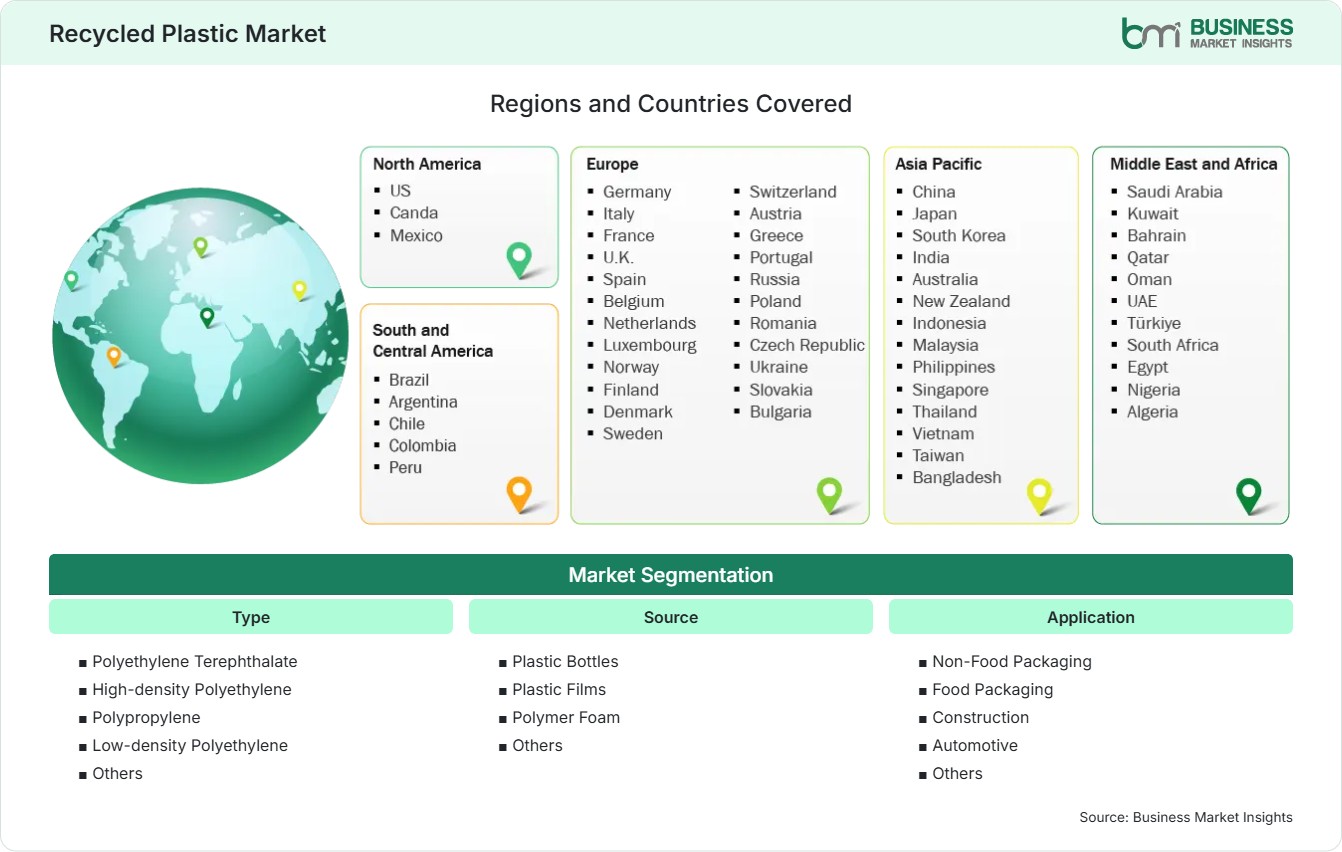
Global Market Geography
FREE PDF
Request your free sample
Request free sample
Segment Analysis

Recycled Plastic Market Segmentation

Type

Type represented approximately 100% of overall industry demand, with PET accounting for the largest contribution. The segment benefits from expanding packaging applications, growing sustainability mandates, and advancements in collection systems. Recycled Plastic Market scope continues widening as food-grade approvals improve adoption. The category is expected to register strong growth through 2033, supported by rising demand from packaging, automotive, and consumer product manufacturers.

  • Polyethylene Terephthalate (PET): Widely used in beverage and food packaging applications due to established collection systems, favorable recyclability characteristics, and increasing corporate commitments supporting closed-loop bottle recycling initiatives.
  • High-density Polyethylene (HDPE): Strongly adopted in personal care, household, and industrial packaging applications where durability, processability, and recycled-content mandates support long-term demand growth.
  • Polypropylene (PP): Growing utilization across automotive components, consumer products, and packaging due to lightweight properties and increasing availability of recycled feedstock streams.
  • Low-density Polyethylene (LDPE): Demand benefits from recycling advancements targeting films and flexible packaging materials, improving circularity opportunities across industrial and commercial sectors.

Source

Source segmentation reflects feedstock availability and processing economics. Plastic bottles account for the largest share, supported by organized collection systems and high-quality material recovery. The segment is projected to maintain healthy expansion through 2033 as recycling infrastructure investments continue. Increasing recovery rates and broader industry collaboration are strengthening feedstock security, creating favorable operating conditions for recyclers and resin producers.

  • Plastic Bottles: Dominant feedstock category supported by established collection frameworks, deposit return systems, and sustained demand for food-grade recycled resin production.
  • Plastic Films: Recycling technologies and sorting innovations are improving recovery potential for flexible materials used across packaging and industrial applications.
  • Polymer Foam: Growing interest in foam recycling is supported by landfill diversion initiatives and development of specialized processing technologies.

Application

Application demand remains led by packaging-related uses, reflecting regulatory pressures and sustainability commitments from major brands. Food packaging demonstrates the strongest growth trajectory, supported by compliance requirements and increasing use of certified recycled materials. Recycled Plastic Market trends indicate expanding utilization across construction and automotive sectors, where lower-carbon material alternatives are becoming a strategic procurement priority through the forecast period.

  • Non-Food Packaging: Strong demand from personal care, household products, industrial goods, and retail packaging applications supports sustained consumption.
  • Food Packaging: Increasing adoption of certified recycled resins is driven by sustainability commitments, food-contact approvals, and packaging regulations.
  • Construction: Utilization in pipes, panels, insulation products, and composite materials supports long-term demand growth linked to infrastructure development.
  • Automotive: Vehicle lightweighting strategies and sustainability objectives encourage higher incorporation of recycled plastic compounds into component manufacturing.
Market Forces

Recycled Plastic Market Dynamics

Key Market Drivers

Expansion of Recycled-Content Regulations

Recycled-content requirements are being enforced in governments from North America, Europe, and Asia, which will help accelerate demand. Packaging regulations now demand recycled content minimums, which means companies need to make sure that there is resin available for the future. The circular economy programs of the EU, their responsibility systems, and waste reduction goals are continuing to impact purchasing decisions in consumer goods industries. Recycled Plastic Market growth will increasingly be driven by policy-driven demand, especially for food and beverage packaging. With compliance regulations expanding in their geographic coverage, companies will have more reasons to put in place their own collection networks and facilities for sorting and food-grade recycling.

Corporate Sustainability Commitments Across Packaging Value Chains

Global consumer brands continue raising recycled-content targets to meet environmental commitments and reduce lifecycle emissions. The largest demand pull factor is packaging since producers of beverages, foods, cosmetics, and housecare products need constant feedstock supplies. Purchasing departments increasingly prefer to purchase certified recycling materials, thus forming lucrative markets. Recyclers are increasing their capacity by entering into joint ventures with converters and brands for guaranteed supplies. Better demand visibility comes from longer purchase agreements becoming widespread. Greater demand for transparency from both shareholders and customers encourages use of recycled polymers. This makes it easier for investments into collection, sorting, washing, and pelletizing to be made.

Advances in Sorting and Recycling Technologies

Sorting processes using artificial intelligence, optical sensors, and recycling methods are improving efficiencies in recovering materials. The higher purity of the output enables recycled polymers to compete for the market applications that were traditionally held by virgin materials. Increased efficiency in the process leads to reduced contamination levels and increased value, making it possible to move into high-end packaging and industrial applications. Recycled Plastic Market trends increasingly reflect the influence of digital automation and enhanced processing capabilities. Greater operational efficiency improves profitability for recyclers while supporting consistent resin quality. These developments enhance industry competitiveness and encourage additional investment in recycling capacity globally.

Key Market Opportunities

Expansion of Food-Grade Recycling Infrastructure

The use of recycled food-grade resin still represents one of the most lucrative areas for investment, owing to the ever-growing need for regulations and sustainability pledges by brands. The production of beverages, foods and packaging materials is increasingly dependent on recycled material certification in order to meet regulatory and corporate targets. There have been advancements in the field of decontamination and processing that will make regulation more likely. Recycled Plastic Market Forecasts continue to reflect rising demand for closed-loop packaging systems. Investors benefit from strong customer visibility, long-term supply agreements, and favorable policy support. Expanding food-grade recycling capacity, therefore, represents a high-value commercialization pathway through the forecast period.

Growth of Circular Automotive Material Solutions

Automotive manufacturers are increasing focus on sustainability and emissions reduction throughout product life cycles. Reclaimed polypropylene, polyethylene, and other engineering plastics are becoming more prevalent in the manufacture of interior trim, underbody parts, and non-structural components. The automobile industry requires alternative materials that perform at least as well as their predecessors without being as carbon-intensive. In light of the increasing use of electric vehicles, the need for lightweight materials is still significant. Suppliers who can guarantee high-quality materials can build long-term partnerships with the automotive industry. The current trend facilitates diversification beyond packaging applications.

Development of Emerging Market Recycling Ecosystems

Many emerging economies continue investing in waste collection, sorting infrastructure, and circular economy programs. Increased urbanization means that the amount of waste produced will be higher, thereby creating substantial feedstock options. The collaboration of governments, development institutions, and private players in recycling activities has created an environment where recycling will be used to reduce reliance on landfills. Consumer consciousness is also pushing companies to use sustainable packaging. Those who set up processing plants in their area stand to gain from the increased feedstock and demand centers in the region. Favorable manufacturing growth in Asia, Latin America, and selected Middle East regions provides great potential for such ventures.

Market Restraints and Challenges

Feedstock Quality Variability and Supply Constraints

Factor: The manufacture of recycled resins requires effective collection, sorting, and proper waste streams to function. The combination of mixed plastics, contamination, and improper collection systems often decreases process efficiency.

Impact: The inconsistency in the quality of the feedstocks results in high operating costs, low production outputs, and an inability to fulfill high-quality requirements from customers. Many companies, which need food-grade resins or top-performing plastics, expect high uniformity in the properties of the raw materials. For this reason, much money should be invested in sorting, washing, and quality control facilities. In places where the waste management system is poorly developed, the lack of the steady supply is always a problem.

Virgin Plastic Price Competitiveness

Factor: Materials that have been recycled will often be competing against new polymers whose prices rise and fall based on the energy and petrochemical markets. If the price of new resin goes down, then the incentive to buy recycled resin may go down as well.

Impact: Margin compression can occur anywhere along the recycling chain of value, influencing both investment choices and plans for expanding capacity. The buyer may choose to focus on short-term costs rather than sustainable practices, especially during economically uncertain times. This results in problems faced by recyclers regarding their pricing power amid the need to invest in improving their facilities and technologies. This situation can slow down the adoption of the technology in some sectors due to favorable sustainability factors.

Company Analysis

Competitive Landscape

Recycled Plastic Market analysis highlights a competitive environment characterized by integrated waste management companies, specialized recyclers, resin producers, and circular economy innovators.

Company Name

Overview

Products and Services relevant to this market

Veolia Environnement S.A.

Global environmental services company with extensive recycling infrastructure and resource recovery operations across multiple regions.

Recycled PET, HDPE, PP resins, waste collection, sorting, material recovery, and circular economy services.

Indorama Ventures Public Company Limited

Major producer of recycled polymers with significant global PET recycling operations and packaging sector focus.

rPET flakes, recycled PET resins, polyester recycling solutions, and food-grade recycled materials.

SUEZ SA

International resource management company focused on waste valorization and recycling technology deployment.

Plastic collection, sorting services, recycled polymers, resource recovery, and recycling infrastructure solutions.

MBA Polymers, Inc.

Specialist recycler recognized for advanced separation and plastics recovery technologies.

Recycled engineering plastics, polymer separation systems, and material recovery services.

Republic Services, Inc.

Leading waste management provider investing in recycling and circular materials recovery platforms.

Collection services, recycling operations, recovered plastics, and sustainability solutions.

Far Eastern New Century Corporation

Integrated manufacturer with strong recycled polyester and PET recycling presence.

Recycled PET, polyester fibers, food-grade recycled packaging materials, and circular textile products.

Plastipak Holdings, Inc.

Packaging company with vertically integrated recycling operations supporting closed-loop packaging.

PET recycling, packaging containers, food-grade recycled resin, and bottle-to-bottle solutions.

Loop Industries, Inc.

Technology-focused company developing advanced recycling approaches for PET materials.

Depolymerization technologies, recycled PET production, and circular packaging solutions.

KW Plastics, Inc.

North American recycler specializing in polyethylene and polypropylene recovery operations.

Recycled HDPE, recycled PP resins, custom compounds, and post-consumer recycling services.

Clean Harbors, Inc.

Environmental services provider supporting waste management and resource recovery activities.

Recycling programs, waste processing, materials recovery, and sustainability-focused environmental services.

Trust & Transparency

Research Methodology

The market analysis combines proprietary research with secondary data from government agencies, company disclosures, regulatory filings, industry databases and expert interviews. Market estimates are validated through data triangulation, cross-market benchmarking and analyst review.

View Full Research Methodology

Questions Answered

Frequently Asked Questions

What does the Recycled Plastic Market Report typically evaluate?

A Recycled Plastic Market Report generally assesses demand trends, technology developments, regulatory impacts, competitive positioning, segment performance, regional opportunities, and long-term industry outlooks.

How are advanced recycling technologies affecting industry development?

Advanced recycling expands the range of recoverable plastics, improves material quality, supports circularity goals, and creates additional opportunities for high-value recycled polymer applications.

What factors influence recycled resin pricing?

Feedstock availability, contamination levels, processing costs, virgin polymer prices, regulatory developments, and demand from packaging manufacturers all influence recycled resin pricing dynamics.

Why is PET the most widely recycled plastic type?

PET benefits from established collection systems, strong bottle recovery rates, food-contact recycling capabilities, and widespread use in beverage packaging, making it commercially attractive for recycling operations.

Which industry generates the highest demand for recycled plastics?

Packaging generates the highest demand due to sustainability commitments, regulatory compliance requirements, and growing adoption of recycled-content materials across consumer goods, food, and beverage applications.

Access the Full Recycled Plastic Market Report

Get segment-level forecasts, regional estimates, competitive benchmarking, company profiles and downloadable Excel datasets.

Access the full Recycled Plastic Market Report
350 pages PDF & Excel | 2026-08-28