
Antimicrobial Plastics Market Outlook: Size, Share, Trends, Growth Analysis, Competitive Landscape & Forecast, 2026-2033

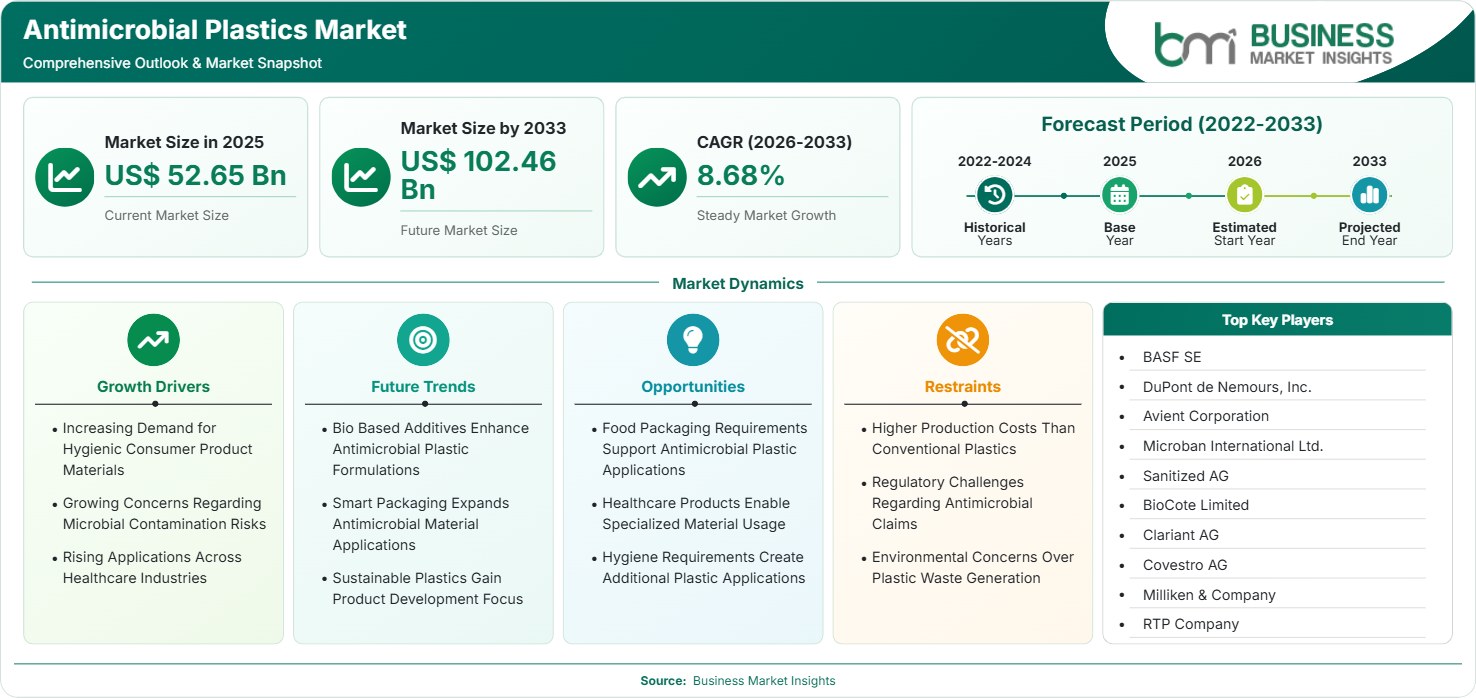
The Antimicrobial Plastics Market size was valued at US$ 52.65 Billion in 2025 and is projected to reach US$ 102.46 Billion by 2033, growing at a CAGR of 8.68% during 2026–2033, driven by infection-control requirements, healthcare infrastructure expansion, food safety regulations, smart packaging adoption, and increasing demand for durable antimicrobial materials across consumer and industrial applications.

Report Coverage
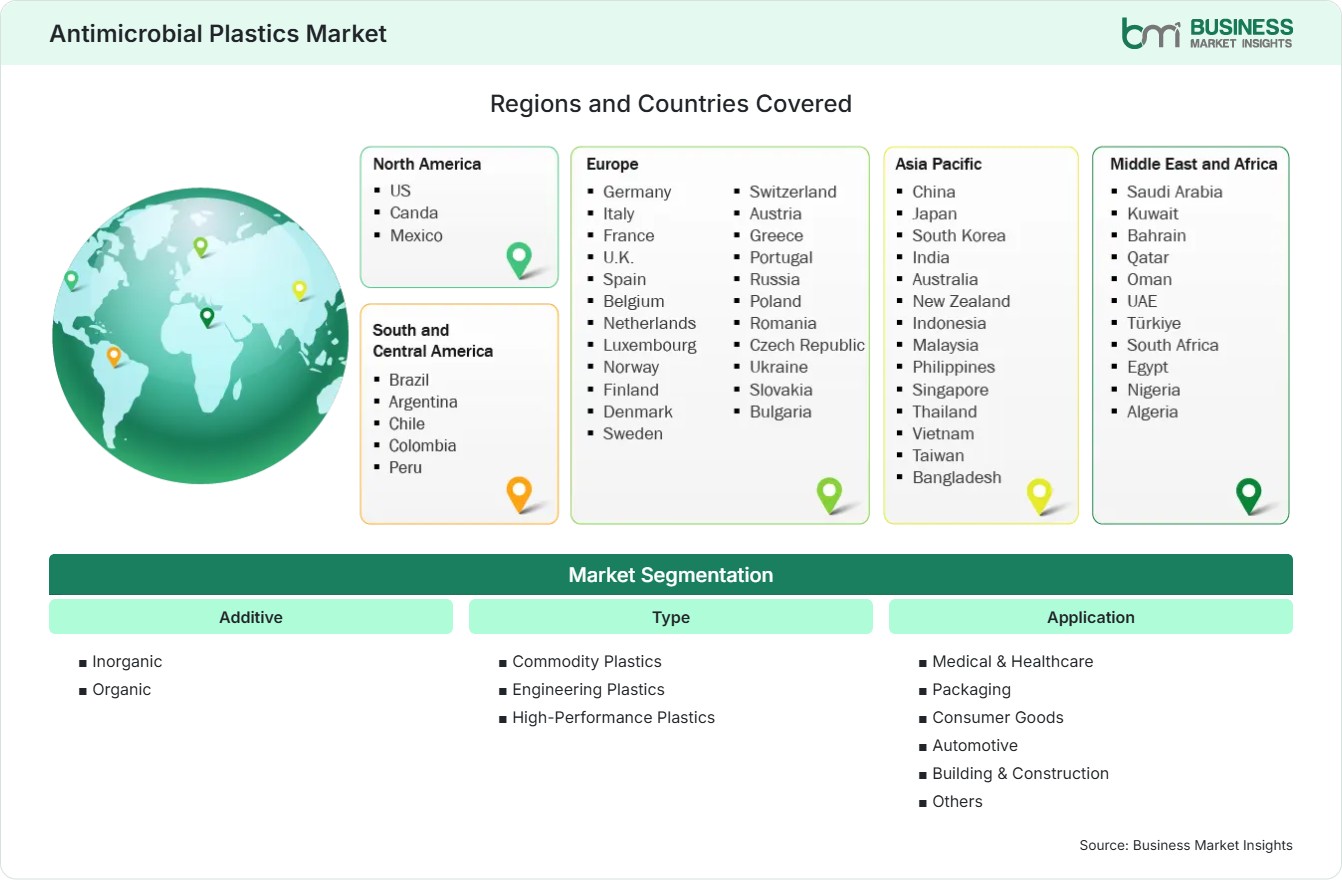
  • Additive: Inorganic, Organic
  • Type: Commodity Plastics, Engineering Plastics, High-Performance Plastics
  • Application: Medical & Healthcare, Packaging, Consumer Goods, Automotive, Building & Construction, Others
US$ 52.65 Bn Market size in 2025
US$ 102.46 Bn Market Size by 2033
8.68% CAGR, 2026 - 2033
2026-2033 Forecast Period

AI Overview

Antimicrobial Plastics Market Summary

  • North America Region: North America holds a market share of 34%–37% in 2025, growing with a CAGR of 7.8%–8.2% during 2026–2033. Demand is supported by healthcare investments, advanced medical device manufacturing, packaging innovation, infection-control regulations, sustainable antimicrobial formulations, and replacement of conventional materials in high-contact environments. US market benefits from medical device innovation and healthcare construction activity, advancing at approximately 7.9%–8.3% CAGR.
  • Fastest Growing Region: Asia Pacific accounts for 28%–31% share in 2025 and expands at 10.1%–10.6% CAGR during 2026–2033. Growth stems from healthcare modernization, electronics manufacturing, food packaging demand, urban construction activity, rising hygiene awareness, and increasing domestic polymer production capacity.
  • Leading Segment: Medical & Healthcare represents 28%–31% share of the Antimicrobial Plastics Market in 2025 and advances at 9.0%–9.4% CAGR. Adoption is driven by infection prevention programs, healthcare facility upgrades, catheter and device applications, hospital hygiene requirements, and stricter contamination-control standards worldwide.
  • High Growth Segment: Engineering Plastics accounts for 24%–27% share in 2025 and expands at 9.6%–10.1% CAGR. Increasing use within automotive electronics, medical components, industrial systems, lightweight designs, performance requirements, and long-term antimicrobial functionality supports accelerating demand.
  • Key Market Opportunity: Integration of antimicrobial functionality into recyclable polymers, smart packaging, healthcare furniture, transit interiors, and consumer electronics creates new premium product categories while supporting sustainability targets and regulatory compliance.
  • Major Market Players: BASF SE, DuPont de Nemours, Inc., Avient Corporation, Microban International Ltd., Sanitized AG, BioCote Limited, Clariant AG, Covestro AG, Milliken & Company, and RTP Company.
Strategic Insights

Antimicrobial Plastics Market: Strategic Insights

Antimicrobial Plastics Market Strategic Framework
FREE PDF
Request your free sample
Request free sample
Stakeholder View

Key Takeaways

  • The value chain increasingly depends on additive suppliers, compounders, resin manufacturers, medical device producers, and packaging converters working collaboratively to achieve certified antimicrobial performance.
  • The highest commercial upside is concentrated in healthcare equipment, diagnostic devices, pharmaceutical packaging, and high-contact consumer products where hygiene differentiation supports premium pricing.
  • Product innovation is shifting toward low-loading antimicrobial additives, recyclable formulations, bio-based active agents, and multifunctional materials offering durability alongside microbial protection.
  • Asia Pacific presents the strongest greenfield investment case due to expanding healthcare systems, electronics manufacturing capacity, and rising consumption of packaged food products.
  • Strategic acquisitions increasingly target additive specialists and polymer technology providers capable of accelerating regulatory approvals and expanding high-margin application portfolios.
  • Sustainability objectives are encouraging manufacturers to integrate antimicrobial functionality into circular economy initiatives, creating opportunities for recycled-content and reusable product platforms.
Geographic Outlook

Antimicrobial Plastics Market Regional Highlights

North America Antimicrobial Plastics Market

North America represents approximately 34%–37% of the Antimicrobial Plastics Market share in 2025 and records a CAGR of 7.8%–8.2% through 2033. Strong healthcare spending, sophisticated medical device manufacturing capabilities, and stringent safety standards support regional demand. Packaging applications continue expanding in food, pharmaceutical, and consumer sectors. Increased adoption of antimicrobial surfaces in educational facilities, transportation systems, and public infrastructure contributes additional momentum. Innovation activity remains concentrated in the United States and Canada, where compounders and additive developers actively commercialize advanced antimicrobial technologies.

  • Healthcare procurement standards increasingly specify antimicrobial materials for high-touch surfaces, accelerating adoption across hospitals, long-term care facilities, and ambulatory centers.
  • Food packaging producers prioritize contamination reduction and shelf-life optimization, encouraging broader integration of antimicrobial polymer technologies.
  • Sustainability-focused product development encourages compatibility between antimicrobial additives and recyclable plastic formulations.
  • Regulatory emphasis on infection prevention continues stimulating investment in specialty polymers across institutional and commercial applications.

US Antimicrobial Plastics Market

The US accounts for 76%-80% of North America’s revenue share and is growing at a 7.9%-8.3% CAGR. Drivers include a developed healthcare sector infrastructure, advanced polymer R&D facilities, and wide commercialization of specialty polymers. Applications include medical devices, healthcare furniture, pharmaceutical packaging, and consumer products. Innovation-driven ecosystems support the consistent development of novel antimicrobial additives that meet performance and compliance criteria, improving national competitiveness in domestic and export markets.

  • Hospital-acquired infection reduction initiatives encourage greater deployment of protected surfaces across patient environments.
  • Medical device manufacturers increasingly employ specialty engineering polymers capable of maintaining performance after repeated sanitation cycles.
  • Consumer awareness of product hygiene supports premiumization across household goods and electronic accessories.
  • Federal and private healthcare construction investments sustain demand for antimicrobial material specifications.

Europe Antimicrobial Plastics Market

Europe captures the share of 24% to 27% in 2025 and experiences an 8.1% to 8.6% CAGR throughout the forecasted period. The regulatory focus on product safety and sustainability drives regional adoption. Germany continues to be the dominant country market, and rapid investment in manufacturing is evident in Eastern Europe. The Antimicrobial Plastics Market growth in Europe is driven by initiatives to improve healthcare facilities, packaging innovations, and the need for antimicrobial products in infrastructure. France and the UK continue to have high consumption in the healthcare and consumer sectors.

  • Germany leads regional demand with strong medical technology and advanced materials manufacturing capabilities.
  • Poland and other Central European countries exhibit above-average expansion supported by industrial development initiatives.
  • Circular economy objectives encourage innovation in recyclable antimicrobial plastic solutions.
  • Food-contact packaging regulations continue driving adoption of advanced additive technologies.

Asia Pacific Antimicrobial Plastics Market

The Asia Pacific holds a 28%-31% share in 2025 and has the highest CAGR of 10.1%-10.6%. The region's largest market is China, driven by healthcare manufacturing and packaging. India is set to be the fastest-growing national market due to increased healthcare spending and growth in plastics manufacturing. Growth in the urban population, increased hygiene and awareness, and the growing production of electronics are favorable drivers of demand. Regional governments are still promoting industrial modernization for long-term growth across healthcare, construction, packaging, and consumer goods applications.

  • China benefits from extensive polymer production capacity and integrated manufacturing ecosystems.
  • India demonstrates rapid expansion through hospital infrastructure development and medical device localization programs.
  • Southeast Asian economies support demand through food processing and export-oriented packaging industries.
  • Consumer electronics manufacturing creates growing opportunities for antimicrobial engineering plastics.
  • Construction activity promotes adoption in high-contact building components and fixtures.

Rest of World Antimicrobial Plastics Market

Rest of World is estimated to have a market share of 11% - 14%, growing at a CAGR of 8.5% - 9%. Increasing use of antimicrobial packaging and healthcare facilities in South and Central America is driving demand. Brazil is estimated to be the dominant regional market, owing to increasing industry diversity and healthcare development.

Demand from the Middle East and Africa is driven by the building of healthcare infrastructure, food security policies, and the use of premium consumer products. Gulf countries exhibit strong investment activity, while South Africa serves as an important regional manufacturing and distribution hub.

  • Brazil leads regional consumption through healthcare expansion and packaging sector modernization.
  • Mexico benefits from proximity to North American manufacturing supply chains.
  • Saudi Arabia demonstrates accelerated healthcare infrastructure spending and procurement of advanced materials.
  • United Arab Emirates supports innovation through medical tourism and healthcare facility investments.
  • South Africa remains an important gateway market for broader African adoption trends.
Global Market Geography
FREE PDF
Request your free sample
Request free sample
Segment Analysis

Antimicrobial Plastics Market Segmentation

Additive

This category holds around 38%-42% market share in 2025 and has a CAGR of 8.4%-8.9%. The factors driving demand include efficacy, regulatory acceptance, longevity, and compatibility with different polymer systems. The scope of the antimicrobial plastics market will continue to widen as additive manufacturers develop low-dose techniques that maintain long-term antimicrobial properties without compromising process efficiency.

  • Inorganic: Silver, copper, and zinc-based systems remain widely preferred for durability, thermal stability, and long-term effectiveness in medical, packaging, and construction applications requiring continuous antimicrobial activity.
  • Organic: Organic antimicrobial technologies gain adoption where transparency, processing flexibility, and application-specific performance are prioritized, particularly within consumer products and specialty packaging formats.

Type

The type segment carries around 30%-33% market share in 2025 and is expected to grow at a CAGR of 8.8%-9.3%. Increased demand for lightweight, performance, and hygiene will drive its adoption in various industrial and consumer end-use industries. Product differentiation now relies heavily on striking a balance between antimicrobial properties and other aspects.

  • Commodity Plastics: Dominant in packaging and consumer applications where affordability, scalability, and established processing infrastructure support widespread antimicrobial integration.
  • Engineering Plastics: Increasingly selected for medical devices, automotive systems, and electronics because of superior mechanical properties and reliable long-term performance.
  • High-Performance Plastics: Favored in demanding environments requiring thermal stability, chemical resistance, and durable antimicrobial protection across specialized industrial applications.

Application

Demand for applications is highly diverse and will account for 45%–48% market share by 2025, expanding at a CAGR of 9.0%–9.4%. The Medical & Healthcare segment leads the pack due to infection control needs. The Antimicrobial Plastics Market trends now favor use in packaging, consumer goods, transport, and construction.

  • Medical & Healthcare: Hospitals, patient-contact devices, diagnostic equipment, and healthcare furniture increasingly utilize antimicrobial polymers to reduce contamination risk and enhance hygiene outcomes.
  • Packaging: Food, pharmaceutical, and specialty consumer packaging adopts antimicrobial solutions to improve safety, shelf stability, and product protection throughout distribution networks.
  • Consumer Goods: Household products, appliances, electronics accessories, and personal-use items increasingly incorporate antimicrobial features as hygiene expectations rise among consumers.
  • Automotive: Vehicle interiors employ antimicrobial materials within touchpoints, seating components, and control interfaces to improve cleanliness and long-term surface protection.
  • Building & Construction: Door handles, wall panels, fixtures, and high-contact building surfaces increasingly integrate antimicrobial properties within institutional and commercial environments.
Market Forces

Antimicrobial Plastics Market Dynamics

Key Market Drivers

Rising Infection Control Requirements Across Healthcare Systems

Infection acquired in healthcare settings is a major threat to operations and the economy worldwide, making it necessary for hospitals and medical device manufacturers to consider materials that cannot be contaminated. Infection prevention and hygiene have always been emphasized in WHO standards. Antimicrobial plastics minimize microbial growth on surfaces. An increase in the number of ambulatory clinics, laboratories, residential healthcare facilities, and even at-home care will increase the demand for this protected material. The increasing use of this material in catheters, equipment covers, trays, and furniture is driving demand for it in the healthcare industry.

Expansion of Advanced Food and Pharmaceutical Packaging

Food safety laws, pharmaceutical supply rules, and increased consumption of packaged foods are driving the adoption of antimicrobial packaging. There is a need for packaging material that improves hygiene, reduces the risk of contamination, and extends product shelf life. The rise in global e-commerce marketplaces and temperature-controlled logistics increases demand for packaging material. Many producers add antimicrobial agents to both flexible and rigid packaging materials. Increased differentiation and branding make antimicrobial packaging attractive from a business perspective. Regulations concerning food-contact materials are becoming stricter in many major economies during the forecast period.

Growing Consumer Preference for Hygienic Products

Consumers increasingly evaluate products according to hygiene, durability, and ease of maintenance. Household goods, appliances, mobile accessories, and public-use products benefit from embedded antimicrobial technologies. Growth drivers for Antimicrobial Plastics include increasing awareness of health and sanitation-centric buying practices. Such initiatives arise from product innovation, premium positioning, and marketing practices that emphasize surface protection. Other commercial spaces, such as educational institutions, offices, airports, and hotels, require materials that keep their surfaces clean even in between regular cleanings. These behavioral and institutional shifts continue expanding addressable opportunities across multiple end-use categories.

Key Market Opportunities

Recyclable and Sustainable Antimicrobial Material Platforms

Circular economy programs have enabled the consideration of antimicrobial properties in the context of recyclable plastics and products. Material companies are focusing on designing materials that are recyclable yet maintain antimicrobial efficacy. This shift is consistent with firms' sustainability goals and the development of environmental legislation. Antimicrobial Plastics Market forecasts continue to account for the need for materials that meet hygiene requirements while optimizing material usage. Firms operating in the packaging industry, healthcare, and consumer goods industries are looking for materials that help them meet both criteria. Companies that successfully commercialize recyclable antimicrobial compounds are positioned to capture premium value and gain strategic competitive advantages.

Rapid Penetration into Smart Consumer Electronics

Consumer electronics are increasingly using hygienic materials in their products, including smartphones, wearables, accessories, and shared electronic devices. Antimicrobial plastics have become an effective means of achieving this objective without any modifications to product design. The increasing use of digital interfaces in the public sector, self-service kiosks, and educational technology machines is widening their scope of application. The life cycle of consumer electronics is lengthening, prompting companies to use more durable antimicrobial materials in their products.

Healthcare Infrastructure Expansion in Emerging Economies

Healthcare spending continues to rise in emerging nations, driven by hospital construction and investment in medical equipment. There are numerous opportunities in such applications from surfaces, furniture, medical devices, and various packaging materials. Nations such as India, Saudi Arabia, Indonesia, and Vietnam are rapidly developing their medical infrastructure. Companies that can provide value-for-money antimicrobial solutions in line with regional needs are likely to benefit from this trend. Cooperation with regional converters, compounders, and medical device manufacturers is a good strategy for rapid market entry. Long-term demographic trends and rising healthcare utilization support durable demand expansion across emerging economies.

Market Restraints and Challenges

High Additive Costs and Pricing Pressure

Factor: More advanced antimicrobial additives, especially those based on silver technology, often result in more costly production than traditional plastic formulations. Effect: Cost-sensitive industries might hold off on implementing such materials or limit their use to expensive cases. Producers need to ensure that the material is both effective and compliant with regulations, and profitable despite competing with cheaper alternatives. Inability to accurately budget and plan for procurement because of fluctuations in the cost of raw materials. It could prove difficult for smaller manufacturers to access the technology at reasonable prices. These challenges can slow penetration rates in price-driven applications despite demonstrated hygiene benefits and performance advantages.

Complex Regulatory Validation Requirements

Factor: Usually, efficacy claims for these antimicrobial agents involve regional testing, certification, and documentation. Impact: There may be an increase in time-to-market and higher cost consequences. Inconsistencies in the regulatory framework complicate matters for multinationals. Performance specifications vary from one application to another, particularly within the healthcare and food sectors. Investments must be made to facilitate testing and compliance efforts. Such factors can pose barriers for smaller companies seeking market access.

Company Analysis

Competitive Landscape

The competitive environment reflects increasing specialization in additives, compounding technologies, and application engineering. Antimicrobial Plastics Market analysis indicates that companies are strengthening portfolios through innovation, regulatory expertise, and partnerships targeting healthcare, packaging, construction, and consumer applications.

Company Name

Overview

Products and Services relevant to this market

BASF SE

Global chemical leader with extensive engineered materials and additive capabilities serving healthcare, industrial, and consumer sectors.

Antimicrobial polymer formulations, engineering plastics, specialty compounds, advanced material solutions for hygiene-critical applications.

DuPont de Nemours, Inc.

Diversified technology company with strong presence in advanced materials and healthcare-oriented solutions.

Specialty polymers, healthcare materials, protective components, antimicrobial-enabled product platforms.

Avient Corporation

Specialist in customized polymer formulations and performance material engineering.

Antimicrobial additives, colorant technologies, engineered compounds, customized resin solutions.

Microban International Ltd.

Dedicated antimicrobial technology provider serving global manufacturers across multiple industries.

Antimicrobial additives, odor-control technologies, product certification and support services.

Sanitized AG

Swiss specialist recognized for antimicrobial and hygiene technologies.

Antimicrobial additives, material protection systems, hygiene enhancement technologies.

BioCote Limited

Focused provider of antimicrobial technologies integrated into manufactured products.

Antimicrobial ingredient systems, technical support, performance validation solutions.

Clariant AG

Specialty chemicals company serving plastics, packaging, healthcare, and industrial applications.

Functional additives, antimicrobial technologies, performance enhancement materials.

Covestro AG

Advanced materials producer with broad polymer innovation capabilities.

High-performance polymer solutions, specialty compounds, industrial material platforms.

Milliken & Company

Innovation-driven manufacturer active in chemicals and material sciences.

Additives, color technologies, antimicrobial enhancement systems, specialty materials.

RTP Company

Global compounder specializing in custom thermoplastic solutions.

Antimicrobial compounds, engineered thermoplastics, application-specific polymer development.

Trust & Transparency

Research Methodology

The market analysis combines proprietary research with secondary data from government agencies, company disclosures, regulatory filings, industry databases and expert interviews. Market estimates are validated through data triangulation, cross-market benchmarking and analyst review.

View Full Research Methodology

Questions Answered

Frequently Asked Questions

What does an Antimicrobial Plastics Market Report typically evaluate?

A Market Report generally assesses demand trends, technology innovation, competitive positioning, regulatory developments, regional opportunities, end-use applications, and strategic growth prospects across the value chain.

How are sustainability targets influencing product development?

Manufacturers are developing recyclable antimicrobial compounds, bio-based additive systems, and circular-economy-compatible formulations that balance environmental objectives with hygiene performance requirements.

What makes Asia Pacific the fastest-growing regional market?

Rapid industrialization, healthcare expansion, packaging demand growth, rising hygiene awareness, and increasing polymer production capacity contribute to stronger regional expansion compared with mature markets.

Why are engineering plastics growing faster than other material types?

Engineering plastics combine mechanical strength, chemical resistance, lightweight properties, and durability, making them increasingly suitable for healthcare devices, electronics, and transportation applications requiring long-lasting antimicrobial performance.

Which application generates the largest revenue demand?

Medical and healthcare applications lead revenue generation due to strict infection-control requirements, extensive usage in medical devices, hospital equipment, and growing investment in healthcare infrastructure worldwide.

Access the Full Antimicrobial Plastics Market Report

Get segment-level forecasts, regional estimates, competitive benchmarking, company profiles and downloadable Excel datasets.

Access the full Antimicrobial Plastics Market Report
350 pages PDF & Excel | 2026-09-16
Similar Research

Related Market Reports