
Thermosetting Plastics Market Outlook: Size, Share, Trends, Growth Analysis, Competitive Landscape & Forecast, 2026-2033

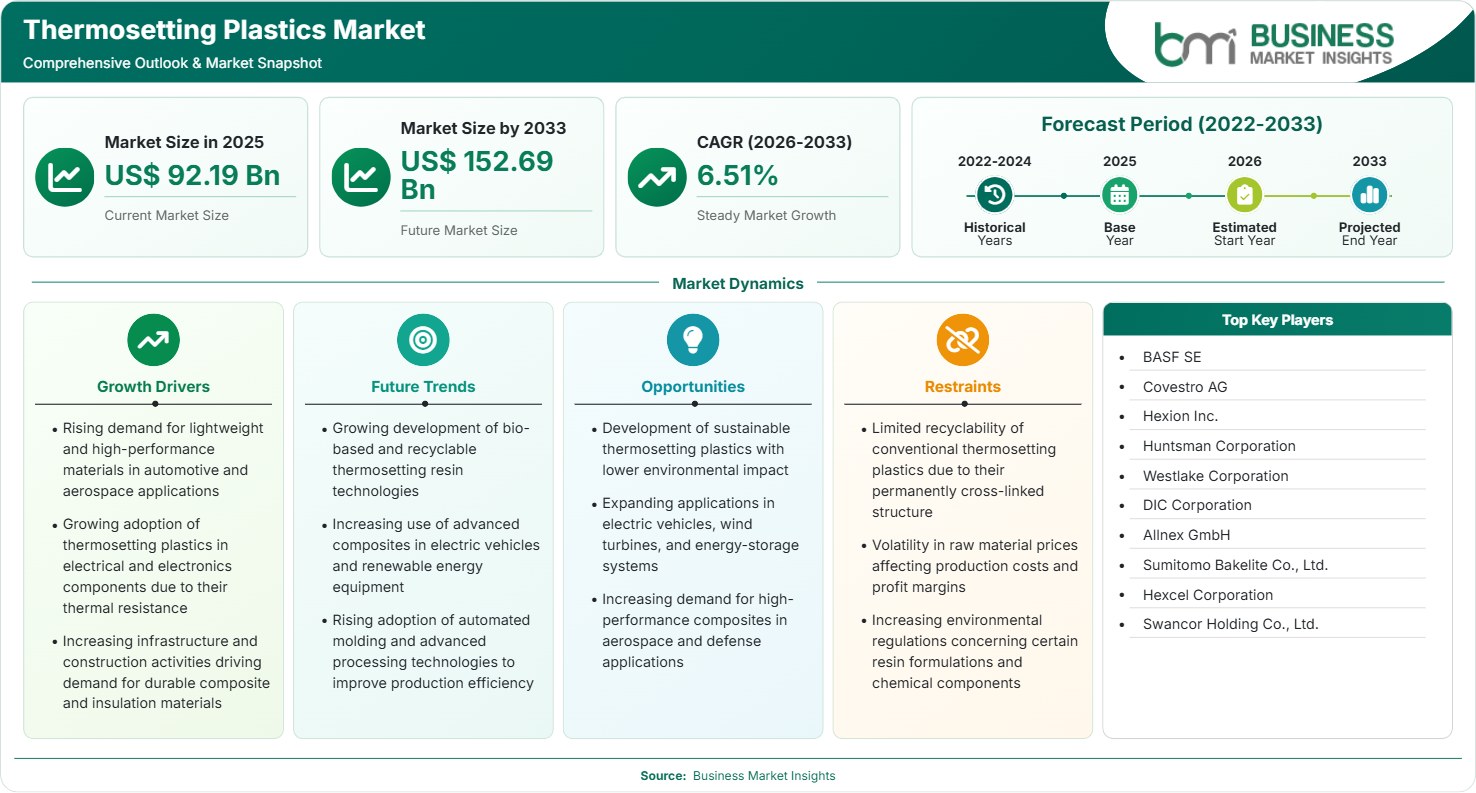
The Thermosetting Plastics Market size was valued at US$ 92.19 Billion in 2025 and is projected to reach US$ 152.69 Billion by 2033, growing at a CAGR of 6.51% during 2026–2033. Rising demand from construction, automotive lightweighting initiatives, renewable energy installations, advanced electronics manufacturing, and high-performance composite applications continues to create significant opportunities across industrial and infrastructure sectors.

Report Coverage
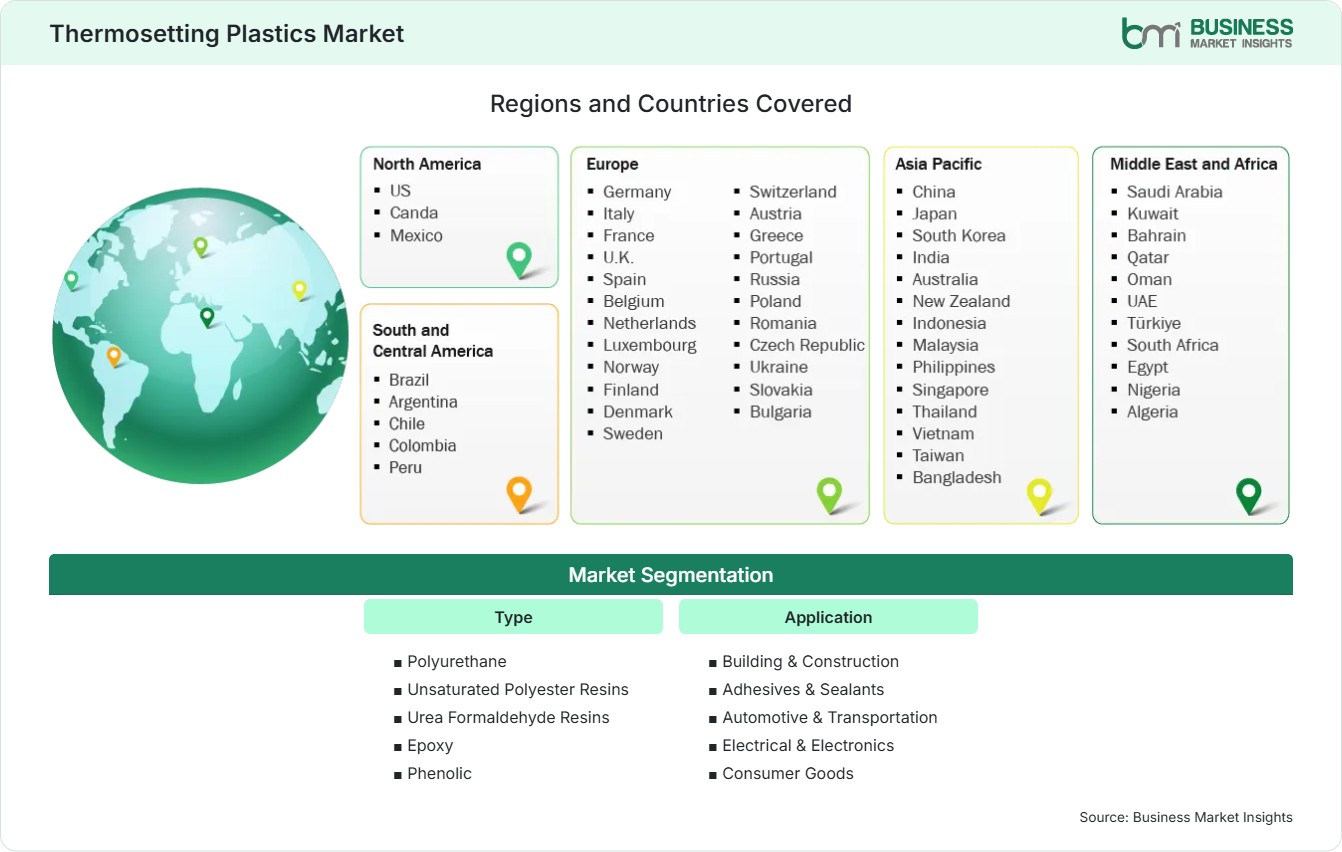
  • Type: Polyurethane, Unsaturated Polyester Resins, Urea Formaldehyde Resins, Epoxy, Phenolic
  • Application: Building & Construction, Adhesives & Sealants, Automotive & Transportation, Electrical & Electronics, Consumer Goods
US$ 92.19 Bn Market size in 2025
US$ 152.69 Bn Market Size by 2033
6.51% CAGR, 2026 - 2033
2026-2033 Forecast Period

01 AI Overview

Thermosetting Plastics Market Summary

  • North America Region: North America holds a Thermosetting Plastics Market share range of 32%–35% in 2025, growing with a CAGR range of 5.8%–6.2% during 2026–2033. Demand is supported by advanced composites manufacturing, aerospace investments, electric vehicle production, infrastructure modernization programs, renewable energy deployment, and increasing adoption of durable industrial materials across sectors. The U.S. market benefits from strong aerospace, electronics, and construction demand, advancing at a CAGR of 5.9%–6.3% through 2033.
  • Fastest Growing Region: Asia Pacific holds a Thermosetting Plastics Market share range of 38%–41% in 2025, growing with a CAGR range of 7.2%–7.8% during 2026–2033. Expansion of manufacturing capacity, urban infrastructure projects, electronics production, automotive electrification, wind energy installations, and industrial modernization initiatives continue supporting accelerated regional demand across end-use industries.
  • Leading Segment: Epoxy holds a market share range of 28%–31% in 2025, growing with a CAGR range of 6.8%–7.2% during 2026–2033. Strong utilization in coatings, electronics encapsulation, structural adhesives, wind turbine blades, and advanced composites supports sustained consumption across multiple high-value industrial applications globally.
  • High Growth Segment: Electrical & Electronics holds a market share range of 18%–21% in 2025, growing with a CAGR range of 7.5%–8.1% during 2026–2033. Increasing semiconductor packaging requirements, insulation applications, circuit protection needs, miniaturized devices, and expanding digital infrastructure investments continue driving material demand worldwide.
  • Key Market Opportunity: Expanding renewable energy infrastructure, particularly wind energy blades, electrical insulation systems, battery components, and lightweight transportation structures, creates attractive long-term opportunities for advanced thermoset resin manufacturers and composite suppliers globally.
  • Major Market Players: BASF SE, Covestro AG, Hexion Inc., Huntsman Corporation, Westlake Corporation, DIC Corporation, Allnex GmbH, Sumitomo Bakelite Co., Ltd., Hexcel Corporation, and Swancor Holding Co., Ltd.
02 Strategic Insights

Thermosetting Plastics Market: Strategic Insights

Thermosetting Plastics Market Strategic Framework
FREE PDF
Request your free sample
Request free sample
03 Stakeholder View

Key Takeaways

  • The value chain is becoming increasingly integrated, with resin manufacturers, composite fabricators, and end-use industries collaborating to improve material performance, supply reliability, and application-specific customization.
  • Electrical systems, infrastructure related to renewables, and light-weight parts in transportation offer the best short-term commercial prospects because of increasing performance needs and regulations.
  • The innovations being worked on include bio-based thermosets, recyclable composites, low emission curing systems, and formulations for improved thermal and mechanical properties.
  • Asia Pacific offers the most compelling investment environment, supported by manufacturing expansion, electronics production growth, infrastructure development, and increasing industrial output across major economies.
  • Acquisitions, strategic alliances, and technology collaborations are gaining momentum with manufacturers looking to expand their geographical presence, specific product range, and entry into end-user applications that are growing rapidly.
  • Sustainability initiatives are altering purchasing strategies, prompting innovations in lower-emission manufacturing technologies and sustainable resin technologies.
04 Geographic Outlook

Thermosetting Plastics Market Regional Highlights

North America Thermosetting Plastics Market

North America accounts for approximately 32%–35% of global demand in 2025 and is expected to expand at a CAGR of 5.8%–6.2% through 2033. The advantages associated with this region include good aerospace manufacturing, adoption of advanced construction materials, and growing renewable energy installations. Good research capacity and well-developed industrial infrastructure facilitate the commercialization of high-performance resins. Growing investments in electric vehicles, modernization of industrial machinery, and intensive use of composites further enhance the competitive edge of the region. Thermosetting Plastics Market share is still high in all industries.

  • Aerospace manufacturers increasingly utilize advanced thermoset composites to reduce weight, improve fuel efficiency, and enhance structural performance, supporting continuous material demand across commercial and defense aviation programs.
  • Wind turbine blade manufacturing remains a major consumption driver as utilities expand renewable energy generation capacity and pursue long-term decarbonization objectives across North American markets.
  • Construction activity increasingly incorporates durable resin-based materials in infrastructure rehabilitation projects, improving lifecycle performance and reducing maintenance requirements in transportation and utility networks.
  • Expanding electric vehicle production stimulates demand for insulation systems, lightweight structural components, and adhesive technologies capable of meeting evolving performance standards.

US Thermosetting Plastics Market

The United States represents approximately 74%–78% of regional demand and is projected to advance at a CAGR range of 5.9%–6.3% through 2033. Strong domestic manufacturing capabilities, expanding renewable energy projects, and further investments in aerospace contribute to market growth. Federal government’s infrastructure spending plans and industrial reshoring projects make increased use of advanced materials possible. Electronics manufacturing, defense manufacturing, and transportation upgrades keep contributing to positive demand dynamics in important end-use markets.

  • Large-scale investments in semiconductor manufacturing facilities are increasing demand for encapsulation materials, insulation systems, and high-performance resin formulations across electronics applications.
  • Defense modernization programs continue supporting consumption of advanced composites and specialized thermoset materials in aerospace, naval, and tactical equipment manufacturing environments.
  • Renewable energy deployment strategies encourage increased utilization of durable composite materials capable of delivering long operational lifespans in demanding environmental conditions.
  • Domestic infrastructure modernization programs support adoption of corrosion-resistant and structurally durable materials for transportation, utilities, and industrial construction applications.

Europe Thermosetting Plastics Market

Europe holds a Thermosetting Plastics Market share range of 24%–27% in 2025 and is anticipated to register a CAGR of 5.5%–5.9% during 2026–2033. Sustainability regulations, advanced automotive manufacturing capabilities, and growing renewable energy investments support regional demand. Germany remains the leading market with estimated growth of 5.6%–6.0%, while Poland emerges among the fastest-growing countries with growth exceeding 6.5%. Industrial decarbonization efforts and increasing utilization of lightweight materials across transportation sectors continue strengthening regional consumption patterns.

  • Automotive manufacturers are increasing use of advanced composites and structural resins to improve vehicle efficiency and support electrification initiatives across European markets.
  • Offshore wind energy projects continue generating demand for specialized resin systems used in large-scale turbine blade manufacturing and infrastructure applications.
  • Circular economy initiatives encourage innovation in sustainable thermoset technologies, including lower-emission production methods and advanced material recovery solutions.
  • Industrial equipment manufacturers increasingly specify high-performance materials capable of withstanding demanding operating conditions and stringent regulatory requirements.

Asia Pacific Thermosetting Plastics Market

Asia Pacific commands a market share range of 38%–41% in 2025 and is forecast to expand at a CAGR of 7.2%–7.8% through 2033, representing the fastest regional growth profile. China remains the largest contributor with estimated growth between 7.0%–7.5%, while India demonstrates some of the strongest expansion rates above 8.0%. Rapid industrialization, electronics manufacturing growth, infrastructure development, and renewable energy deployment continue driving regional consumption. The Thermosetting Plastics Market trend trajectory remains particularly strong across advanced manufacturing sectors.

  • Expanding electronics manufacturing ecosystems increase demand for encapsulation materials, insulation systems, and specialty resin technologies throughout major production hubs.
  • Significant investments in transportation infrastructure and urban development projects support rising utilization of durable construction materials and engineered polymer systems.
  • Wind and solar energy deployment programs continue stimulating demand for composite materials capable of delivering high mechanical performance and long service life.
  • Growing automotive production, particularly electric vehicles, supports increasing consumption of lightweight components and advanced adhesive technologies across regional supply chains.

Rest of World Thermosetting Plastics Market

The Rest of World region accounts for approximately 8%–11% of global demand in 2025 and is expected to expand at a CAGR of 6.0%–6.6% through 2033. South & Central America benefits from infrastructure development, automotive manufacturing activity, and increasing industrial investments. Brazil remains the leading Thermosetting Plastics Market with growth around 6.1%–6.5%. The Middle East & Africa region is supported by industrial diversification programs, renewable energy investments, and construction sector expansion. Saudi Arabia and the UAE continue attracting manufacturing investment, while South Africa demonstrates steady demand across industrial applications.

  • Industrial diversification initiatives across Gulf economies encourage establishment of advanced materials manufacturing capabilities and downstream value-added production activities.
  • Infrastructure modernization projects in Latin America support increasing consumption of adhesives, coatings, insulation systems, and structural composite materials.
  • Renewable energy deployment strategies create opportunities for suppliers serving wind energy, electrical infrastructure, and advanced construction applications.
  • Urbanization trends across emerging economies continue driving demand for durable engineered materials used in transportation and building projects.
Global Market Geography
FREE PDF
Request your free sample
Request free sample
05 Segment Analysis

Thermosetting Plastics Market Segmentation

Type

The Type segment represents the foundation of demand across industrial, infrastructure, transportation, and electronics applications. This segment accounted for approximately 58%–61% of total market revenue in 2025 and is expected to expand at a CAGR of 6.4%–6.8% through 2033. Selection of products is dependent on thermal stability, mechanical properties, chemical resistance, and processing needs. There is a constant widening of the Thermosetting Plastics Market scope due to the development of superior products for durable, reliable performance.

  • Polyurethane: Polyurethane thermosets are increasingly utilized in insulation systems, industrial coatings, composite structures, and construction materials due to excellent durability, energy efficiency, and resistance to demanding environmental conditions.
  • Unsaturated Polyester Resins: Unsaturated polyester resins remain widely adopted in marine structures, construction panels, tanks, and transportation components because of cost-effectiveness, process flexibility, and compatibility with composite manufacturing methods.
  • Urea Formaldehyde Resins: Urea formaldehyde resins maintain strong demand across wood panels, furniture manufacturing, and engineered construction materials where dimensional stability, bonding strength, and efficient processing characteristics are essential.
  • Epoxy: Epoxy materials lead the segment owing to superior adhesion, corrosion resistance, electrical insulation properties, and extensive deployment in wind energy, aerospace, electronics, and industrial composite applications.
  • Phenolic: Phenolic thermosets are preferred in applications requiring fire resistance, thermal stability, and mechanical strength, including transportation interiors, industrial equipment, insulation systems, and specialty construction products.

Application

Application diversity continues to support market resilience across economic cycles. This segment accounted for approximately 39%–42% of Market activity in 2025 and is projected to register a CAGR of 6.7%–7.1% through 2033. The demand for products has been influenced by factors such as lightweighting, renewable energy generation, infrastructural improvements, and digitization. Thermosetting Plastics Market share in advanced industry applications is increasing owing to the need for performance and longevity in preference to traditional materials.

  • Building & Construction: Building and construction applications utilize thermosets in insulation systems, adhesives, coatings, engineered wood products, and structural composites to improve durability, energy efficiency, and long-term operational performance.
  • Adhesives & Sealants: Adhesives and sealants represent a critical application area where high bonding strength, environmental resistance, and compatibility with diverse substrates support growing industrial and construction adoption.
  • Automotive & Transportation: Automotive and transportation sectors increasingly deploy advanced thermosets in lightweight structural components, battery systems, interiors, and composite assemblies supporting fuel efficiency and vehicle electrification goals.
  • Electrical & Electronics: Electrical and electronics applications demonstrate robust momentum as manufacturers require advanced insulation materials, encapsulation compounds, connectors, and protective systems for increasingly sophisticated electronic devices.
  • Consumer Goods: Consumer goods manufacturers utilize thermosets in durable appliances, furniture components, sporting equipment, and household products where dimensional stability and long service life remain important purchasing factors.
06 Market Forces

Thermosetting Plastics Market Dynamics

Key Market Drivers

Expansion of Renewable Energy Composite Applications

Global renewable energy deployment continues accelerating demand for advanced thermoset materials, particularly within wind energy infrastructure. The use of modern turbine blades is reliant upon increasingly complex resin systems such as epoxy and polyester resins that offer high strength to weight ratios and increased service life. The energy industry has seen an increase in the use of increasingly complex composite resins in both large offshore and large land-based wind turbine blades. In addition, the push towards renewable energy and a reduction in reliance upon fossil fuels has seen the increased use of such high-performance thermoset materials in energy transition activities.

Growth in Lightweight Transportation Manufacturing

Transportation manufacturers are accelerating material substitution strategies to improve efficiency, durability, and performance. The Thermosetting Plastics Market growth is increasingly linked to rising adoption of lightweight composites in electric vehicles, commercial transportation systems, rail equipment, and aerospace platforms. Thermoset composites exhibit excellent mechanical strength, corrosion resistance, and weight-reduction benefits compared with many conventional material alternatives. Emissions-reduction and efficiency regulations provide an incentive for use. In light of the growing trend towards vehicle electrification around the world, and the need for increased driving ranges, the future market growth will be significantly fueled by the demand for advanced resin systems and structural composites.

Increasing Electronics and Electrical Infrastructure Demand

Rapid digitalization and expanding electrical infrastructure investments are generating significant opportunities for thermoset materials. Advanced electronics manufacturing relies on epoxy and phenolic systems for encapsulation, insulation, circuit protection, and component reliability. The expansion in semiconductor production, data centers, telecommunication systems, industrial automation, and smart grids leads to rising material consumption. Thermoregulation properties, electrical insulating capability, and dimensional stability will still be key considerations in selection. Manufacturers will keep on innovating in their efforts to formulate materials that will help address the changing needs of miniaturization, high temperature operation, and high reliability.

Key Market Opportunities

Development of Sustainable and Recyclable Thermoset Technologies

Sustainability objectives across industrial sectors are creating substantial opportunities for innovation. Bio-based raw materials, recyclable resins, and reduced-emission manufacturing technologies are being pursued by manufacturers to meet regulatory and customer requirements. In Thermosetting Plastics Market Forecasts, the demand for materials that support the circular economy is now being considered alongside performance specifications. Commercial interest is growing in research programs that address reversible curing chemistry, material recovery processes, and the use of renewable raw materials. The firms that can offer both sustainable value proposition along with economic performance are expected to benefit strategically as purchasing criteria change in the construction, transportation, and industrial sectors.

Expansion of Grid Modernization and Electrification Projects

National electrification strategies and power infrastructure modernization programs continue generating attractive investment opportunities. Advanced insulation materials, enclosures, composites, and electronics with capabilities of carrying complex transmission and distribution grids are necessary for utilities. Growing electricity demand due to EVs, industrial automation, and digital infrastructure reinforces the case for more sophisticated thermosets. Suppliers that are able to deliver materials which meet demanding standards regarding reliability, weather, and thermal properties stand to benefit from the long-term trends in infrastructure investments in both developed and developing countries.

Growth Potential in Emerging Industrial Economies

Emerging manufacturing hubs across Asia, the Middle East, and selected Latin American countries present considerable expansion opportunities. The initiatives related to industrial diversification, infrastructure spending, and increased domestic production capacity are leading to demand for new materials. New electronics manufacturing operations, automotive assembly plants, renewable energy ventures, and construction projects need high-performance thermosets that meet the local market demands. Proper strategic alliance and localized production can help gain better market penetration.

Market Restraints and Challenges

Volatility in Petrochemical Feedstock Costs

Factor: Thermoset resin production depends heavily on petrochemical-derived raw materials, many of which experience periodic price fluctuations resulting from energy market instability, supply disruptions, and geopolitical developments.

Impact: The volatility of feedstocks directly affects production costs, pricing, profit margins, and procurement activities across the entire supply chain. Producers usually encounter difficulties maintaining a balance between competitive pricing and profit margins, especially during periods of rapid cost increases. Small- and medium-scale producers may be adversely affected due to their low purchasing power.

Recycling Complexity and End-of-Life Management Issues

Factor: Conventional thermoset materials are permanently cross-linked during curing, making mechanical recycling significantly more challenging than many thermoplastic alternatives.

Impact: End-of-life management concerns create regulatory, environmental, and economic challenges for manufacturers and end users. Increasing sustainability requirements from governments and corporate stakeholders place pressure on producers to develop alternative recovery pathways and recyclable material solutions. Disposal costs, compliance obligations, and evolving environmental standards may influence purchasing decisions across several industries. Companies that fail to address circularity expectations risk competitive disadvantages as sustainability considerations become increasingly integrated into procurement and investment decisions.

07 Company Analysis

Competitive Landscape

The competitive environment is characterized by innovation in resin chemistry, expansion of composite material capabilities, and increasing focus on sustainability. Current Thermosetting Plastics Market analysis indicates that leading participants are investing in advanced formulations, renewable-energy applications, electronics materials, and regional manufacturing expansion to strengthen long-term market positioning.

Company Name

Overview

Products and Services relevant to this market

BASF SE

Global chemical manufacturer with extensive materials expertise and diversified industrial presence across automotive, construction, energy, and electronics sectors.

Thermoset intermediates, polyurethane systems, specialty resins, coatings solutions, composite materials, and performance chemicals supporting industrial applications.

Covestro AG

Leading polymer materials producer focused on high-performance solutions, sustainability initiatives, and advanced manufacturing technologies worldwide.

Polyurethane systems, specialty polymers, insulation materials, composite solutions, and engineered materials for transportation and construction sectors.

Hexion Inc.

Major producer of thermoset technologies serving industrial, construction, infrastructure, and specialty manufacturing applications globally.

Epoxy resins, phenolic resins, adhesives, coatings technologies, composite materials, and specialty thermoset formulations.

Huntsman Corporation

Diversified chemical company supplying advanced material technologies for transportation, construction, electronics, and industrial markets.

Polyurethane products, epoxy systems, adhesives, insulation materials, composite technologies, and specialty performance chemicals.

Westlake Corporation

Integrated materials manufacturer with broad chemical and building product operations supporting industrial development.

Specialty resins, building materials, industrial compounds, coatings ingredients, and performance materials for infrastructure applications.

DIC Corporation

Global specialty chemicals and materials producer serving electronics, automotive, packaging, and industrial sectors.

Epoxy materials, specialty resins, composite ingredients, coatings technologies, and electronic material solutions.

Allnex GmbH

Specialized industrial coatings and resin producer focused on innovation, sustainability, and high-performance applications.

Industrial resins, coating technologies, crosslinking systems, specialty polymers, and performance material solutions.

Sumitomo Bakelite Co., Ltd.

Established advanced materials manufacturer with strong expertise in thermoset and electronics-related technologies.

Phenolic resins, epoxy materials, molding compounds, semiconductor packaging materials, and specialty industrial products.

Hexcel Corporation

Global leader in advanced composites supporting aerospace, transportation, renewable energy, and industrial markets.

Composite reinforcements, prepregs, structural materials, engineered composites, and performance resin systems.

Swancor Holding Co., Ltd.

Composite materials specialist with strong participation in renewable energy and industrial composite applications.

Epoxy systems, composite materials, wind energy solutions, specialty resins, and industrial performance materials.

10 Trust & Transparency

Research Methodology

The market analysis combines proprietary research with secondary data from government agencies, company disclosures, regulatory filings, industry databases and expert interviews. Market estimates are validated through data triangulation, cross-market benchmarking and analyst review.

View Full Research Methodology

11 Questions Answered

Frequently Asked Questions

What information does a Thermosetting Plastics Market Report typically provide?

A comprehensive industry study generally includes market sizing, competitive benchmarking, regional assessments, application analysis, technology developments, investment opportunities, regulatory influences, and long-term demand outlooks across major end-use sectors.

Which segment currently holds the strongest market position?

Epoxy resins maintain a leading position because of their superior adhesion properties, mechanical strength, electrical insulation performance, and extensive utilization in wind energy, electronics, aerospace, coatings, and advanced composite applications.

How are sustainability goals influencing industry development?

Manufacturers are investing in bio-based feedstocks, lower-emission production technologies, and innovative recycling approaches. Sustainability considerations increasingly influence procurement strategies, research priorities, and long-term investment decisions across major end-use industries.

Why is Asia Pacific considered the fastest-growing regional market?

Asia Pacific benefits from rapid industrialization, expanding electronics manufacturing, infrastructure development, renewable energy investments, and increasing automotive production. Strong domestic demand and manufacturing capacity expansion continue supporting above-average growth rates across the region.

What are the primary applications driving demand for thermosetting plastics?

Demand is primarily driven by building and construction, transportation, electronics, adhesives, renewable energy, aerospace, and industrial equipment applications. These sectors require materials offering high thermal stability, mechanical strength, corrosion resistance, and long operational life.

Access the Full Thermosetting Plastics Market Report

Get segment-level forecasts, regional estimates, competitive benchmarking, company profiles and downloadable Excel datasets.

Access the full Thermosetting Plastics Market Report
350 pages PDF & Excel | 2026-08-26