Injection Molded Plastics Market Regional Highlights
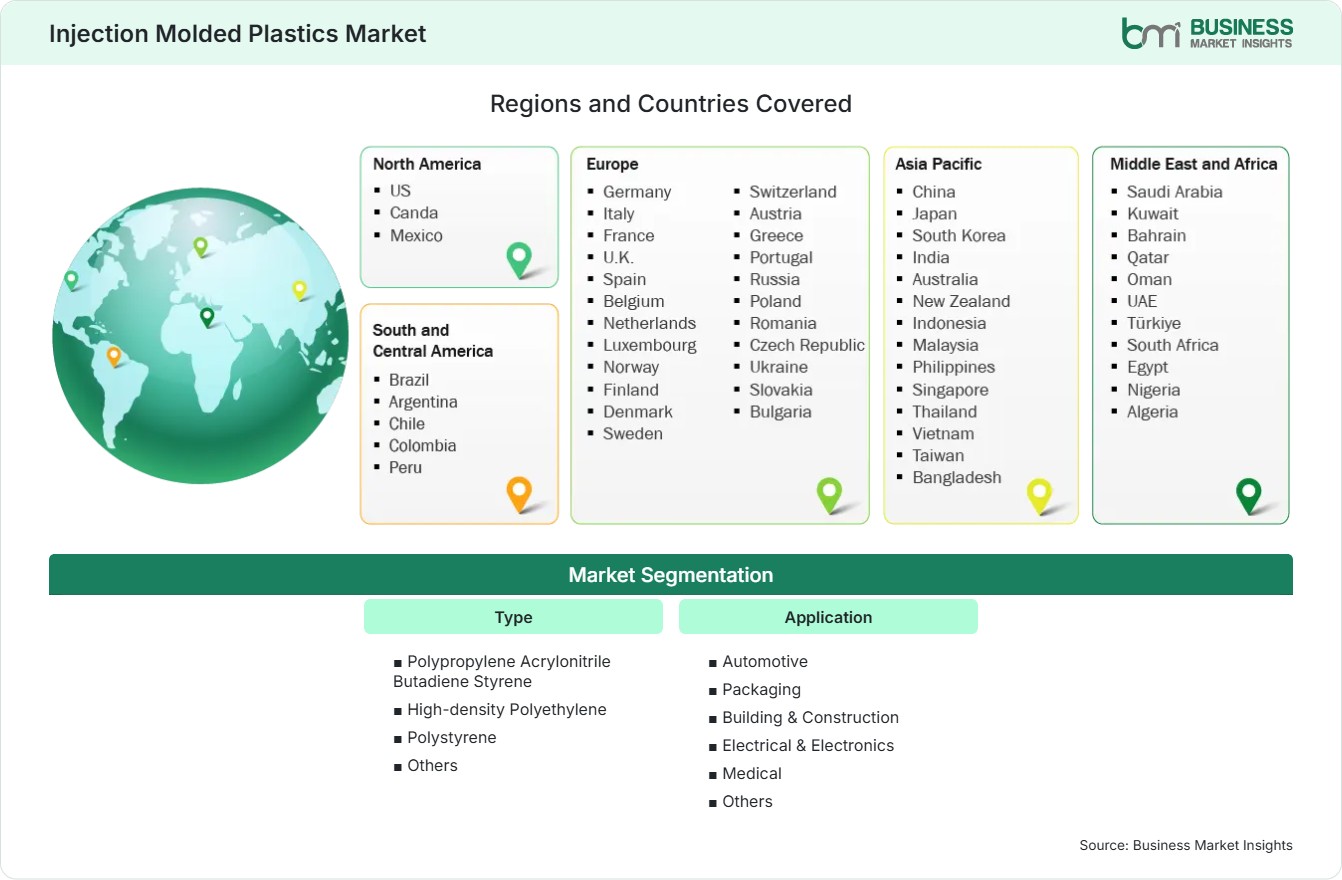
North America Injection-Molded Plastics Market
North America accounted for approximately 32%–35% of global demand in 2025 and is projected to expand at a CAGR of 7.3%–8.0% through 2033. The region benefits from advanced manufacturing capabilities, strong healthcare spending, robust packaging consumption, and significant automotive production. Demand for engineered polymers continues increasing as manufacturers pursue lightweight, durable, and sustainable components. Reshoring strategies and investments in automation support competitiveness while improving supply-chain resilience. The Injection-Molded Plastics Market share remains strongest in the United States and Canada.
- Automotive OEMs increasingly utilize molded plastic components to reduce vehicle weight, improve fuel efficiency, and support electric vehicle platform development while maintaining structural performance and cost competitiveness.
- Healthcare manufacturers continue expanding production of diagnostic equipment, drug-delivery devices, laboratory consumables, and disposable medical products requiring high-precision molding technologies and regulatory compliance.
- Packaging companies are investing in recyclable materials and lightweight container designs to address sustainability targets while maintaining performance, shelf appeal, and operational efficiency requirements.
- Digital manufacturing adoption, including robotics and real-time process monitoring, is improving productivity, reducing defects, and enhancing profitability across molding operations throughout the region.
- Strong investments in advanced materials research encourage development of high-performance polymers suitable for aerospace, electronics, industrial, and healthcare applications.
US Injection-Molded Plastics Market
The United States represents approximately 74%–78% of regional demand and is projected to grow at a CAGR of 7.5%–8.2% through 2033. Extensive manufacturing infrastructure, strong consumer markets, and significant innovation activities support industry expansion. Demand remains particularly strong across packaging, healthcare, automotive, and electronics applications. Investments in domestic production capabilities and advanced manufacturing technologies continue strengthening competitiveness while reducing exposure to supply-chain disruptions and international logistics uncertainties.
- Medical device production continues expanding as healthcare providers increase utilization of disposable products and precision-engineered equipment requiring advanced polymer processing capabilities.
- Electric vehicle manufacturing growth is stimulating demand for lightweight interior, exterior, and under-the-hood components designed to improve efficiency and performance characteristics.
- Consumer goods manufacturers increasingly favor high-volume molding solutions to deliver consistent product quality while supporting rapid product launches and customization requirements.
- Sustainability commitments from major brands are encouraging broader adoption of recycled-content materials and circular manufacturing practices across the domestic production landscape.
Europe Injection-Molded Plastics Market
Europe held approximately 24%–27% of global Injection-Molded Plastics Market demand in 2025 and is anticipated to register a CAGR of 7.8%–8.5% through 2033. Strong environmental regulations, advanced automotive manufacturing, and increasing demand for sustainable packaging continue influencing market development. Germany remains the leading regional market, while Eastern European countries are experiencing faster industrial expansion. Investments in recycling technologies and circular-economy initiatives are encouraging adoption of innovative material solutions while supporting competitiveness among regional manufacturers.
- Germany leads regional demand through its extensive automotive, industrial machinery, and engineering sectors, supported by continued investments in advanced polymer applications and automation technologies.
- Poland and the Czech Republic are emerging as high-growth manufacturing centers, benefiting from foreign direct investment, expanding industrial production, and competitive operating costs.
- Sustainability regulations continue encouraging development of recyclable materials, resource-efficient manufacturing processes, and environmentally responsible packaging solutions across numerous end-use sectors.
- Medical technology manufacturing remains a significant demand contributor, supported by strong healthcare infrastructure and increasing production of diagnostic and therapeutic devices.
- Electronics and appliance manufacturers are adopting advanced molded components offering enhanced durability, aesthetic appeal, and design flexibility for premium consumer products.
Asia Pacific Injection-Molded Plastics Market
Asia Pacific accounted for approximately 30%–33% of global Injection-Molded Plastics Market demand in 2025 and is projected to expand at a CAGR of 9.5%–10.2% through 2033, making it the fastest-growing regional market. Rapid industrialization, expanding middle-class populations, increasing electronics production, and large-scale infrastructure development continue supporting consumption. China remains the leading market, while India and Southeast Asian economies demonstrate accelerated expansion. Strong manufacturing ecosystems and investments in production capacity position the region as a critical global supply center for molded plastic components.
- China maintains regional leadership through extensive manufacturing capabilities, integrated supply chains, large domestic demand, and substantial investments in advanced polymer processing technologies.
- India represents the fastest-growing major market, supported by automotive expansion, healthcare investments, consumer goods demand, and government initiatives encouraging domestic manufacturing activities.
- Southeast Asian economies, including Vietnam, Thailand, and Indonesia, continue attracting production investments due to competitive labor costs and growing export-oriented manufacturing sectors.
- Electronics manufacturing expansion is generating strong demand for precision-molded housings, connectors, and structural components requiring high-quality production standards.
- Infrastructure and construction development projects across the region support increasing utilization of durable plastic products for industrial and commercial applications.
Rest of World Injection-Molded Plastics Market
The Rest of World region accounted for approximately 10%–13% of global Injection-Molded Plastics Market demand in 2025 and is forecast to grow at a CAGR of 8.3%–9.0% through 2033. South & Central America benefits from expanding packaging and consumer goods industries, while Middle East & Africa gains momentum through industrial diversification and infrastructure investments. Brazil remains the leading market in South & Central America, whereas Saudi Arabia and the UAE are emerging growth centers supported by manufacturing and economic diversification initiatives.
Growing industrial development programs are increasing domestic production capabilities across several economies. Rising urbanization, expanding retail networks, and increasing healthcare investments support sustained demand for molded plastic products in both consumer and industrial applications.
- Brazil continues leading regional demand through strong packaging, food processing, and consumer goods sectors supported by a large domestic population.
- Saudi Arabia is emerging as a high-growth market due to industrial diversification initiatives, petrochemical integration, and investments in downstream manufacturing capabilities.
- The UAE continues expanding advanced manufacturing activities through strategic investments, logistics advantages, and business-friendly industrial development policies.
- Healthcare infrastructure modernization across multiple countries is increasing demand for medical-grade molded components and disposable healthcare products.
- Consumer packaged goods manufacturers are expanding regional production networks to meet growing demand while reducing transportation costs and supply-chain complexity.