
Antimicrobial Textiles Market Outlook: Size, Share, Trends, Growth Analysis, Competitive Landscape & Forecast, 2022-2033

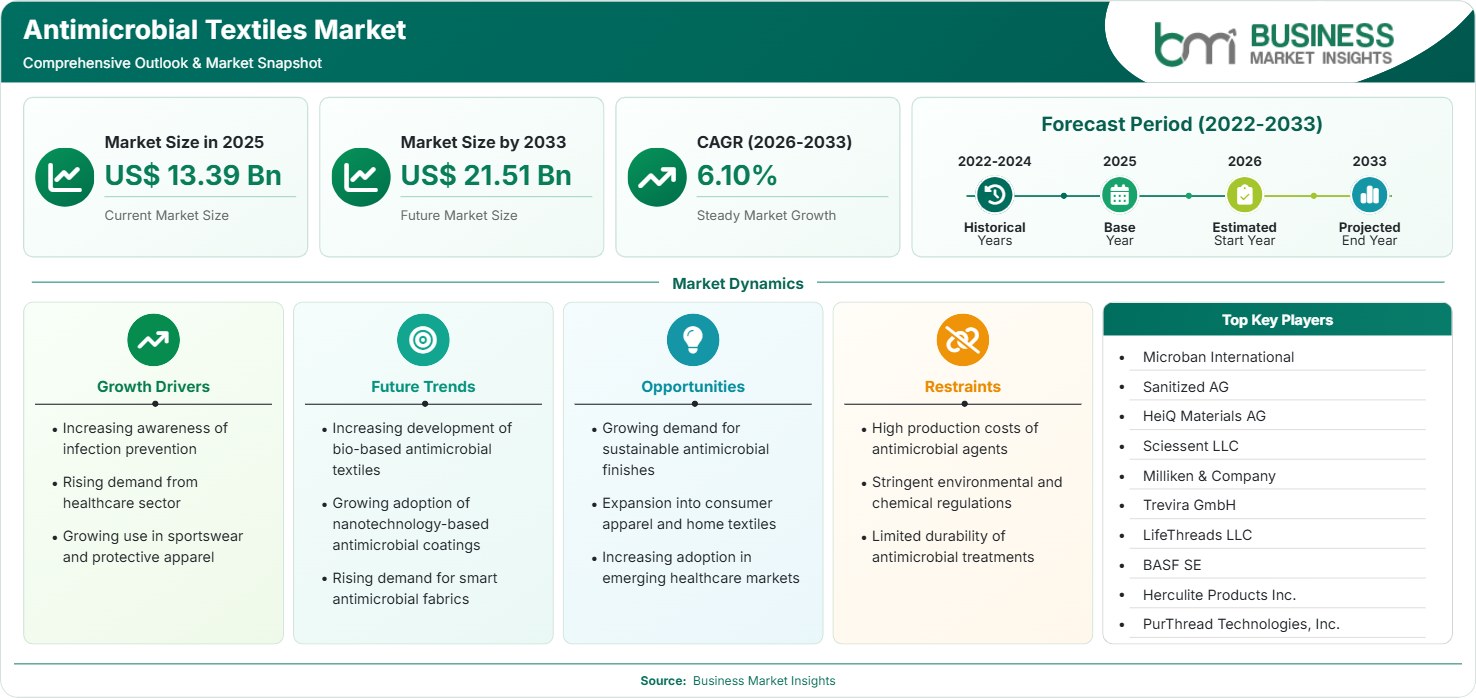
The Antimicrobial Textiles Market size was valued at US$ 13.39 Billion in 2025 and is projected to reach US$ 21.51 Billion by 2033, growing at a CAGR of 6.10% during 2026–2033. Rising awareness of infection prevention, expanding healthcare applications, and increasing adoption of antimicrobial fabrics in sportswear and protective clothing continue driving market demand, while sustainable antimicrobial technologies and penetration into consumer textiles create long-term growth opportunities.

Report Coverage
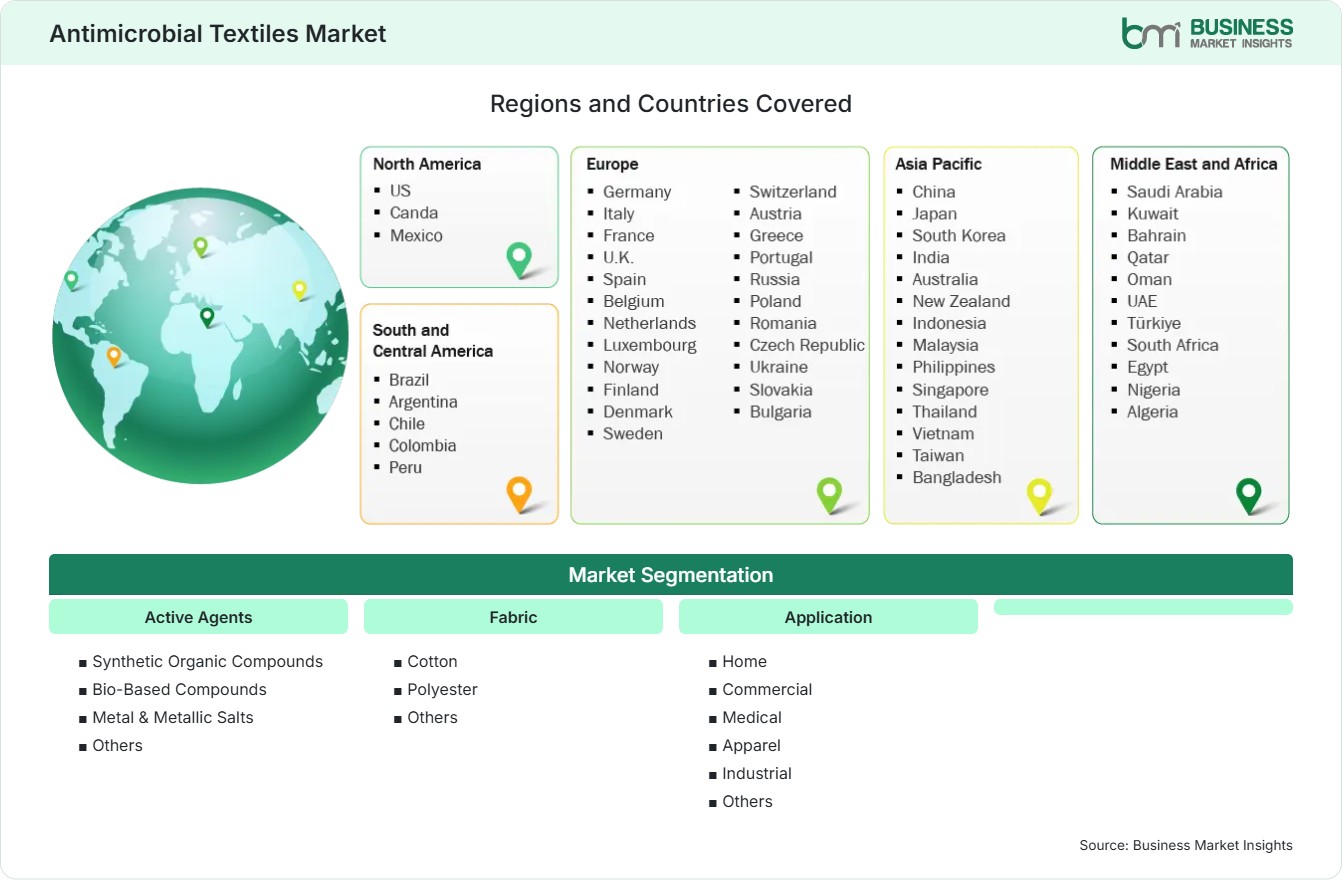
  • Active Agents: Synthetic Organic Compounds, Bio-Based Compounds, Metal & Metallic Salts, Others
  • Fabric: Cotton, Polyester, Others
  • Application: Home, Commercial, Medical, Apparel, Industrial, Others
US$ 13.39 Bn Market size in 2025
US$ 21.51 Bn Market Size by 2033
6.10% CAGR, 2026 - 2033
2026-2033 Forecast Period

01 AI Overview

Antimicrobial Textiles Market Summary

  • North America Region: North America accounts for 35%–37% share in 2025 and is projected to expand at a 5.6%–6.2% CAGR during 2026–2033. Strong healthcare infrastructure, stringent hygiene standards, and continuous innovation in textile finishing technologies support regional leadership. The United States remains the largest contributor, advancing at a CAGR of 5.8%–6.4% due to rising demand across healthcare, sportswear, and defense applications.
  • Fastest Growing Region: Asia Pacific represents 27%–30% share in 2025 while expanding at a 7.2%–7.8% CAGR during 2026–2033. Rising textile manufacturing capacity, growing healthcare expenditure, expanding middle-class consumption, and supportive industrial policies continue accelerating regional adoption.
  • Leading Segment: Medical accounts for 31%–34% share in 2025 and is forecast to register a 6.5%–7.1% CAGR during 2026–2033. Increasing utilization in surgical gowns, patient bedding, wound dressings, and hospital uniforms continues supporting sustained demand across healthcare institutions.
  • High Growth Segment: Bio-Based Compounds contribute 21%–24% share in 2025 while advancing at a 7.4%–8.0% CAGR through 2033. Growing emphasis on sustainable antimicrobial treatments, environmentally friendly chemistries, and regulatory preference for safer textile finishes continues strengthening adoption.
  • Key Market Opportunity: Development of durable, environmentally responsible antimicrobial finishes for apparel, residential textiles, healthcare products, and industrial fabrics presents significant opportunities for manufacturers seeking sustainable product differentiation and premium market positioning.
  • Major Market Players: Microban International, Sanitized AG, HeiQ Materials AG, Sciessent LLC, Milliken & Company, Trevira GmbH, LifeThreads LLC, BASF SE, Herculite Products Inc., PurThread Technologies, Inc.
02 Strategic Insights

Antimicrobial Textiles Market: Strategic Insights

Antimicrobial Textiles Market Strategic Framework
FREE PDF
Request your free sample
Request free sample
03 Stakeholder View

Key Takeaways

  • The market ecosystem increasingly integrates specialty chemical manufacturers, textile mills, fiber producers, apparel brands, healthcare suppliers, and distribution partners to deliver antimicrobial products with enhanced durability, regulatory compliance, and commercial scalability.
  • Healthcare applications continue providing the strongest commercial opportunities owing to increasing demand for infection-resistant textiles used in hospitals, long-term care facilities, surgical environments, and patient care products.
  • Innovation is increasingly directed toward bio-based antimicrobial technologies, nanomaterial-enabled textile treatments, durable wash-resistant finishes, and multifunctional fabrics combining antimicrobial performance with moisture management and comfort.
  • Asia Pacific offers the most attractive long-term investment opportunity because of expanding textile manufacturing, increasing healthcare infrastructure, supportive industrial policies, and growing domestic demand for value-added technical textiles.
  • Strategic collaborations between textile manufacturers, specialty chemical companies, and apparel brands continue accelerating commercialization of sustainable antimicrobial technologies across healthcare, sportswear, and consumer textile markets.
  • Regulatory emphasis on environmental sustainability and safer chemical formulations is encouraging manufacturers to invest in next-generation antimicrobial technologies with lower ecological impact and improved lifecycle performance.
04 Geographic Outlook

Antimicrobial Textiles Market Regional Highlights

North America Antimicrobial Textiles Market

North America accounts for 35%–37% of the Antimicrobial Textiles Market share in 2025 and is projected to expand at a 5.6%–6.2% CAGR during 2026–2033. The region benefits from mature healthcare infrastructure, strong regulatory standards, advanced textile innovation, and increasing demand for hygienic consumer products. Continued investments in medical textiles, defense applications, and performance apparel support sustained regional leadership while manufacturers prioritize durable antimicrobial treatments with proven long-term efficacy.

  • Hospitals increasingly procure antimicrobial bedding, curtains, uniforms, and surgical textiles to strengthen infection prevention strategies and improve patient safety across healthcare environments.
  • Sportswear manufacturers continue incorporating antimicrobial technologies into performance apparel to reduce odor formation, improve fabric hygiene, and enhance consumer comfort during extended use.
  • Textile producers invest in environmentally responsible finishing technologies to meet evolving sustainability targets and regulatory expectations across consumer and industrial markets.
  • Strong collaboration between specialty chemical companies and textile manufacturers accelerates commercialization of next-generation antimicrobial fabrics with improved durability and wash resistance.
  • Growing demand from defense, hospitality, and public infrastructure projects expands commercial opportunities for technically advanced antimicrobial textile solutions.

US Antimicrobial Textiles Market

The United States represents the largest national antimicrobial textiles market, accounting for 27%–29% global share in 2025 while advancing at a 5.8%–6.4% CAGR through 2033. Strong healthcare spending, increasing adoption of advanced medical textiles, and rising consumer awareness regarding hygiene continue driving product innovation. Manufacturers increasingly focus on premium antimicrobial fabrics capable of delivering long-lasting performance across healthcare, athletic wear, and commercial applications.

  • Healthcare institutions continue replacing conventional textiles with antimicrobial alternatives to support hospital-acquired infection prevention initiatives and improve patient care standards.
  • Premium apparel brands increasingly utilize antimicrobial finishes to enhance product value through odor control, freshness retention, and improved fabric performance.
  • Investment in sustainable textile chemistry encourages commercialization of bio-based antimicrobial technologies suitable for mass-market consumer products.
  • Research partnerships between universities, textile manufacturers, and specialty chemical suppliers continue accelerating innovation in multifunctional antimicrobial fabrics.

Europe Antimicrobial Textiles Market

Europe represents 25%–27% share in 2025 while expanding at a 6.0%–6.6% CAGR through 2033. Strong environmental regulations, established technical textile industries, and increasing demand for sustainable materials continue supporting regional expansion. Germany remains the largest regional antimicrobial textiles market, while Poland records the highest growth with a projected 7.1%–7.6% CAGR throughout the forecast period.

  • European manufacturers increasingly prioritize environmentally compliant antimicrobial technologies that align with REACH regulations and circular economy objectives.
  • Medical textile producers continue expanding production capacity to address increasing demand from hospitals, elderly care facilities, and rehabilitation centers.
  • Growing consumer preference for sustainable apparel encourages broader utilization of bio-based antimicrobial treatments across textile manufacturing.
  • Research investment in advanced textile finishing technologies strengthens regional competitiveness within technical textile applications.
  • Luxury apparel brands increasingly integrate antimicrobial performance into premium collections to improve functionality and product differentiation.

Asia Pacific Antimicrobial Textiles Market

Asia Pacific accounts for 27%–30% share in 2025 while recording the fastest expansion at a 7.2%–7.8% CAGR during 2026–2033. Expanding textile production, rising healthcare investments, increasing urbanization, and growing consumer demand for functional fabrics continue supporting regional growth. China leads regional production and consumption, while India records the strongest expansion with a projected 8.1%–8.7% CAGR through 2033.

  • Expanding textile manufacturing capacity supports increasing production of antimicrobial fabrics for domestic consumption and export markets.
  • Government investments in healthcare infrastructure continue stimulating demand for infection-resistant hospital textiles and medical protective clothing.
  • Rapid expansion of sportswear manufacturing strengthens utilization of antimicrobial performance fabrics across domestic and international brands.
  • Increasing awareness regarding hygiene encourages wider adoption of antimicrobial home textiles and consumer apparel.
  • Local chemical manufacturers continue investing in bio-based finishing technologies to strengthen global competitiveness.

Rest of World Antimicrobial Textiles Market

The Rest of World region contributes 10%–12% share in 2025 while expanding at a 6.3%–6.8% CAGR during 2026–2033. South & Central America benefit from growing healthcare modernization, whereas Middle East & Africa experience increasing investments in medical infrastructure, hospitality, and industrial protective textiles that support broader antimicrobial fabric adoption.

Improving manufacturing capabilities, increasing awareness of hygiene standards, and expanding healthcare procurement programs continue to strengthen regional demand for technically advanced antimicrobial textile products across diverse commercial sectors.

  • Brazil remains the leading South & Central American market, while Mexico records the strongest regional expansion with a projected 7.2%–7.8% CAGR.
  • The United Arab Emirates leads Middle Eastern adoption through healthcare and hospitality investments, while Saudi Arabia grows at a 7.3%–7.9% CAGR supported by industrial diversification initiatives.
  • Rising investments in healthcare infrastructure continue increasing procurement of antimicrobial medical textiles across public and private hospitals.
  • Growing hospitality and commercial building sectors create additional demand for hygienic upholstery, bedding, curtains, and interior textile applications.
  • International textile manufacturers continue strengthening regional partnerships to improve product availability, technical support, and distribution efficiency.
Global Market Geography
FREE PDF
Request your free sample
Request free sample
05 Segment Analysis

Antimicrobial Textiles Market Segmentation

Active Agents

Active Agents is the segment responsible for the efficacy, sustainability, regulatory adherence, and applicability of antimicrobials in textiles. Companies are continuously researching and developing better chemistries that can offer prolonged microbial resistance without compromising fabric properties and safety. Metals and Metallic Salts are the dominant segment, with a share of about 39%-42% in 2025, and are expected to register a 6.2%-6.8% CAGR from 2026 to 2033. The Antimicrobial Textiles Market scope continues expanding as sustainable antimicrobial technologies gain wider commercial acceptance across healthcare, apparel, and industrial applications.

  • Synthetic Organic Compounds: Widely utilized for durable antimicrobial performance across healthcare textiles, sportswear, and industrial fabrics, offering effective microbial control with compatibility across multiple textile finishing processes.
  • Bio-Based Compounds: Demand continues increasing owing to sustainability initiatives, biodegradable formulations, regulatory preference for environmentally responsible chemistries, and growing consumer acceptance of naturally derived antimicrobial textile treatments.
  • Metal & Metallic Salts: Silver, zinc, and copper-based antimicrobial technologies remain widely adopted because of their broad-spectrum antimicrobial effectiveness, wash durability, and suitability across medical, industrial, and consumer textile applications.

Fabric

Fabric selection significantly influences antimicrobial treatment performance, durability, comfort, and utility. Cotton is considered the ideal material due to its wide applications in various fields such as medical care, clothing, and household items, where hygiene and comfort for wearers are needed. Cotton accounted for around 46%-49% of market share in 2025 and is projected to grow at a 6.0%-6.6% CAGR until 2033. The Antimicrobial Textiles Market trends increasingly favor high-performance fabrics with durable antimicrobial finishes that do not compromise softness, breathability, or laundering performance.

  • Cotton: Cotton continues to lead demand because of its excellent comfort, absorbency, and compatibility with antimicrobial finishing technologies across healthcare garments, home textiles, and premium apparel products.
  • Polyester: Polyester experiences strong demand in sportswear, industrial protective clothing, and commercial textiles due to superior durability, moisture management, dimensional stability, and long-lasting antimicrobial treatment performance.

Application

Application demand is still rising as the focus on hygiene, infections, and performance increases for various industries. Among all applications, the medical application is still considered the largest, accounting for around 31%–34% of market share in 2025 and is expected to maintain a CAGR of 6.5%–7.1%. The Antimicrobial Textiles Market continues to grow due to rising use in hospitals, homes, offices, and high-performance apparel, supported by growing awareness of hygiene-focused textile solutions.

  • Home: Residential consumers increasingly adopt antimicrobial bedding, towels, upholstery, curtains, and mattresses to improve hygiene, reduce microbial growth, and enhance long-term product freshness.
  • Commercial: Hospitality, education, transportation, and office environments continue deploying antimicrobial textiles for upholstery, seating, curtains, and interior furnishings requiring improved cleanliness and durability.
  • Medical: Hospitals extensively utilize antimicrobial textiles in surgical gowns, patient clothing, bedding, wound care products, curtains, and staff uniforms to strengthen infection prevention strategies.
  • Apparel: Sportswear, uniforms, outdoor clothing, and lifestyle apparel increasingly integrate antimicrobial technologies to control odor, improve wearer comfort, and extend garment freshness.
  • Industrial: Industrial sectors adopt antimicrobial fabrics for protective clothing, filtration materials, cleanroom garments, and technical textile applications requiring enhanced hygiene and operational reliability.
06 Market Forces

Antimicrobial Textiles Market Dynamics

Key Market Drivers

Increasing awareness of infection prevention

Awareness of hygiene and infection control has increased demand for antimicrobial fabric-based products across hospitals, industries, homes, and similar settings. The World Health Organization states that Healthcare-Associated Infections remain a major problem worldwide. This has prompted healthcare organizations to take preventive steps. Antimicrobial Textiles Market growth is supported by increasing utilization of antimicrobial fabrics in hospital bedding, uniforms, curtains, and protective clothing. Awareness among consumers, following the outbreak of various health issues over the past few years, has created demand for hygienic fabrics in the clothing, hospitality, and domestic sectors, spurring innovations in antimicrobial finishes that remain effective even after multiple washes.

Rising demand from healthcare sector

Healthcare organizations continue to invest in modern medical fabrics that help reduce infections, enhance patient safety, and meet regulatory requirements. Modern hospitals use antimicrobial fabrics for surgical gowns, patient clothing, wound dressings, bedding, and washable protective equipment to reduce the risk of microbial contamination. An aging population structure, a rising number of surgeries, and the development of healthcare infrastructure increase demand for products worldwide. Producers continue working with healthcare organizations to develop antimicrobial fabric solutions.

Growing use in sportswear and protective apparel

The expanding performance apparel industry continues driving demand for antimicrobial textiles that improve wearer comfort by controlling odor-causing microorganisms and maintaining fabric freshness during prolonged use. Antimicrobial Textiles Market trends increasingly reflect consumer preference for multifunctional garments that offer moisture management, breathability, durability, and antimicrobial protection in a single product. Protection for industrial workers, military personnel, and occupational safety attire is also employing antimicrobial technology for hygienic purposes. Due to innovations in textile finishing processes, companies can develop antimicrobial technology for textiles without compromising the comfort or flexibility of the garments.

Key Market Opportunities

Growing demand for sustainable antimicrobial finishes

Increasing environmental awareness and more stringent sustainability goals are driving a shift toward bio-based antimicrobials. Companies are focusing on natural sources of antimicrobial products, as well as biodegradable finishes and eco-friendly manufacturing processes. Antimicrobial Textiles Market Forecasts indicate that investment in green textiles is likely to continue growing as manufacturers, healthcare institutions, and consumers favor sustainable products. The competitive position of companies that can commercialize sustainable, bio-based antimicrobial textiles that comply with regulations and meet performance standards is likely to improve over the forecast period.

Expansion into consumer apparel and home textiles

Growing consumer interest in lifestyle goods with hygienic attributes continues to open up new business prospects beyond traditional medical applications. Hygienic attributes, such as antibacterial properties, are being built into bedding, towels, upholstery, curtains, mattresses, kids' products, and luxurious clothing to add value and keep products fresh longer. Growing incomes, urbanization, and increasing hygiene consciousness continue to fuel the popularity of luxury textiles. Companies are producing stylish products with antibacterial features.

Increasing adoption in emerging healthcare markets

Modernization of the healthcare sector in the Asia-Pacific region, Latin America, and the Middle East continues to generate ample opportunities for producers of antimicrobial textiles. The increase in government spending on hospitals, specialized centers, and infection control programs, along with the purchase of more advanced medical textiles, will contribute to the growing demand. Higher healthcare expenditures, improved healthcare infrastructure, and growing awareness of hospital-acquired infections all support increased demand. Proper expansion through strategic alliances will help to meet the changing needs of the healthcare sector.

Market Restraints and Challenges

High production costs of antimicrobial agents

Factor: Manufacturing antimicrobial textiles requires specialized antimicrobial agents, advanced finishing technologies, and stringent quality control processes, resulting in significantly higher production costs than conventional textile manufacturing. Impact: Higher production costs increase product costs and restrict usage among consumers sensitive to product costs, and among small textile companies. The implementation of advanced antimicrobial technology might be deferred by firms due to uncertainties and rising raw material costs. Cost considerations prompt firms to improve production efficiency and scale up production with appropriate antimicrobial properties.

Stringent environmental and chemical regulations

Factor: Manufacturers must comply with strict regulations governing antimicrobial chemicals, product safety, environmental emissions, and approvals for biocidal substances across major international markets. Impact: Regulatory compliance increases certification expenses and the testing duration required before new antimicrobial textile products can be introduced to the market. Companies usually must alter their products to meet new environmental regulations, which increases R&D spending. With stricter regulations in place, manufacturers are investing heavily in sustainable antimicrobial technologies.

07 Company Analysis

Competitive Landscape

The competitive environment is characterized by continuous innovation in antimicrobial chemistries, sustainable textile finishing technologies, and strategic collaborations across the textile value chain. Antimicrobial Textiles Market analysis indicates that leading companies are investing in bio-based antimicrobial solutions, durable wash-resistant technologies, regulatory compliance, and application-specific product development to strengthen their competitive positions across healthcare, apparel, industrial, and consumer textile markets.

Company Name

Overview

Products and Services Relevant to this Market

Microban International Ltd.

Global leader specializing in antimicrobial technologies for consumer, medical, industrial, and commercial product applications worldwide.

Antimicrobial additives, odor control technologies, textile treatments, surface protection solutions, and product performance enhancement services.

Sanitized AG

Swiss specialty company developing antimicrobial and hygiene technologies for textiles, polymers, and consumer products globally.

Textile antimicrobial finishes, odor-control treatments, hygiene technologies, and sustainable antimicrobial solutions for technical and consumer textiles.

HeiQ Materials AG

Innovation-driven materials company focused on textile technologies enhancing hygiene, comfort, and sustainability across multiple industries.

Antimicrobial textile finishes, cooling technologies, odor-control solutions, functional coatings, and sustainable textile performance treatments.

Sciessent LLC

Specialty materials company delivering advanced antimicrobial technologies for textiles, healthcare products, footwear, and industrial applications.

Agion antimicrobial technologies, textile additives, odor-control solutions, and customized antimicrobial performance systems.

Milliken & Company

Global diversified manufacturer providing specialty chemicals, advanced textiles, flooring, and performance material solutions worldwide.

Performance textiles, antimicrobial finishes, protective fabrics, specialty chemicals, and technical textile innovations.

Trevira GmbH

European fiber manufacturer recognized for high-performance polyester fibers serving technical textile and interior furnishing markets.

Polyester fibers, flame-retardant fibers, antimicrobial fiber technologies, and technical textile materials.

LifeThreads LLC

Healthcare apparel company specializing in antimicrobial medical garments designed to improve hygiene and clinician protection.

Antimicrobial medical scrubs, healthcare uniforms, protective apparel, and infection-control textile solutions.

BASF SE

Global chemical manufacturer supplying specialty ingredients, polymers, and performance materials for diverse industrial applications.

Textile chemicals, antimicrobial additives, specialty polymers, finishing agents, and sustainable chemical technologies.

Herculite Products Inc.

Manufacturer of high-performance coated fabrics serving healthcare, industrial, transportation, and architectural textile markets.

Antimicrobial coated fabrics, healthcare textiles, industrial fabrics, protective materials, and specialty performance textiles.

PurThread Technologies, Inc.

Textile technology company developing embedded antimicrobial fiber solutions for healthcare and performance textile applications.

Antimicrobial yarns, embedded fiber technologies, medical textiles, apparel fabrics, and permanent antimicrobial textile solutions.


10 Trust & Transparency

Research Methodology

The market analysis combines proprietary research with secondary data from government agencies, company disclosures, regulatory filings, industry databases and expert interviews. Market estimates are validated through data triangulation, cross-market benchmarking and analyst review.

View Full Research Methodology

11 Questions Answered

Frequently Asked Questions

How does the Antimicrobial Textiles Market Report support strategic business decisions?

The report provides comprehensive insights into market size, competitive landscape, regional performance, technological advancements, segmentation, investment opportunities, regulatory developments, and future industry trends, enabling informed strategic planning and long-term investment decisions.

Which antimicrobial agent category is expected to experience the highest growth?

Bio-based compounds are projected to witness the fastest growth due to increasing sustainability initiatives, regulatory preference for environmentally responsible chemistries, and growing demand for naturally derived antimicrobial textile treatments across healthcare and consumer applications.

Why is Asia Pacific the fastest-growing regional market?

Asia Pacific benefits from expanding textile manufacturing, rising healthcare investments, increasing urbanization, growing consumer awareness regarding hygiene, and supportive government initiatives promoting technical textile production and healthcare infrastructure development.

Which application segment dominates the Market?

The medical segment accounts for the largest market share because antimicrobial textiles are extensively utilized in surgical gowns, hospital bedding, patient apparel, wound care products, curtains, and healthcare uniforms to improve infection prevention and patient safety.

What factors are driving the Antimicrobial Textiles Market?

The market is primarily driven by growing awareness of infection prevention, increasing healthcare demand, expanding use of antimicrobial sportswear, and rising consumer preference for hygienic textile products. Continuous innovation in durable and sustainable antimicrobial technologies further supports long-term market expansion.

Access the Full Antimicrobial Textiles Market Report

Get segment-level forecasts, regional estimates, competitive benchmarking, company profiles and downloadable Excel datasets.

Access the full Antimicrobial Textiles Market Report
350 pages PDF & Excel | 2026-08-03