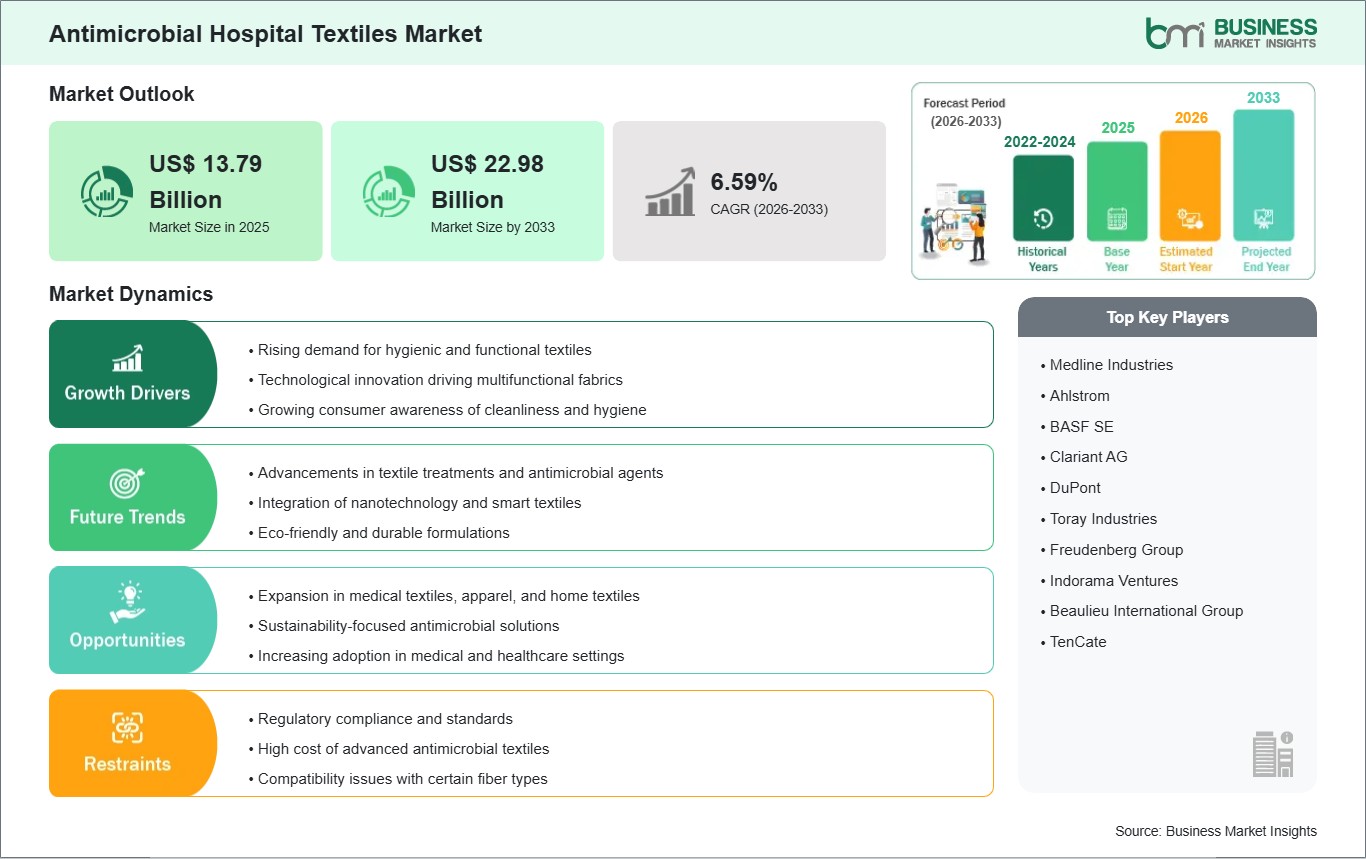
The Antimicrobial Hospital Textiles Market size is expected to reach US$ 22.98 Billion by 2033 from US$ 13.79 Billion in 2025. The market is estimated to record a CAGR of 6.59% from 2026 to 2033.
The global antimicrobial hospital textile market is witnessing substantial growth due to increasing demand for hygienic and infection-resistant textiles across healthcare, apparel, home, and industrial applications. Antimicrobial textiles are treated with agents that inhibit the growth of bacteria, fungi, and other microbes, enhancing the functional properties of fabrics.
Rising awareness of hygiene, particularly in healthcare settings, coupled with the ongoing focus on consumer safety and cleanliness, is propelling the adoption of antimicrobial textiles. Innovations in active agents, including synthetic organic compounds, metal salts, and bio-based agents, are enabling enhanced performance, durability, and environmental compliance.
The market is also driven by the increasing use of antimicrobial textiles in medical applications such as surgical gowns, bedding, and uniforms, as well as in everyday consumer products like sportswear, home textiles, and industrial fabrics. Sustainability and regulatory compliance are increasingly shaping product development and market adoption.

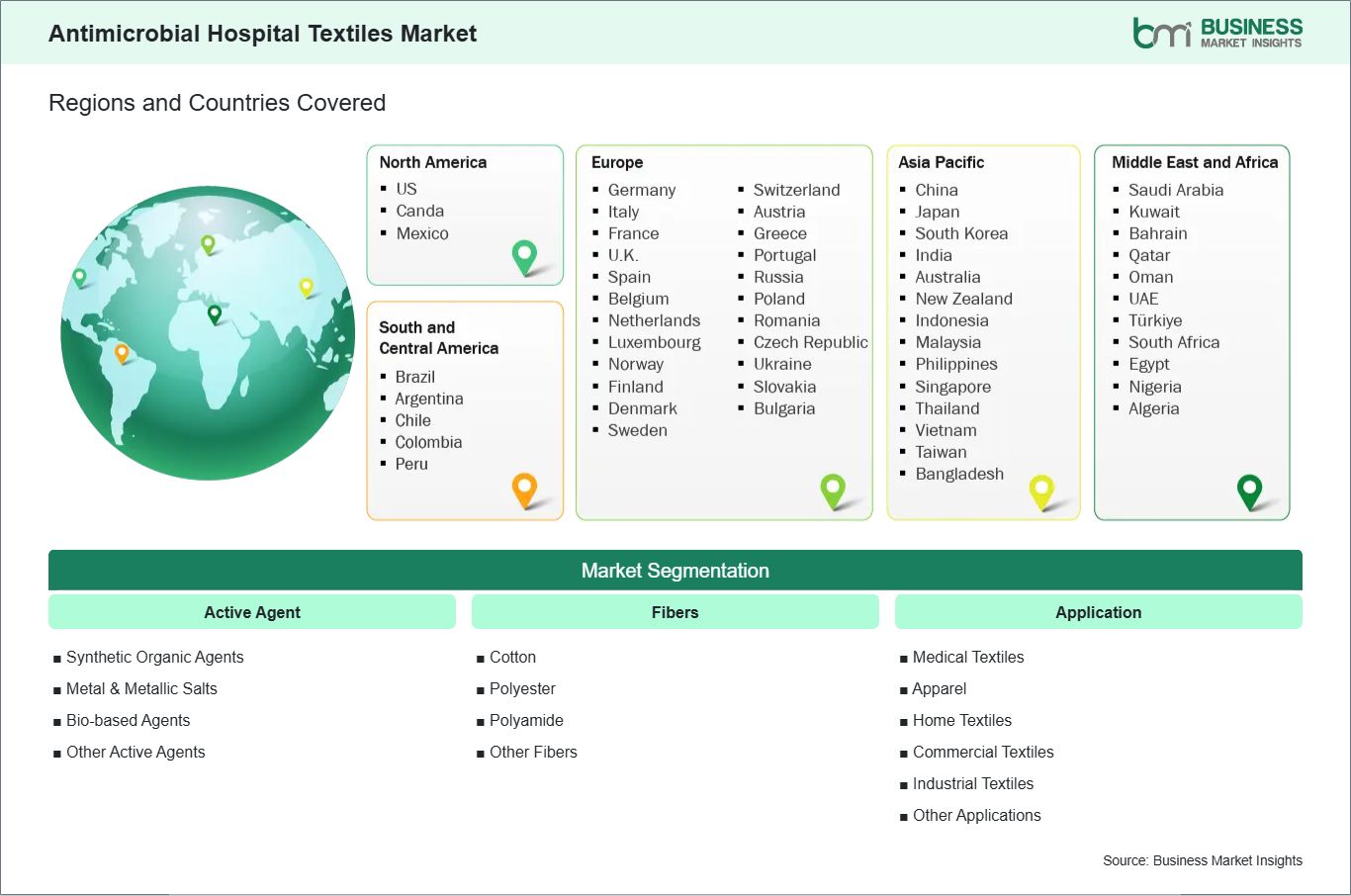
Key segments that contributed to the derivation of the antimicrobial hospital textiles market analysis are active agent, fiber type, and application.
Antimicrobial textiles are gaining popularity and increasing acceptance from consumers In addition to their expanding use by medical facilities to combat infection and promote hygiene; however, they are also experiencing increased demand due to consumer education initiatives that promote the importance of cleanliness and safety.
As a result of changing lifestyles, antimicrobial textiles are becoming more desirable in functional apparel. The growing popularity of active lifestyles, increased awareness of fitness, and the continued expansion of the outdoor recreation market have opened up new avenues for the use of antimicrobial textiles in both performance sports and casual clothing. In addition, these textiles provide consumers with odor-resistant properties caused by bacterial growth; durability; and the ability to maintain the garment's integrity after repeated use and washing. Consumers value performance apparel that offers comfort and hygiene, and as a result, antimicrobial textiles are becoming a key differentiating factor in the competitive apparel market.
Antimicrobial textile products also significantly impact household products like upholstery, carpets, and bedding. These types of products contribute to the creation of healthier indoor environments. In light of the recent health concerns that have raised the awareness of people about the importance of hygiene and cleanliness, antimicrobial textiles will continue to gain popularity among various consumer market segments as well as healthcare providers.
Technological innovation is reshaping the antimicrobial textile market, enabling more effective and sustainable solutions. Advances in antimicrobial agents and textile finishing techniques are expanding the scope of applications. Metal‑based salts such as silver and copper remain popular due to their proven efficacy, while bio‑based antimicrobial compounds are gaining attention for their eco‑friendly properties. These agents are being integrated into fabrics through advanced methods such as coating, impregnation, and fiber spinning, ensuring long‑lasting antimicrobial effects.
Modern treatments are designed to maintain compatibility with diverse fiber types, including cotton, polyester, and blends, while preserving fabric softness, breathability, and appearance. Importantly, new formulations are reducing environmental impact by minimizing chemical residues and supporting recyclability. This aligns with rising consumer and regulatory demand for sustainable textile solutions.
Technological improvements also enhance durability, allowing antimicrobial properties to withstand multiple wash cycles without losing effectiveness. This is particularly valuable in healthcare and sportswear applications, where textiles are subject to frequent cleaning. Innovations in nanotechnology and smart textiles are further expanding possibilities, enabling fabrics that actively respond to microbial presence or integrate multifunctional properties such as moisture management and UV protection.
As sustainability becomes a priority, eco‑friendly and non‑toxic antimicrobial treatments are gaining traction across medical, consumer, and industrial segments. These advancements not only improve safety and hygiene but also support broader environmental goals. With continuous R&D investment, technological progress is expected to drive widespread adoption of antimicrobial textiles, reinforcing their role in modern healthcare, apparel, and lifestyle markets.

The Antimicrobial Hospital Textiles Market demonstrates steady growth, with size and share analysis highlighting evolving trends and competitive dynamics among key players. The report examines subsegments categorized within active agent, fiber type, and application, offering insights into their contribution to overall market performance.
By active agent, the metal & metallic salts subsegment dominated the market in 2025, driven by its proven antimicrobial efficiency and durability.
Based on fiber, the cotton subsegment dominated the market in 2025, due to extensive use in medical and home textiles.
In terms of application, the medical textiles subsegment dominated the market in 2025, supported by rising demand for hygienic and infection-resistant fabrics.
| Report Attribute | Details |
|---|---|
| Market size in 2025 | US$ 13.79 Billion |
| Market Size by 2033 | US$ 22.98 Billion |
| Global CAGR (2026 - 2033) | 6.59% |
| Historical Data | 2022-2024 |
| Forecast period | 2026-2033 |
| Segments Covered | By Active Agent
|
|
Regions and Countries Covered
| |
| North America | US, Canada, Mexico |
| Europe | Belgium, Austria, Finland, Denmark, Greece, Poland, Romania, Russia, Ukraine, Czech Republic, Slovakia, Bulgaria, Italy, Luxembourg, Germany, Switzerland, France, Netherlands, Norway, Portugal, Spain, Sweden, United Kingdom |
| Asia-Pacific | Australia, China, India, Japan, South Korea, Indonesia, Malaysia, Philippines, Singapore, Thailand, Vietnam, Bangladesh, New Zealand, Taiwan |
| South and Central America | Brazil, Argentina, Peru, Chile, Colombia |
| Middle East and Africa | Bahrain, Kuwait, Oman, Qatar, Saudi Arabia, United Arab Emirates, Turkiye, South Africa, Egypt, Algeria, Nigeria |
| Market leaders and key company profiles |
|
The "Antimicrobial Hospital Textiles Market Size and Forecast (2022 - 2033)" report provides a detailed analysis of the market covering below areas:
The geographical scope of the Antimicrobial Hospital Textiles Market report is divided into North America, Asia Pacific, Europe, Middle East & Africa, and South & Central America. North America held the largest share in 2025.
North America dominates due to advanced healthcare infrastructure, high adoption of infection-resistant materials, and strong regulatory compliance. Asia Pacific is witnessing rapid growth due to expanding medical facilities, growing apparel and home textile industries, and increasing awareness of hygiene in countries such as China and India.
Europe is characterized by strong regulatory enforcement and sustainable textile innovations. The Middle East & Africa and South & Central America are emerging markets, driven by industrialization, healthcare development, and increasing adoption of functional textiles.

The Antimicrobial Hospital Textiles Market is evaluated by gathering qualitative and quantitative data post primary and secondary research, which includes important corporate publications, association data, and databases. A few of the key developments in the antimicrobial hospital textiles market are:
The Antimicrobial Hospital Textiles Market is valued at US$ 13.79 Billion in 2025, it is projected to reach US$ 22.98 Billion by 2033.
As per our report Antimicrobial Hospital Textiles Market, the market size is valued at US$ 13.79 Billion in 2025, projecting it to reach US$ 22.98 Billion by 2033. This translates to a CAGR of approximately 6.59% during the forecast period.
The Antimicrobial Hospital Textiles Market report typically cover these key segments-
The historic period, base year, and forecast period can vary slightly depending on the specific market research report. However, for the Antimicrobial Hospital Textiles Market report:
The Antimicrobial Hospital Textiles Market is populated by several key players, each contributing to its growth and innovation. Some of the major players include:
The Antimicrobial Hospital Textiles Market report is valuable for diverse stakeholders, including:
Essentially, anyone involved in or considering involvement in the Antimicrobial Hospital Textiles Market value chain can benefit from the information contained in a comprehensive market report.
Please tell us your area of interest
(Market Segments/ Regions and Countries/ Companies)