Market Summary
Executive Summary and Global Market Analysis
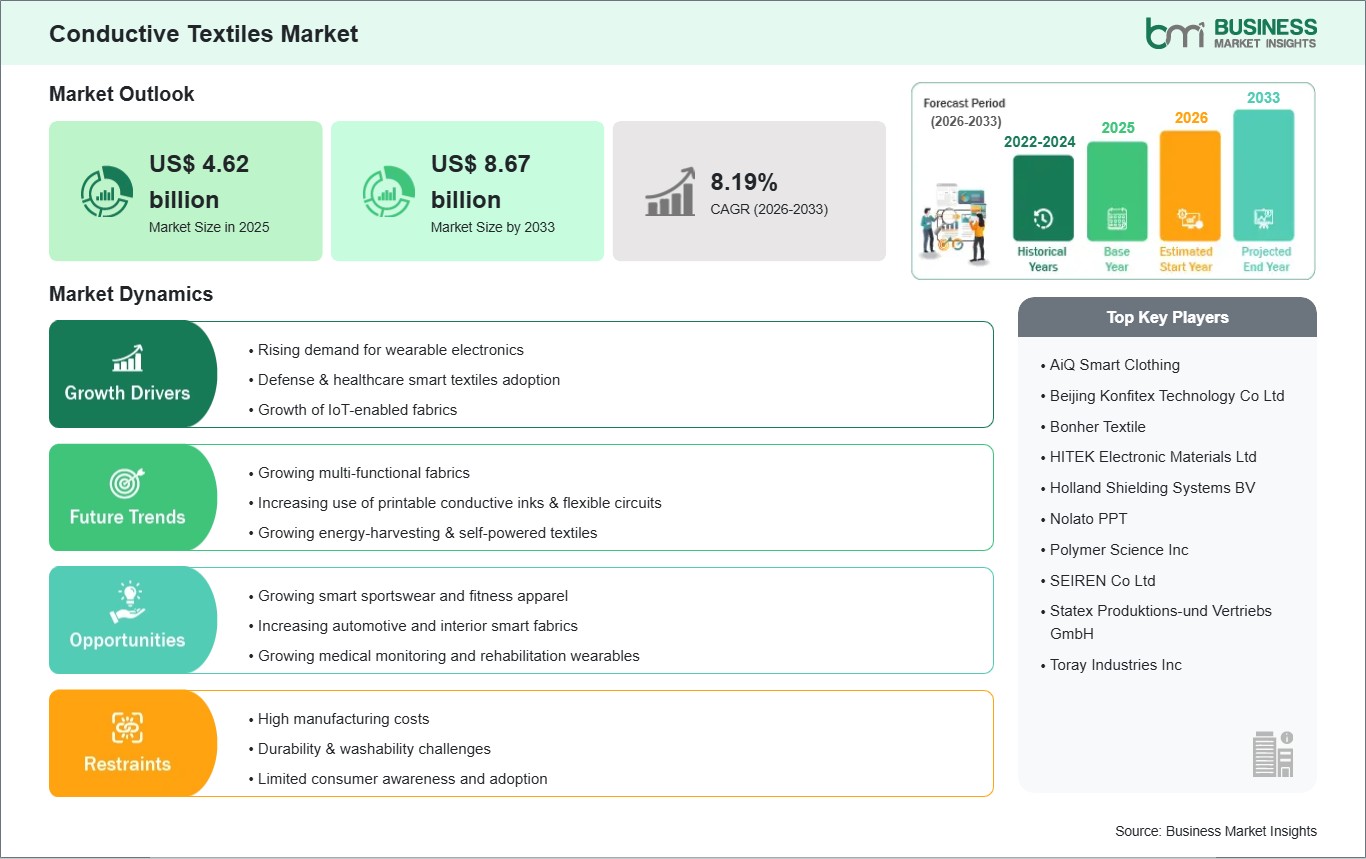
Conductive textiles are fabrics made with materials that conduct electricity, such as metal fibers, carbon-based compounds, or conductive polymers. These textiles allow electrical signals and power to flow while remaining flexible, lightweight, and durable. They find use in various industries, including healthcare, defense, sports and fitness, consumer electronics, and automotive. Common uses include wearable devices, smart clothing, medical monitoring systems, electromagnetic shielding, and flexible sensors. Conductive textiles come in different forms, such as woven, non-woven, and knitted structures, with varying levels of conductivity and performance characteristics to meet different functional needs.
The market is growing steadily due to the increasing demand for wearable technology and smart textiles in global industries. The rising use in healthcare for remote patient monitoring and rehabilitation, along with the growing application in defense for communication and protection systems, is pushing this growth. Innovations in material science and nanotechnology are enhancing conductivity, comfort, and durability. Moreover, the focus on lightweight, flexible, and multifunctional materials is driving market development. Support from government initiatives, increasing investments in research and development, and greater awareness of smart fabric applications are further boosting the conductive textiles market worldwide.
Segment Analysis
Conductive Textiles Market Segmentation
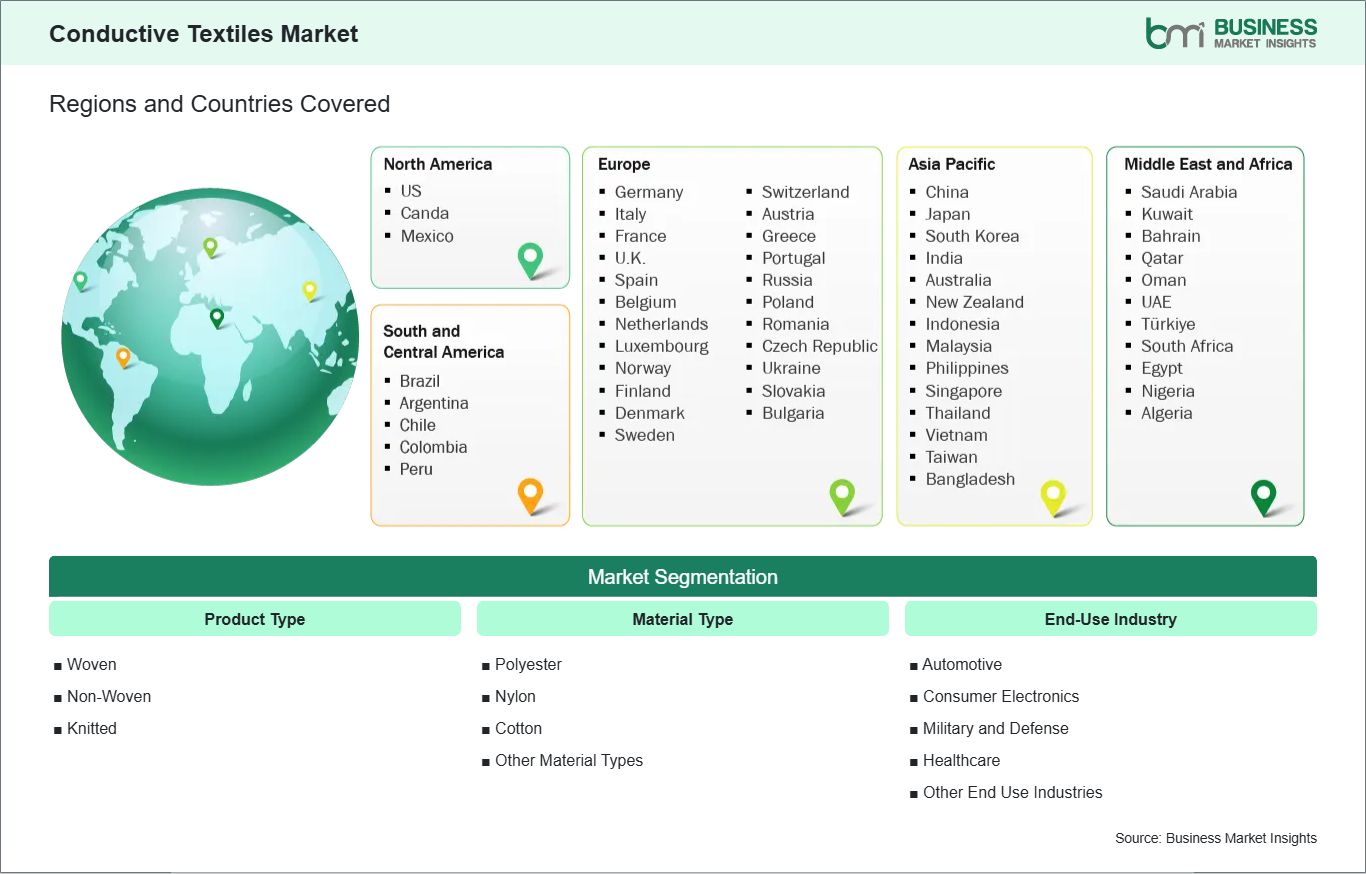
Key segments that contributed to the derivation of the conductive textiles market analysis are product type, material type, and end-use industry.
- By product type, the conductive textiles market is segmented into woven, non-woven, and knitted. The woven segment held the largest market share in 2025.
- By material type, the conductive textiles market is segmented into polyester, nylon, cotton, and others. The polyester segment held the largest market share in 2025.
- By end-use industry, the conductive textiles market is segmented into automotive, consumer electronics, military and defense, healthcare, and others. The consumer electronics segment held the largest market share in 2025.
Market Forces
Conductive Textiles Market Drivers and Opportunities
Rising Demand for Wearable Electronics and Smart Textiles
The growing use of wearable electronics and smart textiles is driving growth in the conductive textiles market. Both consumers and industries are showing strong interest in products that combine technology with everyday materials. This integration enables improved functionality and real-time data monitoring. Conductive textiles are vital for these features since they allow electrical signals to pass through fabrics while remaining flexible and comfortable. In the healthcare sector, these textiles are commonly used in wearable monitoring devices that track vital signs like heart rate, temperature, and physical activity. They aid in preventive care and remote patient management. Likewise, in sports and fitness, smart clothing with conductive fibers offers insights for performance tracking and injury prevention.
The rising popularity of connected devices, along with improvements in smaller electronics, is speeding up the use of conductive textiles in consumer products. As demand grows for multifunctional, lightweight, and easy-to-use wearable solutions, conductive textiles are becoming key in developing next-generation smart fabric innovations worldwide.
Expanding Applications in Healthcare and Medical Textiles
The growing use of conductive textiles in healthcare and medical applications offers a major opportunity for market growth. With a stronger focus on remote patient monitoring, telemedicine, and personalized healthcare, conductive textiles are being integrated into advanced medical garments and devices that allow for continuous and non-invasive health tracking. These textiles are found in smart bandages, rehabilitation wear, and patient monitoring systems. They provide reliable data collection while ensuring comfort and ease of use. The aging global population and the increasing number of chronic diseases drive the demand for new healthcare solutions that cut down on hospital visits and improve patient outcomes.
Moreover, progress in material science is improving the compatibility, washability, and durability of conductive fabrics, making them better suited for long-term medical use. More investments in healthcare infrastructure and digital health technologies also boost the adoption of these solutions. As healthcare systems keep focusing on efficiency and patient-centered care, conductive textiles are set to be essential in shaping the future of medical technology.
Size and Share Analysis
Conductive Textiles Market Size and Share Analysis
The conductive textiles market demonstrates steady growth, with size and share analysis revealing evolving trends and competitive positioning among key players. The report examines subsegments categorized within product type, material type, and end-use industry, offering insights into their contribution to overall market performance. By application, the consumer electronics segment has the largest market share. Conductive textiles are commonly used in wearable devices, smart clothing, touch-sensitive fabrics, and flexible electronic components. Manufacturers prefer conductive textiles because they are lightweight, flexible, and can integrate easily with electronic circuits while keeping users comfortable. These textiles provide benefits such as better conductivity, durability, resistance to wear and tear, and compatibility with new technologies. The industry values conductive textiles because they promote innovation in smart devices, support miniaturization, and improve product performance. Growth in this segment is fueled by the increasing use of wearable technology, rising consumer demand for smart gadgets, advancements in flexible electronics, and ongoing innovation in the consumer electronics industry worldwide.
Report Coverage
Conductive Textiles Market Report Coverage and Deliverables
The " Conductive Textiles Market Size and Forecast (2022 - 2033)" report provides a detailed analysis of the market covering below areas:
- Conductive textiles market size and forecast at global, regional, and country levels for all the key market segments covered under the scope
- Conductive textiles market trends, as well as market dynamics such as drivers, restraints, and key opportunities
- Conductive textiles market analysis covering key market trends, global and regional framework, major players, regulations, and recent market developments
- Industry landscape and competition analysis covering market concentration, heat map analysis, prominent players, and recent developments for the conductive textiles market
- Detailed company profiles, including SWOT analysis
Geographic Insights
Conductive Textiles Market Geographic Insights
The geographical scope of the conductive textiles market report is divided into five regions: North America, Asia Pacific, Europe, the Middle East & Africa, and South & Central America. North America holds a significant share of the conductive textiles market. The region is backed by its strong technology sector and key industry players. The region has been a leader in smart textile innovation, fueled by extensive research and development and partnerships between tech companies, textile makers, and universities. The high use of wearable electronics and connected devices in the consumer, healthcare, and defense sectors has played a big role in market growth. In particular, the healthcare sector in North America has increasingly used conductive textiles in remote monitoring systems and smart medical garments. This has improved patient care and made operations more efficient.
The region also benefits from solid infrastructure, supportive regulations, and significant investment in advanced materials and nanotechnology. The presence of major consumer electronics and defense manufacturers speeds up the development and market launch of conductive textile solutions. Growing demand for lightweight, flexible, and high-performance materials in automotive and sports applications further encourages market growth. In addition, rising awareness of smart fabric capabilities and an increase in consumer preference for high-tech products help maintain North America's top position in the global conductive textiles market.
Industry Activity
Recent Developments
The conductive textiles market is evaluated by gathering qualitative and quantitative data post-primary and secondary research, which includes important corporate publications, association data, and databases. A few of the key developments in the conductive textiles market are:
- In February 2025, researchers at the Indian Institute of Technology (IIT) Guwahati created a water-repellent conductive textile that can turn electricity and sunlight into heat. The fabric features silver nanowires on cotton along with a lotus-inspired coating to boost durability, water resistance, and conductivity.
- In December 2023, researchers at Washington State University unveiled a new conductive cotton-based fiber for smart textiles. This fiber blends the flexibility of cotton with the electrical conductivity of a polymer called polyaniline. It can power devices and detect gases, making it ideal for wearable sensors and smart clothing used in health monitoring and hazardous environment detection.
Trust & Transparency
Research Methodology
The market analysis combines proprietary research with secondary data from government agencies, company disclosures, regulatory filings, industry databases and expert interviews. Market estimates are validated through data triangulation, cross-market benchmarking and analyst
review.
View Full Research Methodology
Key Sources Referred:
World Bank - Global Trade IndicatorsWorld Trade Organization (WTO)International Monetary Fund (IMF)International Trade Administration (ITA)Company WebsitesCompany Annual ReportsCompany Investor PresentationsAdvanced Textiles Association (ATA)International Federation of Technical Textiles and Non-wovens (IFAI)American Association of Textile Chemists and Colorists (AATCC)European Apparel and Textile Confederation (EURATEX)