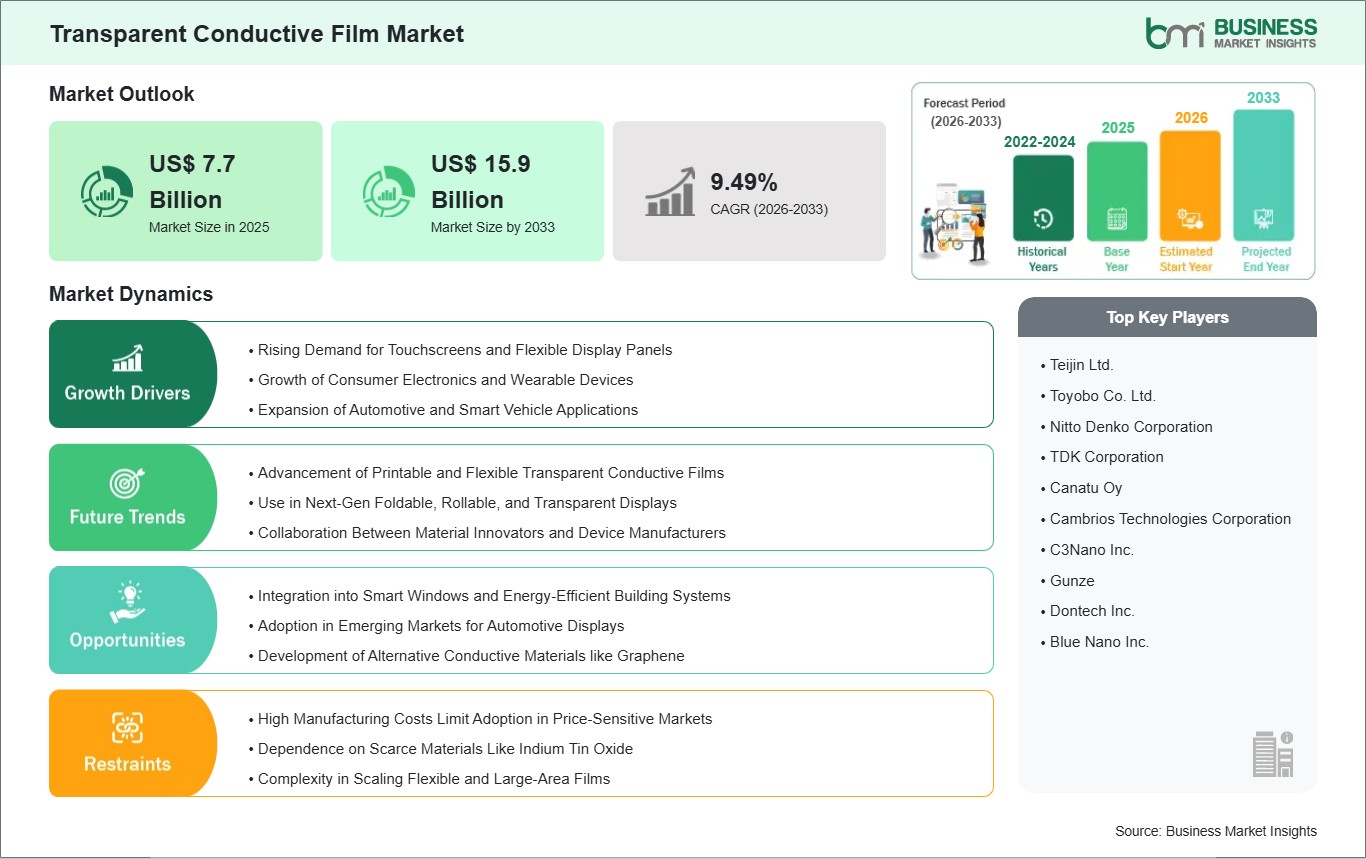
The Transparent Conductive Film Market size is expected to reach US$ 15.9 billion by 2033 from US$ 7.7 billion in 2025. The market is estimated to record a CAGR of 9.49% from 2026 to 2033.
The global transparent conductive film (TCF) market keeps growing because multiple industries need interactive display technologies that consume less energy and accommodate flexible designs. Transparent conductive films are created as thin layers that feature conductive materials that keep optical transparency while delivering electrical performance. They serve as essential elements for touchscreens and flat panel displays, OLED and LCD screens, smart windows, photovoltaic modules and wearable electronics and human-machine interface systems. The worldwide adoption of TCFs occurs because consumer electronics are becoming more common, and people switch to using devices that require less energy and offer interactive features.
The region experiences increased demand because businesses invest more in electric vehicles, avionics and smart manufacturing, which require TCFs to create better user interfaces and energy-efficient surfaces. North American manufacturers develop new flexible conductive films, which they use in printable applications because of the rising demand for foldable and rollable displays. The market encounters specific limitations that restrict its growth. The cost and complexity of producing high‑performance transparent conductive films can hinder adoption in cost‑sensitive segments, particularly in developing regions. The competition between traditional materials such as indium tin oxide (ITO) and new materials, which include silver nanowires, conductive polymers and graphene, creates uncertainty for manufacturers who need to choose their materials. The market faces restrictions through supply chain issues, which arise from the need for particular raw materials. The transparent conductive film market will keep growing through new technological developments, which will create additional applications for advanced electronics and sustainable technology sectors.

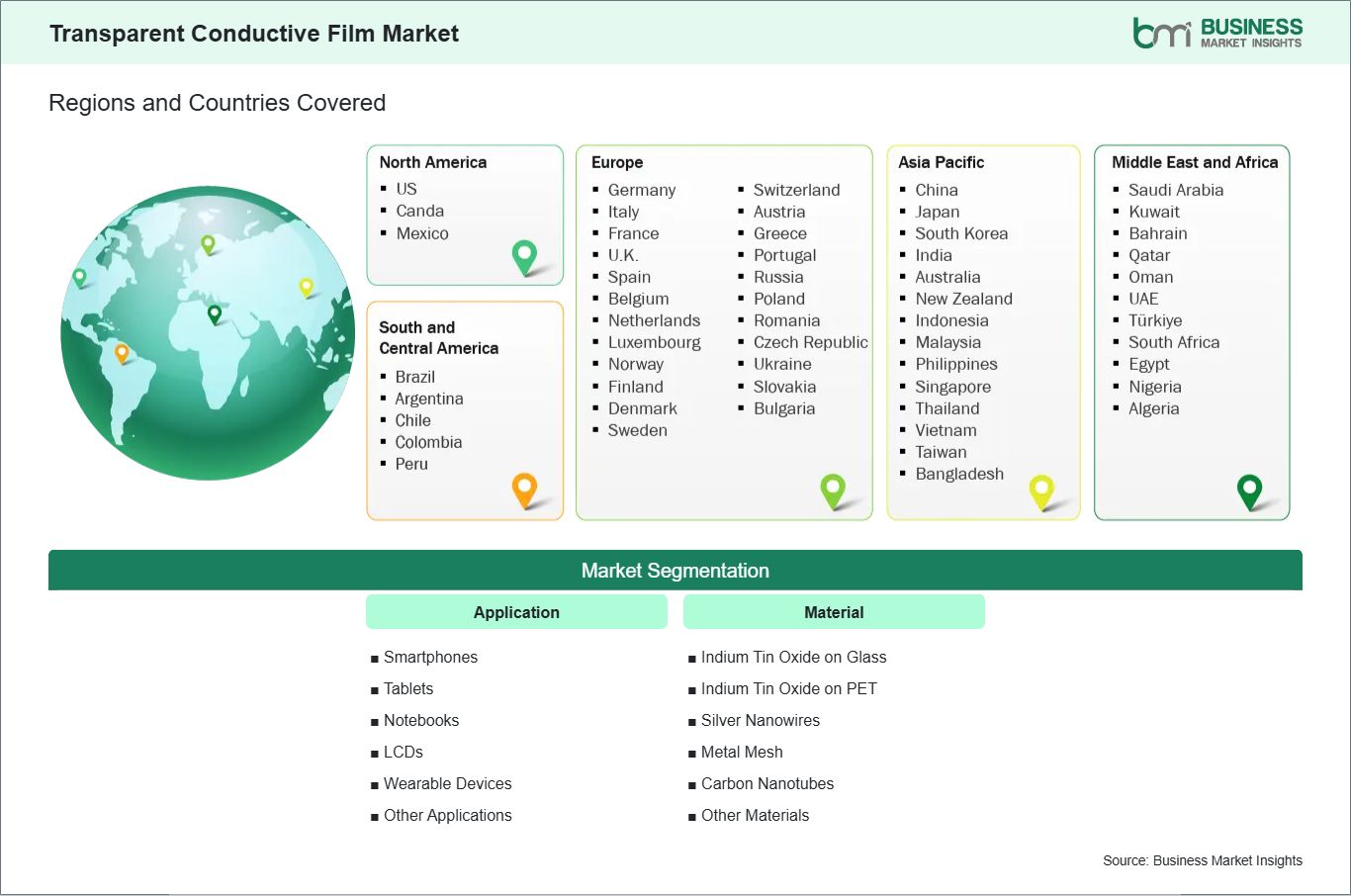
Key segments that contributed to the derivation of the transparent conductive film market analysis are application and material.
The global transparent conductive film market experiences its main growth because people increasingly use devices that have touch screens for their daily activities. Transparent conductive films (TCFs) serve as essential components in modern touchscreens, which are used in smartphones, tablets and laptops and interactive kiosks because TCFs deliver electrical conductivity while preserving visual transparency. North America and the Asia Pacific are key markets where touchscreen adoption is accelerating because both markets serve users who want the latest electronic devices and the latest advanced industrial display products.
The market experiences growth because flexible displays create new requirements for TCFs needed in foldable smartphones and rollable OLED panels, which must withstand continuous bending and physical pressure. Manufacturers are exploring alternatives to traditional indium tin oxide, which includes silver nanowires, conductive polymers and graphene as they seek to enhance product flexibility and functionality. Advanced material production reaches its highest level in Japan, South Korea and China because these countries establish themselves as manufacturing leaders who produce durable high-performance films for next-generation electronic devices.
The automotive industry drives market expansion because vehicle infotainment systems, digital dashboards and heads-up displays now adopt touch-based interactive systems. The displays use transparent conductive films, which enable the creation of thin, lightweight, durable components that match design requirements. The combination of consumer electronics development, automotive digital transformation and material development makes TCFs essential for delivery of touchscreen technology and flexible display systems, which exist in all parts of the globe.
Transparent conductive films are increasingly integrated into smart windows and energy-efficient building systems, supporting daylight management, solar control, and building automation. In North America, architectural firms are specifying TCF-based electrochromic and switchable glass for commercial and residential projects, allowing windows to dynamically adjust light transmission and reduce energy consumption. These applications combine aesthetic appeal with functional benefits, enhancing occupant comfort and lowering operational costs.
Europe also shows growing adoption, with Germany, France, and the UK implementing smart building codes and energy efficiency mandates that encourage conductive film usage in automated glazing, skylights, and façade systems. By enabling transparent yet conductive surfaces, TCFs allow integration of sensors and control systems for climate-adaptive buildings, reducing reliance on artificial lighting and HVAC systems while promoting sustainable construction practices.
Asia Pacific is leveraging TCFs for large-scale smart building initiatives, particularly in China, Japan, and Australia, where rapid urbanization and demand for energy-efficient infrastructure drive innovation. TCFs facilitate flexible design options, allowing architects to maintain transparency, aesthetic consistency, and functional performance. The combination of energy savings, smart control, and advanced materials positions TCFs as a critical technology for the growing global smart building and sustainable construction market.

The transparent conductive film market demonstrates steady growth, with size and share analysis highlighting evolving trends and competitive dynamics among key players. The report examines subsegments categorized within application and material, offering insights into their contribution to overall market performance.
By application, the smartphones subsegment dominated the market in 2025, driven by the high and growing demand for touchscreens in electronic devices.
Based on material, the indium tin oxide (ITO) on glass subsegment dominated the market in 2025, driven by its excellent optical transparency and superior electrical conductivity for display and touchscreen applications.
| Report Attribute | Details |
|---|---|
| Market size in 2025 | US$ 7.7 Billion |
| Market Size by 2033 | US$ 15.9 Billion |
| Global CAGR (2026 - 2033) | 9.49% |
| Historical Data | 2022-2024 |
| Forecast period | 2026-2033 |
| Segments Covered | By Application
|
|
Regions and Countries Covered
| |
| North America | US, Canada, Mexico |
| Europe | Belgium, Austria, Finland, Denmark, Greece, Poland, Romania, Russia, Ukraine, Czech Republic, Slovakia, Bulgaria, Italy, Luxembourg, Germany, Switzerland, France, Netherlands, Norway, Portugal, Spain, Sweden, United Kingdom |
| Asia-Pacific | Australia, China, India, Japan, South Korea, Indonesia, Malaysia, Philippines, Singapore, Thailand, Vietnam, Bangladesh, New Zealand, Taiwan |
| South and Central America | Brazil, Argentina, Peru, Chile, Colombia |
| Middle East and Africa | Bahrain, Kuwait, Oman, Qatar, Saudi Arabia, United Arab Emirates, Turkiye, South Africa, Egypt, Algeria, Nigeria |
| Market leaders and key company profiles |
|
The "Transparent Conductive Film Market Size and Forecast (2022 - 2033)" report provides a detailed analysis of the market covering below areas:
The geographical scope of the Transparent Conductive Film Market report is divided into North America, Asia Pacific, Europe, Middle East & Africa, and South & Central America. North America held the largest share in 2025.
North America leads the international market for transparent conductive films (TCF) because the region possesses an established electronics industry, superior research facilities, and markets advanced display and interface technologies. The United States establishes itself as the top market because it experiences high demand from consumer electronics, automotive displays, medical devices and industrial touch-enabled systems, while Canada supports the market through material research and specialized fields, including smart windows and wearable electronics. The region derives advantages from its technological expertise in flexible and transparent electronics, which includes foldable displays and advanced OLED and LCD panels and its partnerships between manufacturers and research institutions to create next-generation conductive films that use silver nanowires and graphene and other materials instead of conventional indium tin oxide (ITO). Europe creates a major market which the industrial and automotive sectors drive, especially in Germany, France and the UK, where TCFs find use in infotainment systems, human-machine interfaces and smart building solutions. European countries emphasize energy efficiency and high-performance materials, which drive the use of advanced conductive films that enable sustainable and long-lasting applications. The Asia Pacific region experiences the fastest growth in manufacturing and end-use adoption because China, Japan, and South Korea drive TCF demand for consumer electronics, smartphones, tablets and solar energy applications through their extensive production facilities and their government-led programs which support smart technology adoption. The Middle East and Africa show increasing interest in architectural glass and smart building technologies and premium consumer electronics because the UAE, Saudi Arabia and South Africa exhibit slower adoption rates than developed markets. The South and Central American market is developing because Brazil, Mexico and Argentina are starting to use TCFs in their automotive displays, consumer electronics and renewable energy projects. North America maintains its technological leadership through innovative high-value applications, but different regions of the world create distinct TCF demand because of their industrial automation needs, sustainable technology requirements, consumer electronics adoption rates and smart infrastructure growth.

The Transparent Conductive Film Market is evaluated by gathering qualitative and quantitative data post primary and secondary research, which includes important corporate publications, association data, and databases. A few of the key developments in the transparent conductive film market are:
The Transparent Conductive Film Market is valued at US$ 7.7 Billion in 2025, it is projected to reach US$ 15.9 Billion by 2033.
As per our report Transparent Conductive Film Market, the market size is valued at US$ 7.7 Billion in 2025, projecting it to reach US$ 15.9 Billion by 2033. This translates to a CAGR of approximately 9.49% during the forecast period.
The Transparent Conductive Film Market report typically cover these key segments-
The historic period, base year, and forecast period can vary slightly depending on the specific market research report. However, for the Transparent Conductive Film Market report:
The Transparent Conductive Film Market is populated by several key players, each contributing to its growth and innovation. Some of the major players include:
The Transparent Conductive Film Market report is valuable for diverse stakeholders, including:
Essentially, anyone involved in or considering involvement in the Transparent Conductive Film Market value chain can benefit from the information contained in a comprehensive market report.
Please tell us your area of interest
(Market Segments/ Regions and Countries/ Companies)