Market Summary
Executive Summary and Global Market Analysis
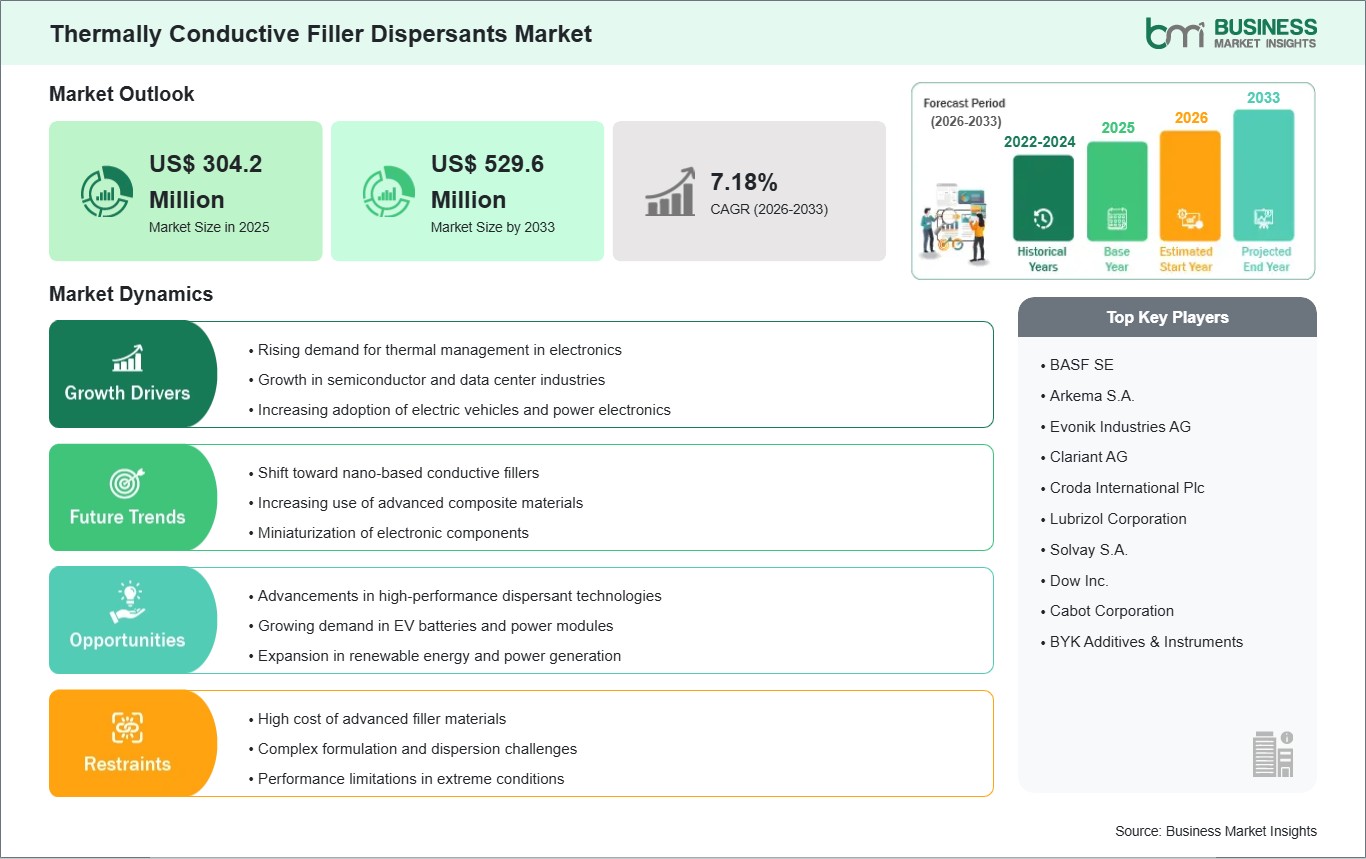
The thermally conductive filler dispersants market is witnessing steady growth with increasing demand for efficient thermally conductive solutions in various industries. The dispersants play a significant role in the enhancement of thermally conductive fillers’ performance by ensuring compatibility with base materials. The filler type segment is dominated by aluminum oxide due to its cost-effectiveness and availability in the market; on the other hand, the formulation segment is dominated by liquid dispersions due to ease of use and performance consistency.
The electronics sector remains the largest end-user segment, supported by the rapid expansion of semiconductor manufacturing, consumer electronics, and data center infrastructure. The market is also benefiting from growing adoption in automotive and power generation applications, particularly with the rise of electric vehicles and renewable energy systems. Despite challenges such as high material costs and formulation complexities, innovations in dispersant technology and the need for high-performance materials are creating fresh growth opportunities. Overall, the market is expected to grow steadily, fueled by technological innovations and the need for efficient thermal management materials
Segment Analysis
Thermally Conductive Filler Dispersants Market Segmentation
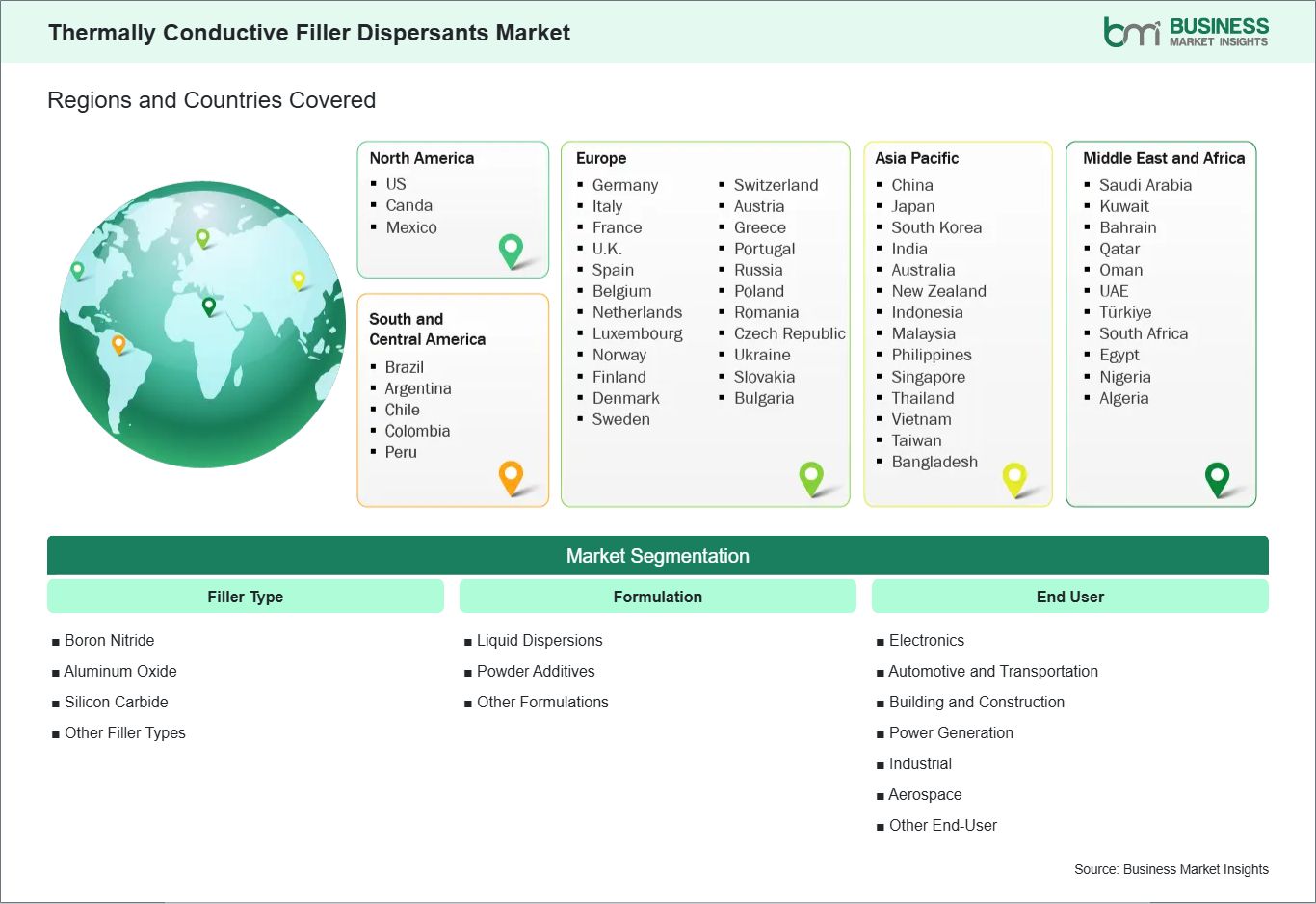
Key segments that contributed to the derivation of the Thermally Conductive Filler Dispersants market analysis are filler type, formulation, and end user.
- By filler type, the thermally conductive filler dispersants market is segmented into Boron Nitride, Aluminum Oxide, Silicon Carbide, and Other Filler Types. The Aluminum Oxide segment dominated the market in 2025.
- By formulation, the thermally conductive filler dispersants market is segmented into Liquid Dispersions, Powder Additives, and Others. The Liquid Dispersions segment dominated the market in 2025.
- By end user, the thermally conductive filler dispersants market is segmented into Electronics, Automotive and Transportation, Building and Construction, Power Generation, Industrial, Aerospace, and Other End-User. The Electronics segment dominated the market in 2025.
Market Forces
Thermally Conductive Filler Dispersants Market Drivers and Opportunities
Rising demand for thermal management in electronics
The increasing need for thermals in electronic devices is a major driver for the thermally conductive filler dispersants market, as modern electronic devices produce a lot of heat due to increased power density and miniaturization of electronic devices. Effective heat dissipation is critical for the performance, reliability, and life expectancy of electronic devices. Thermally conductive fillers can improve the thermally conductive properties of materials used in electronic devices such as circuit boards, encapsulants, and thermal interfaces. The need for efficient heat management in electronic devices has created a significant need for the use of advanced dispersant technology in the field of electronics.
In addition, the rising trend of data centers, cloud computing, and consumer electronics is likely to boost the market for high-performance thermal solutions. As devices get smaller and more powerful, the need for materials that can efficiently handle thermal management while providing mechanical integrity is crucial. There is a focus on improving dispersion technology to obtain a consistent filler distribution, and this trend is likely to persist with the increasing need for advanced electronic devices in various industries, thus propelling the market for thermally conductive filler dispersants.
Advancements in high-performance dispersant technologies
Advancements in high-performance dispersant technologies present significant opportunities for the thermally conductive filler dispersants market, as industries seek improved methods to enhance thermal conductivity and material performance. Innovative dispersants are being developed to ensure better compatibility between fillers and base materials, resulting in more efficient heat transfer and improved mechanical properties. These advancements are particularly important in applications such as electronics, automotive, and power generation, where thermal management plays a critical role in system performance.
Furthermore, the integration of nanotechnology and advanced material science is enabling the development of dispersants that can achieve superior dispersion stability and thermal efficiency. These next-generation solutions are designed to meet the increasing demands of high-performance applications, including electric vehicles and renewable energy systems. As industries continue to adopt advanced technologies, the need for efficient thermal management solutions is expected to rise. This creates opportunities for manufacturers to innovate and develop differentiated products that cater to evolving market requirements, ultimately driving growth in the thermally conductive filler dispersants market.
Size and Share Analysis
Thermally Conductive Filler Dispersants Market Size and Share Analysis
The global Thermally Conductive Filler Dispersants market is experiencing steady growth, with market size and share analysis reflecting evolving treatment preferences and competitive dynamics among key players. The report evaluates important subsegments categorized within filler type, formulation, and end user highlighting their respective contributions to overall market performance.
By filler type, the Aluminum Oxide subsegment dominated the market in 2025 due to its cost-effectiveness, good thermal conductivity, and wide availability, making it a preferred choice for large-scale thermal management applications across electronics and industrial sectors.
By formulation, the Liquid Dispersions subsegment dominated the market in 2025 due to their ease of application, uniform particle distribution, and enhanced processing efficiency, enabling consistent thermal performance in coatings, adhesives, and composite materials used in various industries.
By end user, the Electronics subsegment dominated the market in 2025 due to increasing demand for efficient heat dissipation in compact electronic devices, growing semiconductor production, and the expansion of data centers requiring advanced thermal management solutions.
Report Coverage
Thermally Conductive Filler Dispersants Market Report Coverage and Deliverables
The "Thermally Conductive Filler Dispersants Market Size and Forecast (2022 - 2033)" report provides a detailed analysis of the market covering below areas:
- Thermally Conductive Filler Dispersants market size and forecast at the regional and country levels for segments covered under the scope
- Thermally Conductive Filler Dispersants market trends, as well as drivers, restraints, and opportunities
- Thermally Conductive Filler Dispersants market analysis covering key trends, regional framework, major players, regulations, and recent developments
- Industry landscape and competition analysis covering market concentration, heat map analysis, prominent players, and recent developments for the Thermally Conductive Filler Dispersants market
- Detailed company profiles, including SWOT analysis
Geographic Insights
Thermally Conductive Filler Dispersants Market Geographic Insights
The geographical scope of the Thermally Conductive Filler Dispersants market report is divided into: North America, Asia Pacific, Europe, Middle East & Africa, and South & Central America. North America held the largest share in 2025.
North America dominates the thermally conductive filler dispersants market due to its strong presence in advanced electronics manufacturing and semiconductor industries. The region is home to major technology companies and research institutions that drive innovation in thermal management solutions. Increasing investments in data centers, cloud computing, and high-performance computing infrastructure are further supporting market growth.
Additionally, the growing adoption of electric vehicles and advanced automotive technologies in North America is contributing to increased demand for thermally conductive materials. The presence of established industrial and aerospace sectors also supports market expansion. Regulatory focus on energy efficiency and technological advancements are encouraging the use of high-performance materials across industries. Continuous research and development activities and strong industrial infrastructure are strengthening the region`s leadership position. With increasing demand for efficient heat dissipation solutions, North America is expected to maintain its dominance in the thermally conductive filler dispersants market.
Industry Activity
Recent Developments
The Thermally Conductive Filler Dispersants market is evaluated by gathering qualitative and quantitative data post primary and secondary research, which includes important corporate publications, association data, and databases. A few of the key developments in the Thermally Conductive Filler Dispersants market are:
- In October 2025, Dow announced that it had introduced a new series of thermally conductive dispersants for silicone-based thermal interface materials, designed to improve filler dispersion and heat transfer efficiency in EV batteries and high-performance electronics.
- In July 2024, BASF announced that it had expanded its portfolio of dispersant additives for thermally conductive composites, focusing on carbon-based fillers such as graphene and carbon nanotubes to enhance conductivity in advanced electronics packaging.
- In March 2023, Shin-Etsu Chemical announced that it had launched new thermally conductive filler dispersants tailored for silicone elastomers, targeting LED lighting and semiconductor cooling applications.
Trust & Transparency
Research Methodology
The market analysis combines proprietary research with secondary data from government agencies, company disclosures, regulatory filings, industry databases and expert interviews. Market estimates are validated through data triangulation, cross-market benchmarking and analyst
review.
View Full Research Methodology
Key Sources Referred:
American Chemistry Council (ACC)International Council of Chemical Associations (ICCA)European Chemical Industry Council (Cefic)China Petroleum and Chemical Industry Federation (CPCIF)Indian Chemical Council (ICC)Japan Chemical Industry Association (JCIA)Brazilian Chemical Industry Association (ABIQUIM)Company WebsitesCompany Annual ReportsCompany Investor Presentations