Market Summary
Executive Summary and Global Market Analysis
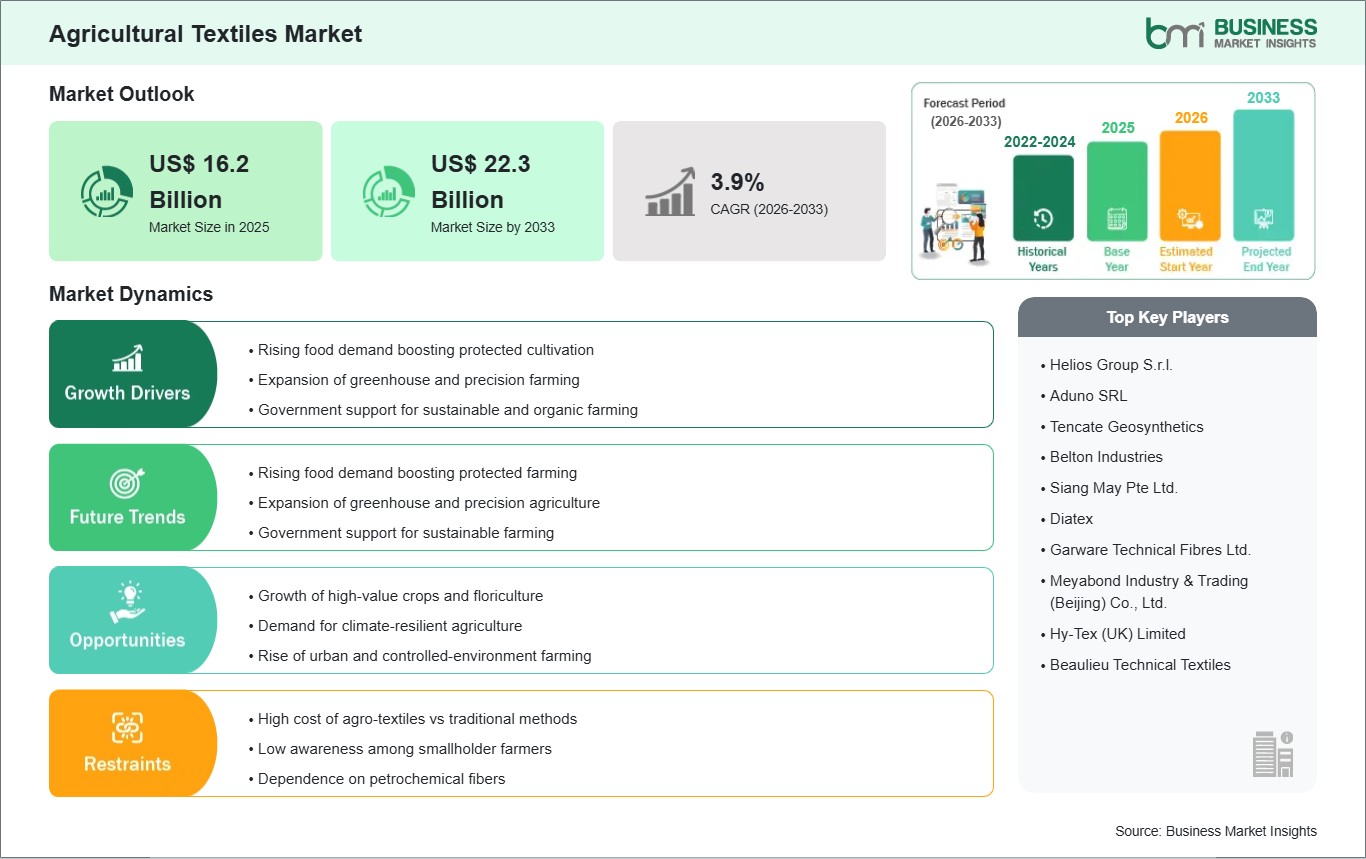
Agricultural textiles are vital for modern farming. They help manage crops, soil, and resources efficiently and sustainably. These fabrics are widely used in crop production, horticulture, and livestock management. They serve as effective tools for protection, improving yields, and conserving resources. Agricultural textiles create better microclimates, provide physical protection, and stabilize soil. They also promote water conservation and controlled growing conditions. The benefits include consistent protection, durable materials, reduced chemical use, and better resistance to environmental damage. Market growth mainly results from increased global food demand, the use of protected cultivation, and a shift toward precision and climate-resilient agriculture. Innovations in strong and smart textile solutions also play a significant role.
However, the agricultural textiles market faces challenges. Fluctuating raw material prices can create obstacles, as can performance issues in extreme conditions. Higher costs may deter small-scale farmers from adopting these solutions. Achieving the best results also requires technical knowledge for selecting and handling products properly. Despite these challenges, there are significant opportunities due to technological progress, a strong emphasis on sustainability, and the rising need for solutions that boost productivity. Future market trends will depend on research into high-performance and biodegradable materials, supportive agricultural policies, and the increasing shift from traditional methods to textile systems.
Segment Analysis
Agricultural Textiles Market Segmentation
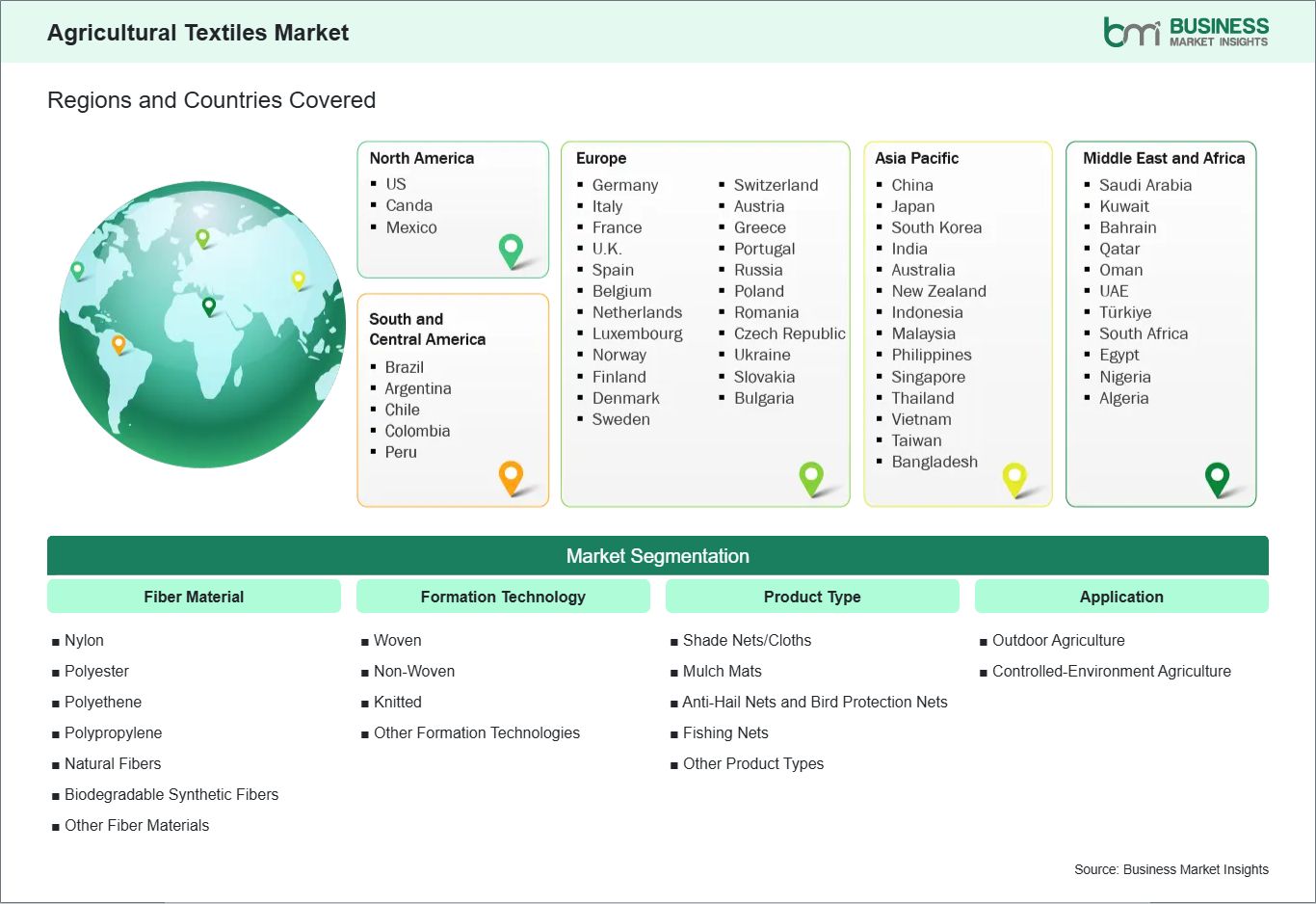
Key segments that contributed to the derivation of the Agricultural Textiles market analysis are fiber material, formation technology, product type, and application.
- By fiber material, the agricultural textiles market is segmented into nylon, polyester, polyethene, polypropylene, natural fibers, biodegradable synthetic fibers, and other fiber materials. The polyethene segment dominated the market in 2025.
- By formation technology, the market is categorized into woven, non-woven, knitted, and other formation technologies. The woven segment dominated the market in 2025.
- By product type, the agricultural textiles market is segmented into shade nets/cloths, mulch mats, anti-hail nets and bird protection nets, fishing nets, and other product types. The mulch mats segment dominated the market in 2025.
- By application, the market is categorized into outdoor agriculture and controlled-environment agriculture. The controlled-environment agriculture segment held the largest share of the market in 2025.
Market Forces
Agricultural Textiles Market Drivers and Opportunities
Growing Need for High-Performance and Smart Farming Solutions
Producers are increasingly using advanced agricultural textiles to boost crop yield, optimize resources, and improve climate resilience. These textiles offer a cost-effective way to provide uniform protection, control microclimates, and enhance durability without requiring major infrastructure changes. They meet modern demands for safer, more productive, and efficient farming by delivering reliable quality and easier application. Their role in precision and protected agriculture is crucial for high-value and large-scale production. The trend toward controlled-environment farming and sustainable practices is speeding up innovation in agrotextiles. The industry is focusing on research and customized products to meet changing agricultural standards. Growth is also supported by the adoption of technology, government initiatives, and the expansion of commercial farming. The demand for specialized functionality continues to drive the development of new materials, ensuring ongoing market expansion.
Shift Toward Sustainable and Regulated Agricultural Practices
There is a growing focus on biodegradable, recyclable, and chemical-reducing technologies. This shift reflects an increasing demand for eco-friendly solutions. Products like biodegradable mulches reduce waste and improve end-of-life management, which appeals to farmers. These textiles improve resource efficiency by saving water, reducing pesticide use, and preventing soil erosion. They support global environmental goals. Interest in bio-based materials and smart textiles shows a commitment to combining high performance with ecological responsibility. Strict environmental regulations and global efforts to cut farm pollution are accelerating the development of green technologies. The industry is focusing on textiles that boost productivity sustainably while meeting safety and environmental standards. The quest for long-term efficiency, compliance with regulations, and a smaller ecological footprint is driving the global adoption of innovative agricultural textiles.
Size and Share Analysis
Agricultural Textiles Market Size and Share Analysis
The Agricultural Textiles market demonstrates steady growth, with size and share analysis revealing evolving trends and competitive positioning among key players. The report further examines subsegments categorized within fiber material, formation technology, product type, and application, offering insights into their contribution to overall market performance.
Based on fiber material, the polyethylene subsegment dominates the agricultural textiles market. Polyethylene-based textiles provide excellent moisture resistance, durability, and cost-effectiveness. They also have strong resistance to weathering and chemicals. These materials are common in mulch films, greenhouse covers, shade nets, and crop protection fabrics. Their reliable performance, flexibility, and consistent protection make them the top choice for farmers and manufacturers who want durable and budget-friendly solutions for better crop management and increased yields.
Report Coverage
Agricultural Textiles Market Report Coverage and Deliverables
The " Agricultural Textiles Market Size and Forecast (2022–2033)" report provides a detailed analysis of the market covering below areas:
- Agricultural Textiles market size and forecast at global, regional, and country levels for all the key market segments covered under the scope
- Agricultural Textiles market trends, as well as market dynamics such as drivers, restraints, and key opportunities
- Agricultural Textiles market analysis covering key market trends, global and regional framework, major players, regulations, and recent market developments
- Industry landscape and competition analysis covering market concentration, heat map analysis, prominent players, and recent developments for the agricultural textiles market
- Detailed company profiles, including SWOT analysis
Geographic Insights
Agricultural Textiles Market Geographic Insights
The geographical scope of the Agricultural Textiles market report is divided into five regions: North America, Asia Pacific, Europe, Middle East & Africa, and South & Central America. The Asia Pacific Agricultural Textiles Market is segmented into China, Japan, South Korea, India, Australia, New Zealand, Indonesia, Malaysia, the Philippines, Singapore, Thailand, Vietnam, Taiwan, Bangladesh, and the Rest of Asia Pacific. Asia Pacific’s fast agricultural modernization, especially in horticulture, protected farming, animal husbandry, and landscape management, helps make it a key region for market expansion.
The market growth is also fueled by the need for better crop protection, resource management, and yield improvement solutions, as well as the demand for long-lasting, climate-resilient, and affordable materials. The region’s large population growth, rising food needs, and greater awareness of sustainable and precise farming practices confirm Asia Pacific’s role as a top producer and consumer of agricultural textiles worldwide.
Industry Activity
Recent Developments
The Agricultural Textiles market is evaluated by gathering qualitative and quantitative data post-primary and secondary research, which includes important corporate publications, association data, and databases. A few of the key developments in the agricultural textiles market are:
- In December 2024, India's Ministry of Textiles and SASMIRA launched a climate-smart agro-textile demonstration centre in Navsari, Gujarat. Spanning 15,000 square metres, the centre showcases solutions such as shade nets, ground covers, and pond liners, offering live demonstrations, practical training, and IoT-based monitoring.
- In November 2025, Sinopec's biodegradable mulch film, PBST, successfully piloted in Xinjiang cotton fields, addressing plastic pollution caused by traditional polyethylene films, yielding cotton crops comparable to those grown using traditional plastic film.
Trust & Transparency
Research Methodology
The market analysis combines proprietary research with secondary data from government agencies, company disclosures, regulatory filings, industry databases and expert interviews. Market estimates are validated through data triangulation, cross-market benchmarking and analyst
review.
View Full Research Methodology
Key Sources Referred:
World Bank – Global Trade IndicatorsEuropean Chemicals AgencyInternational Council of Chemical AssociationsInternational Monetary Fund (IMF)World Trade Organization (WTO)International Trade Administration (ITA)Company WebsitesCompany Annual ReportsCompany Investor Presentations