Market Summary
Executive Summary and Global Market Analysis
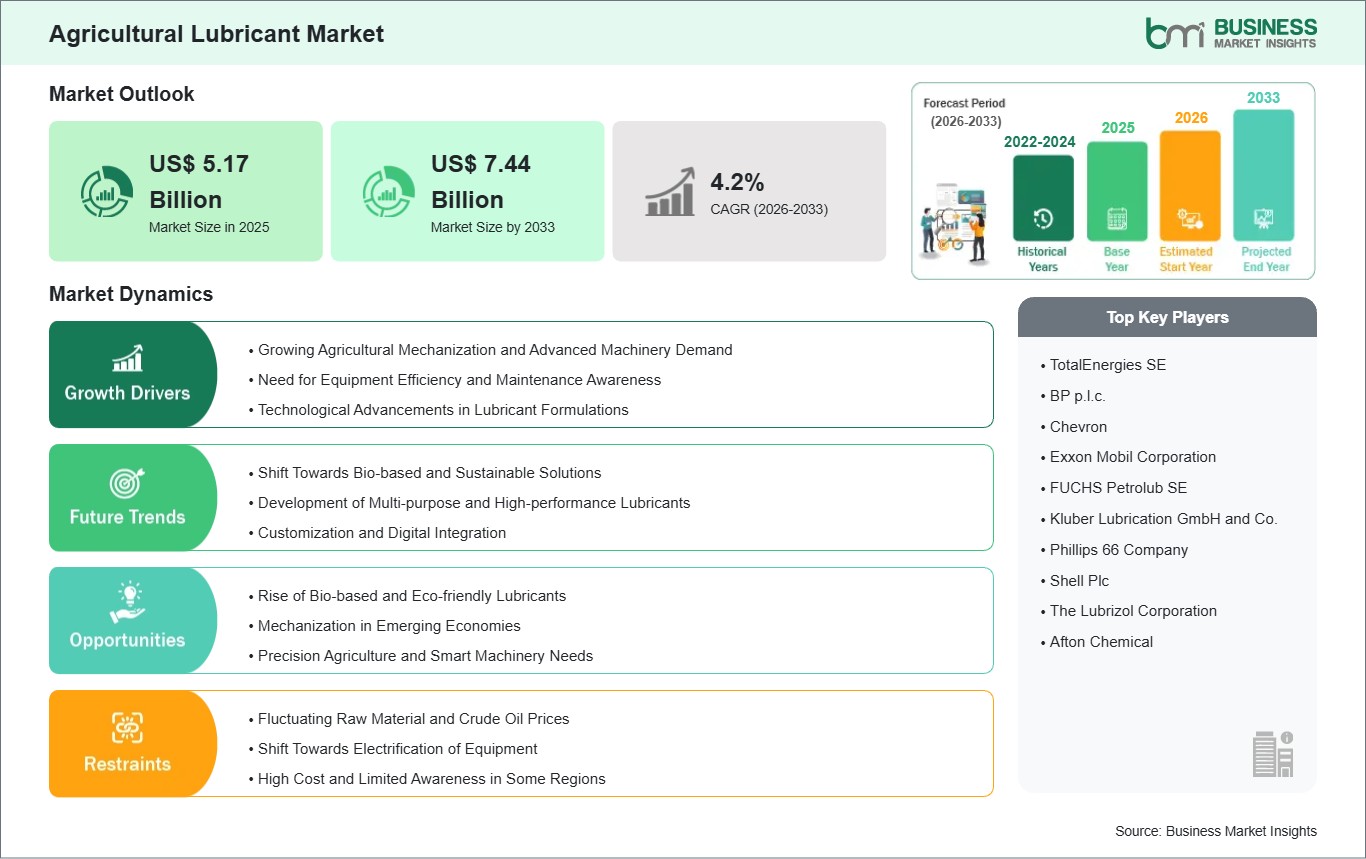
Agricultural lubricants are specialized oils and greases that help agricultural machinery and equipment run smoothly, stay protected, and last longer. These lubricants are used in tractors, harvesters, irrigation systems, fertilizer sprayers, and other farm machinery that work under tough conditions like heavy loads, dust, moisture, and temperature changes. Agricultural lubricants include engine oils, hydraulic fluids, transmission fluids, gear oils, greases, and metalworking fluids. They reduce friction, prevent wear and corrosion, and improve fuel efficiency.
The agricultural lubricant market mainly grows due to the increasing use of machinery in farming and the greater focus on maintaining equipment and improving operations. As farms use more advanced machines to boost productivity and lessen reliance on labor, the need for high-quality lubricants keeps rising. Also, greater awareness of managing equipment lifecycles and practicing preventive maintenance leads to steady lubricant use. The rise of synthetic and bio-based lubricants with better performance and environmental safety supports market growth, making agricultural lubricants essential for modern farming.
Segment Analysis
Agricultural Lubricant Market Segmentation
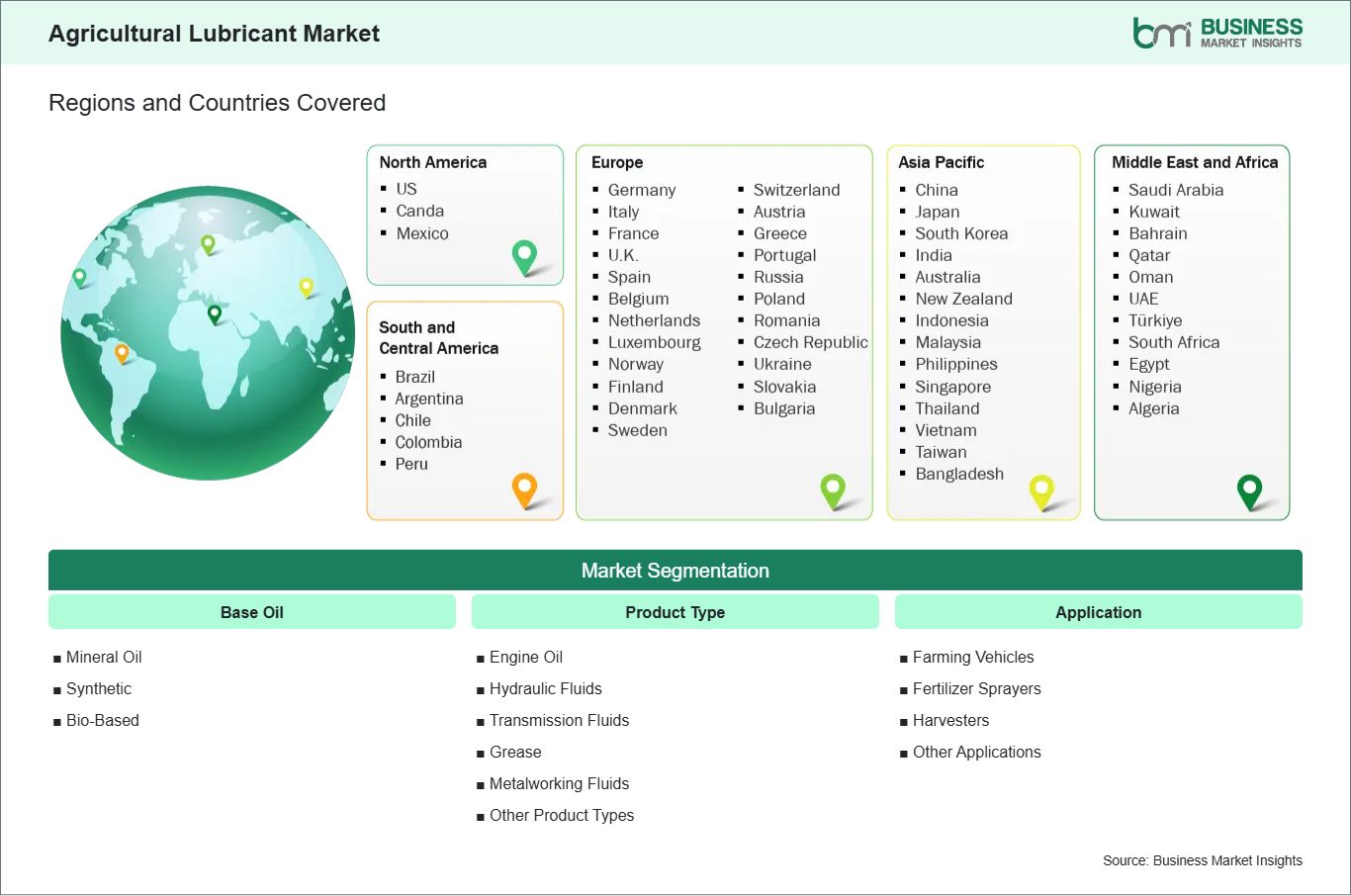
Key segments that contributed to the derivation of the agricultural lubricant market analysis are base oil, product type, and application.
- By base oil, the agricultural lubricant market is segmented into mineral oil, synthetic, and bio-based lubricants. Among these, the mineral oil segment accounted for the largest share in 2025.
- By product type, the market is categorized into engine oil, hydraulic fluids, transmission fluids, grease, metalworking fluids, and others. Among these, engine oil held the largest share in 2025.
- By application, the agricultural lubricant market is divided into farming vehicles, fertilizer sprayers, harvesters, and others. Among these, farming vehicles accounted for the largest share in 2025.
Market Forces
Agricultural Lubricant Market Drivers and Opportunities
Increasing Mechanization and Equipment Utilization
As agricultural producers aim to boost productivity, reduce reliance on labor, and improve efficiency, the use of tractors, harvesters, irrigation systems, and fertilizer application equipment is on the rise. These machines operate in tough conditions involving heavy loads, long hours, dust exposure, and temperature changes, which greatly increases the demand for high-performance lubricants. Agricultural lubricants are essential for reducing friction, preventing wear, cutting down on equipment downtime, and extending the lifespan of machinery. Furthermore, farmers are becoming more aware of preventive maintenance and total ownership costs, leading to more frequent lubricant changes and the use of specialized formulations. In both developed and developing countries, government programs that promote farm modernization and mechanized agriculture are also boosting lubricant demand. As new equipment becomes more sophisticated and requires precise lubrication standards, the need for reliable and high-quality agricultural lubricants continues to rise, making mechanization a key driver in the market.
Growth of Synthetic and Bio-Based Lubricants
Synthetic and bio-based lubricant formulations offer better performance, such as higher thermal stability, longer drain intervals, improved oxidation resistance, and greater protection in extreme operating conditions compared to regular mineral oils. Farmers want to lower maintenance costs and reduce equipment downtime. Synthetic lubricants provide long-term value even with higher initial costs. Moreover, growing awareness of environmental issues and regulations aimed at cutting soil and water pollution are boosting interest in biodegradable and low-toxicity bio-based lubricants.
These products are especially appealing for uses like harvesting, irrigation, and fertilizer spraying, where lubricant leaks can harm the environment. Manufacturers are investing heavily in research and development to make bio-based solutions perform better and increase affordability. As sustainability efforts, precision farming, and responsible equipment use continue to grow, synthetic and bio-based lubricants are set to be more important for market expansion.
Size and Share Analysis
Agricultural Lubricant Market Size and Share Analysis
The agricultural lubricant market demonstrates steady growth, with size and share analysis highlighting evolving trends and competitive dynamics among key players. The report further examines subsegments categorized by base oil, product type, and application, offering insights into their contribution to overall market performance.
For instance, the engine oil segment within the product type category holds a significant market share due to its critical role in protecting engines from wear, heat, and contamination during prolonged agricultural operations. The segment benefits from regular replacement cycles and widespread use across farming vehicles and harvesters.
Report Coverage
Agricultural Lubricant Market Report Coverage and Deliverables
The " Agricultural Lubricant Market Size and Forecast (2022–2033)" report provides a detailed analysis of the market covering below areas:
- Agricultural lubricant market size and forecast at global, regional, and country levels for all the key market segments covered under the scope
- Agricultural lubricant market trends, as well as market dynamics such as drivers, restraints, and key opportunities
- Agricultural lubricant market analysis, covering key market trends, global and regional framework, major players, regulations, and recent market developments
- Industry landscape and competition analysis covering market concentration, heat map analysis, prominent players, and recent developments for the agricultural lubricant market
- Detailed company profiles, including SWOT analysis
Geographic Insights
Agricultural Lubricant Market Geographic Insights
The geographical scope of the agricultural lubricant market report is divided into five regions: North America, Asia Pacific, Europe, the Middle East & Africa, and South & Central America. The agricultural lubricant market in Asia Pacific is expected to grow significantly during the forecast period.
This growth comes from the region's large agricultural landscape, the rising use of mechanized farming, and increased investments in modern agricultural infrastructure. Countries like China, India, Japan, and Australia are facing strong demand for agricultural lubricants because of the growing use of tractors, harvesters, and irrigation systems. Government programs that aim to improve farm productivity and promote mechanization have also boosted lubricant consumption.
Moreover, the many small and medium-sized farms are driving demand for affordable and reliable lubricant solutions to keep equipment running efficiently. Rapid economic growth and greater awareness of maintenance practices among farmers also help the market expand. At the same time, improved distribution networks and the presence of both global and regional lubricant manufacturers enhance product availability in rural areas. Together, these factors make Asia Pacific a crucial growth area for the agricultural lubricant market.
Industry Activity
Recent Developments
The agricultural lubricant market is evaluated by gathering qualitative and quantitative data post-primary and secondary research, which includes important corporate publications, association data, and databases. A few of the key developments in the agricultural lubricant market are:
- In April 2025, TotalEnergies grew its bio-based lubricant lineup for agriculture, focusing on environmentally friendly farming practices. The new products aim to lessen environmental harm while keeping high-performance standards, helping the industry move towards sustainable lubrication options.
- In February 2025, BP Castrol launched a new range of agricultural engine and hydraulic oils. These oils are made to provide longer drain intervals and better protection for modern farming equipment used in heavy conditions. This launch highlights the increasing emphasis on efficiency and the longevity of equipment in farming.
Trust & Transparency
Research Methodology
The market analysis combines proprietary research with secondary data from government agencies, company disclosures, regulatory filings, industry databases and expert interviews. Market estimates are validated through data triangulation, cross-market benchmarking and analyst
review.
View Full Research Methodology
Key Sources Referred:
World Bank Global Trade IndicatorsWorld Trade Organization (WTO)International Monetary Fund (IMF)International Trade Administration (ITA)Company WebsitesCompany Annual ReportsCompany Investor PresentationsIndependent Lubricant Manufacturers Association (ILMA)Society of Tribologists and Lubrication Engineers (STLE)National Lubricating Grease Institute (NLGI)International Council for Machinery Lubrication (ICML)