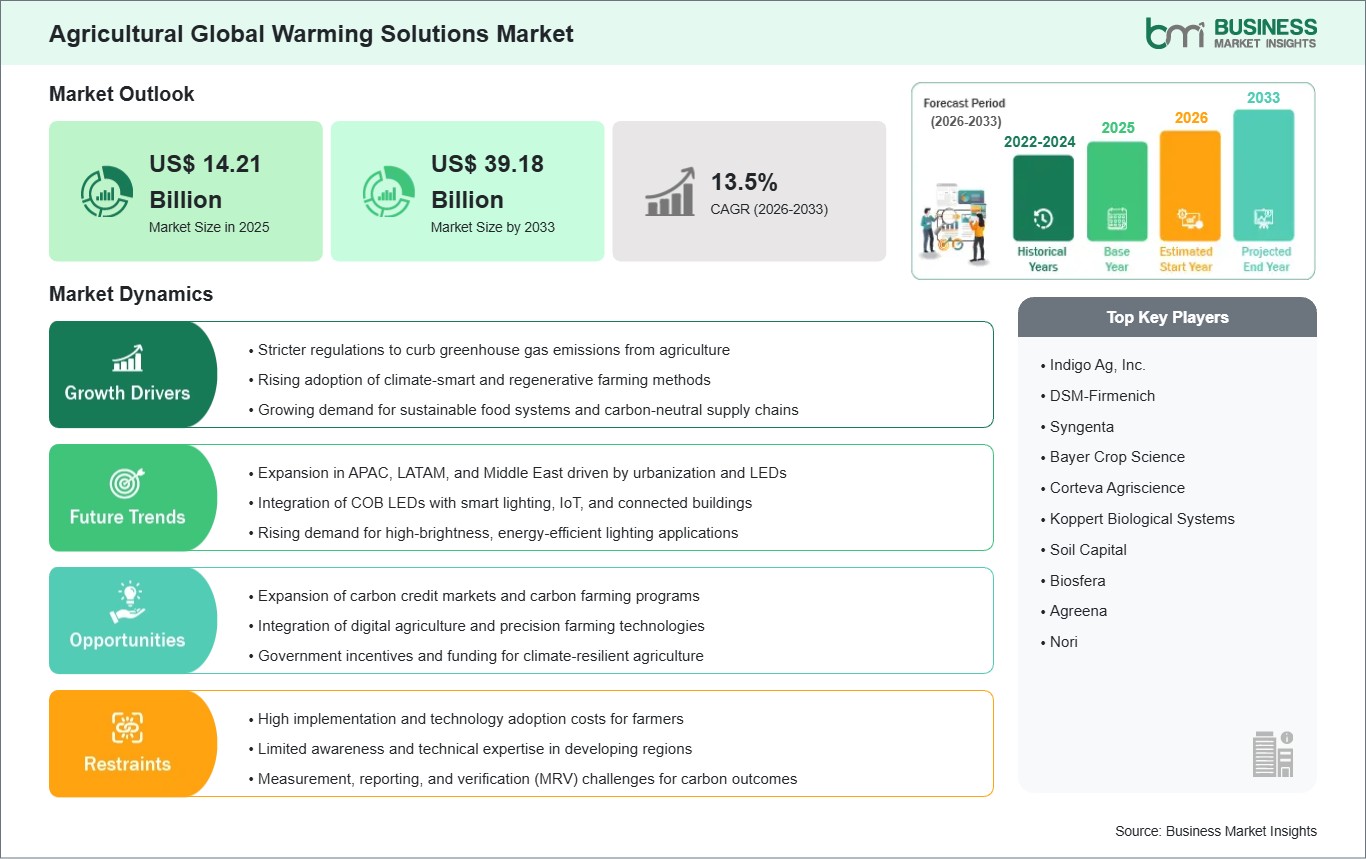
Market Summary
Executive Summary and Global Market Analysis
Agricultural global warming solutions are practices, technologies, and products designed to cut greenhouse gas (GHG) emissions from farming. They also focus on improving carbon storage and encouraging sustainable farming. These solutions include various strategies such as precision farming, managing soil carbon, using low-emission fertilizers, feeding livestock methane-reducing diets, practicing agroforestry, and incorporating renewable energy in farm work. Biological solutions like biofertilizers and microbial inoculants also help by improving how nutrients are used and lowering nitrous oxide emissions.
The market for these solutions is mainly driven by growing awareness of climate change effects, government policies, and international climate commitments that support sustainable agriculture. Regulatory frameworks and incentives, such as carbon credits and subsidies for low-emission technologies, motivate farmers to adopt these practices. The increasing demand for sustainable and climate-friendly food products also boosts market growth, as consumers and supply chains focus on environmentally responsible practices. Furthermore, advances in precision agriculture, remote sensing, and soil health monitoring allow for the effective implementation of these solutions, which encourages market expansion.
Segment Analysis
Agricultural Global Warming Solutions Market Segmentation
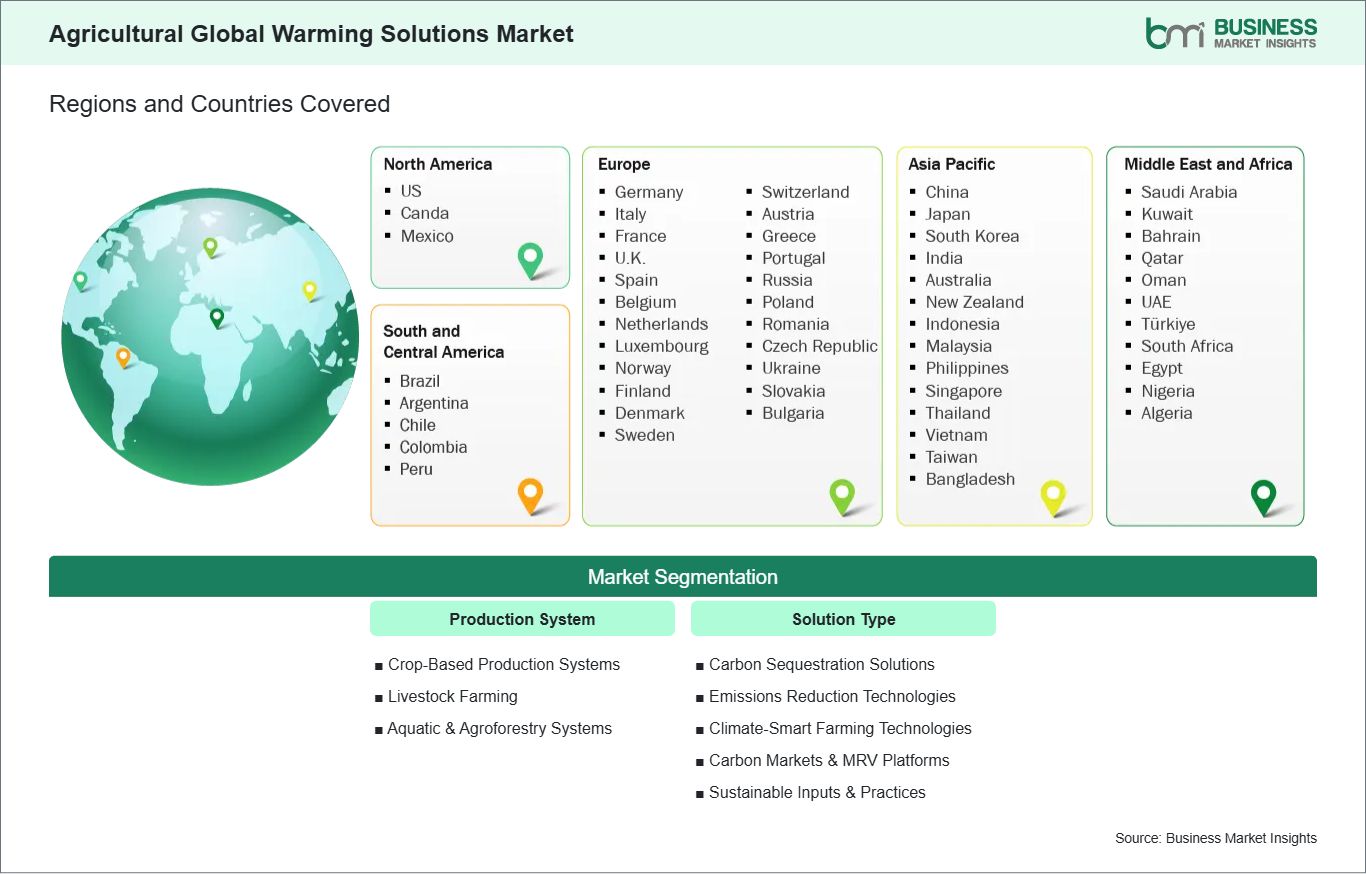
Key segments that contributed to the derivation of the agricultural global warming solutions market analysis are production system and solution type.
- By production system, the agricultural global warming solutions market is categorized into crop-based production systems, livestock farming, and aquatic & agroforestry systems. Among these, the crop-based production systems segment accounted for the largest share in 2025.
- By solution type, the market is categorized into carbon sequestration solutions, emissions reduction technologies, climate-smart farming technologies, carbon markets & MRV platforms, and sustainable inputs & practices. Among these, the carbon sequestration solutions segment held the largest share in 2025.
Market Forces
Agricultural Global Warming Solutions Market Drivers and Opportunities
Government Policies and Climate Regulations
Many countries are committed to cutting greenhouse gas emissions as part of international agreements like the Paris Agreement. This has pushed policymakers to promote sustainable farming practices. Governments are offering subsidies, tax breaks, and carbon credit systems to encourage farmers to use low-emission technologies, precision agriculture tools, and practices that conserve soil and water. These regulations often require farmers to monitor and report their emissions, creating a need for solutions that help them comply.
Additionally, regional initiatives that support sustainable farming, such as promoting biofertilizers, livestock feed that reduces methane, and the use of renewable energy in farming, further boost market growth. As agricultural players recognize the financial and environmental advantages of compliance, the adoption of climate-smart practices continues to grow. Therefore, incentives and policy frameworks from the government serve as a strong and steady driver, promoting the use of products and services that aim to reduce the sector's impact on global warming.
Adoption of Precision Agriculture Technologies
Precision agriculture uses tools like GPS-guided machinery, remote sensing, IoT-enabled soil and crop monitoring, and data analysis to improve input use, such as water, fertilizers, and pesticides. By improving resource efficiency, these technologies cut nitrous oxide emissions from over-fertilization and reduce energy use in farming operations. Moreover, precision agriculture allows for targeted actions, like applying variable-rate fertilizers and using controlled irrigation, which can boost soil carbon storage and overall farm sustainability.
The growing availability of affordable sensors, drones, and AI-driven software is making it easier for small, medium, and large farms to adopt these practices, especially in areas with better technological infrastructure. Companies that provide integrated digital solutions for monitoring emissions and implementing strategies to reduce them can gain market share in this changing landscape. As farmers and agribusinesses strive to balance productivity with environmental responsibility, precision agriculture offers a flexible and innovative way to improve the effectiveness of global warming solutions in agriculture.
Size and Share Analysis
Agricultural Global Warming Solutions Market Size and Share Analysis
The agricultural global warming solutions market demonstrates steady growth, with size and share analysis highlighting evolving trends and competitive dynamics among key players. The report further examines subsegments categorized by production system and solution type, offering insights into their contribution to overall market performance.
For instance, the crop-based production systems segment within the production system category holds a significant market share. This is due to the widespread adoption of climate-smart practices, including precision farming, soil carbon management, and sustainable input use in major crop-growing regions such as North America, Europe, and Asia-Pacific. The segment benefits from the high scalability of these solutions across cereals, fruits, and vegetables, as well as government incentives supporting sustainable farming practices.
Report Coverage
Agricultural Global Warming Solutions Market Report Coverage and Deliverables
The " Agricultural Global Warming Solutions Market Size and Forecast (2022–2033)" report provides a detailed analysis of the market covering below areas:
- Agricultural global warming solutions market size and forecast at global, regional, and country levels for all the key market segments covered under the scope
- Agricultural global warming solutions market trends, as well as market dynamics such as drivers, restraints, and key opportunities
- Agricultural global warming solutions market analysis, covering key market trends, global and regional framework, major players, regulations, and recent market developments
- Industry landscape and competition analysis covering market concentration, heat map analysis, prominent players, and recent developments for the agricultural global warming solutions market
- Detailed company profiles, including SWOT analysis
Geographic Insights
Agricultural Global Warming Solutions Market Geographic Insights
The geographical scope of the agricultural global warming solutions market report is divided into five regions: North America, Asia Pacific, Europe, the Middle East & Africa, and South & Central America. The agricultural global warming solutions market in North America is expected to grow significantly during the forecast period.
This growth is due to regulatory support, technology use, and high awareness of sustainable farming practices. The United States and Canada have strong frameworks that promote climate-smart agriculture. They offer subsidies for low-emission equipment, incentives for carbon sequestration projects, and enforce strict regulations on agricultural greenhouse gas emissions. These policies motivate farmers to use improved solutions like precision agriculture, biofertilizers, methane-reducing livestock feed, and renewable energy-powered farming.
Moreover, North America witnesses significant investments in research and development. Universities, government agencies, and private companies are actively working on new strategies to reduce emissions from crop and livestock production. The widespread use of technologies such as GPS-guided machinery, IoT-based soil monitoring, and data-driven farm management systems speeds up the implementation of global warming solutions. Rising consumer demand for sustainably produced food and commitments from supply chains to lower carbon footprints also boost market growth.
Industry Activity
Recent Developments
The agricultural global warming solutions market is evaluated by gathering qualitative and quantitative data post-primary and secondary research, which includes important corporate publications, association data, and databases. A few of the key developments in the agricultural global warming solutions market are:
- In December 2025, Sea Forest partnered with Woolworths, DIT AgTech, and Teys Australia to start a multi-year trial of Sea Forest's seaweed-based livestock feed, SeaFeed. This feed aims to cut methane emissions in cattle by up to 80%. This collaboration shows the growing commitment within the industry to find effective solutions for reducing methane in livestock farming.
- In November 2025, Mars launched a Europe-wide initiative to support over 300 farmers across 60,900 hectares. The goal is to promote climate-smart agriculture practices. This program highlights the efforts of the private sector to expand regenerative farming methods that focus on reducing emissions across large agricultural areas.
Trust & Transparency
Research Methodology
The market analysis combines proprietary research with secondary data from government agencies, company disclosures, regulatory filings, industry databases and expert interviews. Market estimates are validated through data triangulation, cross-market benchmarking and analyst
review.
View Full Research Methodology
Key Sources Referred:
World Bank Global Trade IndicatorsWorld Trade Organization (WTO)International Monetary Fund (IMF)International Trade Administration (ITA)Company WebsitesCompany Annual ReportsCompany Investor PresentationsAssociation of International Research and Development Centers for Agriculture (AIRCA)Food and Agriculture Organization (FAO)International Center for Biosaline Agriculture (ICBA)