Market Summary
Executive Summary and Global Market Analysis
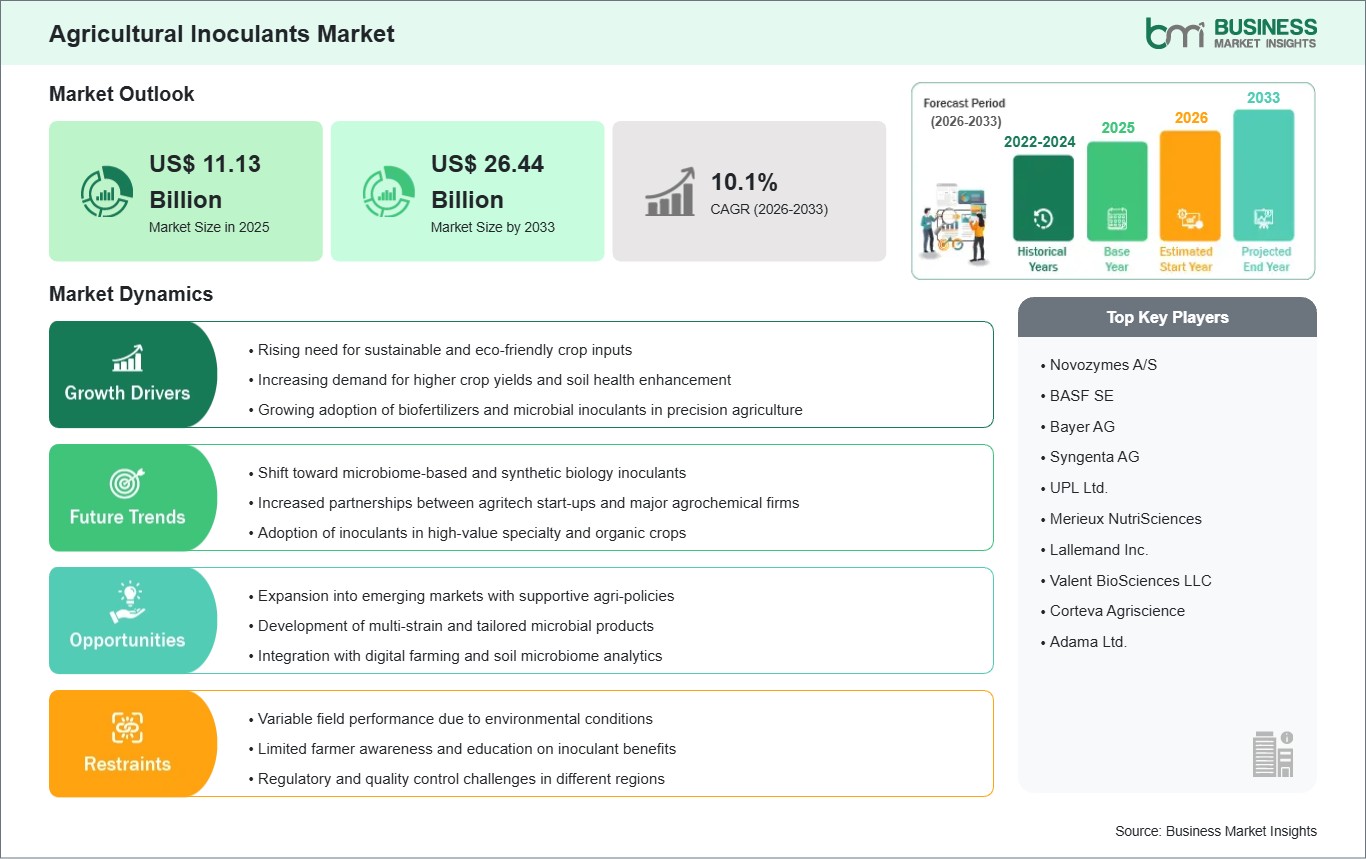
Agricultural inoculants contain beneficial microorganisms like rhizobia, mycorrhizal fungi, and nitrogen-fixing bacteria. These are applied to seeds, soil, or plants to improve crop growth, nutrient uptake, and soil health. These biological products enhance plant-microbe interactions, leading to more nitrogen fixation, better disease resistance, and increased tolerance to challenges like drought or salinity. Inoculants are commonly used to grow legumes, cereals, and horticultural crops. They support sustainable farming practices and reduce the need for synthetic fertilizers.
The agricultural inoculants market is expanding as global agriculture shifts toward sustainable and organic practices. Rising environmental awareness and increasing pressure to reduce chemical fertilizer use are accelerating the adoption of bio‑based alternatives. Growing demand for higher crop yields and improved soil health, particularly in developing regions, is further driving market uptake.
Advancements in microbial strain development, carrier formulations, and delivery technologies are enhancing the effectiveness and longevity of inoculant products, making them more attractive to farmers. With a strong focus on eco‑friendly farming, cost efficiency, and productivity gains, agricultural inoculants are emerging as a key component of modern agriculture, supporting broader adoption and unlocking new market opportunities worldwide.
Segment Analysis
Agricultural Inoculants Market Segmentation
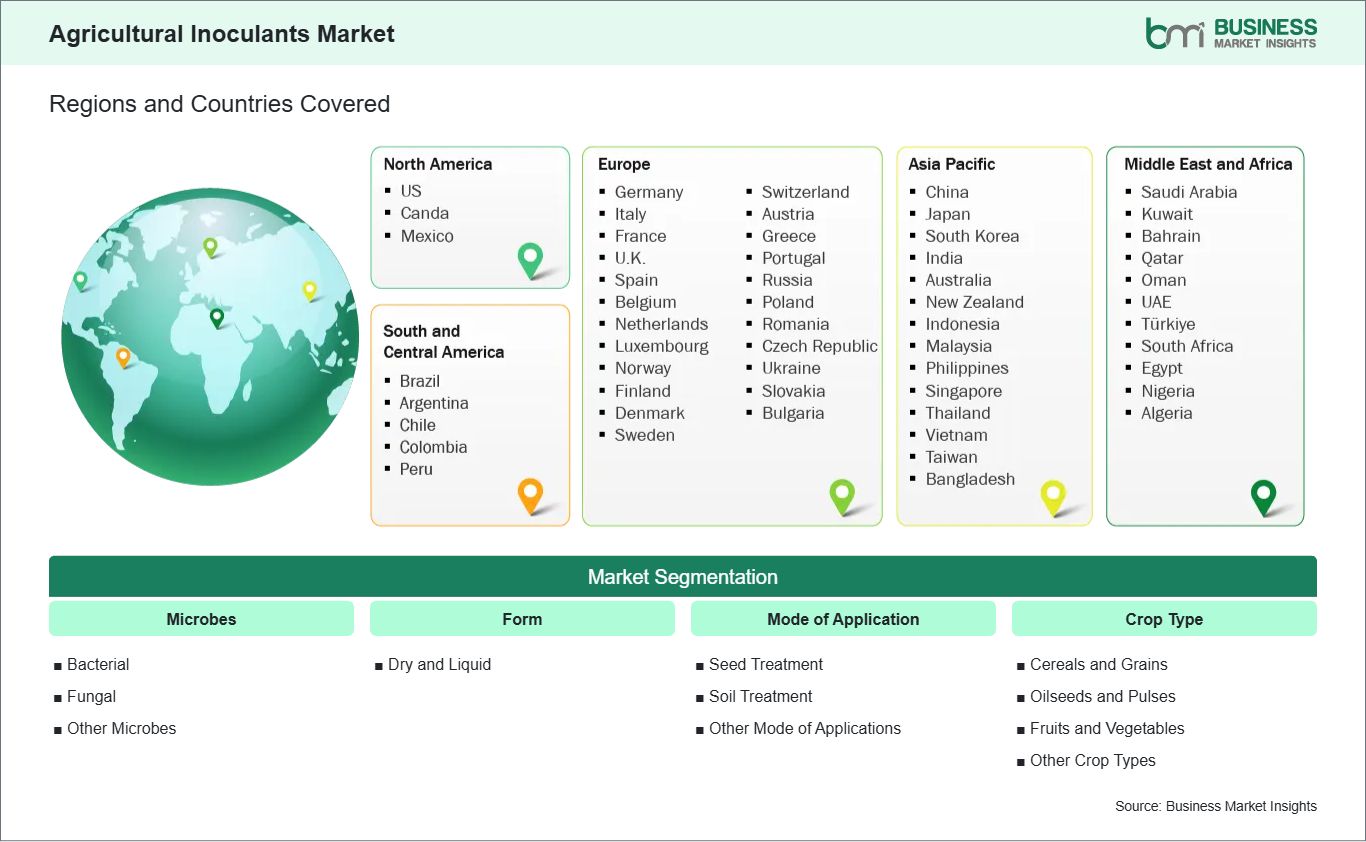
Key segments that contributed to the derivation of the agricultural inoculants market analysis are microbes, form, mode of application, and crop type.
- By microbes, the agricultural inoculants market is segmented into bacterial, fungal, and others. Among these, the bacterial segment accounted for the largest share in 2025.
- By form, the market is categorized into dry and liquid formulations. Among these, the liquid segment held the largest share in 2025.
- By mode of application, the agricultural inoculants market is divided into seed treatment, soil treatment, and others. Among these, the seed treatment segment accounted for the largest share in 2025.
- By crop type, the market is categorized into cereals and grains, oilseeds and pulses, fruits and vegetables, and others. Among these, the cereals and grains segment dominated in 2025.
Market Forces
Agricultural Inoculants Market Drivers and Opportunities
Rising Demand for Sustainable and Low-Input Agriculture
Concerns about soil degradation, reduced soil fertility, and the environmental impacts of chemical fertilizers have compelled farmers and policymakers to look for biological alternatives. Agricultural inoculants help with nutrient cycling, especially nitrogen fixation and phosphorus solubilization. This supports healthy crop growth while using fewer synthetic inputs. Limits on chemical fertilizers and greater support for organic and regenerative farming systems further encourage their use.
Additionally, rising input costs have made affordable biological solutions more attractive to farmers, especially in developing regions. Inoculants also improve soil health and long-term productivity, which supports global goals for climate-resilient agriculture. As awareness of these benefits increases through government extension programs and private agribusiness initiatives, more people view agricultural inoculants as a practical and environmentally friendly choice. This shift toward sustainability drives market growth.
Expansion in Emerging and High-Value Crop Markets
A significant growth opportunity in the agricultural inoculants market lies in expanding usage in emerging economies and high-value crop areas. Rapid agricultural development in regions like Asia Pacific, South and Central America, and Africa is creating a demand for technologies that improve yields while protecting soil health. Inoculants provide a scalable solution for small and medium farmers looking for affordable ways to boost productivity. Additionally, the rise in cultivation of fruits, vegetables, oilseeds, and horticultural crops creates chances for specialized microbial formulations suited to specific crop needs.
Advances in microbial research, formulation stability, and seed-coating technologies make wider commercialization and application easier. Collaborations among inoculant manufacturers, seed companies, and agricultural cooperatives are enhancing distribution and farmer awareness. As precision agriculture and integrated nutrient management practices gain popularity, inoculants are well-positioned to become a key part of modern crop production systems, supporting long-term market growth.
Size and Share Analysis
Agricultural Inoculants Market Size and Share Analysis
The agricultural inoculants market demonstrates steady growth, with size and share analysis highlighting evolving trends and competitive dynamics among key players. The report further examines subsegments categorized by microbes, form, mode of application, and crop type, offering insights into their contribution to overall market performance.
For instance, the seed treatment segment within the mode of application category holds a significant market share. This is due to its widespread adoption across cereals, grains, oilseeds, and pulses, where it enables early-stage microbial colonization and enhances nutrient uptake during critical growth phases. The segment benefits from its cost-effectiveness, precise application, and compatibility with commercial seed processing systems.
Report Coverage
Agricultural Inoculants Market Report Coverage and Deliverables
The " Agricultural Inoculants Market Size and Forecast (2022–2033)" report provides a detailed analysis of the market covering below areas:
- Agricultural inoculants market size and forecast at global, regional, and country levels for all the key market segments covered under the scope
- Agricultural inoculants market trends, as well as market dynamics such as drivers, restraints, and key opportunities
- Agricultural inoculants market analysis, covering key market trends, global and regional framework, major players, regulations, and recent market developments
- Industry landscape and competition analysis covering market concentration, heat map analysis, prominent players, and recent developments for the agricultural inoculants market
- Detailed company profiles, including SWOT analysis
Geographic Insights
Agricultural Inoculants Market Geographic Insights
The geographical scope of the agricultural inoculants market report is divided into five regions: North America, Asia Pacific, Europe, the Middle East & Africa, and South & Central America. The agricultural inoculants market in Asia Pacific is expected to grow significantly during the forecast period.
This market growth is attributed to the region's vast agricultural base and the high cultivation of cereals, grains, oilseeds, and pulses. There is also a rising interest in sustainable farming practices. Countries like India, China, Australia, and various Southeast Asian nations have shown strong demand for inoculants to improve soil fertility, boost crop productivity, and lessen the reliance on chemical fertilizers. Government programs that support biofertilizers and biological inputs, along with favorable regulatory frameworks, have sped up market adoption.
Additionally, the large number of small and medium-sized farmers has driven demand for affordable and effective solutions, making inoculants appealing. Growing awareness about soil health management and the long-term benefits of microbial products has also aided market growth. Moreover, increasing investments in agricultural research, local manufacturing, and distribution networks have improved supply throughout the region. Together, these factors establish Asia Pacific as the leading area in the agricultural inoculants market.
Industry Activity
Recent Developments
The agricultural inoculants market is evaluated by gathering qualitative and quantitative data post-primary and secondary research, which includes important corporate publications, association data, and databases. A few of the key developments in the agricultural inoculants market are:
- In January 2025, Groundwork BioAg partnered with ADAMA Ltd. to improve access to Rootella mycorrhizal inoculants for farmers in China. This partnership seeks to promote the use of affordable fungal inoculants that boost crop yields, improve soil health, and lower reliance on synthetic fertilizers for key crops such as vegetables, sugarcane, corn, and soybean.
- In February 2025, Syngenta and Coopavel teamed up with Embrapa Soja to launch Azoscoop, a new corn inoculant featuring two strains of Azospirillum brasilense. Unveiled at the Show Rural Coopavel in Paraná, Brazil, this product aims to raise grain yields and decrease nitrogen fertilizer needs.
Trust & Transparency
Research Methodology
The market analysis combines proprietary research with secondary data from government agencies, company disclosures, regulatory filings, industry databases and expert interviews. Market estimates are validated through data triangulation, cross-market benchmarking and analyst
review.
View Full Research Methodology
Key Sources Referred:
World Bank Global Trade IndicatorsWorld Trade Organization (WTO)International Monetary Fund (IMF)International Trade Administration (ITA)Company WebsitesCompany Annual ReportsCompany Investor PresentationsInternational Federation of Organic Agriculture Movements (IFOAM)Global Alliance for Climate-Smart Agriculture (GACSA)International Society for Applied Biological Sciences (ISABS)The Soil Science Society of America (SSSA)