Market Summary
Executive Summary and Global Market Analysis
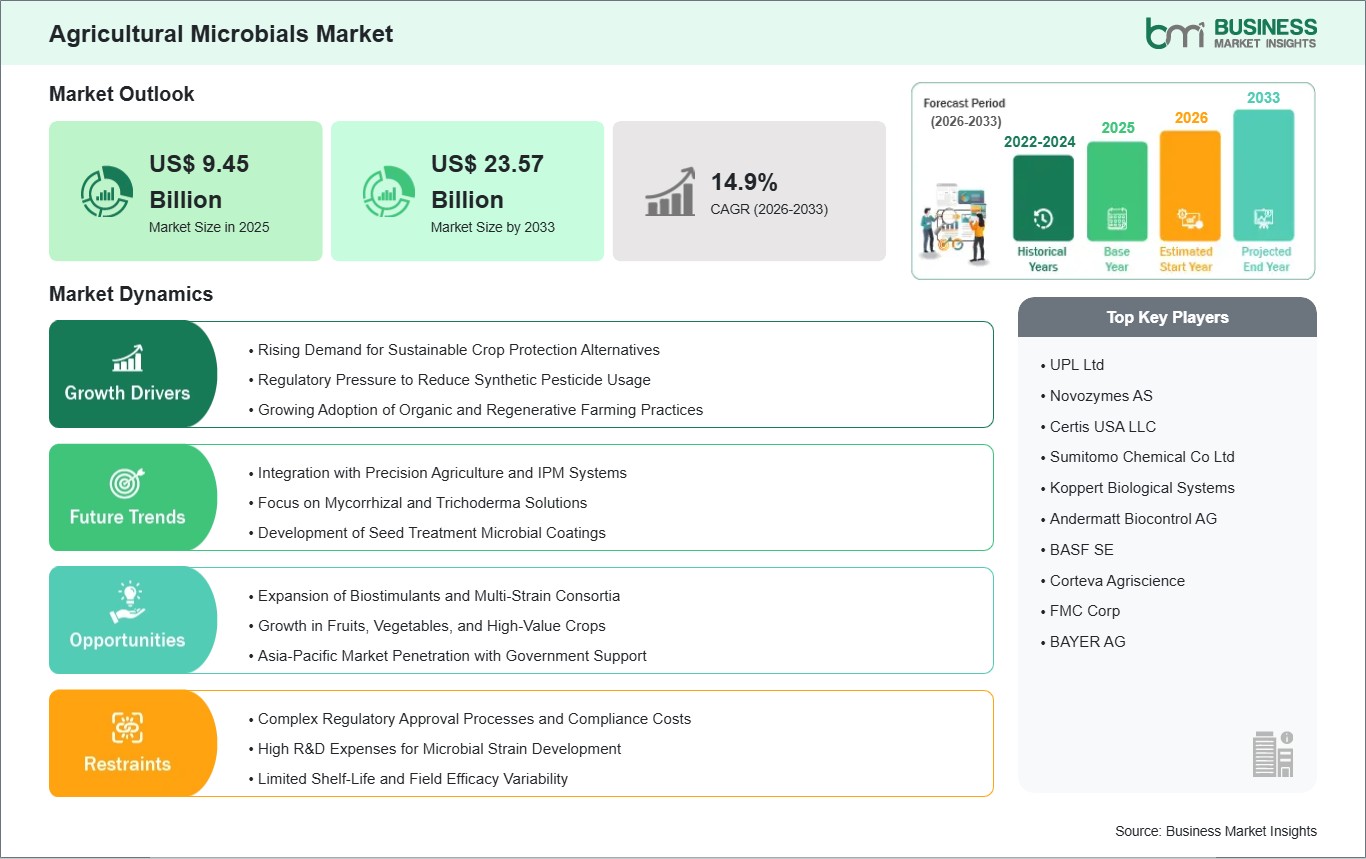
Agricultural microbials represent a critical segment within the global agricultural and biological inputs industry. As a foundational component of modern agroecosystem solutions, they enhance the resilience, productivity, and overall efficiency of agricultural systems across diverse farming environments. They are mostly used in crop protection, soil conditioning, seed treatment, and plant growth promotion, which are solutions that have been found to be extensively used in cereals, fruits and vegetables, oilseeds, pulses, turf, and plantation crops. In biological agriculture, agricultural microorganisms play a prime role in increasing the availability of nutrients, development of roots, stress tolerance, disease resistance in crops, and also sustaining a sustainable cultivation regimen and long-term soil fertility. When used in field crop and horticulture processes, they allow better nutrient absorption, inhibition of soil-borne pathogens, and plant vigor. They are a crucial aspect in integrated pest management systems, where they help to decrease the reliance on chemicals at the cost of ensuring that crops remain healthy.
In the organic and conventional farming market, agricultural microbials are used in the production of biofertilizers, biopesticides, and soil amendments to guarantee stable cropping and ecological balance. The benefits of the technology are that it can be used with the current farming methods, it has a higher efficiency of using inputs, it can adapt to different climatic environments, and the option of tailoring formulations with the help of modern microbial science. The market is also highly developed by the development of increased interest in sustainable agriculture, the necessity to use organic farming, the spread of the problems with soil erosion, and the worldwide transition to the use of eco-friendly and residue-free crops. Moreover, continuous development of strains of microbes, developments in formulation processes, and attempts to advance regenerative and climate-resistant agriculture are driving further market growth in the global economy. Such advances make agricultural microbials an indispensable part of the sustainable and high-performance food production systems in the evolution.
Despite the bright future of agricultural microbials, there are some challenges present in the market, such as fluctuations in field performance, environmental conditions, as well as the lack of awareness among farmers in developing countries. The growth can also be hampered by regulatory complexities and the requirement to have specialized storage and handling, as well as in significantly cost-sensitive agricultural markets. Furthermore, to maintain the consistency and efficacy of the product, the formulation and quality control need to be highly accurate, which may complicate the operations of the manufacturers. Nevertheless, there are enormous market opportunities that are brought about by enhanced microbial biotechnology, conducive government policies that encourage sustainable agriculture, and continued high demand for safe and environmentally friendly agricultural inputs. It is believed that the future of the global agricultural microbials market will be influenced by its continued innovation, positive regulatory environment, greater farmer education, and the gradual replacement of chemical-intensive production systems with biologically motivated, sustainable systems of crop management.
Segment Analysis
Agricultural Microbials Market Segmentation
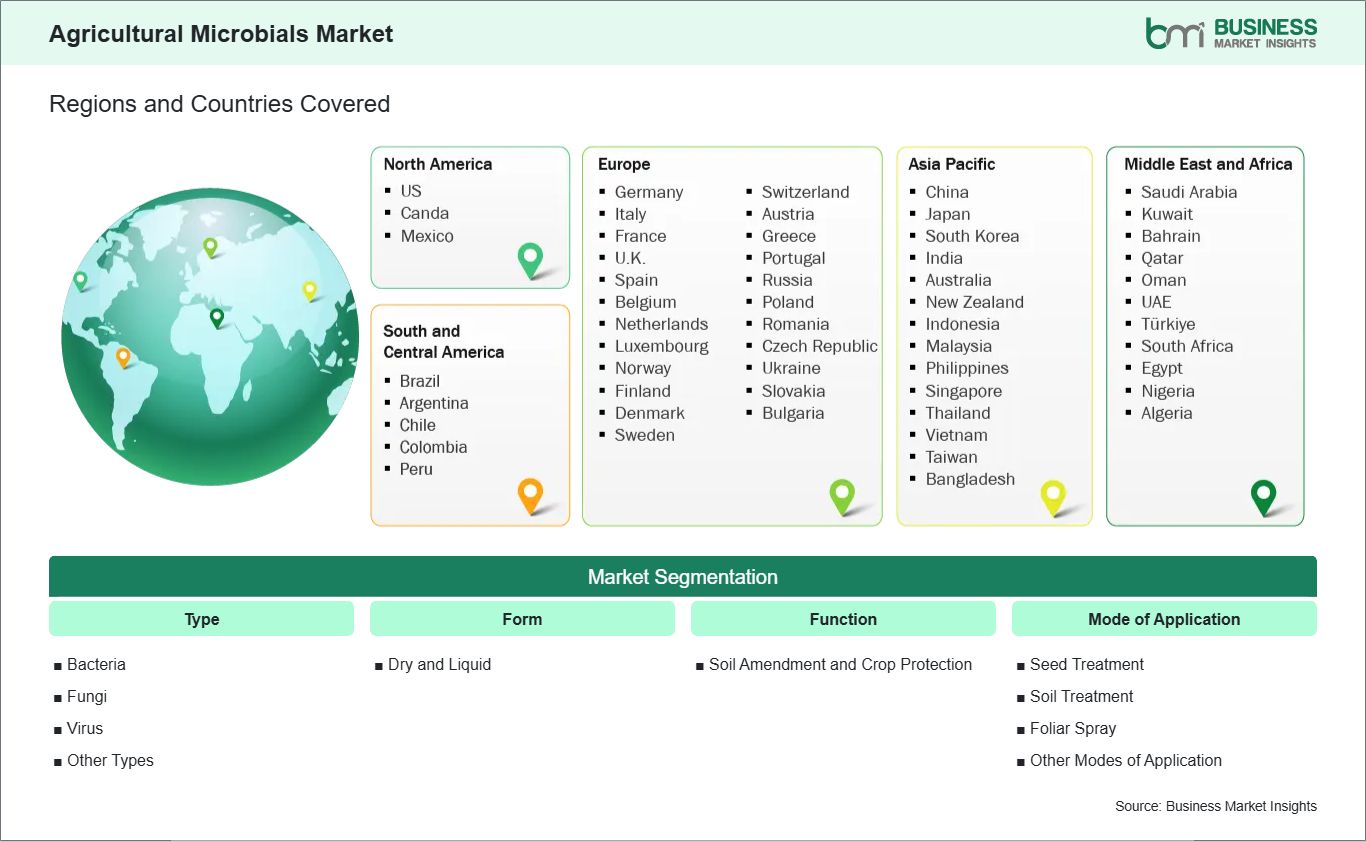
Key segments that contributed to the derivation of the agricultural microbials market analysis are type, form, function, mode of application, and crop type.
- By type, the agricultural microbials market is segmented into bacteria, fungi, virus, and other types. The bacteria segment dominated the market in 2025.
- By form, the market is divided into dry and liquid. The liquid segment dominated the market in 2025.
- By function, the agricultural microbials market is bifurcated into soil amendment and crop protection. The crop protection segment dominated the market in 2025.
- By mode of application, the market is segmented into seed treatment, soil treatment, foliar spray, and other modes of application. The foliar spray segment dominated the market in 2025.
- By crop type, the agricultural microbials market is categorized into cereals and grains, oilseeds and pulses, fruits and vegetables, and other crop types. The fruits and vegetables segment dominated the market in 2025. The cereals and grains segment is further sub-segmented into corn, wheat, rice, and other cereals and grains. The oilseeds and pulses segment is further sub-segmented into soybean, sunflower, and other oilseeds and pulses. The fruits and vegetables segment is further sub-segmented into root and tuber vegetables, leafy vegetables, pome fruits, berries, citrus fruits, and other fruits and vegetables.
Market Forces
Agricultural Microbials Market Drivers and Opportunities
Rising Adoption of Sustainable and Biological Farming Practices
The use of agricultural microbials is rapidly growing because they can improve soil health, nutrient efficiency, and crop productivity and limit the use of synthetic chemical inputs. Increasing worries about soil erosion, reduced soil fertility, and the environmental effects of traditional agrochemicals have driven farmers and agribusiness companies towards sustainable solutions. Agricultural microbials such as biofertilizers and biopesticides are applicable to conventional and organic farming systems because they enhance nutrient dissolution, root growth, and crop resistance to pests and diseases. Their use has been further accelerated by the increasing necessity to cultivate more crops to satisfy the world food demand and the need to reduce the chemical residues and to comply with the regulatory requirements. Moreover, the government programs of sustainable agriculture and integrated pest management, as well as a rise in awareness by farmers of the long-term productivity of the soil, are also creating a great demand. With growers increasingly seeking cost-effective and environmentally responsible solutions that enable the achievement of yield stability and resiliency, agricultural microbials are attaining great momentum in the world agricultural market.
Advancement in Microbial Biotechnology and Precision Agriculture
Farming inputs are usually not flexible to changing climatic variations and soil diversity, which opens potential prospects of sophisticated microbial solutions to particular crops and environments. Advances in microbial biotechnology, genomics, and fermentation are allowing the enhancement of highly productive, strain-selective agricultural microbials that have better shelf life and field performance. The new generation products have the ability to be tailored to specific nutritional deficiencies, stress tolerance, and disease suppression. The acceptance and efficacy of microbial products is also increased by the increased integration of accuracy agriculture technologies like soil diagnostics and data-driven farming. Such alignment helps in the increase of sustainable yield and minimizes the wastage of inputs and ecological cost. Furthermore, more investment by agritechnology firms and favorable regulatory policies on biological inputs are enhancing commercialization. The firms that take advantage of the state-of-the-art research and formulation technologies, as well as strategic partnerships are in good positions to seize the opportunities, improve the market presence, and assist the world in moving towards resilient and sustainable agricultural systems.
Size and Share Analysis
Agricultural Microbials Market Size and Share Analysis
The Agricultural Microbials market demonstrates steady growth, with size and share analysis revealing evolving trends and competitive positioning among key players. The report further examines subsegments categorized within type, form, function, mode of application, and crop type, offering insights into their contribution to overall market performance.
Based on the mode of application, the foliar spray subsegment dominates the market. Foliar spray microbial formulation provides quick uptake of nutrients, enhanced metabolism by plants, and resistance to pests and environmental stresses. The products are common in cereals, fruits and vegetables, oilseeds, and plantation crops. Foliar sprays are also most preferred because of their capacity to provide instant benefits, even distribution, and satisfactory performance in various field conditions by farmers interested in quick response and better health of their crops in different stages of crop growth.
Report Coverage
Agricultural Microbials Market Report Coverage and Deliverables
The " Agricultural Microbials Market Size and Forecast (2022–2033)" report provides a detailed analysis of the market covering below areas:
- Agricultural Microbials market size and forecast at global, regional, and country levels for all the key market segments covered under the scope
- Agricultural Microbials market trends, as well as market dynamics such as drivers, restraints, and key opportunities
- Agricultural Microbials market analysis covering key market trends, global and regional framework, major players, regulations, and recent market developments
- Industry landscape and competition analysis covering market concentration, heat map analysis, prominent players, and recent developments for the agricultural microbials market
- Detailed company profiles, including SWOT analysis
Geographic Insights
Agricultural Microbials Market Geographic Insights
The geographical scope of the Agricultural Microbials market report is divided into five regions: North America, Asia Pacific, Europe, Middle East & Africa, and South & Central America.
The Asia Pacific Agricultural Microbials Market is segmented into China, Japan, South Korea, India, Australia, New Zealand, Indonesia, Malaysia, the Philippines, Singapore, Thailand, Vietnam, Taiwan, Bangladesh, and the Rest of Asia Pacific. Asian Pacific shows positive growth in major sectors of agriculture, such as cereals, fruits and vegetables, plantation crops, and commercial farming, making the region a leading agricultural microbials market. This trend is also facilitated by the growing need for sustainable farming inputs, the enhanced use of organic farming, and the development of concerns related to soil health and crop productivity improvement.
The continued population growth, agricultural land expansion, increased attention to food security, and environmentally friendly production and farming methods further consolidate the role of the Asia Pacific as the major producer and an important consumer of agricultural microbials. All these combined create a strong strategic value to the region in the global agricultural inputs value chain.
Industry Activity
Recent Developments
The Agricultural Microbials market is evaluated by gathering qualitative and quantitative data post-primary and secondary research, which includes important corporate publications, association data, and databases. A few of the key developments in the agricultural microbials market are:
- In August 2025, BioConsortia, Inc. secured US$ 15 million in funding from internal investors, including Otter Capital, to advance its nitrogen-fixing microbial seed treatment products. The company has conducted over 1,000 trials in the last five years, focusing on sustainable agriculture solutions.
- In February 2025, the US-based Jord BioScience secured US$ 7 million in its Series B funding round to enhance the development and commercialization of its customizable microbial solutions for agriculture, aiming to provide next-generation crop inputs.
Trust & Transparency
Research Methodology
The market analysis combines proprietary research with secondary data from government agencies, company disclosures, regulatory filings, industry databases and expert interviews. Market estimates are validated through data triangulation, cross-market benchmarking and analyst
review.
View Full Research Methodology
Key Sources Referred:
World Bank – Global Trade Indicators European Chemicals Agency International Council of Chemical Associations International Monetary Fund (IMF) World Trade Organization (WTO) International Trade Administration (ITA) Company Websites Company Annual Reports Company Investor Presentations