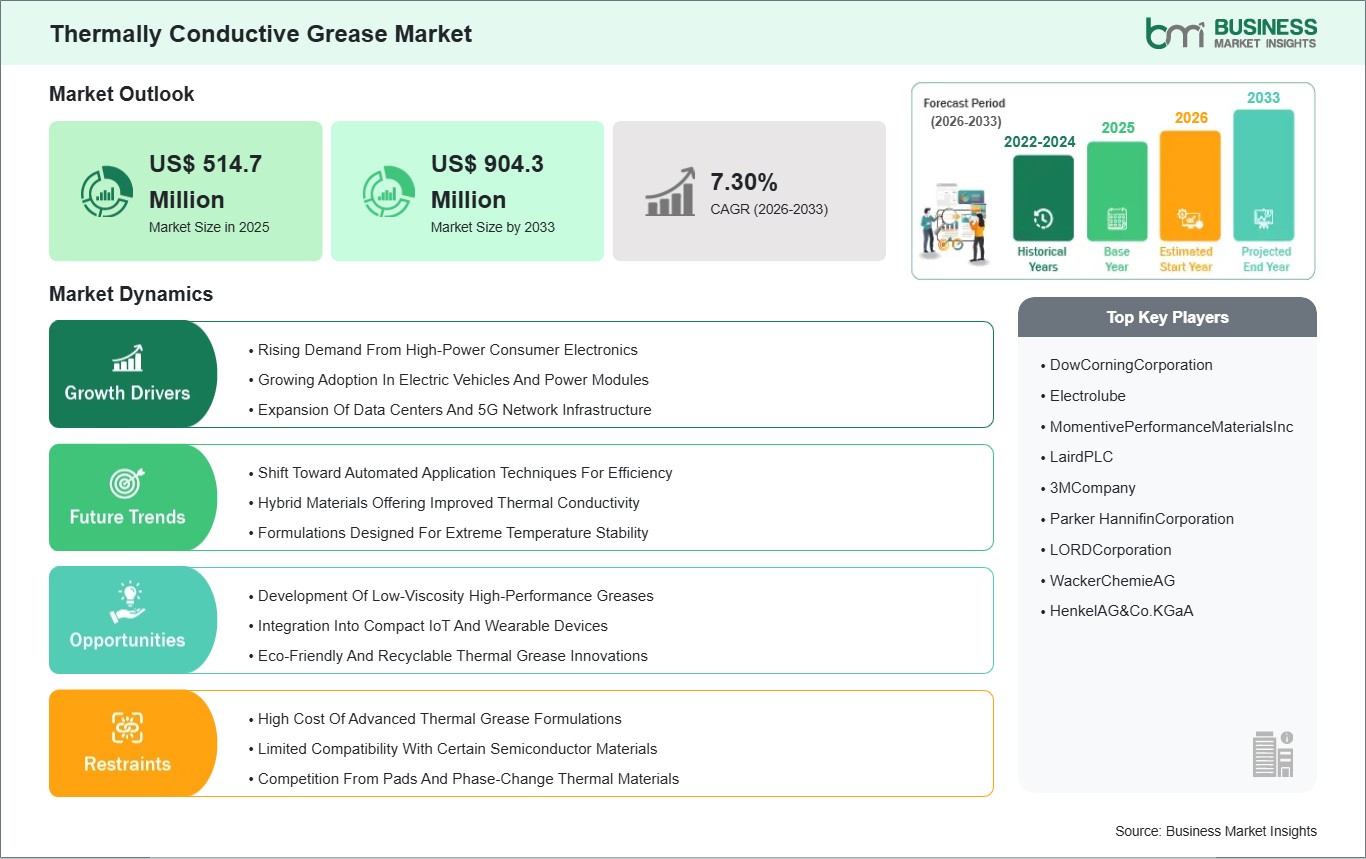
The Thermally Conductive Grease Market size is expected to reach US$ 904.3 million by 2033 from US$ 514.7 million in 2025. The market is estimated to record a CAGR of 7.30% from 2026 to 2033.
The worldwide market for thermally conductive grease functions as an essential tool that helps electronic and electrical systems control their heat distribution by using the grease to fill tiny spaces found between heating elements and their cooling devices. The greases improve the thermal conductivity of materials while they reduce thermal resistance between components and their operating systems, which handle heat management tasks. The increasing power density of compact electronic devices requires efficient heat management solutions to prevent thermal throttling, performance drops and component breakdowns. Thermally conductive greases find extensive application throughout the consumer electronics sector, the data center industry, telecom equipment, industrial machinery, automotive electronics and LED lighting systems because they provide essential thermal management solutions that determine system efficiency and product lifespan.
North America dominates the worldwide thermally conductive grease market because its established electronics market, extensive data center infrastructure investments and various industries have embraced advanced thermal management technologies. The United States leads the way in high-performance computing and cloud infrastructure and telecommunications applications, which need efficient thermal interface materials to handle increasing power demands and support ultra-thin device designs.
North America sees the automotive industry as an important sector because thermally conductive greases function in power electronics and battery thermal management systems and inverter assemblies to enhance heat transfer and system efficiency. The market experiences global growth through four main factors, which include higher performance electronics becoming more common, 5G network installation increasing, smaller device technology development, and rising use of power-efficient semiconductor devices. The need for advanced thermally conductive grease solutions increases because devices operate at faster speeds while producing more heat.
The market operates under multiple obstacles, which include unpredictable changes in raw material prices, increasing environmental regulations that restrict specific chemical materials, and the market challenge from thermal interface materials that provide different installation methods and superior gap-filling abilities. The market develops through the introduction of new eco-friendly thermally conductive greases, which have high performance and low viscosity. The value of these greases increases through three main features, which include their ability to maintain performance across different temperature ranges, their improved usability in automated production processes, and their compatibility with emerging semiconductor technologies. The global market will maintain its focus on thermally conductive greases because electronic systems need efficient thermal interface solutions that work in compact designs that require high power operation.

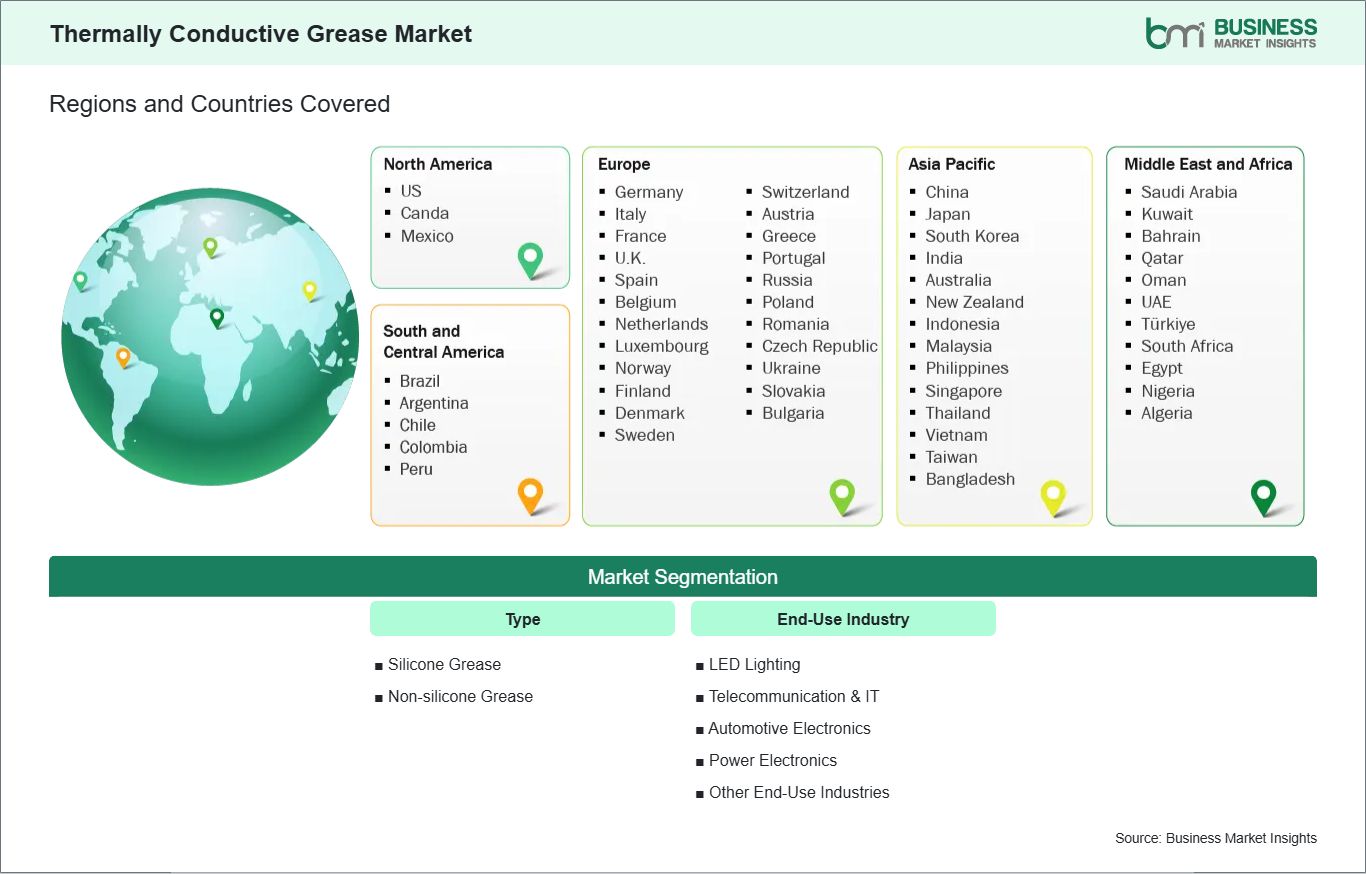
Key segments that contributed to the derivation of the thermally conductive grease market analysis are type and end‑use industry.
The global surge in high‑power consumer electronics such as gaming consoles, high‑end laptops, augmented reality devices, and smart home systems has significantly increased the demand for efficient thermal management solutions. As processors and graphics units in these devices push higher performance thresholds, they generate more heat within increasingly compact form factors. Thermally conductive grease acts as an essential interface material to bridge microscopic gaps between the heat source and heat sink, enabling rapid heat dissipation and preventing performance throttling or hardware failure. This demand is particularly prominent in advanced markets like North America and Europe, where consumer expectations for performance and reliability are highest.
In the Asia Pacific region, large electronics manufacturing hubs such as China, Japan, and South Korea are pivotal to this trend. Major original equipment manufacturers (OEMs) in these countries integrate thermally conductive greases during assembly to ensure thermal stability in high‑volume consumer electronics. The emphasis on miniaturization and enhanced functionality in these devices further propels the adoption of advanced thermal greases that maintain conductivity under high heat fluxes.
Emerging markets in South America and the Middle East & Africa are also experiencing rising adoption, albeit at a different pace, as smartphone and electronics penetration increases. Local manufacturers are increasingly incorporating thermal greases into products designed for hot climates and prolonged usage. Globally, this trend underscores the critical role of thermal grease in supporting device performance, user experience, and long‑term reliability as consumer electronics continue to evolve toward greater power densities.
Innovation in thermally conductive greases has increasingly focused on developing low‑viscosity, high‑performance formulations that combine superior thermal conductivity with ease of application. Traditional greases often posed challenges during automated assembly due to higher viscosity and inconsistent spreadability, leading to inefficient thermal transfer in compact device architectures. Low‑viscosity formulations address this by enabling uniform application through automated dispensing systems, reducing manufacturing defects and improving thermal performance consistency across production lines.
Leading suppliers in North America and Europe are at the forefront of this innovation, collaborating with OEMs to tailor grease formulations that meet specific performance criteria such as stable thermal conductivity across wide temperature ranges and minimal pump‑out during thermal cycling. For example, next‑generation silicone and polymer composite greases exhibit improved wettability and maintain their properties in demanding applications like server racks and telecommunications hardware. These developments ensure that devices operate efficiently even under sustained power loads.
Asia Pacific manufacturers are also adopting these advanced greases to support high‑throughput electronics production and maintain performance standards for exported devices. The expansion of 5G networks, data centers, and IoT ecosystems in countries such as China and India further amplifies the need for greases that balance performance, reliability, and manufacturability. As electronics continue to demand higher power levels and tighter integration, the development of low‑viscosity, high‑performance thermally conductive greases will remain a key area of innovation, enhancing both thermal management effectiveness and production efficiency globally.
The thermally conductive grease market demonstrates steady growth, with size and share analysis highlighting evolving trends and competitive dynamics among key players. The report examines subsegments categorized within type and end‑use industry, offering insights into their contribution to overall market performance.
By type, the silicone grease subsegment dominated the market in 2025, driven by its cost-effectiveness, high-temperature resistance, and ability to fill small gaps between electronic components.
In terms of end‑use industry, the LED lighting subsegment dominated the market in 2025, driven by the growing global demand for efficient thermal management in indoor and outdoor LED applications.
| Report Attribute | Details |
|---|---|
| Market size in 2025 | US$ 514.7 Million |
| Market Size by 2033 | US$ 904.3 Million |
| Global CAGR (2026 - 2033) | 7.30% |
| Historical Data | 2022-2024 |
| Forecast period | 2026-2033 |
| Segments Covered | By Type
|
|
Regions and Countries Covered
| |
| North America | US, Canada, Mexico |
| Europe | Belgium, Austria, Finland, Denmark, Greece, Poland, Romania, Russia, Ukraine, Czech Republic, Slovakia, Bulgaria, Italy, Luxembourg, Germany, Switzerland, France, Netherlands, Norway, Portugal, Spain, Sweden, United Kingdom |
| Asia-Pacific | Australia, China, India, Japan, South Korea, Indonesia, Malaysia, Philippines, Singapore, Thailand, Vietnam, Bangladesh, New Zealand, Taiwan |
| South and Central America | Brazil, Argentina, Peru, Chile, Colombia |
| Middle East and Africa | Bahrain, Kuwait, Oman, Qatar, Saudi Arabia, United Arab Emirates, Turkiye, South Africa, Egypt, Algeria, Nigeria |
| Market leaders and key company profiles |
|
The "Thermally Conductive Grease Market Size and Forecast (2022 - 2033)" report provides a detailed analysis of the market covering below areas:
The geographical scope of the Thermally Conductive Grease Market report is divided into North America, Asia Pacific, Europe, Middle East & Africa, and South & Central America. North America held the largest share in 2025.
North America dominates the worldwide thermally conductive grease market because of its developed electronics network, together with its modern semiconductor production capabilities, and its growing usage needs from data centers, cloud computing, automotive electronics and industrial systems.
The United States serves as a center for high-performance computing, electric vehicles and telecommunications infrastructure because thermal management plays a vital role in maintaining device reliability and efficiency. Thermally conductive greases offer exceptional heat dissipation capabilities in small high-power devices through their extensive application across processors, GPUs, LED modules, battery management systems and inverter assemblies.
The European market serves as a significant market base because its automotive electrification, industrial automation and energy-efficient infrastructure programs drive market development. Germany, France, and the UK now use thermally conductive greases for power electronics in EVs, industrial robotics systems and LED lighting systems because energy efficiency regulations and performance standards demand these materials.
The Asia Pacific region experiences rapid growth because of its extensive electronics manufacturing capabilities, rising consumer electronics demand and implementation of 5G networks. China, Japan, South Korea and India use thermally conductive greases in smartphones, laptops, LED displays, telecom equipment and EV components to control heat buildup in their compact devices.
The Middle East and Africa market displays smaller size, which shows growth potential through power electronics, data center and industrial machinery adoption that receives backing from infrastructure development, renewable energy projects and urbanization initiatives.
The South and Central American market shows gradual adoption of thermally conductive greases, which regional manufacturers use to improve performance and reliability in consumer electronics, automotive electronics and industrial applications. The increasing need for reliable thermal management, together with rising device miniaturization and power density, drives the worldwide thermal conductive grease market, which North America leads through its advanced technology use and dedicated research and development efforts.

The Thermally Conductive Grease Market is evaluated by gathering qualitative and quantitative data post primary and secondary research, which includes important corporate publications, association data, and databases. A few of the key developments in the thermally conductive grease market are:
The Thermally Conductive Grease Market is valued at US$ 514.7 Million in 2025, it is projected to reach US$ 904.3 Million by 2033.
As per our report Thermally Conductive Grease Market, the market size is valued at US$ 514.7 Million in 2025, projecting it to reach US$ 904.3 Million by 2033. This translates to a CAGR of approximately 7.30% during the forecast period.
The Thermally Conductive Grease Market report typically cover these key segments-
The historic period, base year, and forecast period can vary slightly depending on the specific market research report. However, for the Thermally Conductive Grease Market report:
The Thermally Conductive Grease Market is populated by several key players, each contributing to its growth and innovation. Some of the major players include:
The Thermally Conductive Grease Market report is valuable for diverse stakeholders, including:
Essentially, anyone involved in or considering involvement in the Thermally Conductive Grease Market value chain can benefit from the information contained in a comprehensive market report.
Please tell us your area of interest
(Market Segments/ Regions and Countries/ Companies)