
Grease Market Outlook: Size, Share, Trends, Growth Analysis, Competitive Landscape & Forecast, 2026-2033

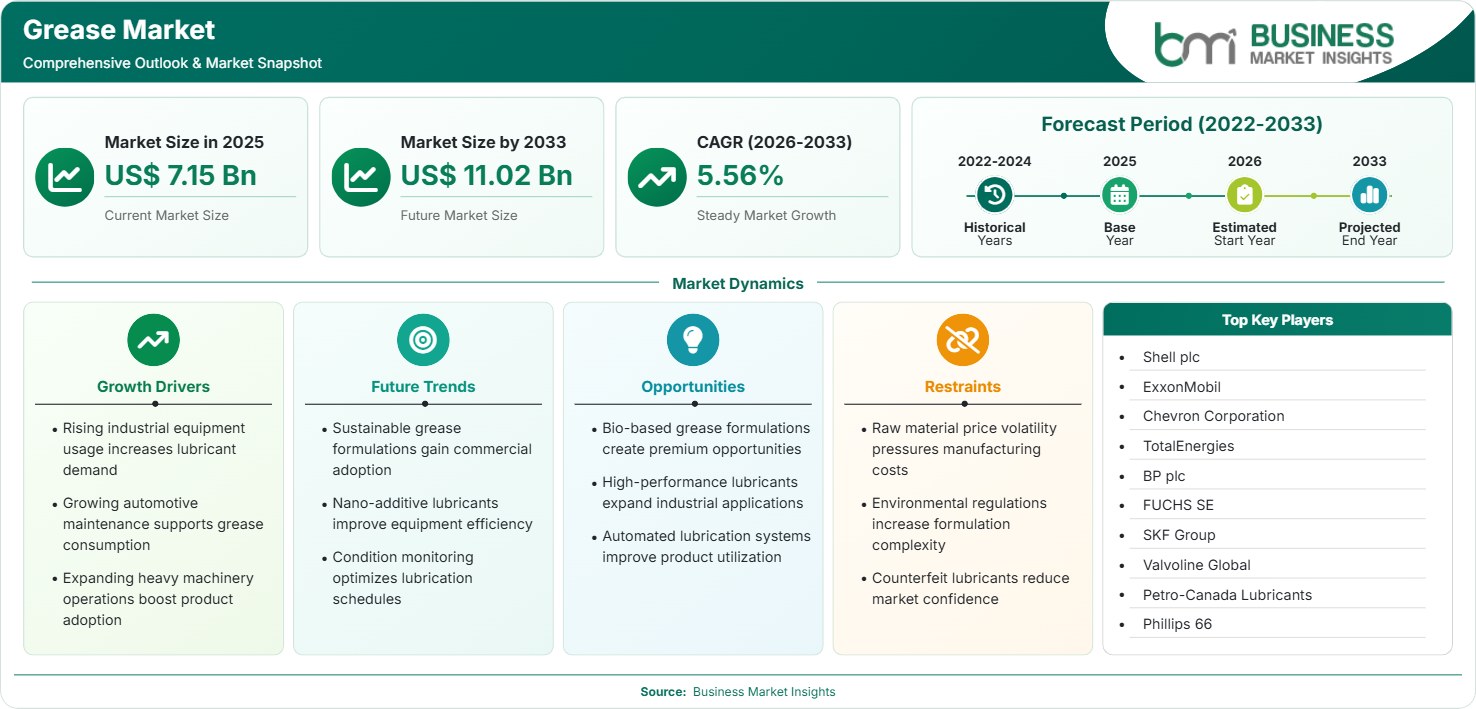
The Grease Market size was valued at US$ 7.15 billion in 2025 and is projected to reach US$ 11.02 billion by 2033, growing at a CAGR of 5.56% during 2026–2033. Rising industrial equipment utilization, increasing automotive maintenance activities, and expanding heavy machinery operations are supporting lubricant consumption, while bio-based formulations and automated lubrication technologies create new growth opportunities.

Report Coverage
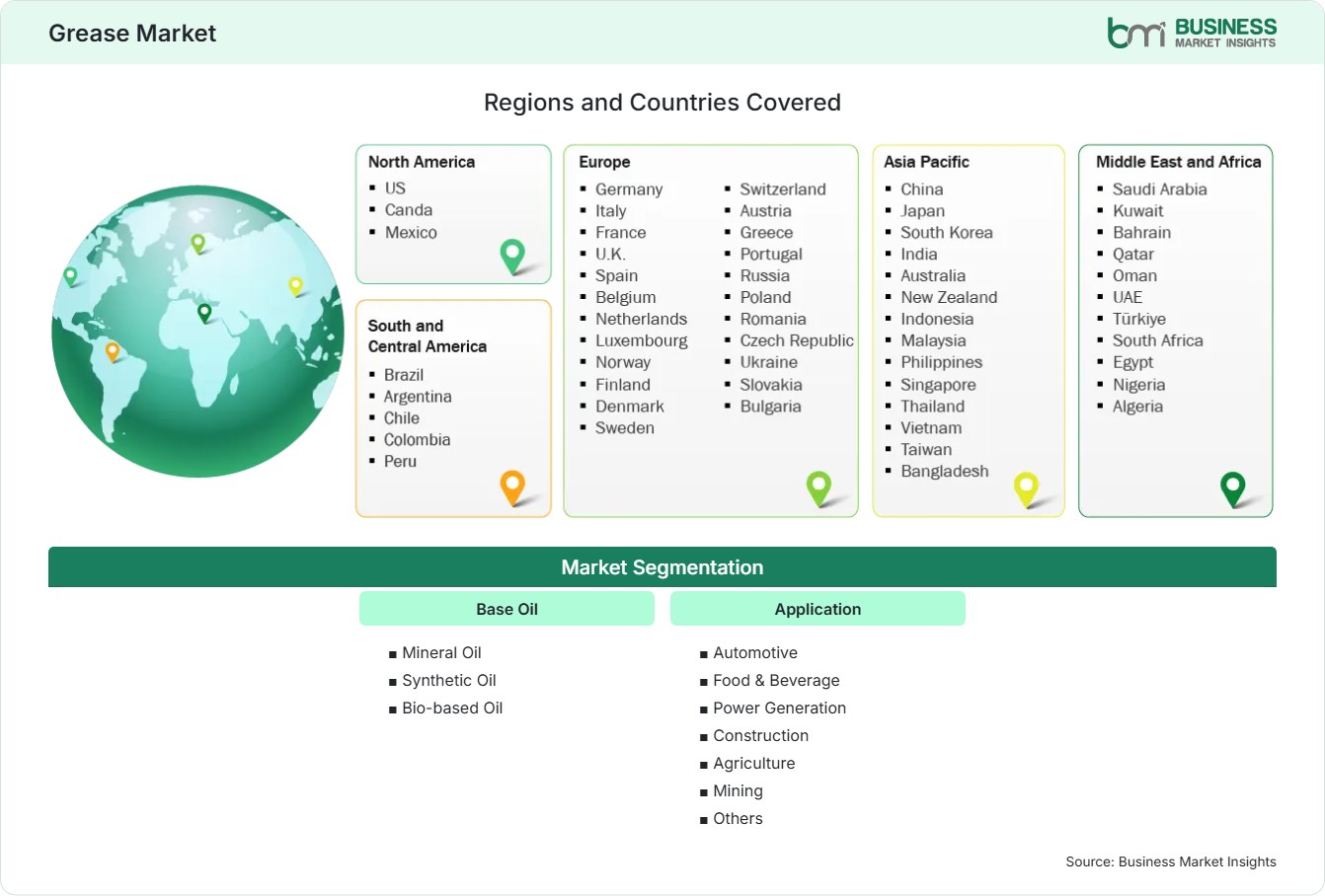
  • Base Oil: Mineral Oil, Synthetic Oil, Bio-based Oil
  • Application: Automotive, Food & Beverage, Power Generation, Construction, Agriculture, Mining, Others
US$ 7.15 Bn Market size in 2025
US$ 11.02 Bn Market Size by 2033
5.56% CAGR, 2026 - 2033
2026-2033 Forecast Period

AI Overview

Grease Market Summary

  • North America Region: North America holds 29%–32% market share in 2025 and is projected to expand at a CAGR of 5.2%–5.7% during 2026–2033. Strong automotive aftermarket demand, industrial machinery maintenance, and mining operations support regional expansion. The U.S. remains the leading contributor with a CAGR of 5.3%–5.8%, driven by manufacturing activity, equipment servicing, and demand for advanced lubricants.
  • Fastest Growing Region: Asia Pacific represents 38%–41% market share in 2025 and is expected to register a CAGR of 6.1%–6.6% during 2026–2033. Industrial expansion, infrastructure development, automotive production, and rising equipment ownership continue accelerating lubricant demand.
  • Leading Segment: Mineral Oil accounts for 52%–55% market share in 2025 and is expected to grow at a CAGR of 5.0%–5.5%, supported by cost efficiency, availability, established manufacturing processes, and widespread industrial applications.
  • High Growth Segment: Synthetic Oil captures 25%–28% market share in 2025 and is projected to expand at a CAGR of 6.2%–6.7%, driven by demand for high-temperature performance, extended service intervals, and advanced machinery lubrication requirements.
  • Key Market Opportunity: Increasing adoption of sustainable lubricants, automated lubrication systems, and high-performance grease formulations is creating opportunities across automotive, industrial, and heavy equipment applications.
  • Major Market Players: Shell plc, ExxonMobil, Chevron Corporation, TotalEnergies, BP plc, FUCHS SE, SKF Group, Valvoline Global, Petro-Canada Lubricants, and Phillips 66.
Strategic Insights

Grease Market: Strategic Insights

Grease Market Strategic Framework
FREE PDF
Request your free sample
Request free sample
Stakeholder View

Key Takeaways

  • Industrial machinery, automotive maintenance, and heavy equipment operations remain the primary demand drivers, creating stable consumption patterns across multiple end-use sectors.
  • Synthetic and bio-based grease formulations provide significant growth opportunities as industries seek improved performance, longer service intervals, and environmentally responsible lubrication solutions.
  • Product innovation is shifting toward advanced additives, automated dispensing compatibility, and formulations designed for extreme operating conditions.
  • Asia Pacific offers strong investment potential due to expanding manufacturing capacity, infrastructure development, automotive production, and rising industrial equipment usage.
  • Leading lubricant companies are strengthening their positions through portfolio expansion, technology development, and strategic collaborations with equipment manufacturers.
  • Sustainability requirements are encouraging manufacturers to balance performance characteristics with regulatory compliance and environmental considerations.
Geographic Outlook

Grease Market Regional Highlights

North America Grease Market

North America represents 29%–32% Grease Market share in 2025 and is projected to grow at a CAGR of 5.2%–5.7% during 2026–2033. The region benefits from established automotive industries, advanced manufacturing infrastructure, and strong demand from mining, construction, and industrial sectors. The U.S. remains the dominant market, supported by equipment maintenance requirements and adoption of premium lubrication products.

  • Automotive repair and maintenance activities continue supporting demand for specialized grease formulations.
  • Industrial manufacturers increasingly adopt high-performance lubricants to improve equipment reliability.
  • Mining and construction operations generate consistent requirements for heavy-duty lubrication products.
  • Sustainable lubricant development is gaining attention among industrial users and manufacturers.

US Grease Market

The United States contributes 82%–85% of North American demand and is expected to record a CAGR of 5.3%–5.8% during 2026–2033. Strong industrial production, vehicle ownership, and equipment maintenance activities continue supporting consumption across automotive and industrial applications.

  • Manufacturing facilities increasingly require advanced grease solutions for machinery protection.
  • Automotive aftermarket servicing remains a significant contributor to product demand.
  • Infrastructure projects continue increasing lubricant requirements for heavy equipment operations.
  • Companies are adopting premium formulations to improve equipment efficiency and reduce downtime.

Europe Grease Market

Europe accounts for 24%–27% market share in 2025 and is projected to expand at a CAGR of 5.0%–5.5% during 2026–2033. Germany leads regional demand due to automotive manufacturing and industrial machinery production, while Eastern European countries are witnessing faster growth through industrial modernization and infrastructure investments.

  • Automotive manufacturing remains a major consumer of specialty grease products.
  • Environmental regulations encourage development of sustainable and biodegradable lubricant formulations.
  • Industrial automation increases demand for high-performance lubrication solutions.
  • Manufacturers are investing in advanced additive technologies for improved efficiency.

Asia Pacific Grease Market

Asia Pacific holds 38%–41% market share in 2025 and is projected to achieve the fastest 6.1%–6.6% CAGR during 2026–2033. China remains the largest market due to manufacturing scale, while India and Southeast Asian economies experience strong growth from industrial expansion, automotive production, and infrastructure development.

  • Rapid industrialization continues increasing demand for machinery lubrication products.
  • Automotive production growth supports expanding grease consumption across vehicle segments.
  • Infrastructure development projects create demand from construction equipment operators.
  • Manufacturers are expanding local production capabilities to serve regional customers.

Rest of World Grease Market

The Rest of World region accounts for 8%–11% market share in 2025 and is anticipated to grow at a CAGR of 5.4%–5.9% during 2026–2033. Latin America, Middle East, and Africa markets are supported by mining, energy, construction, and agricultural activities requiring reliable lubrication solutions.

  • Brazil and Mexico support regional demand through automotive and industrial operations.
  • Middle Eastern economies generate consumption through energy and infrastructure projects.
  • African mining activities continue creating requirements for heavy-duty grease products.
  • Agricultural modernization increases usage of machinery lubrication solutions.
Global Market Geography
FREE PDF
Request your free sample
Request free sample
Segment Analysis

Grease Market Segmentation

Base Oil

The base oil segment represents the foundation of grease formulation, influencing performance characteristics such as temperature resistance, durability, oxidation stability, and application suitability. The segment accounted for 52%–55% market share in 2025 and is expected to expand at a CAGR of 5.0%–5.5% during 2026–2033. Increasing demand for efficient lubrication solutions across automotive, industrial machinery, and heavy equipment applications continues shaping product development strategies. Manufacturers are focusing on advanced base oil technologies to improve operational efficiency and meet changing performance requirements.

  • Mineral Oil: Remains the leading base oil category due to cost advantages, widespread availability, established production infrastructure, and suitability for general industrial, automotive, and machinery lubrication applications.
  • Synthetic Oil: Gains adoption in high-performance applications requiring superior thermal stability, extended service intervals, oxidation resistance, and reliable performance under extreme operating temperatures and heavy mechanical loads.
  • Bio-based Oil: Experiences increasing interest as industries seek environmentally responsible lubrication alternatives with renewable sources, reduced ecological impact, and improved compatibility with sustainability-focused operational practices.

Application

The application segment demonstrates broad adoption across industries requiring reliable lubrication to improve equipment efficiency, reduce maintenance frequency, and extend component life. It represented the largest demand category with 45%–48% market share in 2025 and is projected to register a CAGR of 5.8%–6.3% during 2026–2033. Increasing industrial activities, vehicle ownership, infrastructure development, and equipment modernization continue driving product consumption. Current Grease Market trends indicate rising demand for application-specific formulations designed for improved durability and operational performance.

  • Automotive: Represents a major application area due to increasing vehicle maintenance requirements, demand for long-lasting lubricants, and growing adoption of advanced grease products for automotive components.
  • Food & Beverage: Requires specialized food-grade lubricants that comply with safety standards while providing reliable performance in processing equipment, packaging machinery, and production environments.
  • Power Generation: Generates demand for high-performance grease solutions used in turbines, electrical equipment, generators, and mechanical systems requiring continuous operation and enhanced reliability.
  • Construction: Supports grease consumption through heavy machinery, cranes, excavators, and equipment operating under demanding conditions where durability and load-bearing performance are essential.
  • Agriculture: Drives adoption through tractors, harvesting equipment, and agricultural machinery requiring dependable lubrication solutions to maintain productivity and reduce operational interruptions.
  • Mining: Creates significant demand for heavy-duty grease formulations designed for extreme pressure conditions, large equipment operation, and challenging environments requiring extended lubrication performance.
Market Forces

Grease Market Dynamics

Key Market Drivers

Rising industrial equipment usage increases lubricant demand

Expansion of industries in manufacturing, mining, construction, and power generation is making the demand for efficient lubrication products that enhance the performance of machines and decrease their maintenance needs increasingly necessary. Industrial machinery running under heavy load and under harsh conditions requires grease that can protect its parts from any damage. Increased capital expenditure on automation and capacity building in industries has led firms towards greases with increased interval of service life. The increasing use of machinery across developing economies continues supporting the Grease Market growth as industries prioritize equipment efficiency, productivity improvement, and reduced downtime through effective lubrication practices.

Growing automotive maintenance supports grease consumption

Increasing number of cars in use, increasing age of vehicles on an average, and growth in the automotive service networks have been continually helping drive demand for greases in the automotive industry. Greases play an important role in lubricating many components of a car, including bearings, chassis, joints, and others. Car makers and service providers are now using better greases that provide improved durability, low friction, and increased component life. These developments are influencing Grease Market trends by encouraging innovation in application-specific automotive lubrication solutions.

Expanding heavy machinery operations boost product adoption

Growth in construction, mining, agriculture, and infrastructure development is increasing the utilization of heavy machinery that requires dependable lubrication under demanding operating conditions. Construction equipment including excavators, loaders, drilling rigs, and agricultural equipment relies on greases to ensure their performance and reduce the probability of any breakdowns. Lubricant producers are producing greases that provide increased load carrying capacity, corrosion resistance, and thermal stability to suit their application in challenging conditions. Growing construction and mining projects are driving the demand for robust lubricants in worldwide markets.

Key Market Opportunities

Bio-based grease formulations create premium opportunities

Increasing environmental consciousness and sustainability practices are motivating companies to use greases based on natural sources of ingredients. The greases offer opportunities for compliance with regulations on the part of manufacturers while catering to environmentally-conscious consumers. Progress in formulating techniques is helping to improve the potential of greases based on renewable ingredients, which is facilitating the use of such greases in various industries including agriculture and automobiles. Companies that are using renewable sources for manufacturing greases can benefit from the future market opportunities. Grease Market Forecasts indicate that sustainable product development will remain a key opportunity area as industries transition toward greener operational practices.

High-performance lubricants expand industrial applications

Industrial users are increasingly seeking advanced grease products capable of operating under extreme temperatures, heavy loads, and challenging environmental conditions. Lubricants with high performance that offer better oxidation stability, increased longevity, and greater mechanical stability are gaining wider uses within various industries including manufacturing, energy, mining, and transport industry. The need to reduce maintenance costs and improve efficiency among machinery users is increasing the demand for advanced lubricants. The manufacturers are working on developing additives and formulating their own products to compete in the market.

Automated lubrication systems improve product utilization

The adoption of automated lubrication systems is creating new opportunities by improving grease application accuracy, reducing lubricant waste, and enhancing equipment maintenance efficiency. The industries that use heavy machinery have started adopting automation to achieve a consistency in the intervals of lubrication, while reducing human involvement. The integration of such technology proves to be very helpful for manufacturers, mines, and industries where the efficiency of the equipment is essential. The collaboration of both the lubricant companies and automation industry is helping them to develop integrated lubrication systems.

Market Restraints and Challenges

Raw material price volatility pressures manufacturing costs

Grease production depends on base oils, additives, thickeners, and other chemical components whose prices can fluctuate due to changes in crude oil markets and supply conditions. Factor: Fluctuations in raw materials availability and costs create uncertainties in the production process and influence the cost management strategy of the manufacturer. Impact: Higher costs of inputs can negatively impact profit margins, increase product prices, and pose problems for companies operating in a competitive environment when it comes to manufacturing lubricants.

Environmental regulations increase formulation complexity

Increasing environmental regulations related to lubricant composition, emissions, and waste management are influencing product development strategies across the industry. Factor: Manufacturers must invest in research, testing, and compliance processes to develop formulations that meet evolving environmental standards without compromising performance. Impact: Additional development costs, regulatory approval requirements, and longer commercialization timelines may increase operational complexity for grease producers. Companies are responding by developing biodegradable formulations, improving additive technologies, and adopting sustainable production practices to align with regulatory expectations.

Company Analysis

Competitive Landscape

The competitive environment is shaped by product innovation, sustainable lubricant development, industrial partnerships, and expansion of advanced lubrication technologies. Grease Market analysis highlights that major lubricant manufacturers are focusing on application-specific formulations, improved additive technologies, and environmentally responsible solutions to address evolving requirements across automotive, industrial, energy, mining, and construction sectors.

Company Name

Overview

Products and Services relevant to this market

Shell plc

Global energy and lubricant company providing advanced lubrication solutions across automotive, industrial, and heavy-duty applications.

Automotive greases, industrial lubricants, lithium-based greases, specialty grease formulations, and lubrication management solutions.

ExxonMobil

Leading energy and petrochemical company offering lubricant technologies for transportation and industrial equipment applications.

Mobil-branded greases, synthetic lubricants, industrial grease products, high-performance lubrication solutions, and equipment protection technologies.

Chevron Corporation

Integrated energy company supplying lubricant products through its global Chevron Lubricants business.

Grease formulations, automotive lubricants, industrial greases, heavy-duty lubrication products, and specialty maintenance solutions.

TotalEnergies

Global energy company developing advanced lubricant products for automotive and industrial customers.

High-performance greases, automotive lubrication products, industrial grease solutions, and environmentally focused lubricant technologies.

BP plc

International energy company offering Castrol-branded lubricants for mobility and industrial applications.

Automotive greases, industrial lubricants, machinery lubrication products, and advanced maintenance solutions.

FUCHS SE

Global lubricant specialist focused on customized lubrication solutions for industrial and automotive sectors.

Specialty greases, synthetic lubricants, food-grade lubricants, industrial lubrication systems, and application-specific products.

SKF Group

Engineering company specializing in bearings, seals, and lubrication technologies for industrial applications.

Bearing greases, automatic lubrication systems, maintenance solutions, and high-performance lubrication products.

Valvoline Global

Lubricant company providing automotive maintenance products and advanced lubrication solutions.

Automotive greases, service lubricants, maintenance products, and vehicle protection solutions.

Petro-Canada Lubricants

Lubricant manufacturer producing high-quality products for industrial and automotive markets.

Synthetic greases, industrial lubricants, heavy-duty grease solutions, and specialized maintenance products.

Phillips 66

Energy and chemical company producing lubricant products for transportation and industrial applications.

Automotive greases, industrial lubrication products, specialty greases, and performance-enhancing lubricant solutions.

Trust & Transparency

Research Methodology

The market analysis combines proprietary research with secondary data from government agencies, company disclosures, regulatory filings, industry databases and expert interviews. Market estimates are validated through data triangulation, cross-market benchmarking and analyst review.

View Full Research Methodology

Questions Answered

Frequently Asked Questions

What does the Grease Market Report provide?

The Market Report provides insights into industry trends, segmentation analysis, regional developments, competitive strategies, growth opportunities, market dynamics, and future outlook for global lubricant demand.

Which industries represent major application areas for grease products?

Automotive, manufacturing, construction, mining, agriculture, power generation, and food processing industries represent major application areas due to their continuous requirement for equipment protection and operational efficiency.

How are sustainability trends affecting grease manufacturers?

Sustainability trends are encouraging manufacturers to develop bio-based formulations, environmentally compatible additives, and recyclable packaging solutions to meet regulatory requirements and customer preferences for greener lubricant products.

Which base oil type dominates grease production?

Mineral oil remains widely used due to its cost effectiveness, availability, established manufacturing processes, and suitability across automotive, industrial machinery, and general-purpose lubrication applications.

What factors are increasing demand in the Grease Market?

Demand is increasing due to industrial machinery expansion, rising automotive maintenance activities, infrastructure development, and growing adoption of advanced lubrication solutions that improve equipment reliability and reduce maintenance requirements.

Access the Full Grease Market Report

Get segment-level forecasts, regional estimates, competitive benchmarking, company profiles and downloadable Excel datasets.

Access the full Grease Market Report
350 pages PDF & Excel | 2026-08-24
Similar Research

Related Market Reports