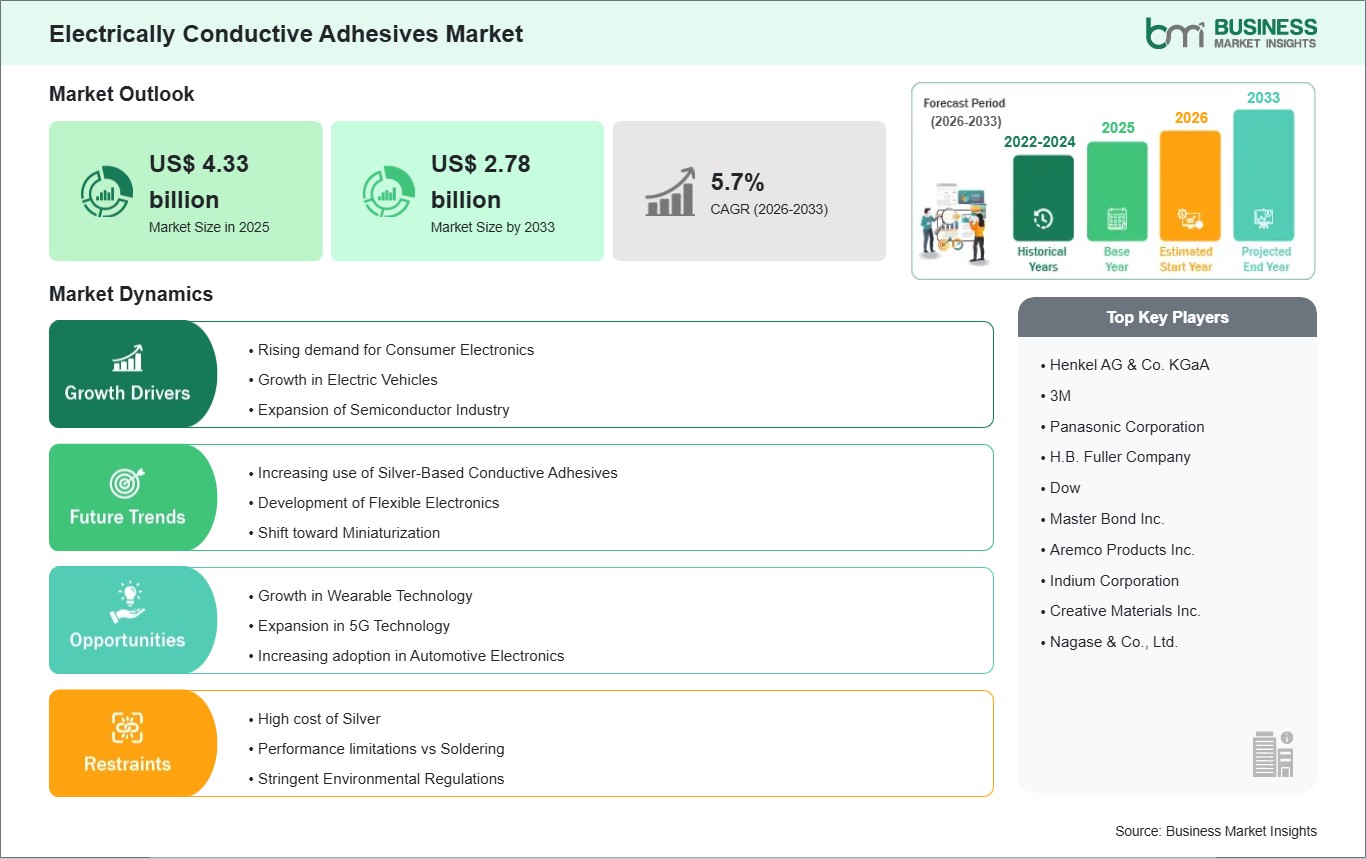
Electrically Conductive Adhesives market size is expected to reach US$ 4.33 billion by 2033 from US$ 2.78 billion in 2025. The market is estimated to record a CAGR of 5.7% from 2026 to 2033.
The global market for electrically conductive adhesives is an important part of the larger electronics and advanced materials industry. It ensures reliable electrical connections and provides mechanical bonding across various electronic and electrical applications. These adhesives are designed to conduct electricity, replace traditional soldering methods, and support the miniaturization of modern devices. They are commonly found in printed circuit boards (PCBs), semiconductors, displays, automotive electronics, and solar panels, where they promote efficient signal transmission and maintain structural integrity. Industries like consumer electronics, automotive, telecommunications, and renewable energy increasingly depend on electrically conductive adhesives to improve performance, flexibility, and durability. Common types include isotropic conductive adhesives (ICAs) and anisotropic conductive adhesives (ACAs), each tailored for specific conductivity and application needs. Manufacturing electrically conductive adhesives involves special formulation techniques. These methods combine polymer resins with conductive fillers such as silver, copper, or carbon. The process requires precise mixing, dispersion, curing, and coating to achieve the best conductivity and adhesion. Additives and fillers enhance thermal stability, mechanical strength, and resistance to environmental factors. Recent innovations focus on creating low-temperature curing adhesives, flexible and stretchable materials, and cost-effective alternatives to precious metal-based fillers. There is also an increasing focus on eco-friendly formulations that minimize hazardous substances and meet environmental regulations. These improvements not only boost product efficiency but also support sustainable manufacturing practices. Electrically conductive adhesives are crucial for compact, lightweight, and high-performance electronic assemblies. In the automotive industry, particularly in electric vehicles, they are used for battery connections, sensors, and control units to ensure reliability and safety. In renewable energy systems, they are vital for photovoltaic modules, creating conductive paths with minimal energy loss. Electronic devices and industrial equipment rely on these adhesives to maintain steady electrical performance under various conditions. Their ability to work under thermal cycling, mechanical stress, and high-frequency operations makes them essential in modern technologies. Market growth is fueled by the rising demand for miniaturized electronics, the quick expansion of electric vehicles, and advancements in renewable energy technologies. Regulations favoring lead-free and environmentally friendly alternatives to traditional soldering further encourage their use. However, challenges like high material costs, especially for silver-based adhesives, complex formulation needs, and performance issues under extreme conditions may hinder growth. Despite these obstacles, ongoing innovation in material science and increasing investments in advanced electronics manufacturing are likely to sustain market expansion. Overall, the market for electrically conductive adhesives is well-prepared to support the development of next-generation electronic systems with better efficiency, reliability, and sustainability.

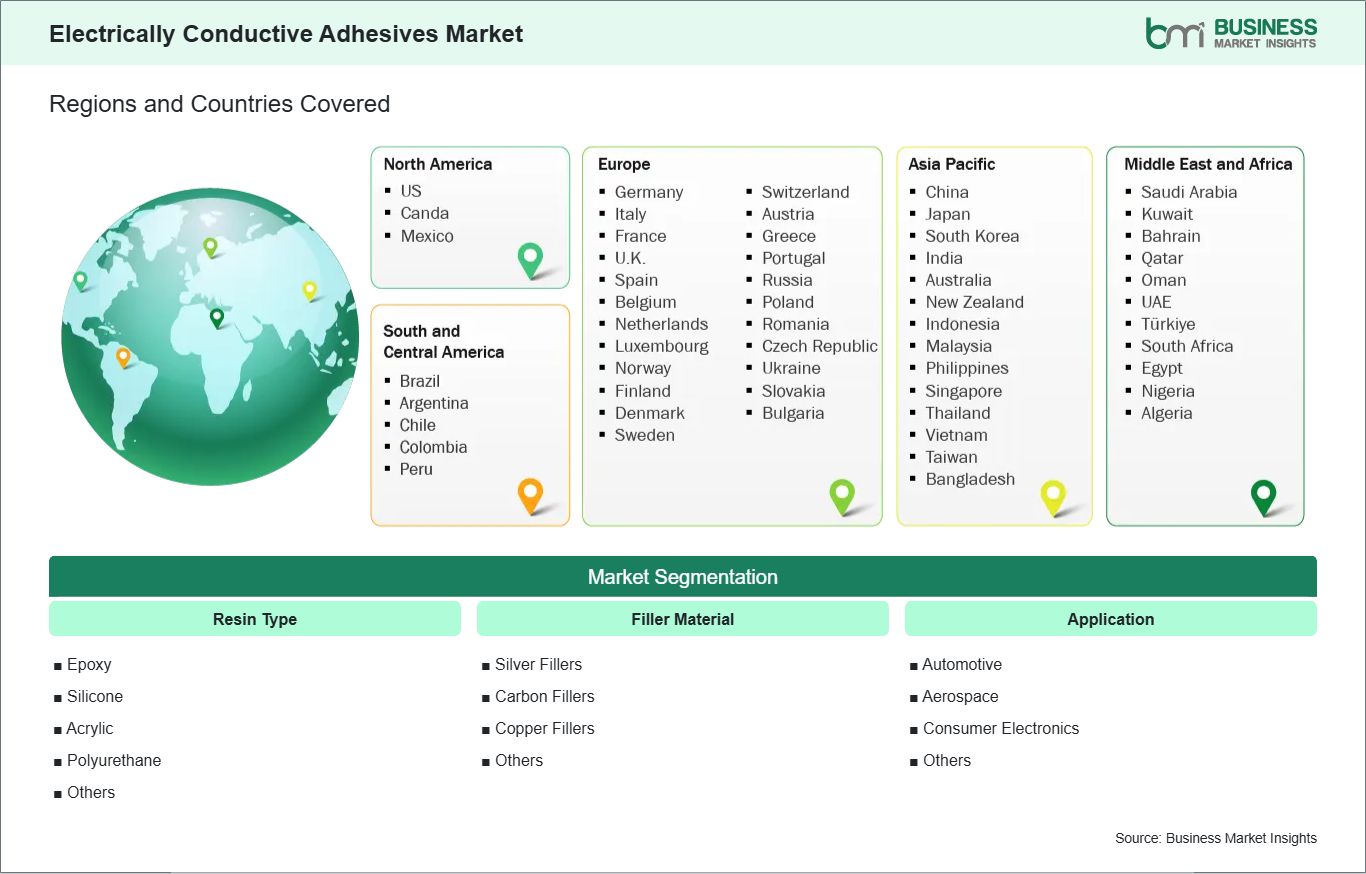
Key segments that contributed to the derivation of the Electrically Conductive Adhesives market analysis are resin type, filler material, and application.
The global market for electrically conductive adhesives is growing steadily. This growth stems from increased demand in advanced electronics, automotive, and renewable energy sectors. The rapid rise of consumer electronics, like smartphones, wearables, and compact devices, has significantly boosted the need for reliable interconnection materials. Electrically conductive adhesives are often used instead of traditional soldering, particularly in miniaturized and heat-sensitive components. Additionally, the growing popularity of electric vehicles is another major driver of market expansion. These adhesives are crucial for battery connections, power modules, and electronic control units, ensuring efficient conductivity and thermal management. Moreover, the increased use of renewable energy systems, such as solar panels and wind turbines, has raised the demand for durable and high-performance conductive bonding solutions. Industrial automation and smart manufacturing systems further support this demand, as they require precise and dependable electrical connections. Government initiatives that promote electrification, clean energy, and advanced manufacturing are also speeding up market growth. As electronic devices become more compact and energy-efficient, the need for electrically conductive adhesives is expected to rise in both developed and emerging markets.
Technological innovation is key in shaping the global market for electrically conductive adhesives. Ongoing advancements focus on improving electrical conductivity, thermal stability, and mechanical performance. Developing new formulations, including silver-filled, carbon-based, and hybrid conductive systems, allows adhesives to meet the needs of high-performance applications. These materials are increasingly designed to replace traditional solder, especially in situations where flexibility, lightweight properties, and low-temperature processing are necessary. The move toward lead-free and environmentally friendly materials, spurred by strict regulations and sustainability goals, is promoting further innovation. Conductive adhesives are becoming more popular in flexible and printed electronics, where traditional joining methods fall short. Advances in nanotechnology are also improving material properties, including better dispersion of conductive fillers and enhanced durability under stress. Modern manufacturing techniques, such as precision dispensing and automated assembly, are increasing consistency and reducing material waste. Ongoing research aims to improve adhesion strength, extend product lifespan, and ensure compatibility with changing electronic designs. As industries focus on performance, sustainability, and miniaturization, technological progress is expected to drive long-term growth in the electrically conductive adhesives market.
Polyurethane-based conductive adhesives are popular because they offer great flexibility, strong adhesion, and resistance to vibration and tough environmental conditions. These features make them ideal for dynamic uses like automotive electronics and flexible circuits.
Carbon fillers dominate this market because they are affordable, lightweight, and maintain stable electrical conductivity. People are increasingly choosing them over costly metal fillers, particularly in high-volume and budget-sensitive applications.
The automotive sector leads the market, driven by the swift growth of electric vehicles and modern electronic systems. The rising demand for lightweight, reliable, and high-performance bonding solutions in batteries, sensors, and control units also encourages adoption.
| Report Attribute | Details |
|---|---|
| Market size in 2025 | US$ 4.33 billion |
| Market Size by 2033 | US$ 2.78 billion |
| Global CAGR (2026 - 2033) | 5.7% |
| Historical Data | 2022-2024 |
| Forecast period | 2026-2033 |
| Segments Covered | By Resin Type
|
|
Regions and Countries Covered
| |
| North America | US, Canada, Mexico |
| Europe | Belgium, Austria, Finland, Denmark, Greece, Poland, Romania, Russia, Ukraine, Czech Republic, Slovakia, Bulgaria, Italy, Luxembourg, Germany, Switzerland, France, Netherlands, Norway, Portugal, Spain, Sweden, United Kingdom |
| Asia-Pacific | Australia, China, India, Japan, South Korea, Indonesia, Malaysia, Philippines, Singapore, Thailand, Vietnam, Bangladesh, New Zealand, Taiwan |
| South and Central America | Brazil, Argentina, Peru, Chile, Colombia |
| Middle East and Africa | Bahrain, Kuwait, Oman, Qatar, Saudi Arabia, United Arab Emirates, Turkiye, South Africa, Egypt, Algeria, Nigeria |
| Market leaders and key company profiles |
|
The "Electrically Conductive Adhesives Market Size and Forecast (2022 - 2033)" report provides a detailed analysis of the market covering below areas:
The geographical scope of the Electrically Conductive Adhesives market report is divided into five regions: North America, Asia Pacific, Europe, Middle East & Africa, and South & Central America. The Electrically Conductive Adhesives market in the Asia Pacific is expected to grow significantly during the forecast period.
The Asia-Pacific Electrically Conductive Adhesives market is segmented into China, Japan, South Korea, India, Australia, New Zealand, Indonesia, Malaysia, the Philippines, Singapore, Thailand, Vietnam, Taiwan, Bangladesh, and the Rest of Asia.
The Asia-Pacific region is now the fastest-growing market for electrically conductive adhesives. This growth comes from rapid industrialization, expanding electronics manufacturing, and rising demand for connectivity solutions. Countries such as China, India, Japan, and South Korea are seeing strong growth in consumer electronics, automotive production, and semiconductor industries, all of which depend heavily on conductive adhesives. The increasing adoption of electric vehicles in the region is significantly raising the demand for these adhesives in battery systems, sensors, and power electronics to improve performance and safety. More investments in electronics assembly and semiconductor packaging are also driving the need for conductive adhesives instead of traditional soldering methods. Urbanization, higher disposable incomes, and widespread use of smart devices are further boosting electronics consumption and supporting market growth. Additionally, the rapid development of renewable energy projects, including solar panels and energy storage systems, is increasing the demand for reliable conductive bonding solutions. The region's strong manufacturing base and well-established electronics supply chain enable cost-effective, high-volume production of conductive adhesives for both domestic use and export. Governments across Asia-Pacific are putting policies in place to focus on digitalization, clean energy, and manufacturing improvements, which encourage the use of high-performance materials. Environmental regulations also promote lead-free and eco-friendly adhesive formulations, reducing the negative impact of electronics manufacturing. Technological advances, including nano-enhanced conductive fillers, hybrid adhesive systems, and better polymer matrices, are improving product conductivity and durability. The availability of skilled workers, easy access to raw materials, and integrated production networks further strengthen the region`s competitive position in the global market. Moreover, rising investments in research and development support innovation in conductive adhesives designed for flexible electronics, electric vehicles, and smaller devices. With ongoing industrial growth, supportive policies, and a strong focus on sustainability and innovation, Asia-Pacific is expected to remain a major hub for production, demand, and technological progress in the global electrically conductive adhesives market.

The Electrically Conductive Adhesives market is evaluated by gathering qualitative and quantitative data post primary and secondary research, which includes important corporate publications, association data, and databases. A few of the key developments in the Electrically Conductive Adhesives market are:
The Electrically Conductive Adhesives Market is valued at US$ 4.33 billion in 2025, it is projected to reach US$ 2.78 billion by 2033.
As per our report Electrically Conductive Adhesives Market, the market size is valued at US$ 4.33 billion in 2025, projecting it to reach US$ 2.78 billion by 2033. This translates to a CAGR of approximately 5.7% during the forecast period.
The Electrically Conductive Adhesives Market report typically cover these key segments-
The historic period, base year, and forecast period can vary slightly depending on the specific market research report. However, for the Electrically Conductive Adhesives Market report:
The Electrically Conductive Adhesives Market is populated by several key players, each contributing to its growth and innovation. Some of the major players include:
The Electrically Conductive Adhesives Market report is valuable for diverse stakeholders, including:
Essentially, anyone involved in or considering involvement in the Electrically Conductive Adhesives Market value chain can benefit from the information contained in a comprehensive market report.
Please tell us your area of interest
(Market Segments/ Regions and Countries/ Companies)