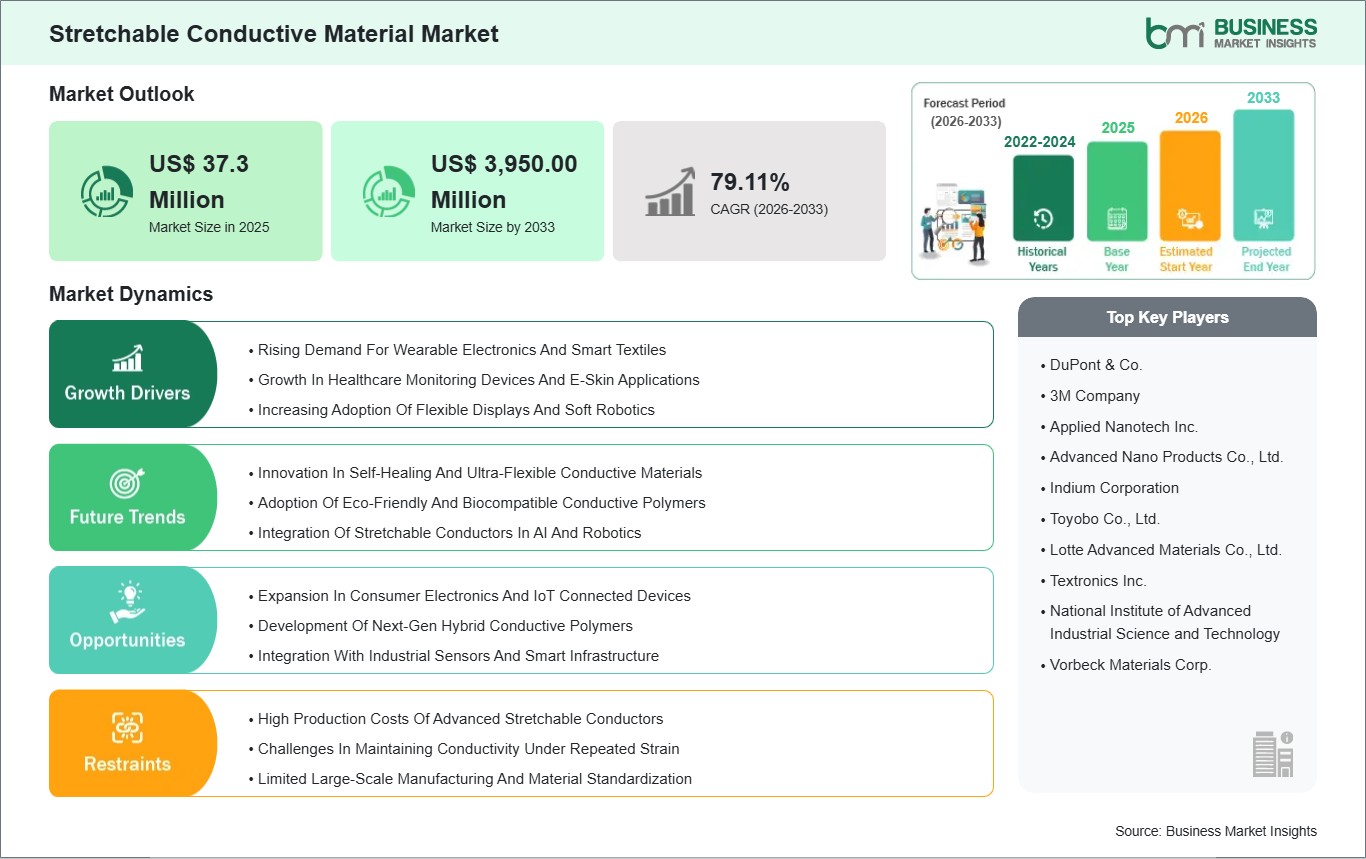
The Stretchable Conductive Material Market size is expected to reach US$ 3,950. million by 2033 from US$ 37.3 million in 2025. The market is estimated to record a CAGR of 79.11% from 2026 to 2033.
The worldwide market for stretchable conductive materials is experiencing rapid expansion because various industries require flexible wearable electronic devices. Stretchable conductive materials provide electrical stability during mechanical deformation, which makes them suitable for situations where standard rigid conductors cannot be used. The next generation of products, which includes wearable sensors flexible displays smart textiles soft robotics electronic skin e-skin devices and healthcare monitoring devices relies on materials that include elastomeric composites, conductive polymers and metal nanowires and intrinsically stretchable inks and hybrid networks. The market experiences significant growth because more people want to buy wearable and portable devices that provide better comfort and versatile usage through multiple connection options. Manufacturers are looking for materials that maintain their performance when smartwatches, health trackers and flexible displays experience bending, twisting and stretching. Stretchable conductive materials enable patient monitoring through healthcare applications because they allow skin-conforming sensors that maintain their performance during natural body movements.
The demand for these materials increased because soft robotics and human-machine interfaces require solutions that maintain electrical performance while allowing mechanical flexibility. The market exhibits strong momentum but encounters significant obstacles that impede its progress. The process of creating materials that provide both high electrical conductivity and mechanical strength while being suitable for manufacturing is the primary obstacle that needs to be addressed. The production and implementation of high‑performance stretchable conductors require expensive materials, which limit their use in manufacturing processes throughout various industries. The field requires additional investigation to establish the dependable operation and endurance of products when used in actual conditions.
The product needs strong solutions to handle material fatigue, environmental degradation, and the challenges of connecting with stiff electronic parts, which will help maintain its durability. Current research in polymer chemistry and nanomaterials and hybrid fabrication methods indicates that stretchable conductive materials will become both cheaper and more effective in their performance. Material scientists, electronics developers, and manufacturing partners from different industries work together to create product development plans. The stretchable conductive material market will experience continuous worldwide growth because technology development matches consumer demands for increased product flexibility and connection.

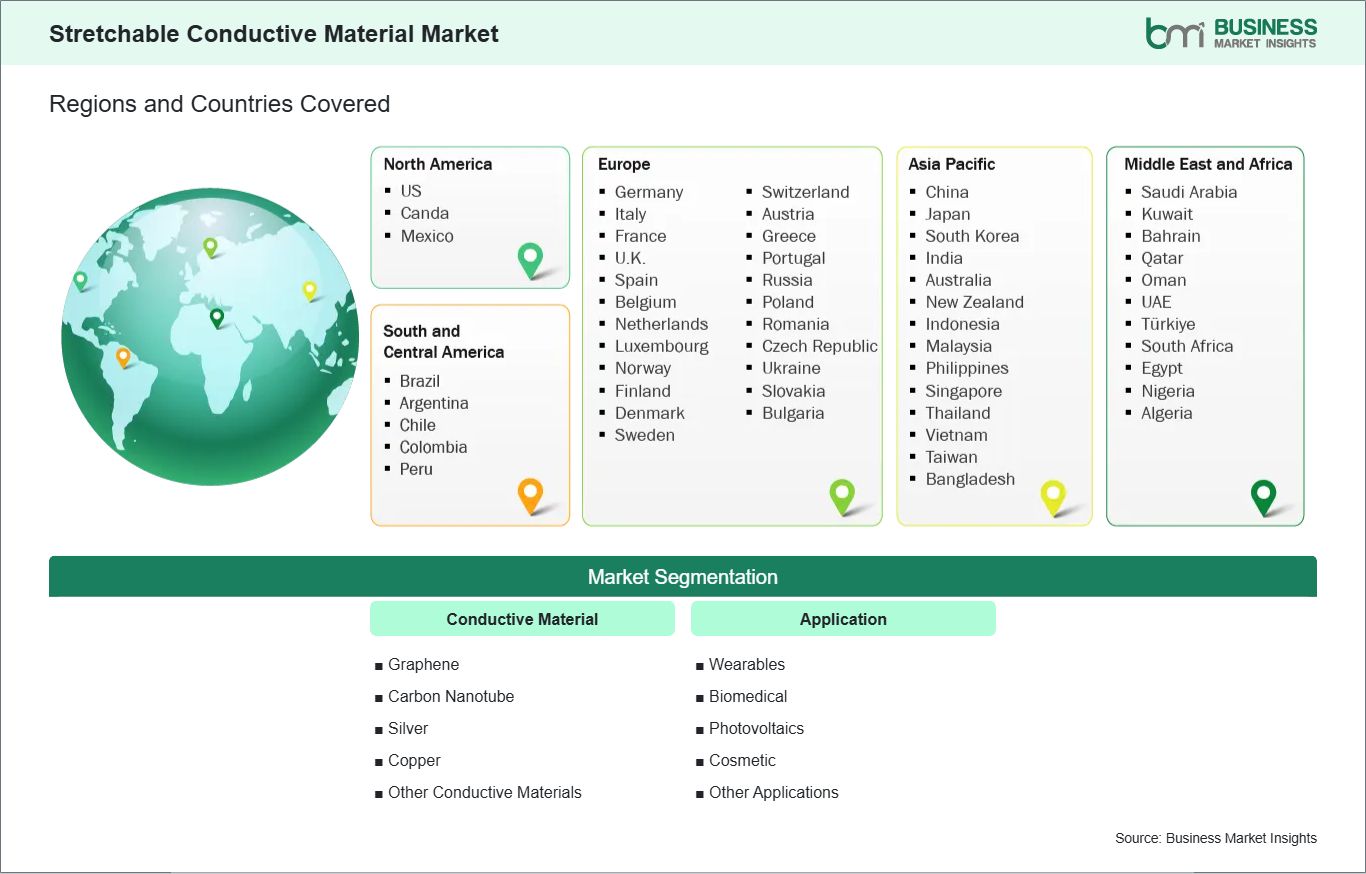
Key segments that contributed to the derivation of the stretchable conductive material market analysis are conductive material and application.
The global market for stretchable conductive materials is being significantly propelled by the rise of wearable electronics and smart textiles. Consumers are increasingly adopting devices that monitor health metrics, physical activity, and environmental parameters, creating strong demand for materials that can sustain mechanical deformation while maintaining electrical performance. Stretchable conductive polymers, metal nanowires, and hybrid elastomer composites are increasingly integrated into smart fabrics, enabling garments and patches that conform to body movements without compromising sensor accuracy.
In healthcare, stretchable conductive materials are critical for next-generation electronic skin, wearable ECG monitors, and rehabilitation devices. These solutions provide continuous monitoring, improved patient comfort, and high-fidelity signal capture. Smart textiles embedded with stretchable conductors are also transforming sports and fitness industries, offering real-time performance tracking while maintaining flexibility, breathability, and durability under repeated strain.
Furthermore, collaboration between textile manufacturers, electronics developers, and material innovators has accelerated the deployment of stretchable conductive materials into commercial products. North America and Europe lead the adoption due to strong research ecosystems and early consumer acceptance, while Asia-Pacific, driven by rapid electronics manufacturing, is increasingly exploring high-performance wearable solutions. This cross-regional adoption reinforces global market growth, highlighting wearable electronics and smart textiles as a primary driver for stretchable conductive materials worldwide.
Consumer electronics and IoT-connected devices are creating a rapidly growing market for stretchable conductive materials. Flexible displays, foldable smartphones, and touch-sensitive interfaces rely on materials that maintain conductivity under repeated bending, stretching, and folding. Stretchable conductive inks and metal-polymer composites provide the necessary mechanical resilience for modern devices, ensuring long-term functionality and user satisfaction.
The proliferation of connected devices, including smart home appliances, wearable cameras, and portable sensors, further increases demand. Stretchable conductive materials enable thin, conformal circuitry that integrates seamlessly into diverse form factors, allowing electronics to be lightweight, durable, and aesthetically appealing. Companies are investing in hybrid material development to combine high conductivity with flexibility, addressing the unique challenges of IoT devices operating in varied environments.
Regionally, North America dominates adoption due to strong technology infrastructure, extensive R&D, and early consumer uptake, while Asia-Pacific leverages large-scale electronics manufacturing to scale production and deployment. Europe emphasizes high-performance, safety-compliant electronics, particularly in automotive and industrial IoT applications. As the global consumer electronics and IoT ecosystem expands, stretchable conductive materials are increasingly critical, supporting new device architectures and enabling broader innovation across industries.

The stretchable conductive material market demonstrates steady growth, with size and share analysis highlighting evolving trends and competitive dynamics among key players. The report examines subsegments categorized within conductive material and application, offering insights into their contribution to overall market performance.
By conductive material, the graphene subsegment dominated the market in 2025, driven by its exceptional electrical conductivity, mechanical strength, and flexibility, making it ideal for stretchable conductive applications.
In terms of application, the photovoltaics subsegment dominated the market in 2025, driven by the growing demand for flexible, lightweight, and efficient solar energy devices that rely on stretchable conductive materials.
| Report Attribute | Details |
|---|---|
| Market size in 2025 | US$ 37.3 Million |
| Market Size by 2033 | US$ 3,950.00 Million |
| Global CAGR (2026 - 2033) | 79.11% |
| Historical Data | 2022-2024 |
| Forecast period | 2026-2033 |
| Segments Covered | By Conductive Material
|
|
Regions and Countries Covered
| |
| North America | US, Canada, Mexico |
| Europe | Belgium, Austria, Finland, Denmark, Greece, Poland, Romania, Russia, Ukraine, Czech Republic, Slovakia, Bulgaria, Italy, Luxembourg, Germany, Switzerland, France, Netherlands, Norway, Portugal, Spain, Sweden, United Kingdom |
| Asia-Pacific | Australia, China, India, Japan, South Korea, Indonesia, Malaysia, Philippines, Singapore, Thailand, Vietnam, Bangladesh, New Zealand, Taiwan |
| South and Central America | Brazil, Argentina, Peru, Chile, Colombia |
| Middle East and Africa | Bahrain, Kuwait, Oman, Qatar, Saudi Arabia, United Arab Emirates, Turkiye, South Africa, Egypt, Algeria, Nigeria |
| Market leaders and key company profiles |
|
The "Stretchable Conductive Material Market Size and Forecast (2022 - 2033)" report provides a detailed analysis of the market covering below areas:
The geographical scope of the Stretchable Conductive Material Market report is divided into North America, Asia Pacific, Europe, Middle East & Africa, and South & Central America. North America held the largest share in 2025.
The market for global stretchable conductive materials shows different market behavior patterns in various regions, but North America stands as the leading market area because of its strong research and development infrastructure, its advanced electronics production facilities and its widespread use of flexible and wearable technologies across its industrial sector. North America benefits from partnerships between top universities and research organizations and technology firms, which drive the development and market introduction of high-performance stretchable conductive materials that include conductive polymers, metal nanowires and hybrid elastomeric composites. The region's healthcare, consumer electronics and defense sectors serve as primary customers who drive market demand for wearable sensors, soft robotics, flexible displays and electronic skin technologies. The Asia Pacific region experiences industrial growth because of its ongoing urban development, industrial expansion and its increasing use of new technologies. The countries of China, Japan and South Korea lead the electronics manufacturing and development sector, which creates a need for stretchable conductive materials used in smart textiles, wearable electronics and future mobile devices. Europe has developed strong research facilities and effective regulatory systems, which together with consumer interest in healthcare and connected devices create product demand that particularly benefits Germany, France and Nordic countries where medical wearables and industrial use of stretchable electronics are growing. The region of Middle East and Africa experiences market expansion because countries invest in smart infrastructure projects, healthcare system improvements and developing industrial electronics. The United Arab Emirates and South Africa currently demonstrate their growing use of wearable and flexible electronic solutions. The healthcare technology market in South and Central America experiences slow growth because of increased technology adoption, rising consumer electronics use and growing interest in smart textiles among Brazilian and Argentine consumers. The research and development funding, the industrial use of flexible electronics and the consumer demand for these products and their new healthcare, wearable and soft robotics applications determine growth in all regions.

The Stretchable Conductive Material Market is evaluated by gathering qualitative and quantitative data post primary and secondary research, which includes important corporate publications, association data, and databases. A few of the key developments in the stretchable conductive material market are:
The Stretchable Conductive Material Market is valued at US$ 37.3 Million in 2025, it is projected to reach US$ 3,950.00 Million by 2033.
As per our report Stretchable Conductive Material Market, the market size is valued at US$ 37.3 Million in 2025, projecting it to reach US$ 3,950.00 Million by 2033. This translates to a CAGR of approximately 79.11% during the forecast period.
The Stretchable Conductive Material Market report typically cover these key segments-
The historic period, base year, and forecast period can vary slightly depending on the specific market research report. However, for the Stretchable Conductive Material Market report:
The Stretchable Conductive Material Market is populated by several key players, each contributing to its growth and innovation. Some of the major players include:
The Stretchable Conductive Material Market report is valuable for diverse stakeholders, including:
Essentially, anyone involved in or considering involvement in the Stretchable Conductive Material Market value chain can benefit from the information contained in a comprehensive market report.
Please tell us your area of interest
(Market Segments/ Regions and Countries/ Companies)