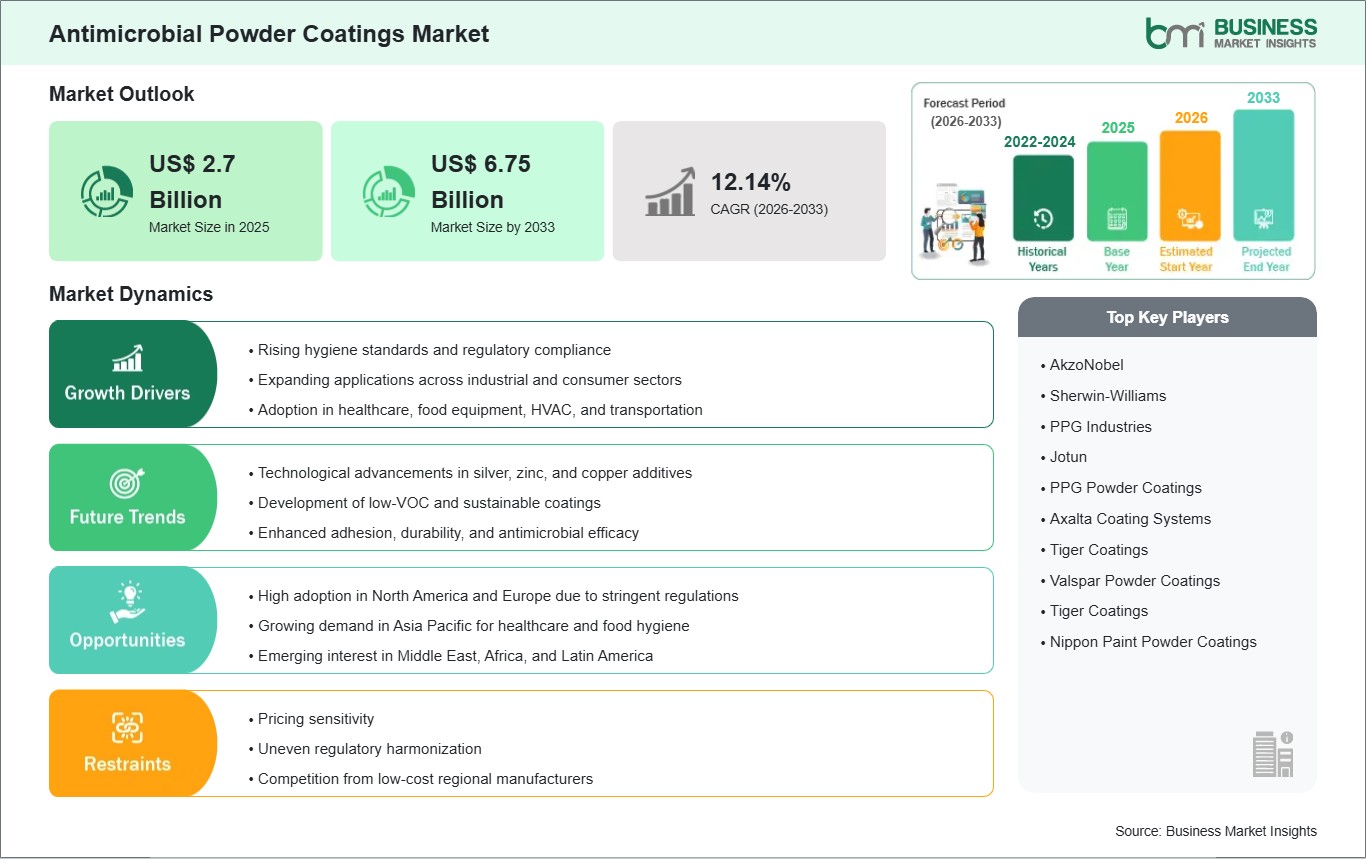
The Antimicrobial Powder Coatings Market size is expected to reach US$ 6.75 Billion by 2033 from US$ 2.7 Billion in 2025. The market is estimated to record a CAGR of 12.14% from 2026 to 2033.
The global antimicrobial powder coatings market is defined by the increasing emphasis on hygiene, contamination control, and durable surface protection across industries such as healthcare, food processing, transportation, and general manufacturing. Antimicrobial powder coatings—incorporating additives such as silver, zinc, and copper—provide long-lasting resistance against bacteria, fungi, and other pathogens on frequently touched surfaces.
This trend reflects broader industry priorities: ensuring regulatory compliance, reducing contamination risks, and improving public and workplace safety. Companies and institutions are increasingly adopting antimicrobial powder coatings to meet hygiene standards while enhancing the durability and aesthetic appeal of coated surfaces.
Technological innovations have improved coating performance, including faster curing times, enhanced adhesion, chemical resistance, and environmentally friendly formulations. The development of low-VOC and sustainable antimicrobial coatings further supports market growth. The evolving landscape positions antimicrobial powder coatings as essential solutions for industrial, healthcare, and consumer applications worldwide.

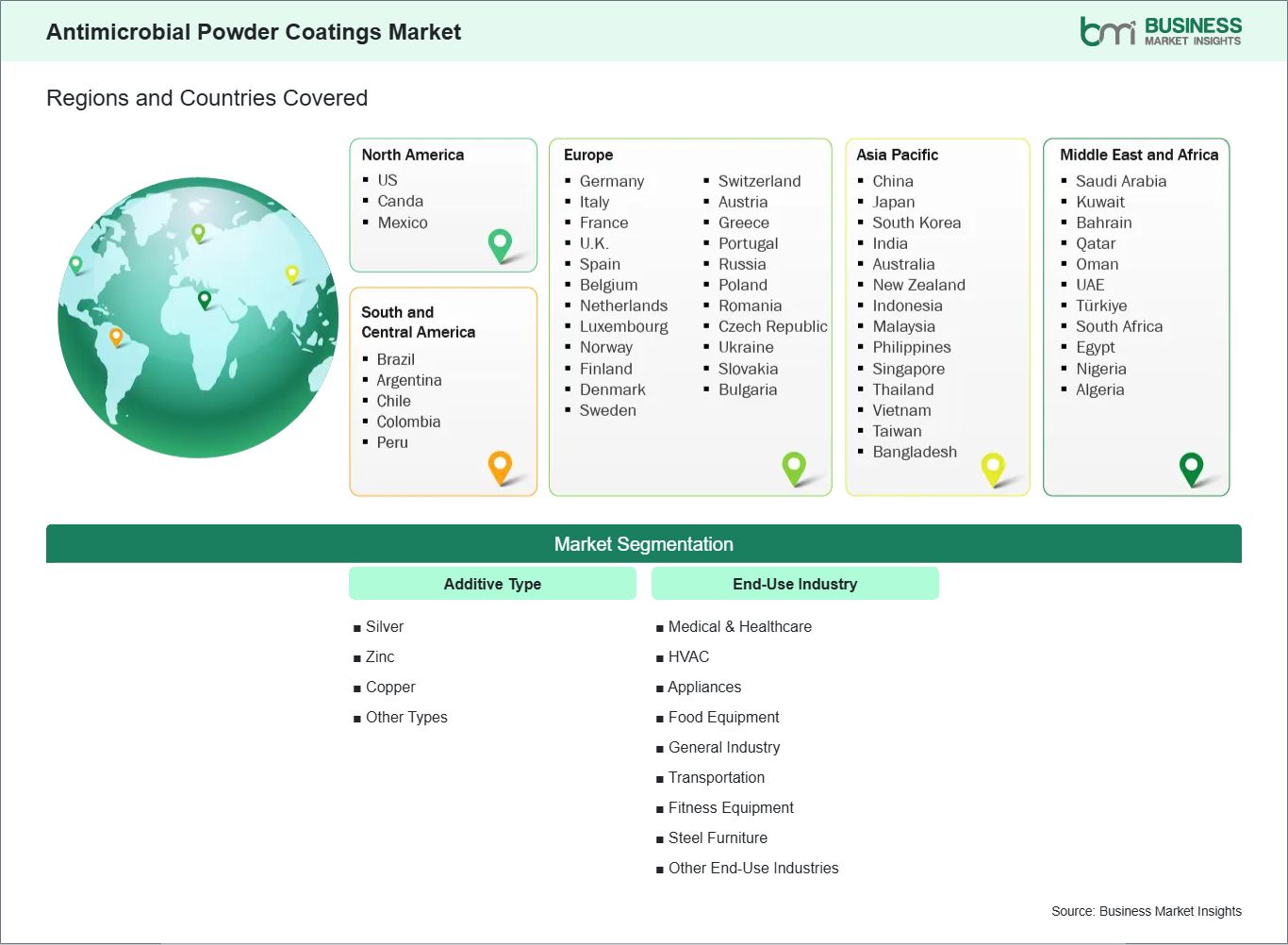
Key segments that contributed to the derivation of the antimicrobial powder coatings market analysis are additive type and end-use industry.
The growing global emphasis on hygiene, infection control, and public safety is a major driver for the antimicrobial powder coatings market. Industries such as healthcare, food processing, transportation, and public infrastructure are under increasing pressure to prevent microbial contamination and ensure clean, safe surfaces. Hospitals, clinics, and laboratories are adopting antimicrobial powder coatings on high-touch surfaces such as door handles, bed rails, and medical equipment to minimize the risk of hospital-acquired infections (HAIs), which are a significant concern for patient safety and operational costs.
Stringent regulatory frameworks, including standards set by the FDA, ISO, and European Chemicals Agency, mandate compliance with hygiene and antimicrobial safety requirements, making antimicrobial coatings an essential solution. These coatings provide long-lasting protection against bacteria, fungi, and other pathogens while maintaining surface durability, reducing the need for frequent cleaning or replacement. Additionally, the COVID-19 pandemic has accelerated awareness of infection prevention, pushing organizations and governments to adopt proactive measures to maintain hygienic environments. The adoption of antimicrobial coatings is particularly strong in sectors where human contact is frequent and contamination risks are high, including food service, public transportation, and fitness equipment. This convergence of regulatory pressure, hygiene awareness, and demand for safer surfaces ensures that antimicrobial powder coatings remain a critical investment for businesses aiming to protect both end-users and employees, driving market growth steadily over the forecast period.
The growing recognition of antimicrobial powder coatings as an effective solution for contamination control presents significant opportunities across multiple industries. Beyond healthcare and food equipment, sectors such as HVAC systems, appliances, steel furniture, transportation, and fitness equipment are increasingly incorporating these coatings to enhance surface hygiene, protect consumers, and comply with safety standards. The rising awareness of the importance of microbial resistance in shared spaces, combined with regulatory guidelines, is prompting manufacturers to integrate antimicrobial coatings into both new and existing products.
Technological advancements in coating formulations—such as silver, copper, and zinc additives—enable superior antimicrobial efficacy while maintaining durability and aesthetic appeal. These coatings can now be applied to diverse surfaces, including metals, plastics, and composites, broadening their usability across industrial, commercial, and consumer applications. Moreover, sustainable and low-VOC formulations align with growing environmental regulations and consumer demand for eco-friendly products, opening new market avenues for innovative coating solutions.
The increasing focus on infection prevention in public infrastructure, workplaces, and residential environments also creates opportunities for growth. Organizations are seeking reliable, low-maintenance solutions to minimize microbial contamination in high-contact areas, supporting long-term adoption. As urbanization, industrialization, and health-conscious consumer behavior continue to rise globally, the demand for antimicrobial powder coatings is expected to expand steadily, offering manufacturers the chance to innovate and capture untapped markets across multiple sectors.

The Antimicrobial Powder Coatings Market demonstrates steady growth, with size and share analysis highlighting evolving trends and competitive dynamics among key players. The report examines subsegments categorized within additive type and end-use industry, offering insights into their contribution to overall market performance.
By additive type, the silver subsegment dominated the market in 2025, driven by its superior antimicrobial efficacy, long-lasting protection, and broad application across healthcare, food equipment, and high-touch industrial surfaces. Silver-based coatings are widely preferred due to their ability to inhibit bacterial growth effectively while maintaining surface durability and aesthetic appeal.
Based on end-use industry, the medical & healthcare subsegment dominated the market in 2025, propelled by the critical need for infection prevention in hospitals, clinics, and laboratories. Antimicrobial powder coatings are increasingly applied to medical devices, furniture, and equipment to reduce hospital-acquired infections, ensure patient safety, and comply with stringent regulatory standards.
| Report Attribute | Details |
|---|---|
| Market size in 2025 | US$ 2.7 Billion |
| Market Size by 2033 | US$ 6.75 Billion |
| Global CAGR (2026 - 2033) | 12.14% |
| Historical Data | 2022-2024 |
| Forecast period | 2026-2033 |
| Segments Covered | By Additive Type
|
|
Regions and Countries Covered
| |
| North America | US, Canada, Mexico |
| Europe | Belgium, Austria, Finland, Denmark, Greece, Poland, Romania, Russia, Ukraine, Czech Republic, Slovakia, Bulgaria, Italy, Luxembourg, Germany, Switzerland, France, Netherlands, Norway, Portugal, Spain, Sweden, United Kingdom |
| Asia-Pacific | Australia, China, India, Japan, South Korea, Indonesia, Malaysia, Philippines, Singapore, Thailand, Vietnam, Bangladesh, New Zealand, Taiwan |
| South and Central America | Brazil, Argentina, Peru, Chile, Colombia |
| Middle East and Africa | Bahrain, Kuwait, Oman, Qatar, Saudi Arabia, United Arab Emirates, Turkiye, South Africa, Egypt, Algeria, Nigeria |
| Market leaders and key company profiles |
|
The "Antimicrobial Powder Coatings Market Size and Forecast (2022 - 2033)" report provides a detailed analysis of the market covering below areas:
The geographical scope of the Antimicrobial Powder Coatings Market report is divided into North America, Asia Pacific, Europe, Middle East & Africa, and South & Central America. North America held the largest share in 2025.
The adoption and maturity of antimicrobial powder coatings vary significantly across regions, driven by industrial infrastructure, regulatory environments, hygiene standards, and end-use sector demand. In North America, stringent hygiene and safety regulations, coupled with high adoption in healthcare, food processing, and commercial sectors, have established the US and Canada as early adopters of advanced antimicrobial coating technologies. Regulatory agencies and standards bodies emphasize surface safety and infection control, incentivizing manufacturers and facility operators to implement coatings that provide long-term antimicrobial protection and compliance.
In Europe, market adoption is influenced by strong public health policies, sustainability regulations, and the emphasis on reducing hospital-acquired infections. Countries such as Germany, the UK, and France lead in institutional integration of antimicrobial powder coatings across medical devices, food equipment, and HVAC systems, with national and EU-level guidelines increasingly incorporating antimicrobial surface requirements. Developed markets in Japan and South Korea are transitioning toward high-performance coatings in medical, industrial, and transportation applications, while emerging markets such as India and Southeast Asia emphasize affordability and broad access to hygiene-critical solutions.
Government initiatives promoting safer public spaces, healthcare infrastructure expansion, and infection control measures are bolstering uptake, though pricing sensitivity and uneven regulatory harmonization remain strategic considerations. Latin America and Middle East & Africa exhibit early yet accelerating interest, particularly in urban centers with growing healthcare, hospitality, and industrial sectors; public-private partnerships and donor-funded programs targeting food safety and healthcare hygiene are facilitating initial deployment of antimicrobial powder coatings. Across all regions, local regulatory frameworks, industry standards, and market-specific end-use needs are pivotal in shaping competitive strategies, with manufacturers tailoring product formulations, performance specifications, and pricing models to regional requirements and hygiene priorities.

The Antimicrobial Powder Coatings Market is evaluated by gathering qualitative and quantitative data post primary and secondary research, which includes important corporate publications, association data, and databases. A few of the key developments in the antimicrobial powder coatings market are:
The Antimicrobial Powder Coatings Market is valued at US$ 2.7 Billion in 2025, it is projected to reach US$ 6.75 Billion by 2033.
As per our report Antimicrobial Powder Coatings Market, the market size is valued at US$ 2.7 Billion in 2025, projecting it to reach US$ 6.75 Billion by 2033. This translates to a CAGR of approximately 12.14% during the forecast period.
The Antimicrobial Powder Coatings Market report typically cover these key segments-
The historic period, base year, and forecast period can vary slightly depending on the specific market research report. However, for the Antimicrobial Powder Coatings Market report:
The Antimicrobial Powder Coatings Market is populated by several key players, each contributing to its growth and innovation. Some of the major players include:
The Antimicrobial Powder Coatings Market report is valuable for diverse stakeholders, including:
Essentially, anyone involved in or considering involvement in the Antimicrobial Powder Coatings Market value chain can benefit from the information contained in a comprehensive market report.
Please tell us your area of interest
(Market Segments/ Regions and Countries/ Companies)