
Electronic Stability Control System Market Outlook: Size, Share, Trends, Growth Analysis, Competitive Landscape & Forecast, 2026-2033

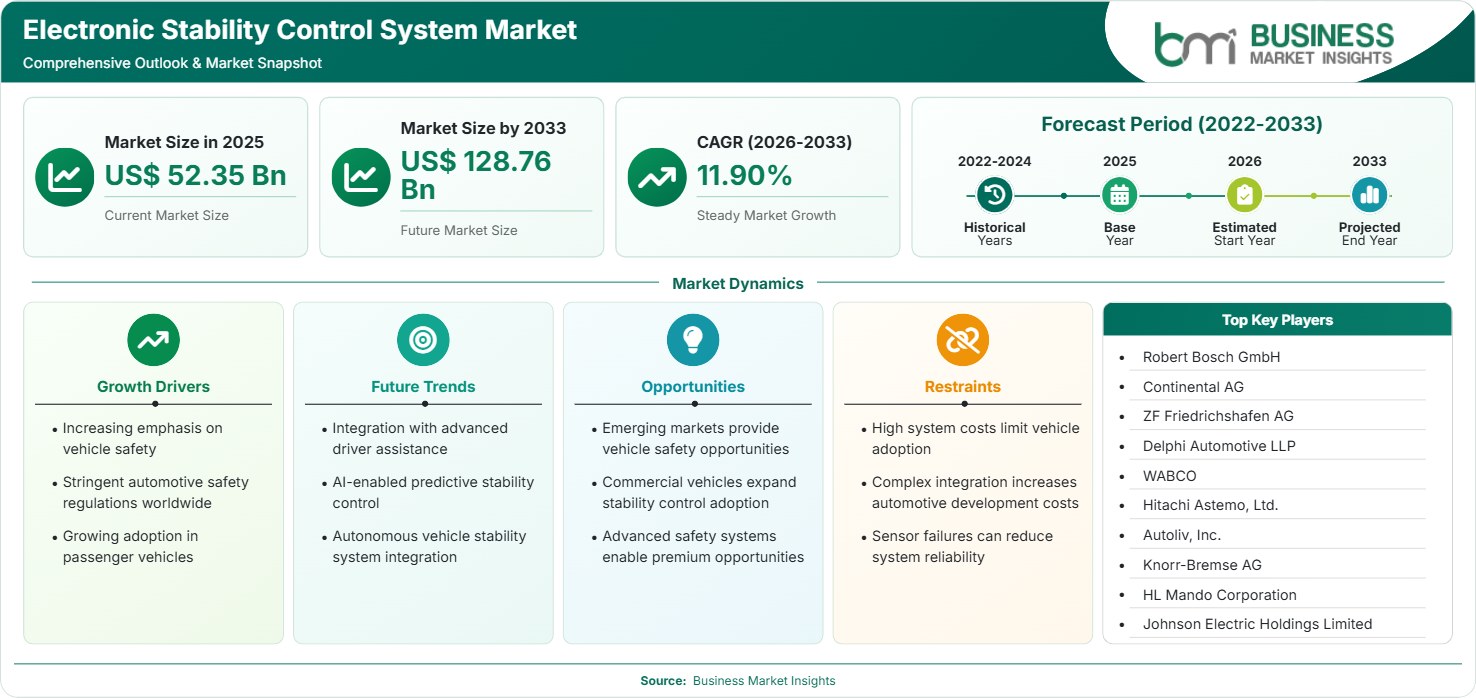
The Electronic Stability Control System Market size was valued at US$ 52.35 Billion in 2025 and is projected to reach US$ 128.76 Billion by 2033, growing at a CAGR of 11.90% during 2026–2033, driven by safety mandates, electrification, ADAS integration, vehicle production, and intelligent braking demand.

Report Coverage
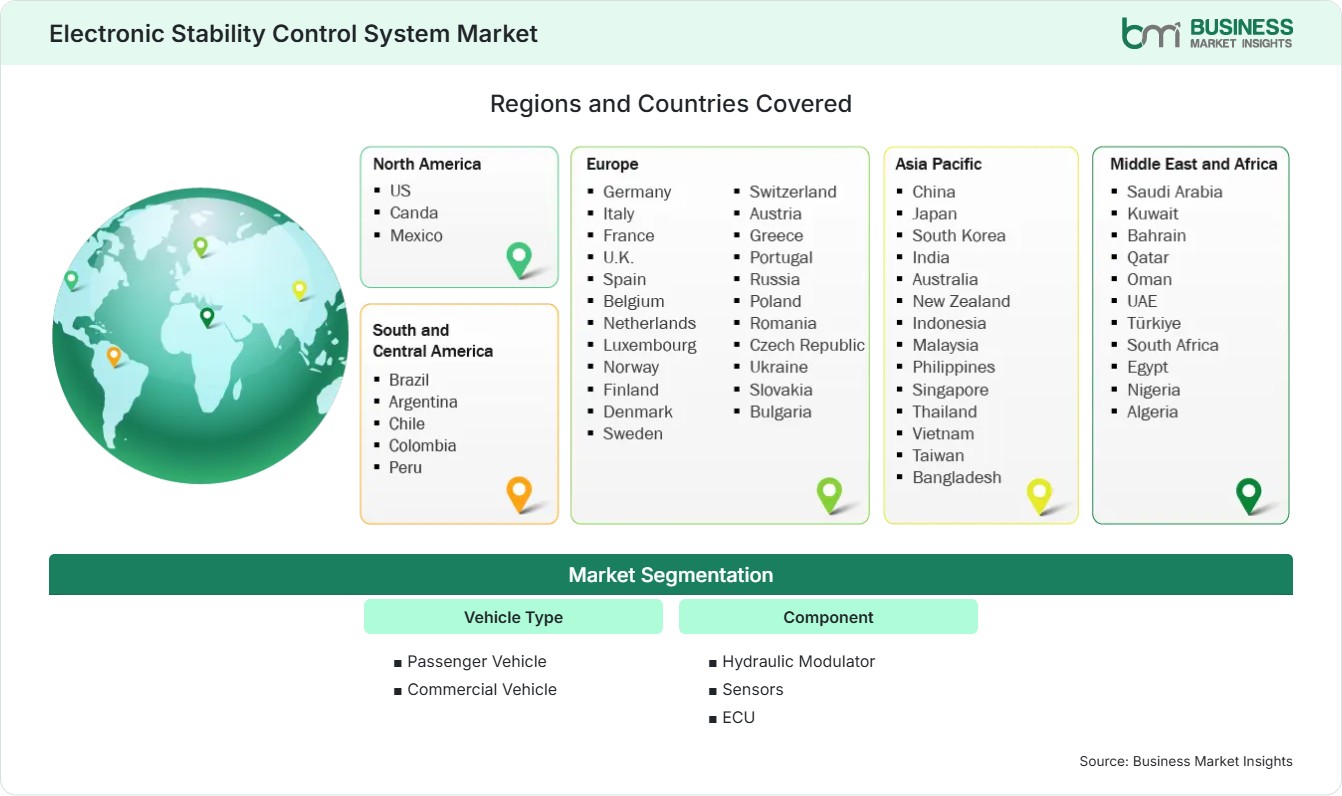
  • Vehicle Type: Passenger Vehicle, Commercial Vehicle
  • Component: Hydraulic Modulator, Sensors, ECU
US$ 52.35 Bn Market size in 2025
US$ 128.76 Bn Market Size by 2033
11.90% CAGR, 2026 - 2033
2026-2033 Forecast Period

AI Overview

Electronic Stability Control System Market Summary

  • North America: North America holds a 28%–31% Electronic Stability Control System Market share in 2025, growing at a CAGR of 10.8%–11.6% during 2026–2033, supported by safety standards, mature vehicle penetration, premium vehicle adoption, and electronic braking integration. The US market expands at a 10.9%–11.7% CAGR, supported by federal safety requirements, advanced braking architectures, electrification, and ADAS deployment across passenger and commercial vehicles.
  • Fastest Growing Region: Asia Pacific holds a 37%–40% share in 2025, expanding at a CAGR of 13.0%–14.2% during 2026–2033, supported by rising vehicle production, Chinese and Indian manufacturing expansion, electrification, local sourcing, safety awareness, and increasing electronic content.
  • Leading Segment: Passenger Vehicle represents a 74%–77% share in 2025, expanding at a CAGR of 11.6%–12.4% during 2026–2033, supported by production volumes, mandatory safety requirements, SUV penetration, electrification, and integrated chassis-control architectures.
  • High Growth Segment: Sensors represent a 22%–25% share within component demand in 2025, expanding at a CAGR of 13.4%–14.5% during 2026–2033, driven by sensing precision, autonomous functions, software integration, redundancy, and increasingly complex vehicle-control architectures.
  • Key Market Opportunity: Integrated brake-by-wire and domain-control architectures can combine ESC, regenerative braking, ADAS, diagnostics, and software functions while reducing hardware duplication and improving vehicle efficiency.
  • Major Market Players: Robert Bosch GmbH, Continental AG, ZF Friedrichshafen AG, Delphi Automotive LLP, WABCO, Hitachi Astemo, Ltd., Autoliv, Inc., Knorr-Bremse AG, HL Mando Corporation, and Johnson Electric Holdings Limited.
Strategic Insights

Electronic Stability Control System Market: Strategic Insights

Electronic Stability Control System Market Strategic Framework
FREE PDF
Request your free sample
Request free sample
Stakeholder View

Key Takeaways

  • The future is towards integrated brake systems which comprise of hydraulic modulator, inertia sensors, ECUs, software, diagnostics, and ADAS interfaces.
  • The greatest growth potential continues to be for passenger SUVs, electrified cars, LCVs, and complex chassis systems which involve coordinated braking and vehicle dynamics control.
  • Innovation is becoming more about smaller electro-hydraulic components, enhanced computing power, sensor fusion, cybersecurity, over-the-air capability, and software-defined control.
  • India and China make attractive markets for investments as manufacturing, localization, electrification, and engineering expertise are advancing in tandem.
  • Investments are getting more geared towards electronics, software, testing, and integrated brake systems leading to more collaborations and diversified technology platforms.
  • CVs present opportunities as unique to ESC due to concerns of rollover, skidding, jackknifing, load dynamics, and electrified powertrain.
Geographic Outlook

Electronic Stability Control System Market Regional Highlights

North America Electronic Stability Control System Market

North America accounts for a 28%–31% share in 2025 and expands at a CAGR of 10.8%–11.6% during 2026–2033. Mature vehicle production, safety regulation, electronic content, and established suppliers support demand. US consumption dominates, while Canada and Mexico contribute through manufacturing and component supply chains. ADAS and electrified braking integration are increasing system value per vehicle, although mature penetration limits unit-growth acceleration compared with Asia Pacific.

  • Safety regulations and maturation of usage continue to drive ESC into mainstream passenger cars, SUVs, and light trucks, driving replacement and technology upgrade demand.
  • The country offers manufacturing benefits through integration into North America’s production chain, thereby providing room for localized module assembly, electronic manufacturing, testing and diversified suppliers.
  • Hybrid and electric vehicles are boosting the need for coordination between regenerative and friction braking systems, thus favoring small-sized controllers able to handle stability and energy regeneration concurrently.
  • Safety in commercial vehicles is an attractive factor since ESC handles both rollovers and directional instability in trucks, buses, and trailers due to varying loads.

US Electronic Stability Control System Market

The US represents a 22%–25% share of global Electronic Stability Control System market share demand in 2025 and grows at a CAGR of 10.9%–11.7% during 2026–2033. Federal requirements established ESC as a mandatory safety technology for applicable light vehicles, creating a mature installed base. Current opportunity is concentrated on replacement cycles, higher-function systems, electrification, commercial vehicles, and ADAS integration rather than first-time penetration.

  • The maturation of regulations causes competition to favor compactness, computing power, diagnostic ability, cybersecurity, and connectivity with automated braking and chassis control features.
  • There is continued demand for pickup trucks and sport utility vehicles, as weight and variable loads necessitate advanced stability control under emergency driving and low traction situations.
  • Commercial fleets place an increasing value on stability control technology that contributes to vehicle availability, cargo security, rollover prevention, and brake system connectivity.

Europe Electronic Stability Control System Market

Europe holds a 24%–27% share in 2025 and grows at a CAGR of 10.2%–11.0% during 2026–2033. Germany remains the leading country, supported by automotive suppliers and premium vehicle production. France and Italy maintain strong engineering capabilities, while Spain and Poland offer faster manufacturing opportunities. Electronic Stability Control System Market demand increasingly emphasizes compact brake systems, electrification compatibility, software integration, functional safety, cybersecurity, and compliance with evolving vehicle safety requirements.

  • Germany continues to be the region’s center of technical development in advanced braking, chassis control, electronics, and vehicle dynamics.
  • France and Italy continue to have considerable engineering and manufacturing capabilities which enable the development of modular ESC systems based on electric powertrains and autonomous driving.
  • Spain and Poland offer more rapid manufacturing growth as manufacturers increase production in Europe and become more cost-effective in terms of component manufacture.
  • Regulatory harmonization in Europe helps with stability-control architectures and emphasizes diagnostics, cybersecurity, and software validation.

Asia Pacific Electronic Stability Control System Market

Asia Pacific represents a 37%–40% share in 2025 and expands at a CAGR of 13.0%–14.2% during 2026–2033. China leads regional demand through vehicle production and electrification, while Japan and South Korea retain advanced supplier capabilities. India represents a high-growth market supported by passenger vehicle production, safety awareness, localization, and engineering investment. Southeast Asia adds opportunities as vehicle supply chains diversify and regional production becomes increasingly technology intensive.

  • China combines high vehicle output, rapid EV adoption, domestic OEM expansion, and electronics capability, making it a major incremental demand center.
  • India offers strong growth potential as passenger vehicles, commercial vehicles, localization programs, and safety-focused engineering develop across domestic and multinational ecosystems.
  • Japan maintains advanced chassis-control expertise and supplier capabilities supporting ESC development for hybrid, electric, premium, and automated vehicle platforms.
  • South Korea combines electronics expertise with major vehicle manufacturers, supporting sensor, ECU, braking, and software integration opportunities.

Rest of World Electronic Stability Control System Market

South and Central America offer selective opportunities through Brazil, Argentina, Chile, and Mexico-linked supply chains, driven by fleet modernization, safety requirements, and manufacturing investment. Brazil accounts for an estimated 45%–50% of the regional Electronic Stability Control System Market, while Chile and Colombia benefit from increasing electronic content and standardized safety architectures.

Middle East and Africa demand is concentrated in Gulf markets, South Africa, Türkiye, and North Africa. Premium vehicles, commercial fleets, safety initiatives, and localized assembly support growth, although lower vehicle volumes limit overall scale.

  • Brazil provides the strongest South American platform for localized production, vehicle assembly, supplier development, and electronic braking deployment.
  • Gulf markets support premium vehicle demand and advanced safety-content adoption, creating opportunities for integrated braking and chassis-control systems.
  • Türkiye benefits from European manufacturing connections and can support regional production of braking electronics, modules, and vehicle-control technologies.
  • South Africa offers commercial vehicle opportunities because trucks and buses require stability functions addressing rollover, traction, directional control, and variable conditions.
Global Market Geography
FREE PDF
Request your free sample
Request free sample
Segment Analysis

Electronic Stability Control System Market Segmentation

Vehicle Type

Passenger vehicles represent a 74%–77% share in 2025 and grow at a CAGR of 11.6%–12.4% through 2033. The Electronic Stability Control System Market scope is anchored by production volumes, SUV expansion, electrification, mandatory safety systems, and ADAS integration across global vehicle platforms.

  • Passenger Vehicle: High production volumes and broad regulatory coverage support widespread ESC deployment, while SUV growth, electrification, and premium safety packages increase electronic content.
    • Hatchback: Compact platforms prioritize lightweight, low-cost modules while retaining comprehensive safety functionality, encouraging scalable ESC architectures that balance packaging constraints with electronic integration.
    • Sedan: Sedans maintain demand for refined stability, braking comfort, and directional control, particularly in mature markets where replacement cycles favor efficient electronic systems.
    • SUV: Higher mass, elevated centers of gravity, and strong adoption make sophisticated stability intervention valuable, especially when combined with traction control and automated braking.
    • MPV: Family-oriented MPVs benefit from stability systems accommodating variable passenger and cargo loading, supporting calibrated intervention and broader electronic braking integration.
  • Commercial Vehicle: Commercial applications require robust stability management under changing loads and demanding duty cycles, creating opportunities for advanced controllers, sensors, and coordinated braking.
    • Light Commercial Vehicle: Delivery fleets increasingly require compact stability systems compatible with advanced braking, fleet safety technologies, electrified drivetrains, and high-utilization cycles.
    • Heavy Commercial Vehicle: Trucks and buses require stability functions addressing rollover, skidding, jackknifing, and load variation, supporting higher-value electronic braking architectures.

Component

Hydraulic modulators remain core actuation elements, while sensors and ECUs capture increasing strategic value as control architectures become software intensive. Sensors account for an estimated 30%–35% share of the Market in 2025, supported by rising demand for advanced vehicle dynamics monitoring and safety functions. The Electronic Stability Control System Market trends favor compact electro-hydraulic integration, higher sensor accuracy, faster computation, and interoperability with ADAS.

  • Hydraulic Modulator: Modulators execute brake-pressure intervention, with innovation focused on compactness, response speed, noise reduction, efficiency, and regenerative-braking integration.
  • Sensors: Inertial, wheel-speed, steering-angle, and related sensors provide stability data, with precision and redundancy becoming increasingly important for automated functions.
  • ECU: ESC controllers increasingly combine stability logic with braking, traction, diagnostics, and ADAS interfaces, creating demand for computational capability and cybersecurity.
Market Forces

Electronic Stability Control System Market Dynamics

Key Market Drivers

Mandatory Safety Integration and Vehicle Safety Requirements

ESC has gone from being a luxury add-on feature to becoming an integral part of vehicle structure in the leading automotive markets around the world. In the US, the mandate made ESC necessary for appropriate light vehicles, resulting in a substantial installed base that contributes to demand for replacement and upgrade in technology. The international safety regimes also favor stability control systems deployment. Safety on the roads remains a priority that favors the use of proven active safety systems. Electronic Stability Control System Market growth is increasingly dependent on added functionalities such as integration with brakes, ADAS integration, diagnostics, and control of electric vehicles.

Electrification and Integrated Brake Control

Electrification has caused the evolution of the braking system since regenerative braking has to function along with friction braking and vehicle dynamics management. Hybrid and all-electric cars need seamless shifts from regenerative braking to friction braking, as well as stability management that remains stable regardless of torque variations. The integrated braking systems are integrating electro-hydraulic actuation with electronics and stability functions. This elevates the role of controllers and software while allowing automotive manufacturers to cut down on parts and optimize packaging. Suppliers of the Electronic Stability Control System having electro-hydraulic control, sensors, and software can earn more value per car.

ADAS and Software-Defined Vehicle Integration

ESC is now widely being adopted as the main chassis control layer for automated braking and vehicle dynamics controls. Contemporary ESC systems communicate with cameras, radars, steering systems, powertrain control units, and domain controllers to ensure coordinated control actions during emergencies. Electronic Stability Control System Market trends point towards more processing capacity, cybersecurity, diagnostic capabilities, updateability of software, and scalable hardware platforms. Competition is shifting from hydraulic capabilities towards software validation and system integration. Companies able to provide system engineering and software development services will thus be well positioned as braking becomes a vehicle control system.

Key Market Opportunities

Integrated Brake By Wire and Domain Control Platforms

Transition towards integration of brake-by-wire and domain control system presents itself as a key opportunity. Such platforms would allow combining functions related to stability control, regeneration, traction management, automatic emergency braking, diagnostics, and dynamic vehicle control. This way, suppliers could add more value through providing complete platforms for braking systems instead of separate modulators and electronic control units. Car makers could reduce complexity of wiring and packaging, speed up software deployment, and use unified architecture for both internal combustion engines, hybrids, and fully electric models. This opportunity is also supported by software defined vehicle development.

Localization in India and Emerging Asian Production Centers

Localization will continue to play an increasing role with electronic developments within Asian vehicles, as well as shorter supply chains and regional engineering. India is especially important for the localization of brake electronics due to the growth of both engineering capabilities and passenger and commercial vehicle markets. Localization reduces logistics-related risks and speeds up response times for vehicle programs. The Electronic Stability Control System market forecasts will favor suppliers who develop engineering and supply chain networks in the region as opposed to export alone. Localization makes it possible to calibrate the product for the regional vehicles and requirements.

Commercial Vehicle Safety and Electrified Fleets

Commercial vehicles represent another growth area since stability becomes increasingly challenging with varying loads, trailers, increased center of gravity, and harsh duty cycles. The ESC can assist with rollover, skidding, and jackknifing issues, in addition to working in concert with braking systems and fleet management. Electrification creates additional needs for brake blending and stability control in electric buses, delivery vans, and large trucks. There is an opportunity for suppliers to create components for light commercial, heavy commercial, buses, and trailers. Hardware integration, diagnostics, predictive maintenance, and fleet safety can enhance system value.

Market Restraints and Challenges

High Development and Validation Complexity

Factor: Electronic Stability Control System Market products combine safety-critical sensors, hydraulic actuation, electronic control, embedded software, diagnostics, calibration, and functional-safety validation. Impact: Each individual vehicle platform might have to go through testing on a variety of roads, under a number of weather conditions, using a range of tire types, and so forth. Impact: It could result in increased engineering expenses and increased validation periods if the supplier uses ADAS and regenerative braking technologies in its vehicles. Many systems may work together simultaneously, necessitating software validation as well.

Cost Pressure and Component Supply Volatility

Factor: ESC systems rely on semiconductor controllers, inertial sensors, wheel-speed sensors, valves, hydraulic components, and precision electronics, exposing suppliers to changes in component costs and availability. Impact: Automobile manufacturers continue to push for cost reductions while simultaneously asking their suppliers for more features. The trend towards electrification means that electronics usage is growing, although purchasing still has strong ties with vehicle-platform economics. The suppliers will need to increase manufacturing yield, standardize modules, localize purchases, and use the same hardware on various projects.

Company Analysis

Competitive Landscape

The Electronic Stability Control System market analysis indicates a competitive structure dominated by global automotive technology suppliers with complementary strengths in braking, electronics, sensing, chassis control, and safety systems. Competitive advantage increasingly depends on platform integration, software capability, regional manufacturing, validation infrastructure, and OEM relationships.

Company Name

Overview

Products and Services relevant to this market

Robert Bosch GmbH

Global automotive technology supplier with deep expertise in braking, electronics, vehicle dynamics, and active safety systems.

Electronic stability programs, ABS, traction control, brake electronics, sensors, ECUs, and vehicle-dynamics software.

Continental AG

Major automotive supplier with strong electronic braking, chassis, sensing, and vehicle-control capabilities.

ESC systems, electronic brakes, hydraulic control units, sensors, brake software, and integrated braking solutions.

ZF Friedrichshafen AG

Global mobility technology supplier with extensive passenger and commercial vehicle braking expertise.

ESC, commercial stability systems, electronic braking, brake modulators, vehicle-dynamics software, and safety technologies.

Delphi Automotive LLP

Automotive technology organization associated with vehicle electronics, controls, sensors, and engineering capabilities.

ECUs, sensors, vehicle electronics, braking controls, electrical architectures, and integrated automotive electronic solutions.

WABCO

Commercial vehicle technology specialist with established electronic braking and stability-control expertise.

Electronic braking systems, stability control, ABS, trailer technologies, brake control units, and safety electronics.

Hitachi Astemo, Ltd.

Global mobility supplier focused on electrification, advanced chassis, braking, ADAS, and intelligent vehicle control.

Brake systems, electro-hydraulic braking, chassis controls, integrated dynamics control, and ADAS technologies.

Autoliv, Inc.

Global automotive safety supplier with capabilities across active and passive vehicle safety.

Safety electronics, vehicle safety controls, sensing technologies, restraint electronics, and integrated safety solutions.

Knorr-Bremse AG

Global braking specialist with strong commercial vehicle expertise and electronic safety capabilities.

Electronic braking systems, stability functions, brake controls, commercial electronics, ADAS, and connected braking.

HL Mando Corporation

Korean automotive supplier specializing in braking, steering, suspension, ADAS, and software-defined vehicles.

Electronic brakes, ESC, brake-by-wire, braking ECUs, sensors, chassis systems, and vehicle-control solutions.

Johnson Electric Holdings Limited

Global motion and control supplier supporting automotive applications through electromechanical and electronic components.

Actuators, motors, sensors, electronic control components, braking actuators, and precision motion technologies.

Trust & Transparency

Research Methodology

The market analysis combines proprietary research with secondary data from government agencies, company disclosures, regulatory filings, industry databases and expert interviews. Market estimates are validated through data triangulation, cross-market benchmarking and analyst review.

View Full Research Methodology

Questions Answered

Frequently Asked Questions

How can buyers use the Electronic Stability Control System Market Report?

The report can support supplier benchmarking, regional investment evaluation, component strategy, product planning, technology prioritization, competitive assessment, and identification of opportunities across vehicle and component categories.

Why is India important for suppliers?

India combines vehicle-production growth, localization, engineering capability, commercial vehicle demand, and expanding safety technology adoption. Regional testing and manufacturing can reduce supply-chain exposure and improve responsiveness to local vehicle platforms.

How does electrification affect ESC system design?

Electric drivetrains introduce regenerative braking and faster torque responses. ESC must coordinate these characteristics with friction braking and stability intervention, increasing demand for integrated electro-hydraulic control and software calibration.

Why are sensors becoming strategically important?

Sensor accuracy determines how reliably the controller detects yaw, wheel slip, steering input, acceleration, and vehicle motion. Higher automation levels increase requirements for precision, redundancy, diagnostics, and rapid processing.

What makes integrated ESC systems different from conventional systems?

Integrated architectures combine stability control with braking, regenerative braking, ADAS, diagnostics, and potentially centralized computing. This reduces duplicated hardware and enables coordinated vehicle-dynamics control.

Access the Full Electronic Stability Control System Market Report

Get segment-level forecasts, regional estimates, competitive benchmarking, company profiles and downloadable Excel datasets.

Access the full Electronic Stability Control System Market Report
350 pages PDF & Excel | 2026-09-22
Similar Research

Related Market Reports