
Airbag Electronics Market Outlook: Size, Share, Trends, Growth Analysis, Competitive Landscape & Forecast, 2026-2033

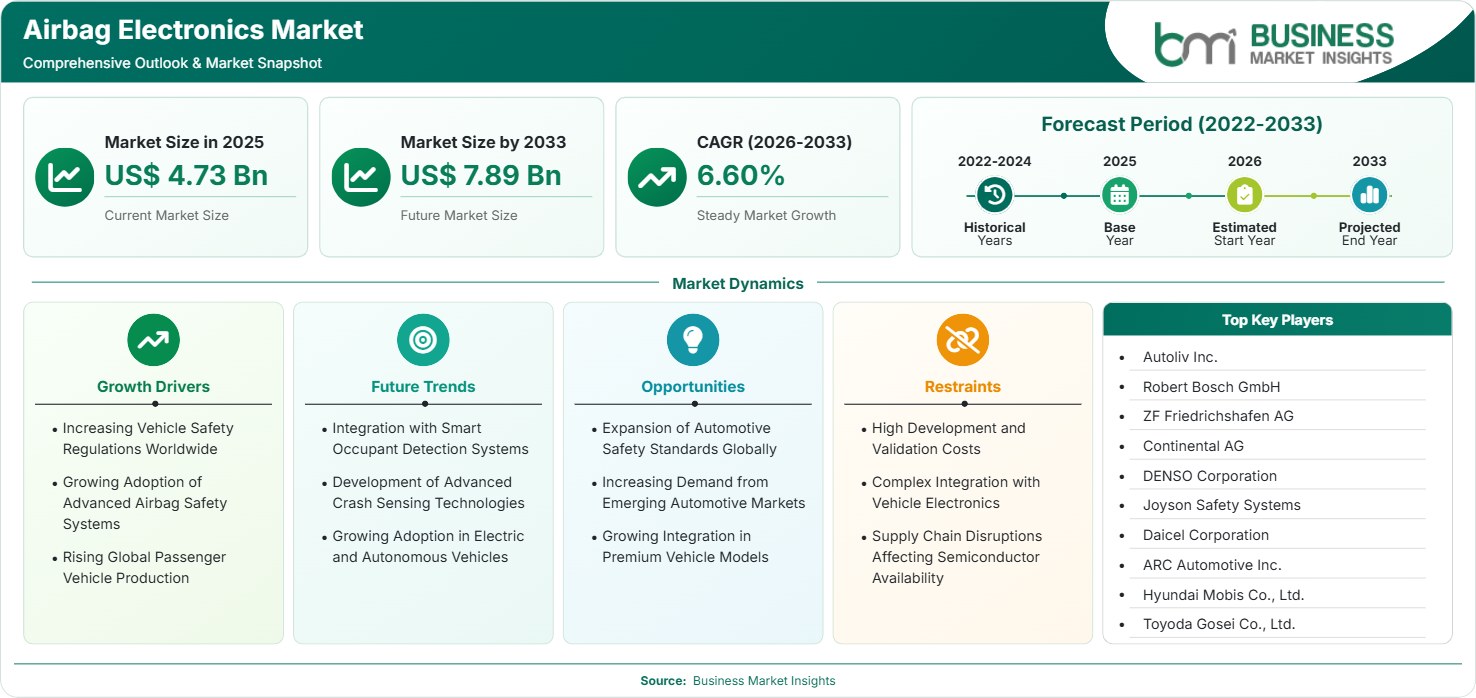
The Airbag Electronics Market size was valued at US$ 4.73 Billion in 2025 and is projected to reach US$ 7.89 Billion by 2033, growing at a CAGR of US$ 6.60% during 2026–2033, driven by stricter vehicle safety regulations, advanced sensing technologies, electric vehicle adoption, and increasing demand for intelligent occupant protection systems.

Report Coverage
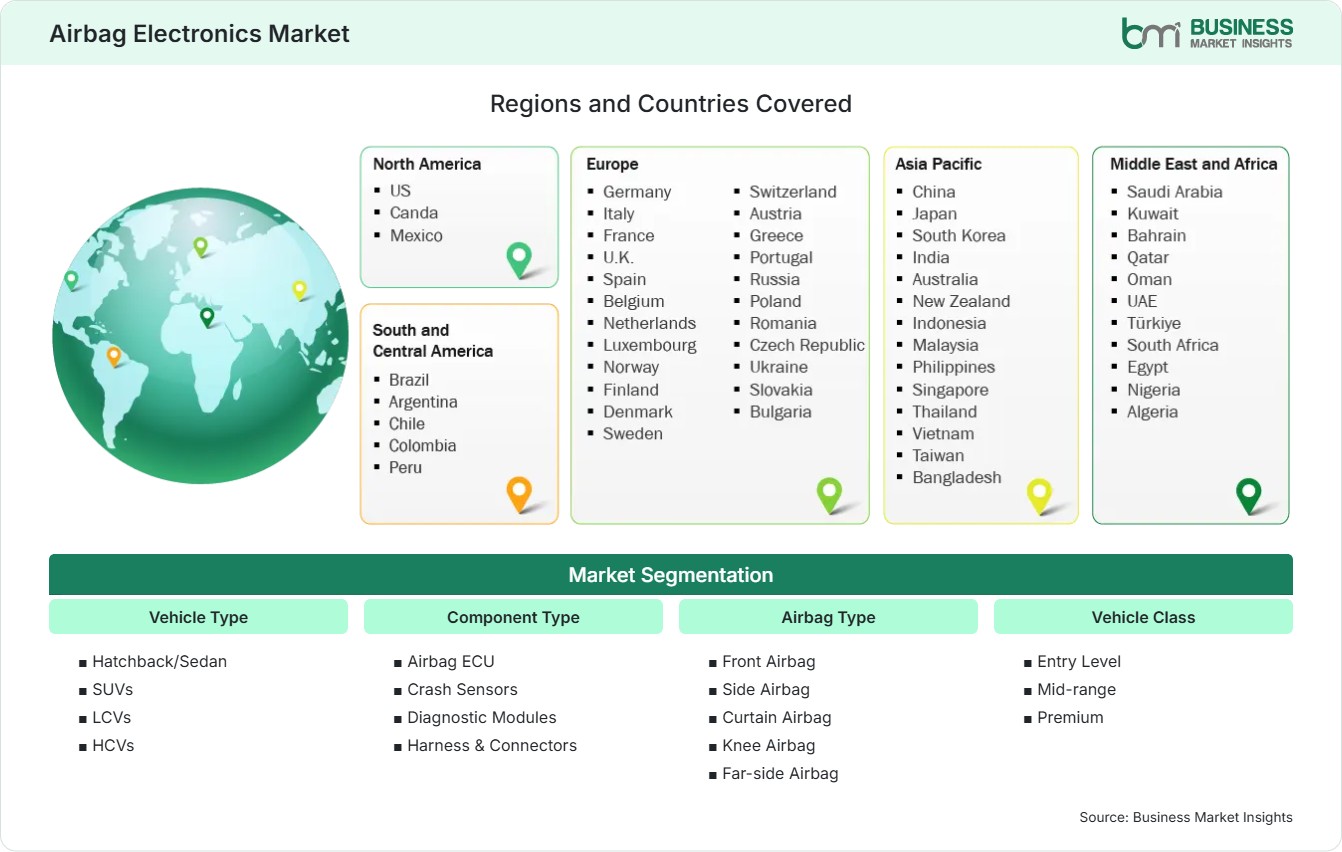
  • Vehicle Type: Hatchback/Sedan, SUVs, LCVs, HCVs
  • Component Type: Airbag ECU, Crash Sensors, Diagnostic Modules, Harness & Connectors
  • Airbag Type: Front Airbag, Side Airbag, Curtain Airbag, Knee Airbag, Far-side Airbag
  • Vehicle Class: Entry Level, Mid-range, Premium
  • Vehicle Propulsion: ICE, Electric
US$ 4.73 Bn Market size in 2025
US$ 7.89 Bn Market Size by 2033
6.60% CAGR, 2026 - 2033
2026-2033 Forecast Period

AI Overview

Airbag Electronics Market Summary

  • North America Region: North America holds a 31%–34% share in 2025, growing with a CAGR of 6.2%–6.7% due to safety regulations, ADAS integration, and vehicle electrification. The US market expands at 6.3%–6.8% CAGR through 2033, supported by advanced automotive technology adoption.
  • Fastest Growing Region: Asia Pacific maintains a 32%–35% share in 2025, growing with a CAGR of 7.1%–7.6% due to rising vehicle production, regulatory improvements, electric mobility expansion, and increasing safety feature adoption across emerging economies.
  • Leading Segment: SUVs represent a 35%–38% share in 2025, expanding at a CAGR of 6.8%–7.3% as consumer preference increases for larger vehicles requiring advanced restraint systems, multiple airbags, and enhanced crash protection technologies.
  • High Growth Segment: Electric vehicles represent a 18%–21% share in 2025, growing at a CAGR of 8.0%–8.5% due to battery platform development, new safety requirements, and integration of intelligent passenger protection systems.
  • Key Market Opportunity: Expansion of electric mobility, advanced driver assistance systems, and emerging automotive manufacturing hubs creates opportunities for suppliers developing compact, reliable, and software-enabled safety electronics solutions.
  • Major Market Players: Autoliv Inc., Robert Bosch GmbH, ZF Friedrichshafen AG, Continental AG, DENSO Corporation, Joyson Safety Systems, Daicel Corporation, ARC Automotive Inc., Hyundai Mobis Co., Ltd., and Toyoda Gosei Co., Ltd.
Strategic Insights

Airbag Electronics Market: Strategic Insights

Airbag Electronics Market Strategic Framework
FREE PDF
Request your free sample
Request free sample
Stakeholder View

Key Takeaways

  • Automotive safety electronics supply chains are becoming increasingly integrated, with semiconductor providers, sensor manufacturers, software developers, and vehicle suppliers collaborating to deliver advanced restraint solutions.
  • SUVs, electric vehicles, and premium passenger vehicles provide stronger growth opportunities as these categories require multiple airbags, sophisticated sensing systems, and enhanced occupant protection features.
  • Innovation is shifting toward intelligent crash detection, predictive algorithms, compact electronic control units, and integration with broader vehicle safety platforms.
  • Asia Pacific presents a compelling investment opportunity due to expanding automotive manufacturing, increasing vehicle ownership, and improving safety regulations across China, India, and Southeast Asian economies.
  • Strategic partnerships and technology acquisitions are increasing as automotive suppliers seek stronger capabilities in electronics, software development, sensor technologies, and electric vehicle safety applications.
Geographic Outlook

Airbag Electronics Market Regional Highlights

North America Airbag Electronics Market

North America accounted for a 31%–34% share in 2025 and is projected to expand at a 6.2%–6.7% CAGR between 2026–2033. The region benefits from established automotive manufacturing, strict safety requirements, and strong adoption of advanced vehicle technologies. Airbag Electronics Market share remains supported by demand from passenger vehicles, electric vehicles, and premium automotive segments across the US, Canada, and Mexico.

  • The US market represents a 27%–30% share in 2025, growing at a 6.3%–6.8% CAGR due to federal safety standards and advanced vehicle technology adoption.
  • Automotive manufacturers are increasing investment in electronic safety systems to meet evolving crash protection requirements and improve vehicle ratings across passenger and commercial categories.
  • Electric vehicle production expansion is supporting demand for advanced restraint systems designed specifically for new vehicle architectures and battery-powered platforms.
  • Supplier collaboration with automakers is accelerating development of integrated safety electronics combining sensors, processors, and software capabilities.

US Airbag Electronics Market

The US represented a 27%–30% share in 2025 and is expected to grow at a 6.3%–6.8% CAGR during 2026–2033. The market benefits from strong regulatory enforcement, established automotive technology infrastructure, and increasing penetration of electric and connected vehicles. Airbag Electronics Market share in the country is influenced by passenger vehicle demand, safety testing requirements, and investments from global automotive suppliers.

  • Federal crash safety regulations continue encouraging manufacturers to integrate advanced electronic restraint systems across new vehicle platforms.
  • Electric vehicle manufacturers are adopting sophisticated safety electronics to support new battery layouts and occupant protection requirements.
  • Automotive technology companies are developing compact control units and advanced sensors for improved crash response performance.

Europe Airbag Electronics Market

Europe held a 24%–27% share in 2025 and is forecast to grow at a 5.9%–6.4% CAGR through 2033. Germany, France, and the UK remain important automotive production centers, while electric vehicle adoption supports future demand. Airbag Electronics Market growth across Europe is influenced by strict vehicle safety regulations, premium vehicle manufacturing, and increasing integration of electronic safety systems.

  • Germany maintains strong demand due to premium vehicle production, advanced engineering capabilities, and automotive technology investments.
  • France and the UK are expanding safety electronics adoption through electric vehicle manufacturing and regulatory compliance initiatives.
  • European automakers are prioritizing lightweight electronic systems to improve efficiency while maintaining occupant protection standards.
  • Safety testing organizations continue influencing adoption of advanced restraint technologies across vehicle categories.

Asia Pacific Airbag Electronics Market

Asia Pacific accounted for a 32%–35% share in 2025 and is projected to register a 7.1%–7.6% CAGR from 2026–2033, making it the fastest-expanding regional market. China, India, Japan, and South Korea are driving adoption through vehicle production growth, electric mobility expansion, and improving safety regulations. The Airbag Electronics market in this region benefits from manufacturing localization and increasing investments in automotive component ecosystems.

  • China remains the largest regional contributor due to high vehicle production volumes, expanding electric vehicle manufacturing, and increasing adoption of advanced occupant safety systems.
  • India is witnessing stronger demand as vehicle manufacturers introduce enhanced safety features, supported by regulatory requirements and growing consumer awareness.
  • Japan and South Korea continue advancing electronic restraint technologies through automotive innovation, semiconductor expertise, and premium vehicle production capabilities.
  • Southeast Asian countries are attracting component investments as manufacturers diversify supply chains and expand regional automotive production capacity.

Rest of World Airbag Electronics Market

Rest of World accounted for a 12%–15% share in 2025 and is estimated to grow at a 6.0%–6.5% CAGR between 2026–2033. South America, the Middle East, and Africa are gradually adopting advanced safety technologies due to vehicle modernization, regulatory improvements, and increasing international automotive investments. Airbag Electronics Market share is supported by rising passenger vehicle demand and growing supplier presence.

South American markets are improving automotive safety adoption through regulatory developments and increased availability of vehicles equipped with advanced restraint technologies. Middle Eastern countries are investing in premium vehicles and mobility infrastructure, while African markets present long-term opportunities through expanding vehicle ownership and manufacturing initiatives.

  • Brazil and Mexico support regional demand through automotive manufacturing activity, supplier networks, and increasing safety feature implementation.
  • Middle Eastern countries are adopting advanced vehicle technologies through premium vehicle imports and modernization of transportation infrastructure.
  • South African automotive production contributes to regional growth through established manufacturing capabilities and export-oriented vehicle programs.
  • Emerging markets are creating opportunities for suppliers offering scalable and cost-efficient safety electronics solutions.
Global Market Geography
FREE PDF
Request your free sample
Request free sample
Segment Analysis

Airbag Electronics Market Segmentation

Vehicle Type

The Vehicle Type segment reflects differences in safety system requirements across passenger and commercial vehicles. SUVs accounted for a 35%–38% share in 2025 and are projected to grow at a 6.8%–7.3% CAGR between 2026–2033. Increasing consumer preference for larger vehicles, higher safety expectations, and integration of multiple airbags are supporting segment expansion. The Airbag Electronics Market scope continues widening as manufacturers develop adaptable systems for diverse vehicle platforms.

  • Hatchback/Sedan: These vehicles maintain steady demand through urban mobility applications, requiring compact safety electronics, efficient deployment systems, and cost-effective restraint technologies.
  • SUVs: SUVs drive adoption through higher vehicle dimensions, increased passenger protection requirements, and greater integration of advanced airbag configurations.
  • LCVs: Light commercial vehicles are adopting enhanced safety systems due to fleet operator requirements, logistics growth, and regulatory compliance needs.
  • HCVs: Heavy commercial vehicles increasingly incorporate electronic safety components to improve driver protection and meet evolving transportation safety standards.

Component Type

The Component Type segment represents critical electronic elements enabling airbag deployment and monitoring functions. Airbag ECU held a 38%–41% share in 2025 and is expected to grow at a 6.7%–7.2% CAGR through 2033 due to increasing system complexity. The Airbag Electronics Market trends are influenced by sensor innovation, improved processing capability, and integration with vehicle safety networks.

  • Airbag ECU: Electronic control units manage crash detection, deployment timing, diagnostics, and communication with broader vehicle systems.
  • Crash Sensors: Sensors provide accurate collision detection by measuring impact forces, acceleration changes, and vehicle movement conditions.
  • Diagnostic Modules: Diagnostic systems enable continuous monitoring, fault detection, and maintenance support for automotive safety electronics.
  • Harness & Connectors: Wiring components ensure reliable communication between sensors, control units, and airbag modules under demanding vehicle conditions.

Airbag Type

The Airbag Type segment is expanding as manufacturers introduce broader occupant protection solutions across vehicle categories. Front airbags maintained a 40%–43% share in 2025 and are projected to grow at a 6.1%–6.6% CAGR through 2033. Increasing safety standards and consumer demand for comprehensive protection systems are driving adoption of multiple airbag configurations.

  • Front Airbag: Front airbags remain essential safety components designed to protect drivers and passengers during frontal collision events.
  • Side Airbag: Side airbags are increasingly adopted to reduce injury risks during side-impact collisions and improve vehicle safety ratings.
  • Curtain Airbag: Curtain airbags provide enhanced head protection and are becoming standard features in many passenger vehicles.
  • Knee Airbag: Knee airbags support lower-body protection by reducing impact forces during severe frontal crashes.
  • Far-side Airbag: Far-side airbags are emerging as advanced safety solutions designed to protect occupants during complex collision scenarios.

Vehicle Class

The Vehicle Class segment reflects adoption differences based on consumer expectations, pricing structures, and safety technology availability. Mid-range vehicles represented a 45%–48% share in 2025 and are anticipated to grow at a 6.5%–7.0% CAGR between 2026–2033. Increasing standardization of safety features, regulatory requirements, and consumer preference for improved protection are encouraging manufacturers to integrate advanced electronic restraint systems across broader vehicle categories.

  • Entry Level: Entry-level vehicles are adopting affordable safety electronics due to mandatory safety regulations, competitive pressure, and increasing customer demand for essential protection technologies.
  • Mid-range: Mid-range vehicles represent broad adoption opportunities as manufacturers balance advanced safety features, production costs, and consumer expectations across high-volume automotive segments.
  • Premium: Premium vehicles incorporate advanced restraint technologies with multiple airbags, intelligent sensing systems, and enhanced occupant protection features.

Vehicle Propulsion

The Vehicle Propulsion segment is influenced by the transition toward electrified mobility and continued demand for internal combustion engine vehicles. ICE vehicles accounted for a 78%–81% share in 2025, while electric vehicles are projected to expand at an 8.0%–8.5% CAGR between 2026–2033. The Airbag Electronics Market share is increasingly shaped by electric vehicle platform development and specialized safety requirements.

  • ICE: Internal combustion engine vehicles continue generating demand through global vehicle production volumes, replacement cycles, and established automotive manufacturing networks.
  • Electric: Electric vehicles are increasing adoption of advanced safety electronics due to battery architecture changes, new crash considerations, and integration of intelligent vehicle systems.
Market Forces

Airbag Electronics Market Dynamics

Key Market Drivers

Increasing Vehicle Safety Regulations Worldwide

The government and automobile safety institutions are tightening the regulations that mandate improvements in the safety system of vehicles. United Nations Economic Commission for Europe (UNECE) has continued to develop automotive safety standards that have impacted automakers worldwide. The Airbag Electronics market growth is driven by the mandated use of airbags, sophisticated crash tests, and increasing passenger safety regulations. Trends in Airbag Electronics industry are also driven by the safety rating programs that push automakers to adopt advanced electronics in vehicles.

Growing Adoption of Advanced Airbag Safety Systems

Automotive companies are now integrating advanced types of airbag designs such as the side airbag, curtain airbag, and far-side protection airbag into automobiles to ensure enhanced occupant protection. Greater consumer awareness and safety programs are pushing for increased use of such types of airbags other than the traditional front airbag. Enhanced electronic control units with advanced processing capacity facilitate enhanced crash recognition and deployment decisions. Safety module suppliers are producing compact and intelligent safety modules that allow various airbag systems to be integrated into current vehicles.

Rising Global Passenger Vehicle Production

The increasing production of passenger vehicles in the world is generating more demand for electronic safety parts due to the expansion of manufacturing capacity. International Organization of Motor Vehicle Manufacturers still monitors major vehicle manufacturing in Asia, Europe, and North America. The growing number of vehicle owners in emerging markets is also helping install safety electronics in larger numbers. Vehicle manufacturers are focusing on standardized safety parts that can be used in several different vehicle platforms. Growing electric vehicle manufacturing is also affecting suppliers' strategies due to the need for redesigning safety systems for different platforms.

Key Market Opportunities

Expansion of Automotive Safety Standards Globally

Growing use of international standards for vehicle safety offers chances for companies that manufacture electronic restraint systems according to the required standards. Countries with emerging economies are enforcing stringent safety laws which push automakers to integrate more advanced technologies like airbags and electronic controls in their cars. Businesses that offer safe electronics technology solutions can cater to various types of vehicles while ensuring compliance with local standards. According to Airbag Electronics Market Forecasts, there are many chances in terms of regulatory standardization, better testing techniques, and growing need for safety in transportation systems.

Increasing Demand from Emerging Automotive Markets

Automotive markets are emerging as key growth sectors due to the rising number of car owners and their demands for more safety measures. Many countries in the Asia Pacific, Latin America, and the Middle East regions are expanding their production of vehicles, along with introducing strict safety norms. Investments made locally and by foreign suppliers are providing better access to sophisticated electronics. Car manufacturers are looking for economically viable options that can ensure safety of passengers without being expensive. Growth in these markets provides an opportunity for technology companies with adaptable airbags.

Growing Integration in Premium Vehicle Models

Advanced electronics are gaining rapid popularity in premium car manufacturing, as it becomes a means of differentiating cars by offering better occupant protection. Advanced airbag technology, sensors, and electronics are commonplace in luxury and high performance cars in Airbag Electronics Market. The incorporation of these electronics encourages manufacturers to come up with advanced electronics with improved efficiency. Connected car technology and ADAS integration are opening up new prospects for safety electronics companies. There is need for innovation in restraint systems for improved protection and automation.

Market Restraints and Challenges

High Development and Validation Costs

Factor: Developing advanced airbag electronic systems requires substantial investment in engineering, testing, software validation, crash simulation, and regulatory certification. Impact: Higher costs of development can affect the prices of parts and prevent small companies from joining the automotive safety system. The validation process should be done regularly since safety parts have an effect on the success of occupant protection. Innovation is required in sensors, processors, and control algorithms. There is high demand for research to balance technology and cost. Companies must balance technological advancement with cost optimization to remain competitive in price-sensitive automotive markets.

Complex Integration with Vehicle Electronics

Factor: Modern vehicles contain interconnected electronic architectures requiring seamless communication between airbag systems, sensors, ECUs, and other safety platforms. Impact: Integration complexity can extend development timelines and increase engineering challenges during vehicle platform upgrades. The automaker and suppliers have to ensure that there is compatibility with other architecture designs as well as reliability in different operational conditions. The trend towards making vehicles electric and software-based brings in even more challenges in ensuring that safety systems interface with the changing electronic architectures.

Company Analysis

Competitive Landscape

The Airbag Electronics Market analysis highlights a competitive environment shaped by automotive safety suppliers, electronics manufacturers, and technology providers focused on intelligent restraint systems. Companies are strengthening capabilities through sensor innovation, electronic control unit development, software integration, and partnerships with vehicle manufacturers. Competitive differentiation depends on safety certification expertise, global manufacturing capacity, component reliability, and the ability to support evolving vehicle architectures, including electric and connected vehicles.

Company Name

Overview

Products and Services relevant to this market

Autoliv Inc.

Global automotive safety supplier specializing in passive safety technologies and restraint systems.

Airbag modules, electronic safety systems, crash sensors, restraint control units, and safety components.

Robert Bosch GmbH

Automotive technology provider offering electronics, software, and vehicle safety solutions.

Airbag ECUs, crash sensors, control systems, and integrated vehicle safety electronics.

ZF Friedrichshafen AG

Automotive technology company developing mobility systems and safety technologies.

Airbag control units, restraint systems, sensors, and advanced safety electronics.

Continental AG

Automotive supplier specializing in electronics, mobility technologies, and safety systems.

Airbag control electronics, sensors, safety modules, and vehicle integration solutions.

DENSO Corporation

Global automotive component manufacturer supporting vehicle safety and electronics development.

Airbag sensors, electronic control units, safety components, and automotive electronic systems.

Joyson Safety Systems

Automotive safety supplier focused on occupant protection technologies worldwide.

Airbags, restraint systems, crash sensors, safety electronics, and integrated protection solutions.

Daicel Corporation

Chemical and automotive safety technology company providing restraint system components.

Inflators, airbag components, safety modules, and occupant protection technologies.

ARC Automotive Inc.

Automotive safety technology company specializing in airbag inflator systems.

Airbag inflators, ignition systems, safety components, and restraint technologies.

Hyundai Mobis Co., Ltd.

Automotive parts manufacturer supplying modules and advanced vehicle technologies.

Airbag systems, electronic components, safety modules, and vehicle integration solutions.

Toyoda Gosei Co., Ltd.

Automotive supplier specializing in safety systems and functional components.

Airbags, steering safety components, restraint technologies, and automotive safety products.

Trust & Transparency

Research Methodology

The market analysis combines proprietary research with secondary data from government agencies, company disclosures, regulatory filings, industry databases and expert interviews. Market estimates are validated through data triangulation, cross-market benchmarking and analyst review.

View Full Research Methodology

Questions Answered

Frequently Asked Questions

What role do electronic control units play in vehicle safety?

Electronic control units analyze crash sensor data, determine deployment timing, manage airbag activation, and support communication between safety components and vehicle electronic networks.

Which vehicle categories are creating stronger demand for safety electronics?

SUVs, premium vehicles, and electric vehicles are creating stronger demand due to increased use of multiple airbags, advanced sensors, and intelligent safety systems.

How does the Airbag Electronics Market Report support automotive industry decisions?

The report evaluates market dynamics, technology developments, regional opportunities, competitive strategies, and application trends to help stakeholders understand future investment areas.

How are electric vehicles affecting airbag technology development?

Electric vehicles require redesigned safety systems because of different battery structures, vehicle weight distribution, and electronic architectures, encouraging development of advanced restraint solutions.

What factors are influencing demand for advanced airbag systems?

Demand is influenced by stricter vehicle safety regulations, increasing consumer awareness, higher adoption of SUVs and electric vehicles, and the need for improved occupant protection technologies.

Access the Full Airbag Electronics Market Report

Get segment-level forecasts, regional estimates, competitive benchmarking, company profiles and downloadable Excel datasets.

Access the full Airbag Electronics Market Report
350 pages PDF & Excel | 2026-08-06
Similar Research

Related Market Reports