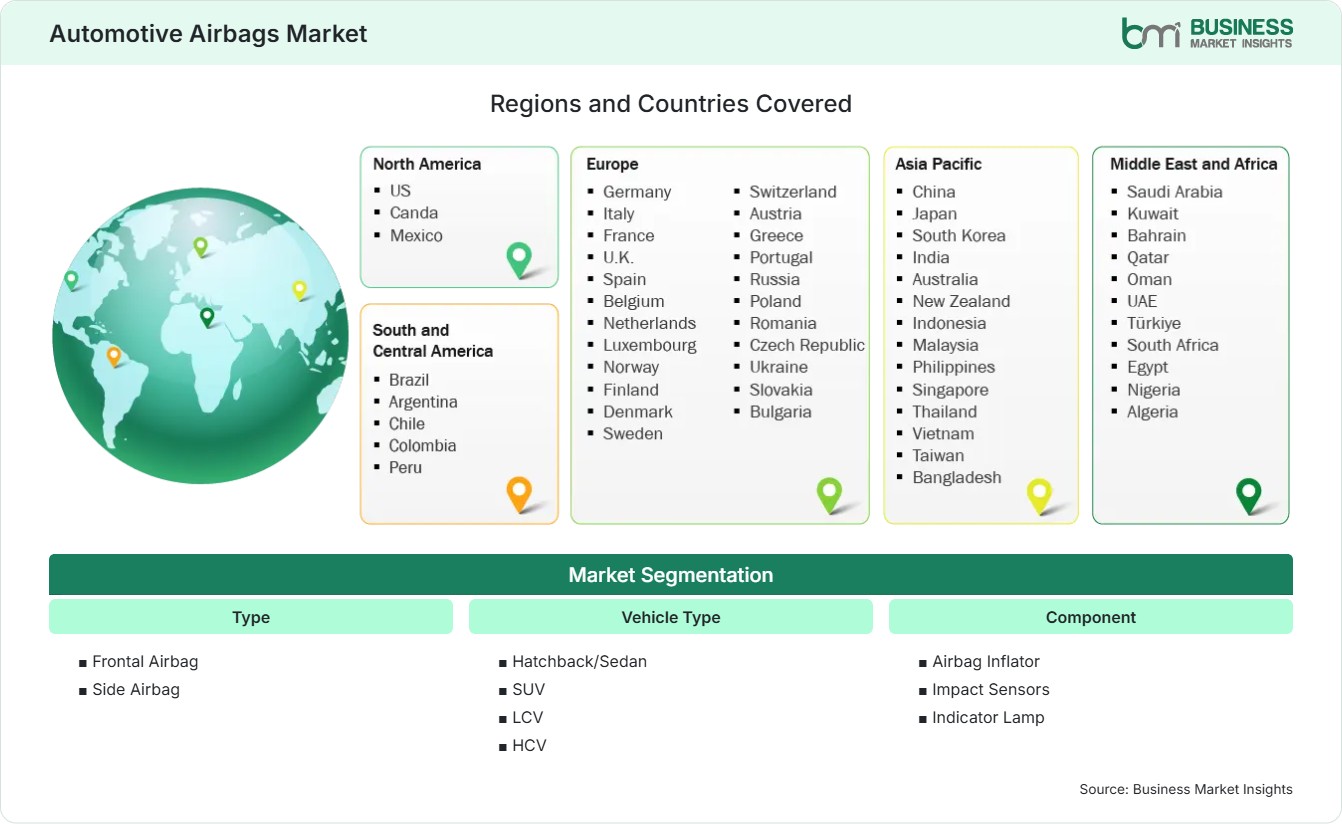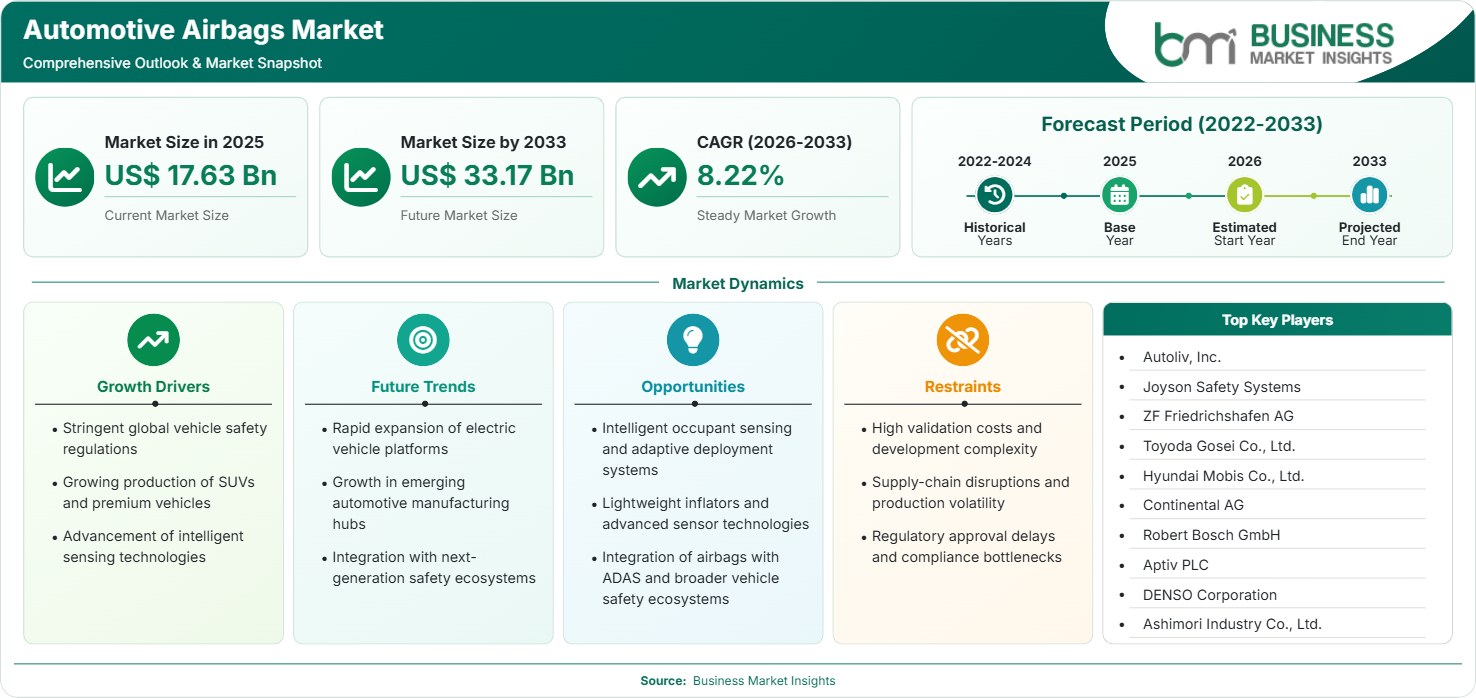
Automotive Airbags Market Regional Highlights
North America Automotive Airbags Market
North America maintains a 32%–35% Automotive Airbags Market share in 2025 and advances at 7.2%–7.8% CAGR through 2033. Strong regulatory oversight, premium vehicle penetration, and widespread multi-airbag adoption support regional leadership. OEM focus on enhanced crash performance and integration of advanced occupant monitoring systems reinforces demand. Consumer preference for larger vehicles requiring additional restraint coverage further strengthens long-term industry expansion throughout the region.
- US and Canada maintain strong demand through stricter federal vehicle safety regulations and expanded deployment of advanced restraint technologies.
- Premium pickups, SUVs, and luxury models incorporate greater airbag content per vehicle, supporting supplier revenues.
- OEM investment in software-defined vehicle platforms accelerates advanced sensing and deployment system adoption.
- Replacement demand and vehicle parc modernization continue contributing to stable aftermarket opportunities.
US Automotive Airbags Market
The United States accounts for 74%–78% of North American revenue and grows at 7.3%–7.9% CAGR. Stronger consumer focus on vehicle safety, elevated SUV production, and continued innovation among domestic and international manufacturers support demand. Advanced airbag configurations, integrated sensing technologies, and growing ADAS deployment increase product sophistication while sustaining supplier investment across manufacturing and engineering facilities.
- Federal Motor Vehicle Safety Standards continue supporting adoption of advanced occupant protection systems.
- Electric vehicle manufacturers increasingly require customized restraint-system designs aligned with unique cabin architectures.
- Insurance and safety-rating influences support consumer preference for enhanced protection technologies.
- Domestic production capabilities provide supply security for high-volume OEM programs.
Europe Automotive Airbags Market
Europe holds a 24%–27% share during 2025 and records 7.8%–8.4% CAGR through 2033. Euro NCAP influence, advanced automotive engineering capabilities, and high safety awareness sustain demand. Germany remains the leading market, while Eastern European manufacturing expansion supports supply-chain growth. Spain and Poland emerge as notable high-growth locations, benefiting from automotive investment and increasing regional production activity.
- Germany leads regional adoption through premium vehicle manufacturing and extensive safety innovation.
- France and Italy support steady demand through passenger vehicle production and safety compliance measures.
- Poland and Spain demonstrate higher growth momentum owing to manufacturing investments and export-oriented production.
- Electrification strategies accelerate development of specialized restraint technologies.
- Supplier collaboration with OEMs remains crucial for next-generation safety architectures.
Asia Pacific Automotive Airbags Market
Asia Pacific represents a 29%–32% share in 2025 and is the fastest-growing region with 9.3%–9.9% CAGR. China leads revenue generation, while India demonstrates the strongest expansion rate. Regulatory tightening, rising vehicle ownership, and expanding local manufacturing capacity drive adoption. Government safety initiatives and increasing fitment of multiple airbags in mass-market vehicles create meaningful demand opportunities across the region.
- China remains the largest production hub, supporting substantial demand for integrated restraint systems.
- India records the strongest growth due to evolving vehicle safety regulations and consumer awareness.
- Japan and South Korea contribute through technological innovation and premium vehicle manufacturing.
- Southeast Asian vehicle assembly expansion strengthens regional production opportunities.
- Domestic supplier development supports localization and cost optimization strategies.
Rest of World Automotive Airbags Market
The Rest of World has a 10%-13% share in 2025 and experiences growth at 8.4%-9.0% CAGR. There is a positive impact of improved safety standards and vehicle fleet modernization in South & Central America. Premium vehicle sales, improved infrastructure, and a more favorable regulatory environment in the Middle East & Africa are driving the adoption of occupant safety technology across passenger and commercial vehicle categories.
- Brazil leads South and Central America owing to vehicle manufacturing scale and regulatory development.
- Mexico benefits from export-oriented automotive production and supplier localization activities.
- UAE remains a key Middle Eastern market influenced by premium vehicle penetration.
- South Africa supports regional demand through automotive assembly operations.
- Safety awareness campaigns continue promoting enhanced restraint-system adoption.