
Airbag Sensor Market Outlook: Size, Share, Trends, Growth Analysis, Competitive Landscape & Forecast, 2022-2033

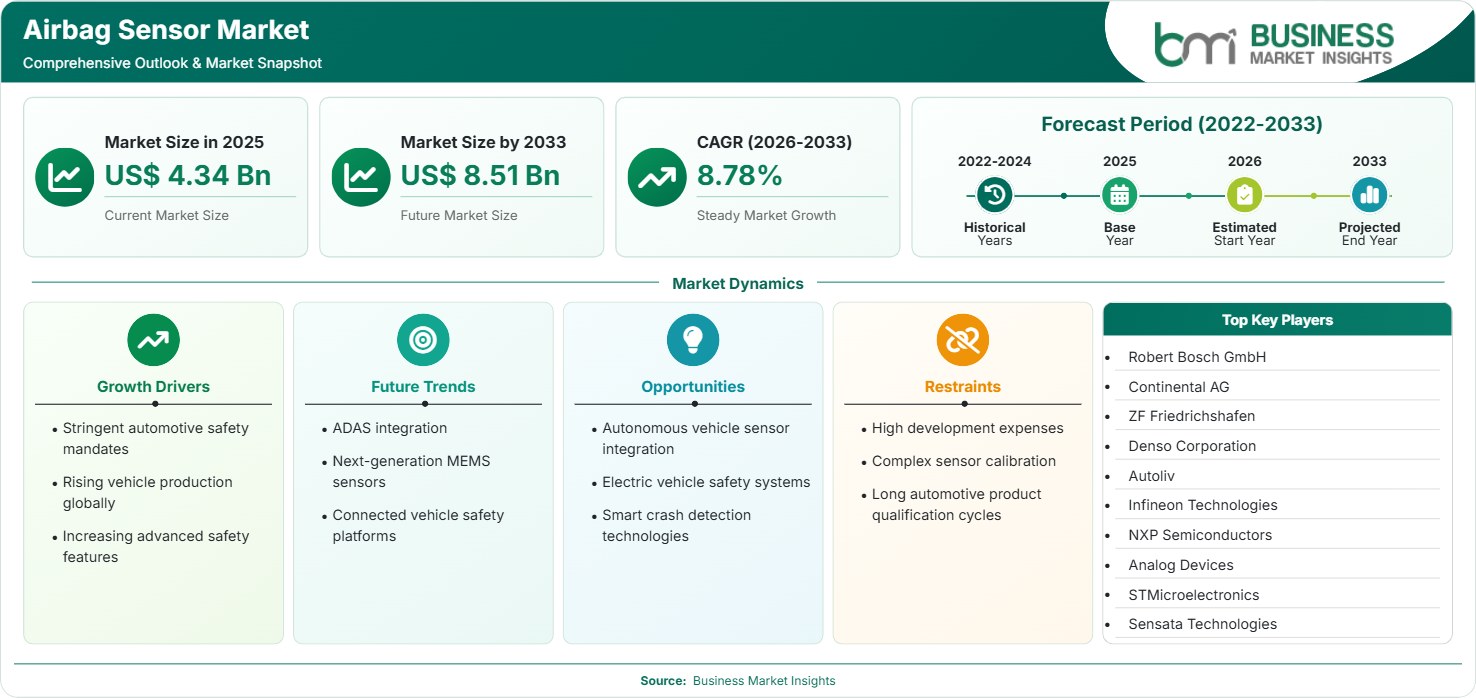
The Airbag Sensor Market size was valued at US$ 4.34 billion in 2025 and is projected to reach US$ 8.51 billion by 2033, growing at a CAGR of 8.78% during 2026–2033. Market growth is driven by stringent automotive safety mandates, rising global vehicle production, increasing adoption of advanced safety features, autonomous vehicle sensor integration, electric vehicle safety systems, and smart crash detection technologies.

Report Coverage
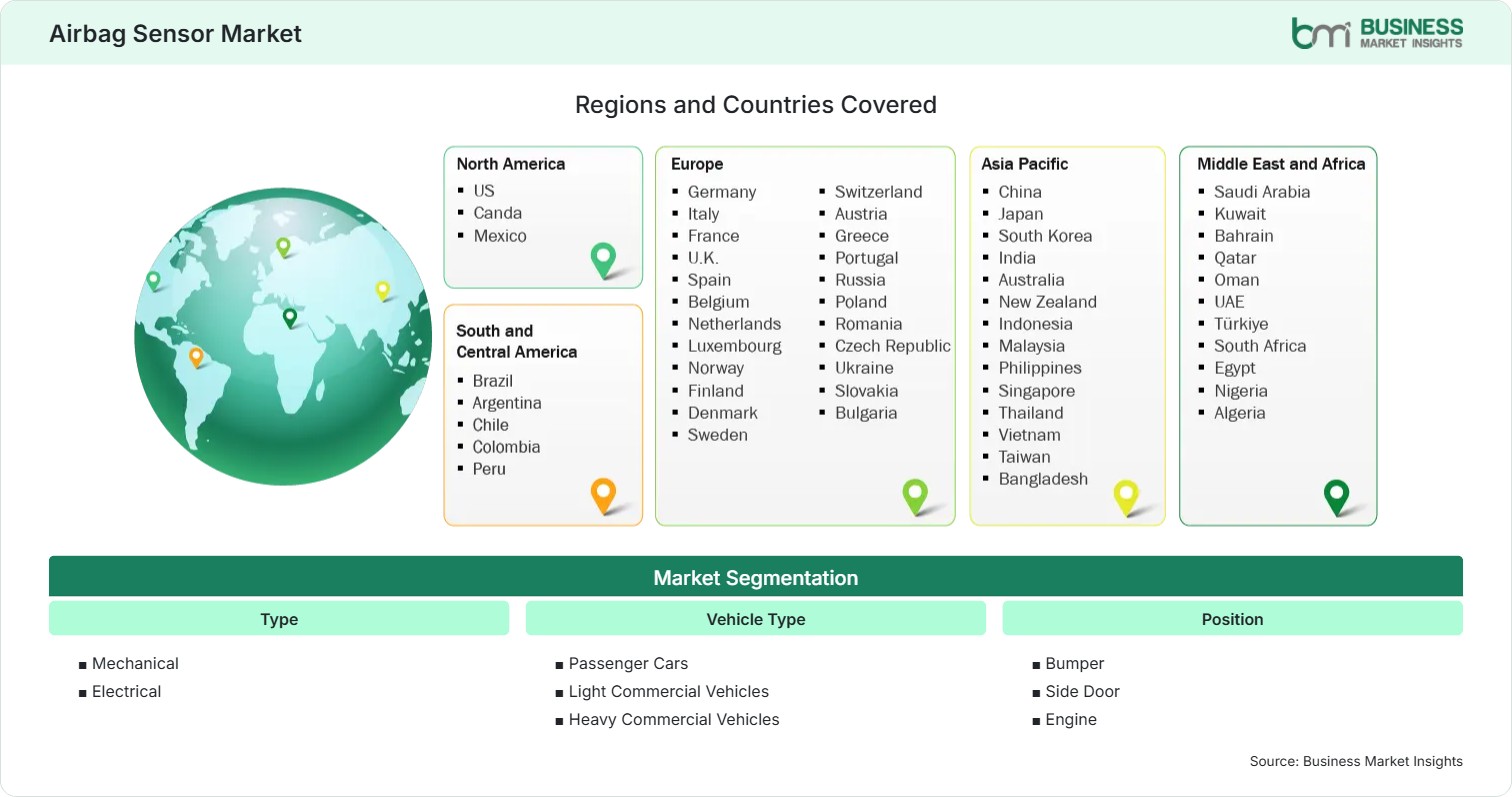
  • Type: Mechanical, Electrical
  • Vehicle Type: Passenger Cars, Light Commercial Vehicles, Heavy Commercial Vehicles
  • Position: Bumper, Side Door, Engine
US$ 4.34 Bn Market size in 2025
US$ 8.51 Bn Market Size by 2033
8.78% CAGR, 2026 - 2033
2026-2033 Forecast Period

01 AI Overview

Airbag Sensor Market Summary

  • North America Region: North America holds a market share of 30%–34% in 2025, growing with a CAGR of 8.2%–8.7% during 2026–2033. Growth is supported by strict vehicle safety regulations, high adoption of advanced driver assistance systems (ADAS), increasing demand for premium vehicles, and integration of advanced crash detection technologies. The U.S. Airbag Sensor market represents the largest contributor due to strong automotive manufacturing capabilities and regulatory focus on passenger safety.
  • Fastest Growing Region: Asia Pacific holds a market share of 35%–39% in 2025 and is expected to grow at a CAGR of 9.5%–10.2% during 2026–2033. Growth is influenced by expanding vehicle production, increasing automotive electrification, rising consumer safety awareness, and growing adoption of advanced automotive electronics across China, India, Japan, and South Korea.
  • Leading Segment: Electrical airbag sensors hold an airbag sensor market share of 75%–80% in 2025, growing at a CAGR of 8.8%–9.3% during 2026–2033. The segment benefits from higher accuracy, faster response times, integration with electronic control units, and increasing adoption of advanced restraint systems.
  • High Growth Segment: Electric vehicle airbag sensors represent a high-growth segment, supported by increasing EV production, specialized battery safety requirements, advanced vehicle architectures, and integration of intelligent safety systems.
  • Key Market Opportunity: Autonomous vehicle sensor integration, smart crash detection technologies, and electric vehicle safety systems are creating opportunities for manufacturers to develop advanced sensing solutions with improved accuracy, connectivity, and real-time response capabilities.
  • Major Market Players: Robert Bosch GmbH, Continental AG, ZF Friedrichshafen, Denso Corporation, Autoliv, Infineon Technologies, NXP Semiconductors, Analog Devices, STMicroelectronics, Sensata Technologies.
02 Strategic Insights

Airbag Sensor Market: Strategic Insights

airbag-sensor-market-market-strategic-framework
FREE PDF
Request your free sample
Request free sample
03 Stakeholder View

Key Takeaways

  • The airbag sensor ecosystem includes automotive OEMs, sensor manufacturers, semiconductor suppliers, safety system providers, and technology companies developing advanced occupant protection solutions.
  • Electrical airbag sensors present strong growth potential due to their improved reliability, faster response capabilities, and integration with modern electronic safety systems.
  • Electric vehicles and autonomous driving technologies are accelerating demand for intelligent crash detection systems and advanced sensor integration.
  • Asia Pacific represents a major investment opportunity due to expanding automotive production, increasing EV adoption, and rising implementation of vehicle safety technologies.
  • Leading companies are focusing on sensor miniaturization, semiconductor innovation, strategic partnerships, and advanced safety platforms to strengthen their competitive position in the automotive safety market.
04 Geographic Outlook

Airbag Sensor Market Regional Highlights

North America Airbag Sensor Market

North America accounted for 30%–34% of the global market in 2025 and is projected to expand at a 8.2%–8.7% CAGR during 2026–2033. The region maintains a strong position due to strict vehicle safety regulations, advanced automotive technology adoption, and increasing integration of electronic safety systems in passenger vehicles. The Airbag Sensor Market share in North America is supported by growing demand for advanced driver assistance systems (ADAS), premium vehicle production, and increasing consumer preference for enhanced safety features. The U.S. represents the major contributor due to strong automotive manufacturing, regulatory enforcement, and investment in next-generation vehicle safety technologies.

  • The United States drives regional demand through advanced vehicle safety regulations, high adoption of connected vehicles, and increasing integration of intelligent restraint systems.
  • Canada supports market development through automotive manufacturing activities, safety compliance requirements, and increasing adoption of advanced vehicle technologies.
  • Automakers are increasingly incorporating multi-sensor safety architectures to improve collision detection accuracy and occupant protection.

US Airbag Sensor Market

The U.S. represented approximately 26%–30% of global revenue in 2025 and is expected to grow at a 8.3%–8.8% CAGR during 2026–2033. The country remains a key market due to strong automotive production, advanced vehicle safety standards, and rapid adoption of electronic safety technologies. The Airbag Sensor Market growth in the U.S. is influenced by increasing implementation of ADAS features, rising demand for safer vehicles, and continuous innovation in automotive electronics. Vehicle manufacturers and technology suppliers are investing in advanced sensing platforms to support improved crash detection and autonomous driving capabilities.

  • Federal vehicle safety requirements continue encouraging adoption of advanced airbag and restraint systems.
  • Automotive manufacturers are integrating multiple sensor systems to enhance occupant protection during different collision scenarios.
  • Electric and autonomous vehicle development is increasing demand for advanced sensing technologies.

Europe Airbag Sensor Market

Europe accounted for approximately 25%–29% of global revenue in 2025 and is anticipated to register a 8.0%–8.5% CAGR during 2026–2033. The region benefits from strict automotive safety regulations, strong vehicle manufacturing capabilities, and high adoption of advanced automotive technologies. Germany, France, the United Kingdom, and Italy represent major markets due to their established automotive industries and focus on vehicle safety innovation. European manufacturers are investing in intelligent sensor systems, electronic control technologies, and advanced restraint solutions to comply with evolving safety requirements.

  • Germany contributes significantly through automotive engineering expertise, premium vehicle production, and advanced safety technology adoption.
  • France and Italy support growth through vehicle manufacturing activities and increasing integration of automotive electronics.
  • The United Kingdom is adopting advanced safety systems through connected vehicle development and regulatory initiatives.

Asia Pacific Airbag Sensor Market

Asia Pacific represented 35%–39% of global revenue in 2025 and is expected to grow at a 9.5%–10.2% CAGR during 2026–2033. The region is the fastest-growing Airbag Sensor market due to expanding vehicle production, rising automotive electrification, increasing consumer safety awareness, and growing investments in automotive electronics manufacturing. China, India, Japan, and South Korea are key contributors supported by large automotive production bases and increasing adoption of advanced safety features. The region offers significant opportunities due to rising vehicle ownership and government initiatives promoting safer transportation.

  • China dominates regional growth through large-scale automotive manufacturing, EV production expansion, and increasing adoption of intelligent vehicle technologies.
  • India is experiencing rising demand due to growing vehicle production, improving safety regulations, and increasing consumer awareness.
  • Japan and South Korea contribute through advanced automotive technology development and strong semiconductor manufacturing capabilities.

Rest of World Airbag Sensor Market

The Rest of World region, including South & Central America and the Middle East & Africa, accounted for approximately 7%–10% of global revenue in 2025 and is projected to expand at a 8.0%–8.6% CAGR through 2033. Growth is supported by increasing vehicle sales, improving road safety awareness, automotive industry development, and adoption of international safety standards. Brazil, Mexico, the UAE, and South Africa represent important markets due to expanding automotive sectors and increasing demand for safer vehicles.

  • Brazil supports growth through automotive manufacturing activities and increasing adoption of vehicle safety technologies.
  • Mexico benefits from its automotive production base and increasing integration into global vehicle supply chains.
  • Middle Eastern countries are investing in advanced transportation systems and vehicle safety improvements.
global-market-geography
FREE PDF
Request your free sample
Request free sample
05 Segment Analysis

Airbag Sensor Market Segmentation

Type

Electrical airbag sensors represent the leading type segment, accounting for approximately 75%–80% of the Airbag Sensor market in 2025 and expanding at a 8.8%–9.3% CAGR during 2026–2033. The segment dominates due to higher accuracy, faster response time, improved reliability, and compatibility with modern electronic restraint systems. The increasing adoption of advanced driver-assistance systems (ADAS), electronic control units (ECUs), and vehicle safety platforms has boosted demand for electrical sensors. Automobile manufacturers have started substituting the old mechanical sensor systems with electronic ones that can detect crash situations and deploy airbags quickly.

  • Mechanical: Mechanically controlled airbag sensors have been deployed for safety due to their simplicity and cost-effectiveness. However, their use is gradually diminishing as car manufacturers adopt electronically controlled safety systems.
  • Electrical: Electrically controlled sensors have become popular due to the availability of advanced safety devices and features that require integration with vehicle control systems and the provision of real-time crash data. Accelerometer sensors, pressure sensors, and electronic crash sensors are increasingly adopted across modern vehicles.

Vehicle

Passenger cars represent the leading vehicle type segment, accounting for approximately 65%–70% of the market in 2025 and growing at a 8.5%–9.0% CAGR during 2026–2033. The segment benefits from increasing global passenger vehicle production, rising consumer safety awareness, and mandatory implementation of advanced safety features. Automakers are integrating multiple airbag sensors into passenger vehicles to improve occupant protection and comply with evolving safety regulations. Growth in premium vehicles, electric passenger cars, and connected vehicles is further increasing demand for advanced sensing systems.

  • Passenger Cars: Passenger cars account for the largest share due to high production volumes and increasing adoption of airbags, ADAS features, and electronic safety systems.
  • Light Commercial Vehicles: Light commercial vehicles are witnessing steady growth due to increasing logistics activities, e-commerce expansion, and rising focus on commercial vehicle safety.
  • Heavy Commercial Vehicles: Heavy commercial vehicles are adopting advanced airbag and safety technologies due to stricter regulations, fleet safety requirements, and increasing emphasis on driver protection.

Position

Side door airbag sensors represent a significant growth segment, accounting for approximately 35%–40% of the market in 2025 and expanding at a 9.0%–9.5% CAGR during 2026–2033. The segment is gaining importance due to increasing adoption of side airbags, curtain airbags, and advanced occupant protection systems. Automakers are installing multiple sensors across vehicle structures to improve detection of side-impact collisions and enhance passenger safety.

  • Bumper: Bumper-mounted sensors are widely used for front-impact detection and provide critical collision information for rapid airbag deployment systems.
  • Side Door: Side door sensors are experiencing strong growth due to increasing installation of side airbags, improved crash detection capabilities, and enhanced occupant protection requirements.
  • Engine: Engine-position sensors support front collision detection systems and contribute to overall vehicle restraint system performance.

Propulsion Type (ICE and Electric)

Internal combustion engine (ICE) vehicles represent the leading propulsion type segment, accounting for approximately 75%–80% of the market in 2025 due to their existing global vehicle fleet and large-scale production volumes. However, electric vehicles represent the fastest-growing segment with a CAGR of approximately 10.5%–11.5% during 2026–2033, supported by rapid EV adoption, new vehicle platform development, and increasing focus on advanced safety systems. EV manufacturers are integrating sophisticated sensor networks to address unique vehicle architecture requirements and improve passenger protection.

  • ICE: ICE vehicles continue to dominate due to widespread global adoption, established automotive manufacturing infrastructure, and continued demand for safety system upgrades.
  • Electric: Electric vehicles are driving future growth through increasing production, advanced electronic architectures, and integration of smart crash detection and connected safety technologies. EV platforms require advanced sensing solutions to support battery protection, occupant safety, and autonomous driving capabilities.
  • Top of FormBottom of Form
06 Market Forces

Airbag Sensor Market Dynamics

Key Market Drivers

Stringent automotive safety mandates

Stringent automotive safety regulations are driving the airbag sensor market trends as governments and regulatory authorities continue introducing stricter vehicle safety requirements. Automotive manufacturers are required to integrate improved occupant-protection technologies, including advanced airbags, electronic crash-detection systems, and multi-sensor safety architectures.

Rising vehicle production globally

Rising vehicle production globally is strengthening demand for airbag sensors as automotive manufacturers increase integration of safety systems across passenger cars, commercial vehicles, and electric vehicles. Expanding vehicle manufacturing in emerging economies is creating additional opportunities for sensor suppliers as safety technologies become increasingly standardized across vehicle categories.

Increasing advanced safety features

Increasing adoption of advanced safety features is accelerating demand for intelligent airbag sensor technologies integrated with ADAS and electronic control systems. Modern vehicles are incorporating multiple sensors to enable faster crash detection, improved occupant protection, and enhanced safety performance. Automotive manufacturers are focusing on developing integrated safety platforms that combine airbag sensors, cameras, radar systems, and vehicle control units. Growing consumer preference for safer vehicles and increasing availability of advanced safety packages in mid-range vehicles are expanding market opportunities.

Key Market Opportunities

Autonomous vehicle sensor integration

The advent of sensor technology in autonomous driving has brought significant benefits to airbag sensor companies, thereby improving Airbag Sensor Market forecasts, as next-generation vehicles require advanced sensing networks for enhanced safety performance. Autonomous driving technologies depend on accurate real-time data from multiple sensors to detect road conditions, vehicle movements, and potential collision risks.

Electric vehicle safety systems

With the increase in the use of electric vehicles, there is a new scope regarding their safety mechanisms, as electric vehicles are characterized by unique designs, batteries, and electronic systems that require complex sensors to reduce the likelihood of collisions. Airbag sensors play an important role in collision detection, occupant protection, and battery safety.

Smart crash detection technologies

Smart crash detection technologies are emerging as a major opportunity area as automotive manufacturers focus on improving safety response through intelligent sensing and data analysis. Advanced sensors combined with electronic control systems enable faster identification of collision severity, impact direction, and occupant protection requirements. Integration of artificial intelligence, machine learning, and connected vehicle technologies is supporting the development of predictive safety systems.

Market Restraints and Challenges

High development expenses

High development expenses create challenges for airbag sensor manufacturers due to the significant investment required for research, testing, and validation of advanced safety technologies. Developing automotive-grade sensors requires extensive engineering, crash testing, software integration, and compliance verification to meet strict performance standards. High development costs can increase product pricing, extend development cycles, and create barriers for smaller technology suppliers entering the market. Companies are investing in modular sensor platforms, semiconductor advancements, and collaborative development strategies to reduce costs.

Complex sensor calibration

Complex sensor calibration creates operational challenges due to the need for precise adjustment and validation of airbag sensing systems across different vehicle models and operating conditions. Airbag sensors must accurately detect collision events while avoiding unnecessary deployment, requiring advanced calibration processes and extensive testing. Calibration complexity increases engineering requirements, development timelines, and manufacturing costs for automotive suppliers. Vehicle manufacturers and sensor providers are investing in advanced simulation tools, software-based calibration methods, and automated testing systems to improve efficiency. As vehicles become more electronically integrated, ensuring reliable sensor performance across diverse platforms remains an important industry challenge.

07 Company Analysis

Competitive Landscape

Competition in the Airbag Sensors Market includes technological advancements, automotive safety expertise, semiconductor technology, and collaborations with foreign automobile manufacturers. The key players in the airbag sensor market focus on manufacturing high-end sensors that can detect collisions, improve sensor precision, integrate artificial intelligence, and provide solutions for electric and autonomous vehicles. The companies operating in the market aim to make sensors smaller, more electronic, and integrated into advanced automotive safety platforms.

Company Name

Overview

Products and Services relevant to this market

Robert Bosch GmbH

A global automotive technology company offering advanced safety, mobility, and electronic solutions for vehicle manufacturers worldwide.

Airbag control units, crash sensors, acceleration sensors, pressure sensors, restraint system electronics, and integrated vehicle safety solutions.

Continental AG

A leading automotive technology provider specializing in vehicle safety, electronics, and intelligent mobility solutions.

Airbag sensors, electronic safety systems, occupant protection technologies, crash detection solutions, and integrated restraint systems.

ZF Friedrichshafen AG

A global automotive supplier providing safety, autonomous mobility, and vehicle control technologies.

Airbag systems, occupant safety solutions, crash sensors, restraint technologies, and integrated vehicle safety platforms.

Denso Corporation

A Japanese automotive technology manufacturer supplying advanced electronic components and safety systems to global vehicle manufacturers.

Airbag sensors, safety electronics, vehicle control systems, semiconductor-based automotive components, and restraint system technologies.

Autoliv Inc.

A global leader in automotive safety systems focused on occupant protection and advanced restraint technologies.

Airbags, crash sensors, electronic safety systems, restraint control units, pedestrian protection systems, and safety solutions.

Infineon Technologies AG

A semiconductor manufacturer providing automotive electronics and sensing technologies for safety-critical applications.

Automotive microcontrollers, MEMS sensors, pressure sensors, semiconductor solutions, and safety system components for airbag applications.

NXP Semiconductors N.V.

A semiconductor technology company developing automotive processors and sensing solutions for connected and safe vehicles.

Automotive microcontrollers, radar and sensing solutions, processing technologies, and semiconductor components supporting vehicle safety systems.

Analog Devices, Inc.

A semiconductor company providing precision sensing and signal processing technologies for automotive applications.

MEMS accelerometers, sensor interface solutions, signal processing technologies, and automotive safety electronics.

STMicroelectronics N.V.

A semiconductor manufacturer offering automotive-grade sensing and microelectronics solutions.

MEMS sensors, accelerometers, microcontrollers, automotive semiconductor solutions, and crash detection components.

Sensata Technologies Holding plc

A sensor technology company developing sensing solutions for automotive and industrial applications.

Pressure sensors, inertial sensors, electronic sensing technologies, and automotive safety components.

08 Industry Activity

Recent Developments

July 2025

Infineon Technologies AG partnered with UL Solutions to support automotive customers in achieving ISO 26262 functional safety compliance. The collaboration focuses on improving safety development processes for automotive semiconductor solutions used in safety-critical applications, supporting the growing demand for reliable sensing and electronic safety systems.

July 2025

Infineon Technologies AG introduced its third-generation XENSIV™ 3D magnetic sensor family with integrated diagnostic functions designed for automotive and industrial safety applications. The technology supports high-precision sensing requirements and aligns with increasing demand for advanced automotive electronic systems.

June 2025

ZF Friedrichshafen AG expanded its advanced driver assistance systems (ADAS) capabilities through enhanced turnkey solutions combining sensors, computing technologies, and software functions. These developments support the broader transition toward intelligent vehicle safety systems requiring advanced sensing integration.

January 2025

Infineon Technologies AG established a dedicated Sensor Units & Radio Frequency (SURF) business unit by combining its existing sensor and RF capabilities. The initiative aims to accelerate innovation in sensing technologies, including automotive sensor applications supporting safer and more intelligent mobility solutions.

10 Trust & Transparency

Research Methodology

The market analysis combines proprietary research with secondary data from government agencies, company disclosures, regulatory filings, industry databases and expert interviews. Market estimates are validated through data triangulation, cross-market benchmarking and analyst review.

View Full Research Methodology

11 Questions Answered

Frequently Asked Questions

What challenges are affecting the Market?

The market faces challenges including high development expenses and complex sensor calibration requirements. Automotive-grade airbag sensors require extensive testing, validation, and compliance with strict safety standards. Manufacturers must invest significantly in research, engineering, and quality control to ensure reliable performance across different vehicle platforms.

What opportunities are highlighted in the Airbag Sensor Market Report?

The Market Report highlights key opportunities in autonomous vehicle sensor integration, electric vehicle safety systems, and smart crash detection technologies. Increasing adoption of connected vehicles, advanced driver assistance systems (ADAS), and artificial intelligence-based safety solutions is encouraging manufacturers to develop more accurate, intelligent, and integrated airbag sensor platforms.

How are electric vehicles influencing the market?

Electric vehicles are creating new opportunities for airbag sensor manufacturers due to their advanced electronic architectures, unique vehicle designs, and increasing safety requirements. EV manufacturers are integrating intelligent sensing systems to improve crash detection, occupant protection, and battery-related safety management. Growing EV production is expected to accelerate demand for advanced automotive sensor technologies.

Which type of airbag sensor holds the largest market share?

Electrical airbag sensors hold the largest market share due to their higher accuracy, faster response capabilities, and compatibility with modern electronic safety systems. These sensors can provide real-time crash data and integrate with electronic control units (ECUs), making them essential components in advanced airbag deployment and occupant protection systems.

What factors are driving the growth of the Airbag Sensor Market?

The Market is driven by stringent automotive safety regulations, increasing global vehicle production, rising adoption of advanced safety features, and growing integration of electronic restraint systems. Automakers are investing in advanced crash detection technologies to improve occupant protection, enhance vehicle safety ratings, and comply with evolving safety standards across global markets.

Access the Full Airbag Sensor Market Report

Get segment-level forecasts, regional estimates, competitive benchmarking, company profiles and downloadable Excel datasets.

Access the full Airbag Sensor Market Report
350 pages PDF & Excel | 2026-07-28