
Anti Collision Sensor Market Outlook: Size, Share, Trends, Growth Analysis, Competitive Landscape & Forecast, 2022-2033

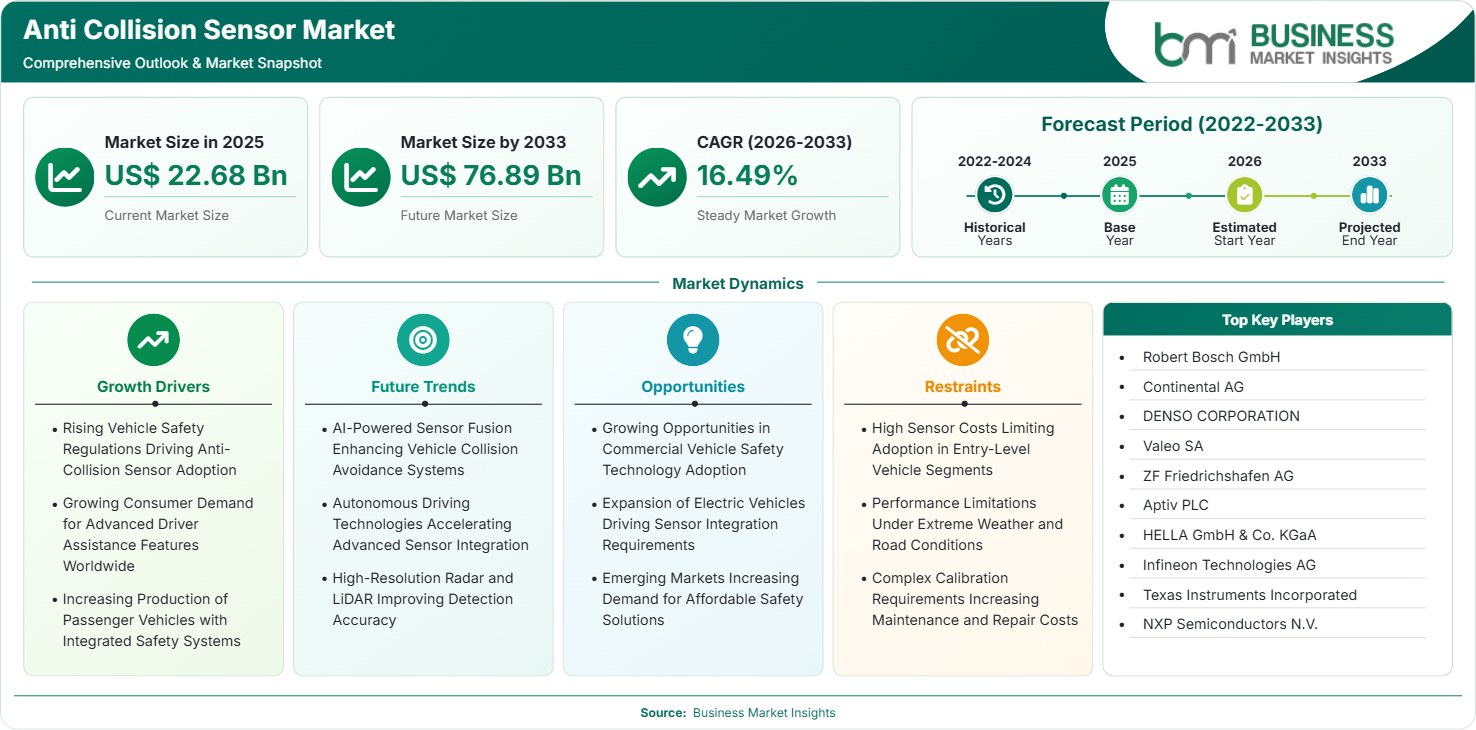
The Anti Collision Sensor Market size was valued at US$ 22.68 billion in 2025 and is projected to reach US$ 76.89 billion by 2033, growing at a CAGR of 16.49% during 2026–2033, driven by stricter vehicle safety regulations, ADAS adoption, rising vehicle production, sensor fusion, electric vehicle integration, and growing demand for collision avoidance technologies.

Report Coverage
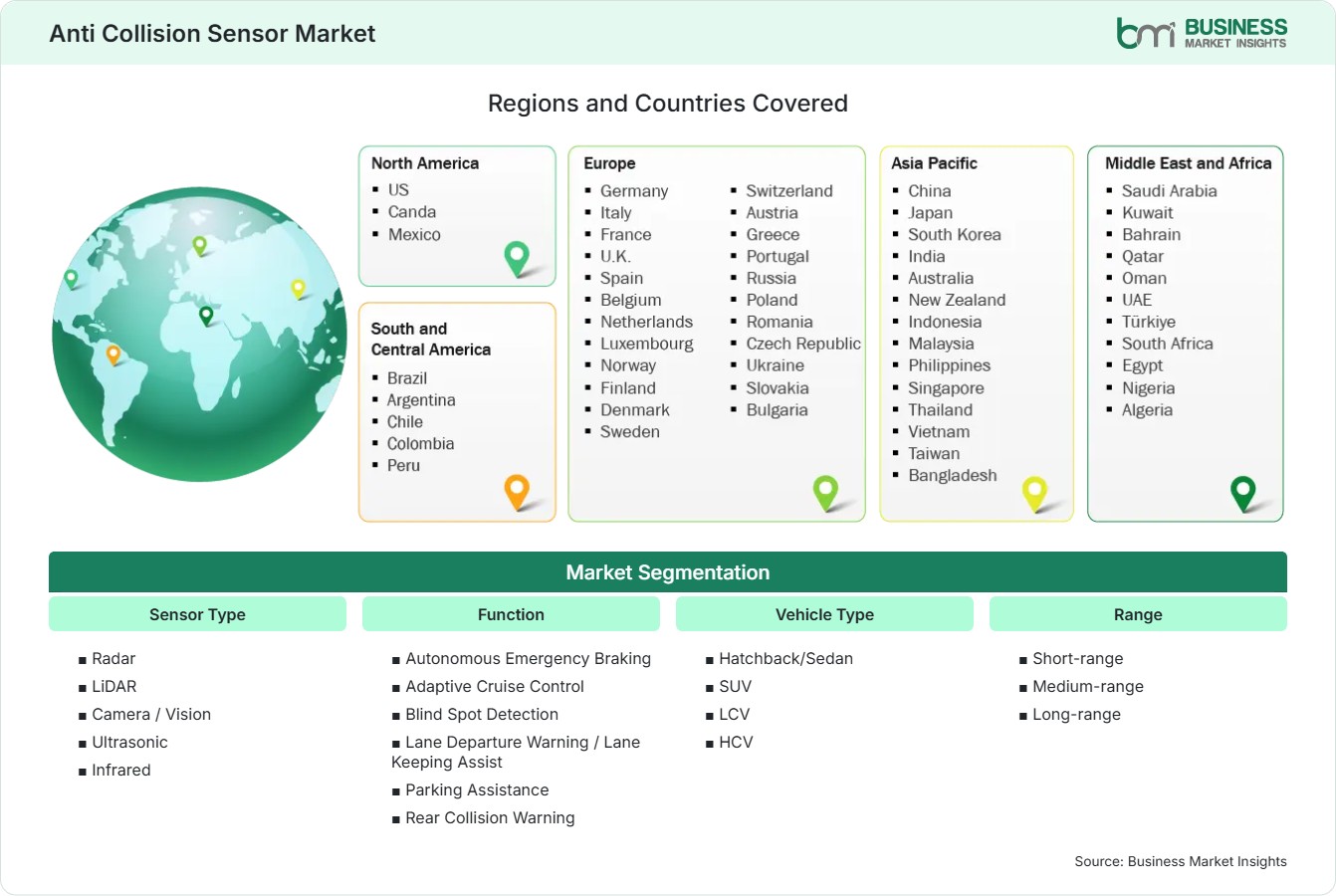
  • Sensor Type: Radar, LiDAR, Camera / Vision, Ultrasonic, Infrared
  • Function: Autonomous Emergency Braking, Adaptive Cruise Control, Blind Spot Detection, Lane Departure Warning / Lane Keeping Assist, Parking Assistance, Rear Collision Warning
  • Vehicle Type: Hatchback/Sedan, SUV, LCV, HCV
  • Range: Short-range (< 5 m), Medium-range (5–60 m), Long-range (> 60 m)
US$ 22.68 Bn Market size in 2025
US$ 76.89 Bn Market Size by 2033
16.49% CAGR, 2026 - 2033
2026-2033 Forecast Period

01 AI Overview

Anti Collision Sensor Market Summary

  • North America Region: North America holds a 25%–29% share in 2025, growing with a CAGR of 15.0%–17.0%, influenced by mandatory safety requirements, high ADAS penetration, premium vehicle adoption, autonomous driving investment, and advanced sensor development. The US market is growing at a CAGR of 15.5%–17.5%, supported by ADAS integration, vehicle safety technology investment, and increasing demand for automated collision avoidance.
  • Fastest Growing Region: Asia Pacific holds a 34%–38% share in 2025, growing with a CAGR of 18.0%–20.0%, supported by expanding vehicle production, increasing safety awareness, electric vehicle manufacturing, government safety initiatives, and growing ADAS integration across passenger and commercial vehicles.
  • Leading Segment: Radar holds a 31%–35% share in 2025, growing with a CAGR of 15.0%–17.0%, driven by cost efficiency, all-weather performance, established automotive integration, and widespread use across emergency braking and adaptive cruise control systems.
  • High Growth Segment: LiDAR holds a 10%–14% share in 2025, growing at a CAGR of 22.0%–25.0% during the Anti Collision Sensor Market forecasts, supported by advances in autonomous driving, high-resolution environmental mapping, sensor fusion, and increasing deployment in advanced vehicle safety architectures.
  • Key Market Opportunity: Commercial vehicle safety, electric vehicle platforms, and emerging automotive markets create opportunities for scalable sensor architectures that combine radar, cameras, LiDAR, and intelligent processing technologies.
  • Major Market Players: Robert Bosch GmbH, Continental AG, DENSO CORPORATION, Valeo SA, ZF Friedrichshafen AG, Aptiv PLC, HELLA GmbH & Co. KGaA, Infineon Technologies AG, Texas Instruments Incorporated, and NXP Semiconductors N.V.
02 Strategic Insights

Anti Collision Sensor Market: Strategic Insights

Anti Collision Sensor Market Strategic Framework
FREE PDF
Request your free sample
Request free sample
03 Stakeholder View

Key Takeaways

  • The value chain is becoming increasingly integrated as sensor manufacturers, semiconductor suppliers, automotive Tier 1 suppliers, software developers, and vehicle OEMs collaborate on perception, processing, and safety architectures.
  • Radar will continue to provide substantial volume opportunities because of its cost-performance balance, while LiDAR offers greater upside as autonomous driving and advanced perception systems progress toward broader commercialization.
  • Sensor fusion is becoming a central technology direction, combining radar, camera, LiDAR, and ultrasonic inputs to improve environmental perception and compensate for the limitations of individual sensing technologies.
  • India and Southeast Asia provide attractive growth opportunities as vehicle ownership expands, automotive manufacturing increases, and safety technologies gradually move beyond premium vehicle categories into broader mass-market segments.
  • Competitive activity is increasingly focused on partnerships and technology integration across sensing, semiconductor processing, software, and vehicle platforms, with suppliers seeking stronger positions in next-generation ADAS architectures.
  • Commercial vehicles represent an underpenetrated opportunity because fleet operators increasingly prioritize collision reduction, driver assistance, insurance risk management, and regulatory compliance across logistics and transportation operations.
04 Geographic Outlook

Anti Collision Sensor Market Regional Highlights

North America Anti Collision Sensor Market

North America accounted for a 25%–29% Anti Collision Sensor Market share in 2025 and is projected to grow at a 15.0%–17.0% CAGR during 2026–2033. The US dominates regional demand because of advanced vehicle technology development, established automotive suppliers, and high consumer awareness of driver assistance features. Canada contributes through vehicle manufacturing and transportation applications. Growing investment in autonomous driving and software-defined vehicles is strengthening demand for sophisticated sensing and processing architectures.

  • Vehicle manufacturers are increasingly integrating multiple sensing technologies into ADAS platforms, improving perception capabilities while creating opportunities for suppliers offering radar, cameras, LiDAR, and sensor-fusion solutions.
  • Consumer awareness of automated safety features is supporting demand for vehicles equipped with emergency braking, adaptive cruise control, blind spot monitoring, and parking assistance capabilities.
  • Autonomous vehicle development is encouraging investment in higher-performance sensors and centralized computing platforms capable of processing large volumes of real-time environmental information.

US Anti Collision Sensor Market

The US Anti Collision Sensor market represented a 21%–25% share in 2025 and is expected to expand at a 15.5%–17.5% CAGR through 2033. Demand is supported by advanced vehicle safety development, established automotive technology companies, consumer acceptance of ADAS, and autonomous driving investment. Vehicle manufacturers and technology suppliers are increasingly focusing on integrated sensor architectures that support multiple safety functions. Commercial transportation also provides opportunities as fleet operators seek improved collision prevention and driver assistance.

  • Automakers are increasingly expanding ADAS availability across vehicle portfolios, increasing sensor volumes and creating opportunities for suppliers capable of meeting cost and performance requirements.
  • Autonomous driving development continues to support investment in LiDAR, radar, cameras, semiconductor processing, and sensor-fusion technologies designed for increasingly complex driving environments.
  • Consumer expectations for automated safety features are encouraging manufacturers to integrate collision avoidance functions into more vehicle categories, including mainstream passenger vehicles.

Europe Anti Collision Sensor Market

Europe held a 27%–31% share in 2025 and is expected to register a 14.0%–16.0% CAGR through 2033. Germany leads the regional market through its automotive manufacturing base and advanced supplier ecosystem. France and the UK remain important technology markets, while Spain is expected to grow at a 16.0%–18.0% CAGR as vehicle manufacturing and the integration of safety technologies expand.

  • European vehicle safety requirements are encouraging manufacturers to integrate advanced driver assistance capabilities more broadly, supporting demand for sensors across multiple vehicle platforms.
  • Germany's automotive ecosystem provides strong opportunities for radar, LiDAR, camera, semiconductor, and sensor-fusion suppliers supporting premium and mass-market vehicle manufacturers.
  • Spain's automotive production base and growing technology integration are supporting increasing demand for safety sensors across passenger and commercial vehicle manufacturing.

Asia Pacific Anti Collision Sensor Market

Asia Pacific Anti Collision Sensor market captured a 34%–38% share in 2025 and is expected to achieve an 18.0%–20.0% CAGR through 2033, making it the fastest-growing major region. China leads through its extensive automotive manufacturing base and expanding electric vehicle ecosystem. India is projected to grow at a 21.0%–23.0% CAGR as vehicle production and the adoption of safety technologies increase.

  • China's electric vehicle industry is accelerating integration of advanced sensing technologies, creating opportunities for suppliers supporting ADAS, autonomous driving, and software-defined vehicle architectures.
  • India's expanding automotive industry provides significant long-term potential as safety awareness increases and advanced driver assistance technologies gradually reach broader vehicle segments.
  • Japan and South Korea maintain strong positions in automotive electronics, semiconductor technology, and vehicle manufacturing, supporting innovation across radar, camera, and sensor processing technologies.
  • Southeast Asian manufacturing hubs are becoming increasingly relevant as automakers expand production capacity and introduce higher levels of vehicle safety and electronic integration.

Rest of World Anti Collision Sensor Market

South and Central America Anti Collision Sensor Market represented a 7%–10% share in 2025 and is expected to grow at a 14.0%–16.0% CAGR through 2033. Brazil leads regional adoption through its automotive manufacturing base. Middle East and Africa accounted for a 5%–8% share and are projected to expand at a 15.0%–17.0% CAGR. Saudi Arabia and the UAE offer growth opportunities driven by premium-vehicle demand and technology-focused transportation investments.

  • Brazil's automotive manufacturing ecosystem offers opportunities for safety sensor adoption as global manufacturers introduce increasingly advanced driver-assistance capabilities across locally produced vehicle platforms.
  • Growing vehicle imports equipped with factory-installed safety technologies are increasing exposure to radar, camera, ultrasonic, and other collision-avoidance systems in developing automotive markets.
  • Saudi Arabia and the UAE offer opportunities for advanced safety technology suppliers due to premium-vehicle penetration, smart mobility investment, and growing interest in autonomous transportation.
Global Market Geography
FREE PDF
Request your free sample
Request free sample
05 Segment Analysis

Anti Collision Sensor Market Segmentation

Sensor Type

Radar accounted for a 31%–35% share in 2025 and is projected to grow at a 15.0%–17.0% CAGR during 2026–2033. Camera and LiDAR technologies are gaining importance as vehicles require greater environmental perception. Anti Collision Sensor Market scope is expanding through multi-sensor architectures combining complementary perception capabilities.

  • Radar: Radar provides reliable object detection across varied lighting and weather conditions, supporting emergency braking, adaptive cruise control, blind spot monitoring, and broader vehicle safety applications.
  • LiDAR: LiDAR delivers high-resolution environmental mapping and precise object detection, supporting autonomous driving development, advanced perception, and increasingly sophisticated sensor-fusion architectures.
  • Camera / Vision: Camera systems enable object recognition, lane detection, traffic sign interpretation, and visual classification, supporting multiple ADAS functions through advanced computer vision.
  • Ultrasonic: Ultrasonic sensors provide cost-effective short-range detection for parking assistance and low-speed maneuvering, maintaining strong adoption across passenger vehicles and commercial platforms.
  • Infrared: Infrared sensing supports specialized low-light and night-time detection applications, complementing conventional cameras and other perception technologies in selected vehicle safety architectures.

Function

Autonomous Emergency Braking accounted for a 21%–25% share in 2025 and is projected to grow at a 16.0%–18.0% CAGR through 2033. Adaptive cruise control and blind-spot detection remain significant applications, while lane-keeping, parking assistance, and rear-collision warning expand sensor utilization. Anti Collision Sensor Market trends increasingly favor integrated systems capable of supporting multiple safety functions through shared sensing architectures.

  • Autonomous Emergency Braking (AEB): AEB systems detect potential forward collisions and issue warnings or apply braking, helping reduce accidents and increasing demand for reliable multi-sensor perception.
  • Adaptive Cruise Control (ACC): ACC uses environmental sensing to maintain vehicle spacing and speed, supporting highway driving assistance and increasing radar integration across passenger vehicle platforms.
  • Blind Spot Detection (BSD): BSD systems monitor adjacent vehicle zones and alert drivers to potential conflicts, creating continued demand for radar and camera-based sensing technologies.
  • Lane Departure Warning / Lane Keeping Assist (LDW / LKA): These systems use cameras and related sensors to monitor lane position and support corrective interventions, strengthening demand for vision-based perception.
  • Parking Assistance: Short-range sensing technologies help detect nearby obstacles and support automated or assisted parking, maintaining broad adoption across passenger vehicles and increasingly advanced vehicle platforms.
  • Rear Collision Warning: Rear collision systems monitor surrounding traffic and obstacles, improving driver awareness during reversing and maneuvering while expanding sensor utilization in safety-focused vehicle architectures.

Vehicle Type

The SUVs had a 32%–36% share in 2025 and will see a 16.0%–18.0% CAGR through 2033, owing to healthy global demand and rising availability of ADAS. The hatchbacks and sedans will continue to be significant in volume, whereas the LCVs and HCVs will gain traction owing to mandatory safety requirements. Anti Collision Sensor Market trends indicate growing sensor deployment across both passenger and commercial vehicle platforms.

  • Hatchback/Sedan: High production volumes and broad consumer adoption make these vehicle categories important for scaling collision avoidance technologies beyond premium automotive segments.
  • SUV: Strong global demand and higher availability of advanced safety packages support extensive sensor integration across compact, mid-size, and premium SUV platforms.
  • LCV: Delivery fleets and commercial operators increasingly adopt collision avoidance systems to improve driver safety, reduce accidents, and manage operational risks.
  • HCVs: Heavy commercial vehicles offer opportunities for advanced sensing due to longer stopping distances, larger blind zones, fleet safety requirements, and high accident-related costs.

Range

Medium-range systems hold 38%- 42% of the Anti-Collision Sensor Market share in 2025 and are expected to witness a CAGR of 16.0%–18.0% through 2033. Short-range sensing is significant for parking and maneuvering applications, whereas long-range sensing is helpful in high-speed driving and perception applications.

  • Short-range (< 5 m): Short-range sensing supports parking assistance, obstacle detection, and low-speed maneuvering, with ultrasonic and camera technologies providing cost-effective solutions.
  • Medium-range (5–60 m): Medium-range sensing supports adaptive cruise control, blind-spot detection, emergency braking, and other ADAS functions that require reliable object detection.
  • Long-range (> 60 m): Long-range sensing supports high-speed driving and advanced perception by enabling earlier object detection and providing additional reaction time for collision-avoidance systems.
06 Market Forces

Anti Collision Sensor Market Dynamics

Key Market Drivers

Rising Vehicle Safety Regulations Driving Anti-Collision Sensor Adoption

Regulatory pressures continue to ensure that car manufacturers install new advanced technologies in their future cars. The need for advanced safety systems such as autonomous emergency braking, lane assist, and driver monitoring is being driven by safety assessment programs and regulations. Automakers have to meet higher safety requirements in key vehicle segments. The process of sensor fusion is shifting from an option in premium cars to a vehicle-level solution, creating a need for sensor technologies such as radar, cameras, and ultrasonic sensors. An increase in the number of required safety functions will create economies of scale, which may lead to cost reductions over time. Supplier companies with functional safety competencies and established relationships with OEMs are well-positioned to benefit from the regulatory adoption cycle.

Growing Consumer Demand for Advanced Driver Assistance Features Worldwide

The consumer population is gradually becoming acquainted with automated safety features through premium cars, marketing, safety assessments, and the availability of technologies. Features such as adaptive cruise control, blind-spot detection, automated parking, and automated emergency braking have become key factors in purchase decisions in some countries. Manufacturers are responding to this trend by increasing ADAS functionality across their diverse fleets of automobiles. This means there will be an increased need for sensors capable of performing multiple tasks within a single electronic system. Camera and radar systems remain attractive because they offer established production scalability, while LiDAR is gaining attention for higher-level automated driving applications.

Increasing Production of Passenger Vehicles with Integrated Safety Systems

The trend in global passenger car production is now to integrate electronic safety systems, driven by standardized vehicle platforms and the use of the same ADAS architecture across several vehicles. The increased number of sensors has reduced the cost of implementing safety systems, making such systems more viable in mid-size vehicles. Centralized electronic architecture also makes it easier to share sensor data for other applications. Vehicle manufacturers are increasingly designing new platforms around centralized computing and software-enabled functionality, creating greater opportunities for sensor suppliers.

Key Market Opportunities

Growing Opportunities in Commercial Vehicle Safety Technology Adoption

Opportunities for commercial vehicles are significant owing to the many costs that fleet owners incur from accidents, downtime, insurance, and driver safety. Moreover, heavy trucks and delivery trucks operate for extended periods under varying road conditions; thus, there is greater importance in having collision avoidance systems. With the help of radar, cameras, and ultrasonic sensors, one can have blind-spot monitoring, forward collision warning, emergency braking, and maneuvering systems. With the development of logistics networks, suppliers will be targeting fleet owners, truck manufacturers, and logistics technology companies.

Expansion of Electric Vehicles Driving Sensor Integration Requirements

The development of EV platforms is opening up avenues for sensor makers, as sophisticated electronic solutions and computing are increasingly adopted in newer architectures. Many times, EV makers have stressed the importance of software-defined capabilities, connectivity services, and autonomy in their platforms, thereby enabling sensor adoption. The absence of legacy architecture in the newly designed EV platforms makes it easy to integrate radar, cameras, LiDAR, and fusion sensors. The opportunity extends beyond passenger cars into electric buses, commercial vehicles, and emerging autonomous mobility applications where perception technologies are central to safe operation.

Emerging Markets Increasing Demand for Affordable Safety Solutions

There are numerous opportunities arising from the development of emerging automobile markets, as vehicle manufacturing is increasing and consumer awareness of the latest safety technology grows. Nonetheless, affordability is an important factor because price sensitivity is higher in some emerging markets than in mature markets for automobiles. Such an opportunity could be harnessed by suppliers by providing affordable radar technology, camera systems, small ultrasonic sensors, and software that enables multiple functionalities with a single piece of hardware. The strongest opportunity will come from technologies that balance reliable performance, regulatory compliance, and cost efficiency without requiring premium vehicle pricing.

Market Restraints and Challenges

High Sensor Costs Limiting Adoption in Entry-Level Vehicle Segments

Factor: Advanced sensing devices require expensive hardware, high processing power, software development, calibration, and system integration. Impact: An increase in component costs would reduce the feasibility of implementing such systems in low-end cars, where car manufacturers operate under tight budgetary constraints, and consumers are cost-sensitive. LiDAR would be especially affected by cost, though it might eventually be reduced due to advancements in manufacturing and technology.

Performance Limitations Under Extreme Weather and Road Conditions

Factors: Heavy rain, snow, fog, dust, glare, inadequate road markings, and poor visibility may individually hinder the functioning of sensing technology. Impact: Lower detection accuracy may compromise the reliability of safety systems and necessitate sensor fusion and redundancy. The cameras may have limited visibility, the radar may struggle with object identification, and LiDAR may be affected by environmental factors. Manufacturers increasingly combine complementary sensors to compensate for individual weaknesses.

07 Company Analysis

Competitive Landscape

The Anti Collision Sensor Market analysis reflects a competitive environment where automotive Tier 1 suppliers, semiconductor companies, sensing specialists, and technology providers compete to deliver increasingly integrated perception solutions. Competition is shifting from individual sensor components to complete architectures that combine hardware, processing, software, and functional safety.

Company Name

Overview

Products and Services relevant to this market

Robert Bosch GmbH

Global automotive technology supplier with extensive expertise in vehicle safety, sensing, electronics, and ADAS.

Radar sensors, camera systems, ultrasonic sensors, ADAS, emergency braking, parking assistance, and vehicle safety electronics.

Continental AG

Major automotive supplier providing integrated sensing, safety, electronics, and automated driving technologies.

Radar, camera, LiDAR-related technologies, ADAS, collision avoidance, sensor fusion, and automated driving systems.

DENSO CORPORATION

Global automotive component manufacturer specializing in advanced vehicle electronics and safety technologies.

Millimeter-wave radar, vision sensors, ADAS technologies, sensing systems, and electronic vehicle safety solutions.

Valeo SA

Automotive technology company providing driver assistance, parking, sensing, and vehicle electrification solutions.

LiDAR, cameras, ultrasonic sensors, radar-related systems, parking assistance, and ADAS technologies.

ZF Friedrichshafen AG

Global mobility technology supplier focused on advanced driver assistance and vehicle safety systems.

Radar, cameras, ADAS, automated emergency braking, sensor fusion, and integrated vehicle safety technologies.

Aptiv PLC

Automotive technology company specializing in electrical architecture, sensing, software, and automated driving systems.

Radar, LiDAR integration, camera systems, perception software, sensor fusion, and ADAS computing platforms.

HELLA GmbH & Co. KGaA

Automotive supplier with expertise in lighting, electronics, sensing, and driver assistance technologies.

Radar sensors, camera-based systems, electronic control units, ADAS, and vehicle safety electronics.

Infineon Technologies AG

Semiconductor manufacturer supplying components that enable automotive sensing, processing, and safety applications.

Radar semiconductors, microcontrollers, power devices, sensor processing, and automotive safety electronics.

Texas Instruments Incorporated

Semiconductor technology provider offering automotive sensing and processing solutions for advanced vehicle systems.

Radar chips, analog processing, microcontrollers, signal processing, and semiconductor solutions for ADAS applications.

NXP Semiconductors N.V.

Semiconductor company providing automotive processors, radar solutions, connectivity, and secure vehicle technologies.

Radar processors, automotive MCUs, edge processing, sensor fusion, vehicle networking, and ADAS semiconductor platforms.


10 Trust & Transparency

Research Methodology

The market analysis combines proprietary research with secondary data from government agencies, company disclosures, regulatory filings, industry databases and expert interviews. Market estimates are validated through data triangulation, cross-market benchmarking and analyst review.

View Full Research Methodology

11 Questions Answered

Frequently Asked Questions

What is limiting adoption in lower-priced vehicles?

Hardware costs, processing requirements, calibration, software development, and system integration can increase vehicle prices.

How are electric vehicles influencing sensor demand?

EV platforms are often designed around modern electronic architectures, creating opportunities to integrate advanced sensing and centralized computing from the development stage.

Which vehicle category offers significant future opportunities in anti collision sensor market report?

Commercial vehicles offer strong potential because collision avoidance can address safety risks associated with long operating hours, large blind zones, heavy vehicle mass, and high accident-related costs.

Why is sensor fusion becoming important?

Combining radar, cameras, LiDAR, and ultrasonic systems allows vehicles to build more comprehensive environmental awareness and improve system reliability across complex driving conditions.

What is the most widely used anti-collision sensor technology?

Radar remains one of the most widely deployed technologies because it provides reliable object detection across lighting conditions and supports multiple ADAS applications.

Access the Full Anti Collision Sensor Market Report

Get segment-level forecasts, regional estimates, competitive benchmarking, company profiles and downloadable Excel datasets.

Access the full Anti Collision Sensor Market Report
350 pages PDF & Excel | 2026-08-03