Market Summary
Executive Summary and Global Market Analysis
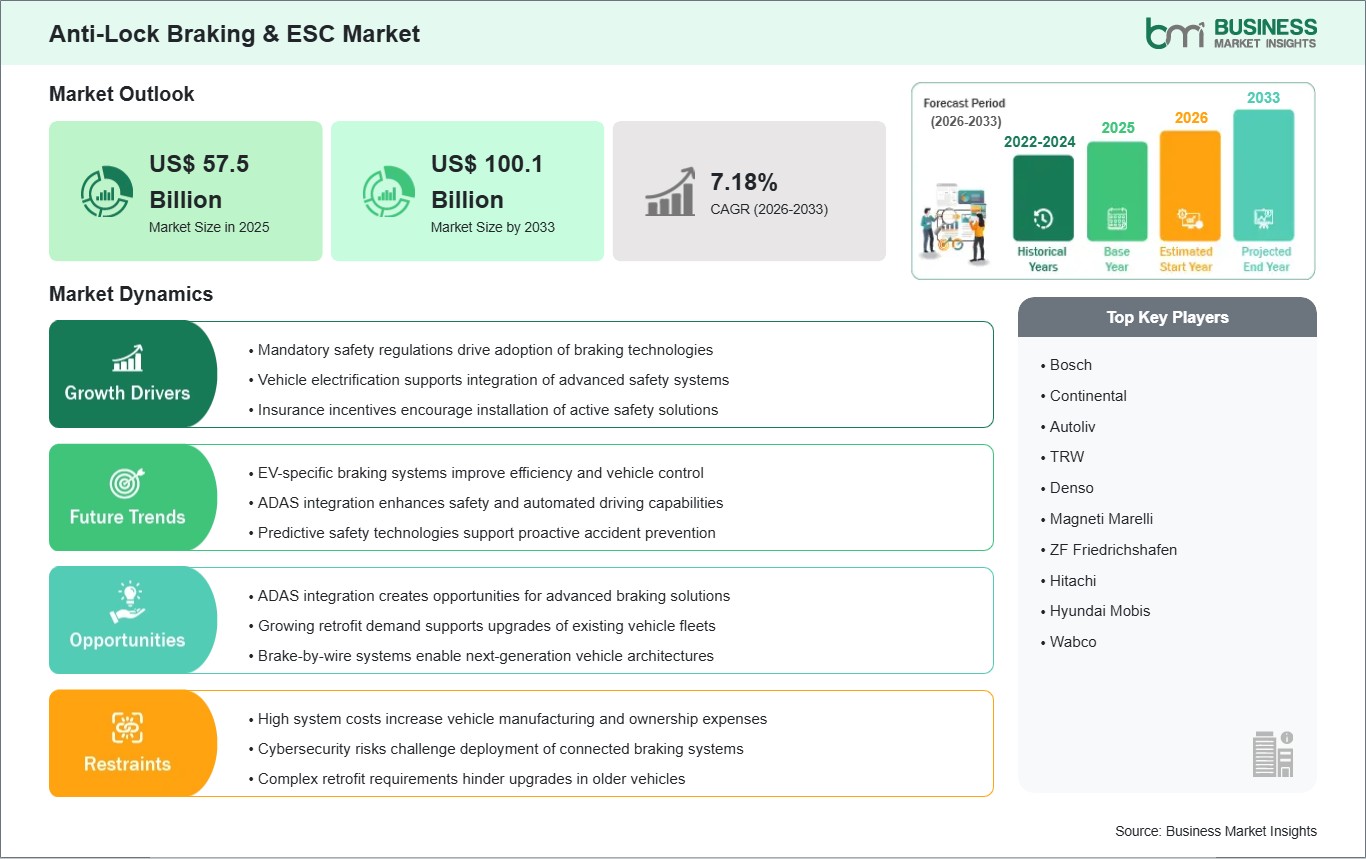
Anti-Lock Braking & ESC systems are advanced vehicle safety technologies designed to prevent wheel lockup during braking and maintain vehicle stability during challenging driving conditions. Anti-lock braking systems improve steering control during emergency braking, while electronic stability control helps prevent skidding and loss of control. These systems are widely used across passenger cars, two-wheelers, and commercial vehicles to enhance road safety and comply with evolving automotive safety regulations. The market is growing due to increasing consumer awareness of vehicle safety, stricter regulatory requirements, rising vehicle production, and the integration of advanced driver assistance technologies. Growing adoption of electric vehicles and connected vehicle platforms is also encouraging the use of more sophisticated braking and stability control systems.
There are several challenges that may influence market growth. The integration of Anti-Lock Braking & ESC systems requires advanced sensors, electronic control units, and hydraulic components, which can increase vehicle manufacturing costs. Cost sensitivity in entry-level vehicle segments can limit the adoption of premium safety technologies in some markets. The complexity of integrating braking systems with emerging autonomous and connected vehicle architectures also creates engineering and validation challenges. Additionally, supply chain disruptions affecting semiconductor and electronic component availability can impact production timelines and increase manufacturing expenses.
Despite these challenges, the market continues to offer significant growth opportunities. Advancements in electric braking technologies, brake-by-wire systems, and intelligent vehicle control platforms are creating new possibilities for innovation. The increasing adoption of autonomous driving functions is driving demand for highly responsive and integrated braking systems. Emerging markets are also strengthening vehicle safety regulations, encouraging broader implementation of Anti-Lock Braking & ESC technologies. As automotive manufacturers focus on safer, smarter, and more connected vehicles, the market is expected to benefit from continuous technological development and expanding safety requirements across global transportation networks.
Segment Analysis
Anti-Lock Braking & ESC Market Segmentation
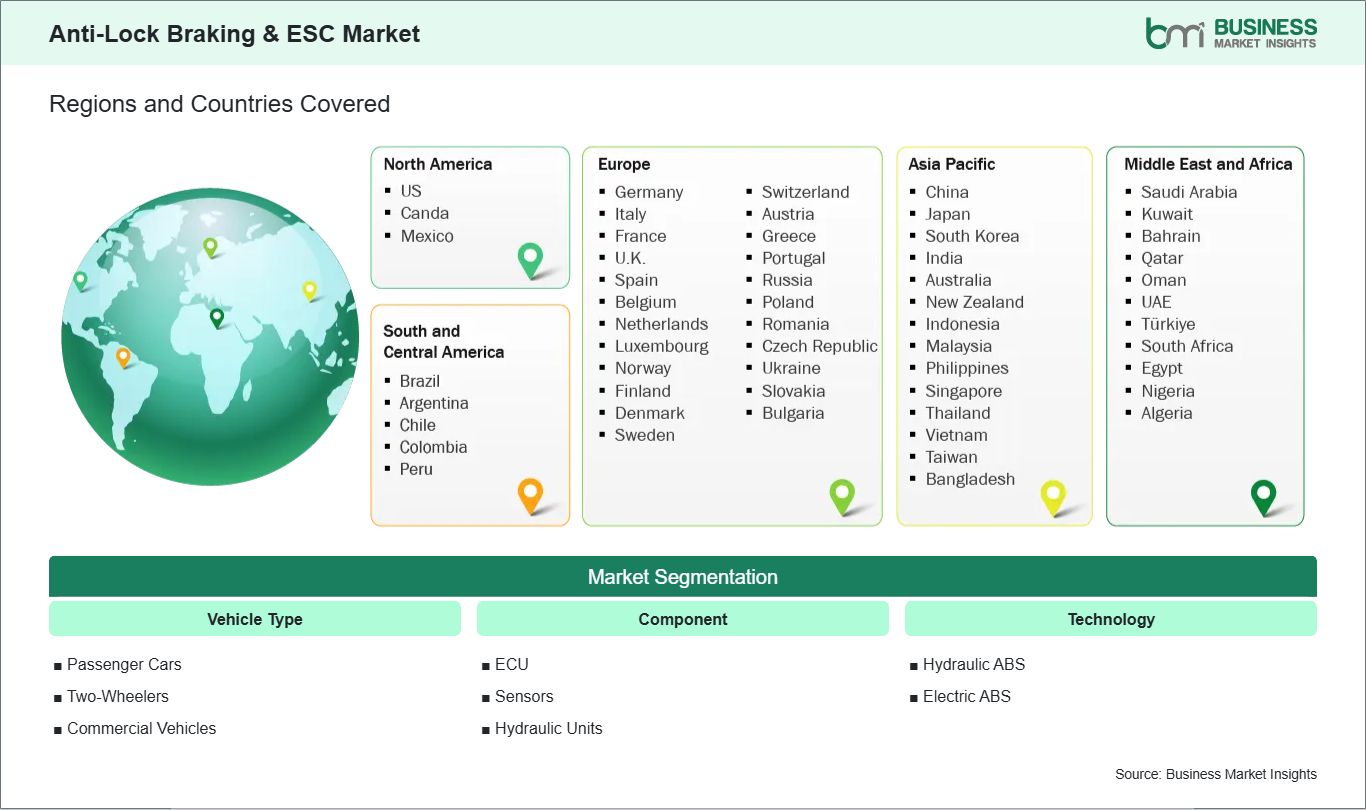
The Anti-Lock Braking & ESC market is segmented based on vehicle type, component, and technology. These segments help address varying safety requirements across different vehicle categories and operating environments.
By Vehicle Type
- Passenger Cars: Largest adoption due to increasing safety standards and consumer demand for advanced vehicle protection systems.
- Two-Wheelers: Growing implementation driven by regulatory mandates and rising awareness of rider safety.
- Commercial Vehicles: Utilized to improve vehicle stability, cargo protection, and operational safety.
By Component
- ECU: Functions as the central processing unit that controls braking and stability operations.
- Sensors: Provide real-time vehicle motion and wheel-speed data for system operation.
- Hydraulic Units: Enable braking pressure modulation required for effective ABS and ESC performance.
By Technology
- Hydraulic ABS: Widely used and established technology across multiple vehicle categories.
- Electric ABS: Gaining adoption due to compatibility with electric and next-generation vehicle platforms.
Market Forces
Anti-Lock Braking & ESC Market Drivers and Opportunities
Increasing Vehicle Safety Regulations Worldwide
Governments and transportation authorities across the world continue to strengthen vehicle safety regulations to reduce road accidents and improve passenger protection. Anti-Lock Braking & ESC systems have become critical technologies for meeting these evolving safety standards. Regulatory bodies are increasingly mandating the inclusion of braking and stability control systems in passenger vehicles, commercial vehicles, and two-wheelers. These requirements encourage manufacturers to integrate advanced braking technologies across a wider range of vehicle models.
The growing emphasis on road safety is also influencing consumer purchasing decisions. Buyers are increasingly prioritizing vehicles equipped with advanced safety features, creating additional demand for Anti-Lock Braking & ESC systems. The expansion of safety assessment programs and vehicle rating systems further supports the adoption of these technologies. As automotive manufacturers strive to comply with regulations and enhance vehicle safety performance, investment in advanced braking and stability control solutions continues to increase. This trend is expected to remain a major growth factor for the market throughout the forecast period.
Growth of Electric and Software-Defined Vehicles
The transition toward electric vehicles and software-defined vehicle architectures is creating new opportunities for the Anti-Lock Braking & ESC market. Modern electric vehicles require advanced braking systems that can work efficiently with regenerative braking technologies while maintaining optimal vehicle stability and control. This requirement is encouraging the development of intelligent and electronically controlled braking solutions.
Emerging vehicle platforms are increasingly integrating software-driven functionalities that enable improved coordination between braking, steering, and vehicle dynamics systems. Advanced sensors, artificial intelligence, and real-time data processing capabilities are supporting the evolution of more responsive stability control technologies. Future autonomous driving systems will also depend heavily on reliable braking and stability mechanisms to ensure safe vehicle operation. As vehicle electrification and automation continue to expand globally, manufacturers are expected to invest in next-generation braking technologies that offer enhanced safety, efficiency, and system integration capabilities. These developments create significant long-term opportunities for market participants.
Size and Share Analysis
Anti-Lock Braking & ESC Market Size and Share Analysis
The Anti-Lock Braking & ESC Market size is expected to reach US$ 100.1 billion by 2033 from US$ 57.5 billion in 2025. The market is estimated to record a CAGR of 7.18% from 2026 to 2033.
By vehicle type, passenger cars account for a significant share due to the widespread integration of Anti-Lock Braking & ESC systems in modern vehicles and increasing global safety regulations. Two-wheelers are experiencing growing adoption as governments introduce stricter safety requirements, while commercial vehicles continue to implement these technologies to improve fleet safety and operational reliability.
By component, sensors and electronic control units represent critical elements of modern braking systems because they enable real-time monitoring and vehicle stability management. Hydraulic units remain essential for braking force control and system responsiveness. By technology, hydraulic ABS continues to maintain a strong presence due to its proven reliability, while electric ABS is gaining momentum as vehicle electrification and advanced electronic architectures become more common across the automotive industry.
Report Coverage
Anti-Lock Braking & ESC Market Report Coverage and Deliverables
The "Anti-Lock Braking & ESC Market Size and Forecast (2022-2033)" report provides a detailed analysis of the market covering below areas:
- Market size and forecast at global, regional, and country levels for all the key market segments covered under the scope
- Market trends, as well as market dynamics such as drivers, restraints, and key opportunities
- Market analysis covering key market trends, global and regional framework, major players, regulations, and recent market developments
- Industry landscape and competition analysis covering market concentration, heat map analysis, prominent players, and recent developments for the market
- Detailed company profiles, including SWOT analysis
Geographic Insights
Anti-Lock Braking & ESC Market Geographic Insights
The Anti-Lock Braking & ESC Market shows diverse regional adoption patterns influenced by vehicle safety regulations, automotive manufacturing activity, and increasing consumer demand for advanced safety technologies.
North America, being a developed region, has a mature automotive industry and a high level of adoption of advanced vehicle safety systems. The region comprises the United States and Canada, where vehicle manufacturers increasingly integrate braking and stability control technologies into passenger and commercial vehicles. The region focuses on road safety improvements, compliance with vehicle safety standards, and the adoption of advanced driver assistance systems. Strong automotive research capabilities and established regulatory frameworks support continuous innovation and deployment of Anti-Lock Braking & ESC technologies across multiple vehicle segments.
Asia Pacific is growing significantly, driven by expanding vehicle production, rising vehicle ownership, and evolving safety regulations. The region comprises countries such as China, India, and Japan, where governments and automotive manufacturers are increasing their focus on road safety and accident reduction. The region is witnessing growing adoption of Anti-Lock Braking & ESC systems across passenger vehicles, two-wheelers, and commercial fleets. Infrastructure development, increasing urbanization, and expanding automotive manufacturing capacity further contribute to market growth. The rise of electric vehicle production is also creating additional opportunities for advanced braking technologies.
Both regions are contributing significantly to the growth of the Anti-Lock Braking & ESC Market, focusing on vehicle safety enhancement, technological innovation, and broader adoption of advanced braking and stability control systems across the automotive sector.
Industry Activity
Recent Developments
The Anti-Lock Braking & ESC Market is analyzed using a mix of primary and secondary research sources, including corporate publications, industry associations, and verified databases. This approach ensures accurate tracking of innovation trends and strategic developments influencing the market.
- In April 2025, Continental AG showcased its next-generation Integrated Brake-by-Wire System at the Auto Shanghai exhibition to advance its Future Brake Systems (FBS) technology roadmap. The updated system integrates the master cylinder, brake booster, and stability control software into a single compact module that reduces total hardware weight by nearly 30%. The development supports the industry's shift toward completely electro-mechanical, "fully dry" braking solutions and highlights growing manufacturing investments in modular, fluid-free architectures for highly automated electric vehicles.
- In September 2024, NAMI announced advanced infrastructure and equipment installation milestones toward launching localized production of Anti-Lock Braking Systems (ABS) and Electronic Stability Control (ESC) systems at its Samara facility. The initiative supports local manufacturing capabilities and strengthens the availability of advanced braking and stability technologies for automotive applications.
Trust & Transparency
Research Methodology
The market analysis combines proprietary research with secondary data from government agencies, company disclosures, regulatory filings, industry databases and expert interviews. Market estimates are validated through data triangulation, cross-market benchmarking and analyst
review.
View Full Research Methodology
Key Sources Referred:
World Bank - Global Trade IndicatorsWorld Trade Organization (WTO)International Monetary Fund (IMF)International Trade Administration (ITA)Company WebsitesCompany Annual ReportsCompany Investor Presentations