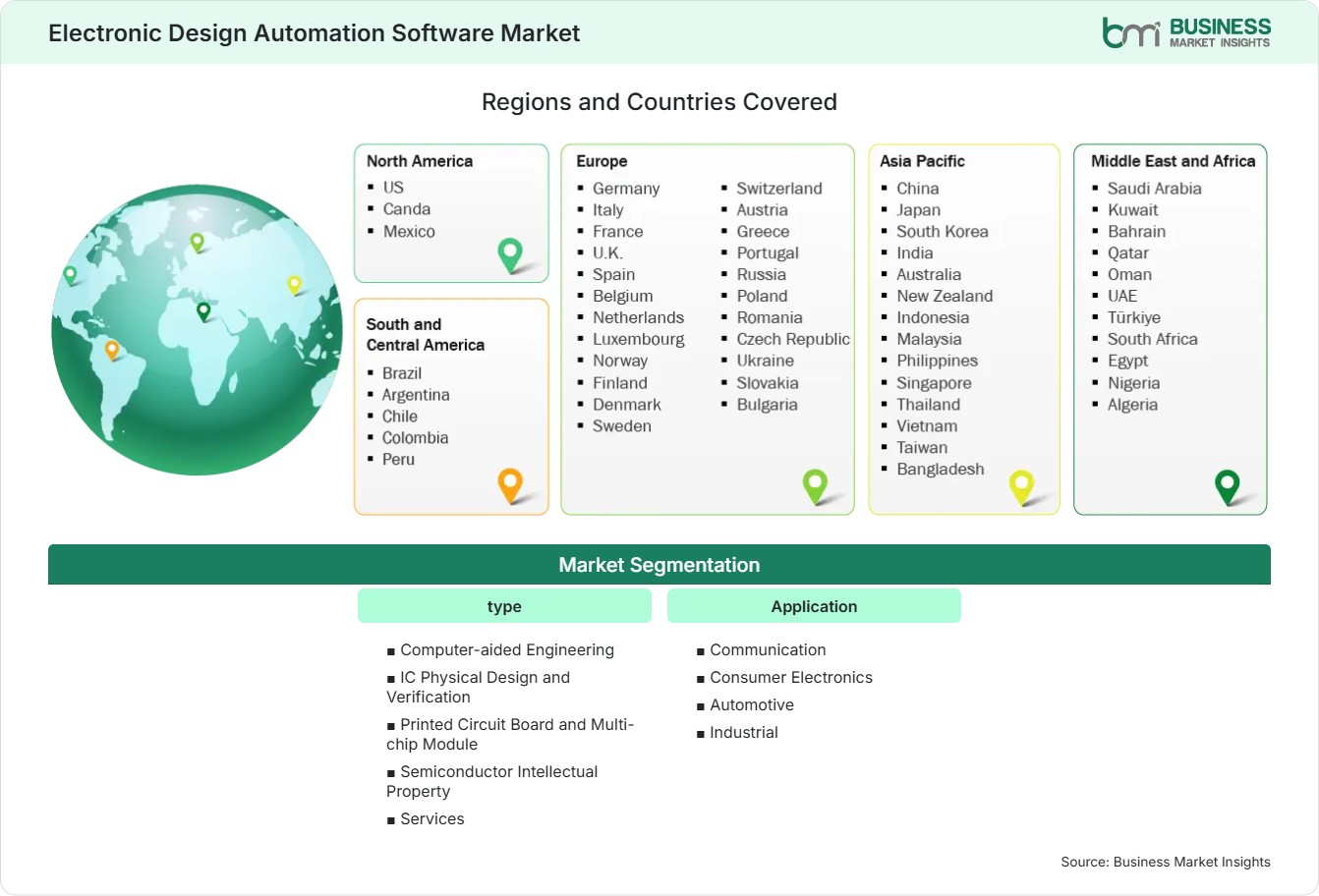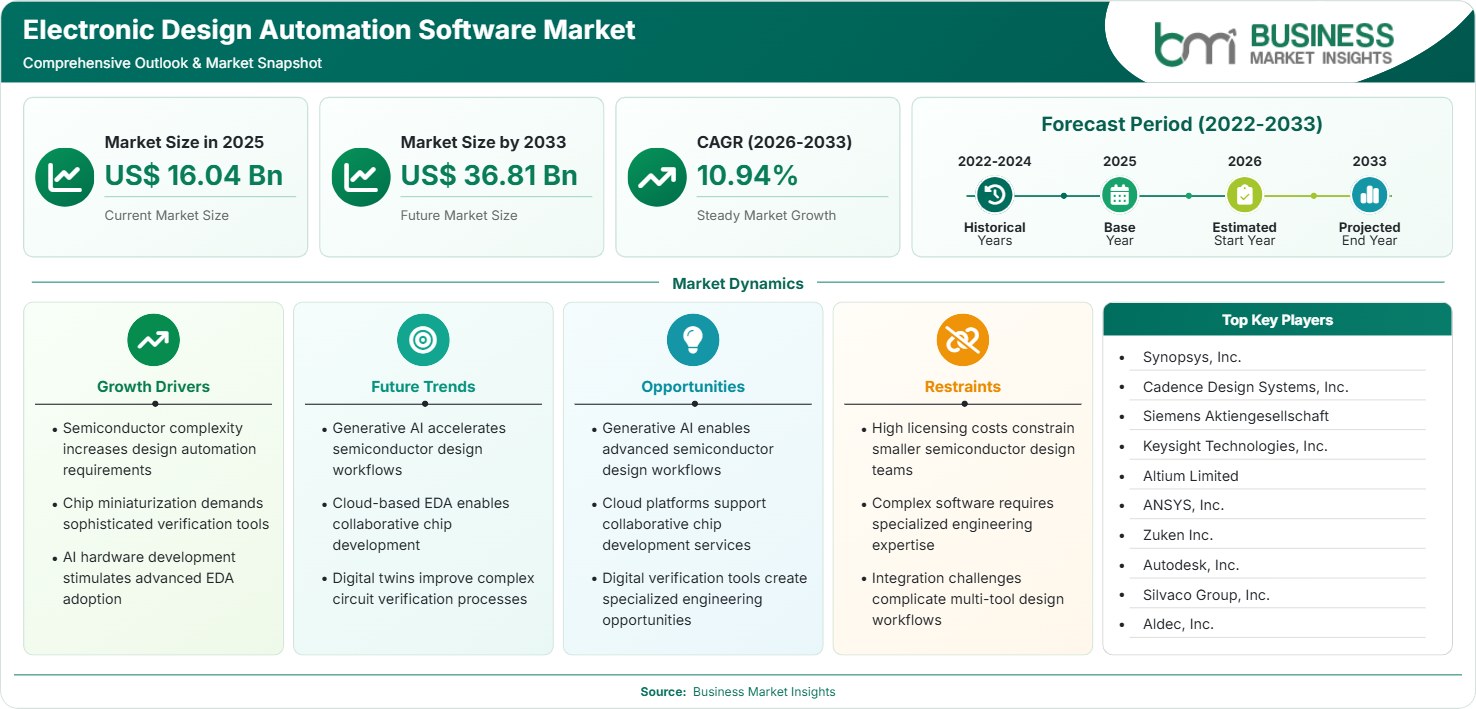
Electronic Design Automation Software Market Regional Highlights
North America Electronic Design Automation Software Market
North America represents a 38%–41% Electronic Design Automation Software Market share in 2025 and is projected to expand at a 10.2%–10.8% CAGR through 2033. The region benefits from concentrated semiconductor design activity, hyperscaler investment, advanced AI processors, defense electronics, and mature EDA adoption. The US remains the dominant national market because leading EDA suppliers, fabless semiconductor companies, cloud providers, and system developers maintain substantial engineering operations there. Strong demand for verification, advanced packaging, simulation, and AI-assisted workflows supports premium software spending across enterprise accounts.
- AI accelerator development is increasing demand for automated verification, power optimization, thermal analysis, and design closure, particularly among fabless semiconductor companies and hyperscale technology developers.
- Advanced packaging is broadening software requirements beyond conventional IC design toward chiplets, interposers, 2.5D and 3D architectures, requiring coordinated electrical, thermal, structural, and manufacturing analysis.
- Defense and aerospace engineering supports demand for high-reliability simulation, verification, PCB development, and lifecycle management where traceability and design assurance influence software purchasing decisions.
- Cloud-based engineering enables distributed teams to access computationally intensive simulation and verification resources without replicating large local infrastructure investments.
US Electronic Design Automation Software Market
The US accounts for 78%–82% of North American demand in 2025 and is expected to grow at a 10.4%–11.0% CAGR. Its position reflects strong semiconductor design concentration, AI infrastructure investment, automotive computing development, and sustained R&D expenditure. Leading software vendors also use the US as a launch market for agentic AI, multiphysics integration, and cloud-native engineering products. Domestic semiconductor incentives further reinforce demand for design infrastructure as manufacturers, fabless companies, universities, and emerging chip developers expand engineering capacity.
- US hyperscalers are developing increasingly specialized processors, creating recurring demand for architecture exploration, RTL verification, physical implementation, thermal modeling, and power-performance optimization.
- Semiconductor manufacturing incentives encourage domestic capacity while indirectly strengthening demand for design, packaging, verification, and manufacturing-aware engineering software.
- Automotive software-defined vehicle programs are increasing electronic content and requiring coordinated E/E architecture, PCB, functional safety, simulation, and verification environments.
Europe Electronic Design Automation Software Market
The European market represents 24%-27% market share in 2025 and is expected to grow at a 10.0%-10.6% CAGR. Germany, France, the UK, and the Netherlands are key demand regions driven by the automotive electronics, industrial automation, aerospace, semiconductor equipment, and embedded systems markets. Germany still represents a major market, while France and the Netherlands benefit from their strong semiconductor and advanced engineering communities. Increasing emphasis in Europe is being placed on functional safety, energy efficiency, digital engineering, and lifecycle traceability of electronic products.
- Germany's automotive and industrial engineering base sustains demand for PCB design, CAE, embedded electronics, simulation, and verification across increasingly software-defined products.
- France benefits from aerospace, defense, semiconductor, and automotive engineering programs that require high-assurance design and verification workflows.
- The Netherlands combines semiconductor equipment expertise with advanced electronics engineering, supporting specialized demand for IC design, packaging, and verification software.
- European sustainability objectives encourage virtual prototyping and simulation because engineering teams can reduce physical iterations while improving energy, material, and component efficiency.
Asia Pacific Electronic Design Automation Software Market
Asia Pacific holds a 25%-28% share in 2025 and has the highest regional growth rate at a 12.0%-12.7% CAGR. The major regions in demand include Taiwan, China, South Korea, Japan, and India, with Taiwan and South Korea gaining strength in semiconductor and memory production. China is improving its semiconductor design capabilities domestically, and India is building semiconductor and electronics engineering design capabilities. Increased investment in foundries, packaging technology, consumer and automotive electronics applications, and the semiconductor ecosystem drives continued software adoption.
- Taiwan's foundry ecosystem drives advanced-node design, physical verification, packaging, and IP requirements as semiconductor companies pursue increasingly complex architectures.
- South Korea's memory, logic, automotive, and electronics industries create demand for verification, simulation, physical implementation, and semiconductor IP workflows.
- India is becoming a larger engineering and chip-design center, with expanding semiconductor programs and a growing pool of electronics and software engineers.
- China continues developing domestic semiconductor capabilities, encouraging localized EDA alternatives while maintaining demand for globally established design workflows where advanced capabilities remain essential.
Rest of World Electronic Design Automation Software Market
South and Central America collectively account for a small but growing share of global consumption, driven by applications in automotive parts, industrial electronics, aerospace, and electronics manufacturing. While Brazil is the dominant market, Mexico gains due to integrated electronics and automotive production. The RoW region is led by Israel, the UAE, and Saudi Arabia as they offer specialized demand via semiconductors, military, communications, and technology programs in the Middle East & Africa. RoW is projected to capture a 7%–9% share in 2025 and grow at a 9.0%–10.0% CAGR in the Electronic Design Automation Software Market through 2033.
- Brazil's industrial and automotive electronics ecosystem creates demand for PCB, simulation, and engineering design software as manufacturers modernize production capabilities.
- Mexico benefits from nearshoring and electronics manufacturing, increasing the need for PCB design, component management, testing, and manufacturing-oriented engineering workflows.
- Israel remains a specialized semiconductor design hub, supporting demand for IC design, verification, semiconductor IP, and advanced engineering software.
- Gulf technology investment is expanding digital engineering capabilities, particularly across aerospace, communications, defense, and advanced industrial applications.