
Electric Vehicle (EV) Charging Connectors Market Outlook: Size, Share, Trends, Growth Analysis, Competitive Landscape & Forecast, 2026-2033

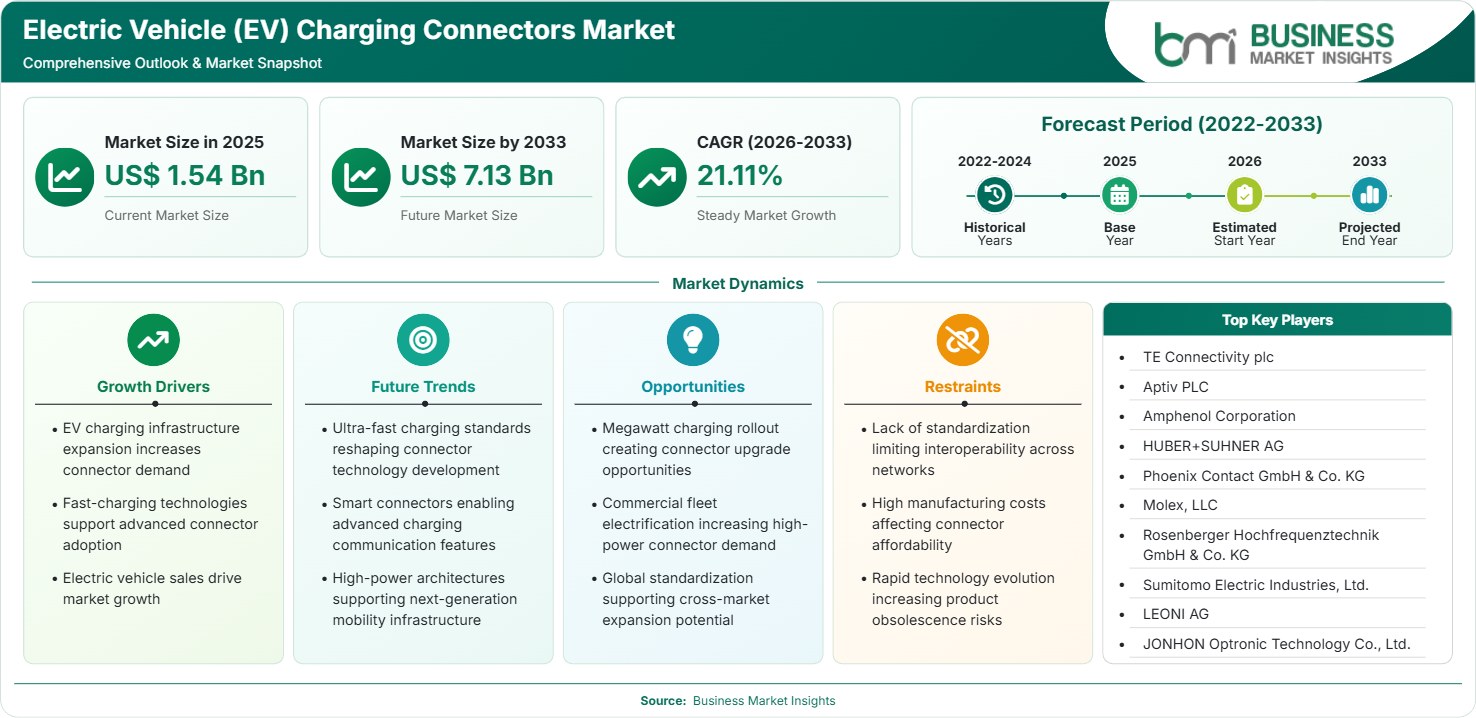
The Electric Vehicle (EV) Charging Connectors Market size was valued at US$ 1.54 Billion in 2025 and is projected to reach US$ 7.13 Billion by 2033, growing at a CAGR of 21.11% during 2026–2033, driven by EV adoption, high-power charging, infrastructure investment, connector standardization, fleet electrification, and ultra-fast charging deployment.

Report Coverage
  • Charging Level Type: Level 1, Level 2, Level 3
  • Charging Speed Type: Slow, Fast
  • End-User Type: Public, Private
US$ 1.54 Bn Market size in 2025
US$ 7.13 Bn Market Size by 2033
21.11% CAGR, 2026 - 2033
2026-2033 Forecast Period

AI Overview

Electric Vehicle (EV) Charging Connectors Market Summary

  • North America Region: North America holds a 23%–26% EV Charging Connectors Market share in 2025, growing at 18%–21% CAGR through 2033, influenced by corridor charging, fleet electrification, NACS adoption, domestic manufacturing, federal infrastructure programs, and demand for reliable high-power connectors. US charging deployment, fleet electrification, standardized interfaces, and high-power infrastructure expansion support 17%–20% CAGR through 2033.
  • Fastest Growing Region: Asia Pacific holds a 40%–44% share in 2025, expanding at 24%–27% CAGR through 2033, supported by EV manufacturing scale, urban charging expansion, domestic connector production, commercial fleets, battery innovation, and rapidly expanding high-power charging infrastructure.
  • Leading Segment: Level 2 holds a 46%–50% share in 2025 and expands at 19%–22% CAGR, supported by residential installations, workplace charging, destination infrastructure, manageable electrical requirements, lower equipment costs, and broad compatibility across passenger electric vehicles.
  • High Growth Segment: Level 3 represents a 28%–32% Electric Vehicle Charging Connectors Market share in 2025 and advances at 25%–28% CAGR, driven by highway charging, commercial fleets, battery capacity growth, shorter charging windows, rising charging utilization, and increasing deployment of high-power DC systems.
  • Key Market Opportunity: Connector suppliers can capture value through liquid cooling, higher current density, lightweight cables, modular interfaces, smart temperature sensing, interoperable standards, fleet charging, megawatt charging, and integrated connector-cable assemblies.
  • Major Market Players: TE Connectivity plc, Aptiv PLC, Amphenol Corporation, HUBER+SUHNER AG, Phoenix Contact GmbH & Co. KG, Molex, LLC, Rosenberger Hochfrequenztechnik GmbH & Co. KG, Sumitomo Electric Industries, Ltd., LEONI AG, and JONHON Optronic Technology Co., Ltd.
Strategic Insights

Electric Vehicle (EV) Charging Connectors Market: Strategic Insights

Electric Vehicle (EV) Charging Connectors Market Strategic Framework
FREE PDF
Request your free sample
Request free sample
Stakeholder View

Key Takeaways

  • The value chain covers conductive materials, terminals, housings, cables, cooling systems, connector assemblies, vehicle inlets, charging equipment manufacturers, the automotive OEMs, the charge point operators, the utilities, and the certification bodies.
  • Level 3 and fast charging applications are the ones with the greatest upside, as higher charging power necessitates specialized contacts, thermal management, robust cable construction, and improved safety.
  • Connector development is heading in the direction of liquid-cooled conductors, higher current densities, lighter-weight materials, temperature sensors, compatibility with automated assembly, smaller form factors, and modular designs to support the 800V to 1200V vehicle architectures.
  • Asia Pacific is clearly the best investment case as China has both very high EV production and extensive charging deployment. India and SE Asia are both expanding their charging networks out from the cities onto the highways and into the commercial transport corridors.
  • Strategic transactions are in the process of reconfiguring the supplier landscape, with established connectivity companies acquiring into the charging inlet space. The February 2026 TE Connectivity transaction with the Phoenix Contact E-Mobility assets is a case in point with respect to the value of portfolio consolidation and continuity of supply.
  • Connector manufacturers can boost their margins by bundling the hardware with engineering support, regional manufacturing, testing, thermal management technology, and application-specific designs for passenger vehicles, buses, trucks, and high-utilization charging networks.
    Regional Trends and Share Analysis
Geographic Outlook

Electric Vehicle (EV) Charging Connectors Market Regional Highlights

North America Electric Vehicle Charging Connectors Market

North America accounts for a 23%–26% share in 2025 and is projected to expand at an 18%–21% CAGR through 2033. Electric Vehicle Charging Connectors Market Demand is supported by expanding public charging networks, fleet electrification, growing use of NACS-compatible infrastructure, and continued investment in charging reliability.

  • Public charging expansion is increasing demand for connectors capable of repeated mating cycles, weather exposure, mechanical stress, and sustained current transmission across highway and urban charging environments.
  • Fleet electrification is creating demand for high-power interfaces because buses, delivery vehicles, and commercial trucks require predictable charging windows and connectors designed for frequent daily operation.
  • NACS adoption is encouraging suppliers to diversify interface portfolios while maintaining CCS compatibility, creating additional qualification requirements for connector manufacturers serving multiple automotive platforms.
  • Localized manufacturing and supply-chain resilience are increasingly important as automotive customers seek shorter lead times, regional technical support, and reduced exposure to international component disruptions.

US Electric Vehicle Charging Connectors Market

The US represents 72%–76% of North America's connector demand in 2025 and is projected to grow at 17%–20% CAGR through 2033. The Electric Vehicle Charging Connectors Market benefits from continued charging-network development, fleet electrification, and expanding adoption of standardized charging interfaces.

  • Highway charging requires high-current connector assemblies capable of repeated use while maintaining low contact resistance and controlled thermal performance during extended peak-power sessions.
  • Fleet depots create concentrated charging loads, increasing demand for robust connectors and cable systems engineered for predictable operation, maintenance accessibility, and intensive utilization.
  • Federal infrastructure programs continue to encourage charging deployment, although project timing and funding execution can influence procurement schedules and regional demand patterns.

Europe Electric Vehicle Charging Connectors Market

Europe represents a 24%–27% Electric Vehicle Charging Connectors Market share in 2025 and is forecast to grow at 19%–22% CAGR through 2033. Germany, France, the Netherlands, and the United Kingdom remain important markets because of established EV fleets and extensive charging infrastructure.

  • The Netherlands combines high charging-network maturity with dense urban deployment, supporting demand for durable connectors designed for repeated public use and compact charging installations.
  • Germany provides a strong industrial opportunity because automotive manufacturing, fleet electrification, and highway charging investments create demand for high-current and vehicle-side connector systems.
  • France is expanding high-power infrastructure, creating opportunities for liquid-cooled connectors, ergonomic charging cables, and assemblies designed for higher utilization across corridor networks.
  • European connector suppliers increasingly emphasize standardized designs, recyclable materials, automated production, and localized engineering to meet automotive sustainability and manufacturing requirements.

Asia Pacific Electric Vehicle Charging Connectors Market

Asia Pacific holds a 40%–44% Electric Vehicle Charging Connectors Market share in 2025 and is projected to achieve the fastest 24%–27% CAGR through 2033. China remains the leading market because of its EV manufacturing scale, extensive charging network, and strong domestic component ecosystem.

  • China remains the region's principal demand center, with large EV production volumes and extensive fast-charging deployment supporting both vehicle-side and charging-station connector consumption.
  • India offers substantial infrastructure upside as public charging deployment expands and domestic vehicle production increases, creating demand for localized connectors, cable assemblies, and serviceable charging interfaces.
  • Japan combines mature automotive engineering with continued interest in bidirectional charging, creating opportunities for compact connectors supporting vehicle-to-home and vehicle-to-grid applications.
  • Southeast Asia is emerging as a manufacturing and deployment hub, with Thailand and Indonesia expanding EV production, charging infrastructure, and supply-chain localization.

Rest of World Electric Vehicle Charging Connectors Market

South and Central America represent an emerging Electric Vehicle Charging Connectors Market demand pool within the Rest of World, supported by EV adoption in Brazil, Mexico, Chile, Colombia, and other urban markets.

  • Brazil is developing a broader charging ecosystem, creating opportunities for connectors compatible with international standards and designed for high utilization across metropolitan and highway locations.
  • Mexico benefits from automotive manufacturing integration, supporting connector demand from vehicle assembly, charging equipment, and component supply chains serving North American programs.
  • The United Arab Emirates and Saudi Arabia are developing premium charging corridors where high-power connectors, liquid cooling, and durable outdoor housings can command stronger value.
  • South Africa provides an emerging infrastructure opportunity as EV adoption develops, with connector suppliers needing products suited to long-distance travel and variable environmental conditions.
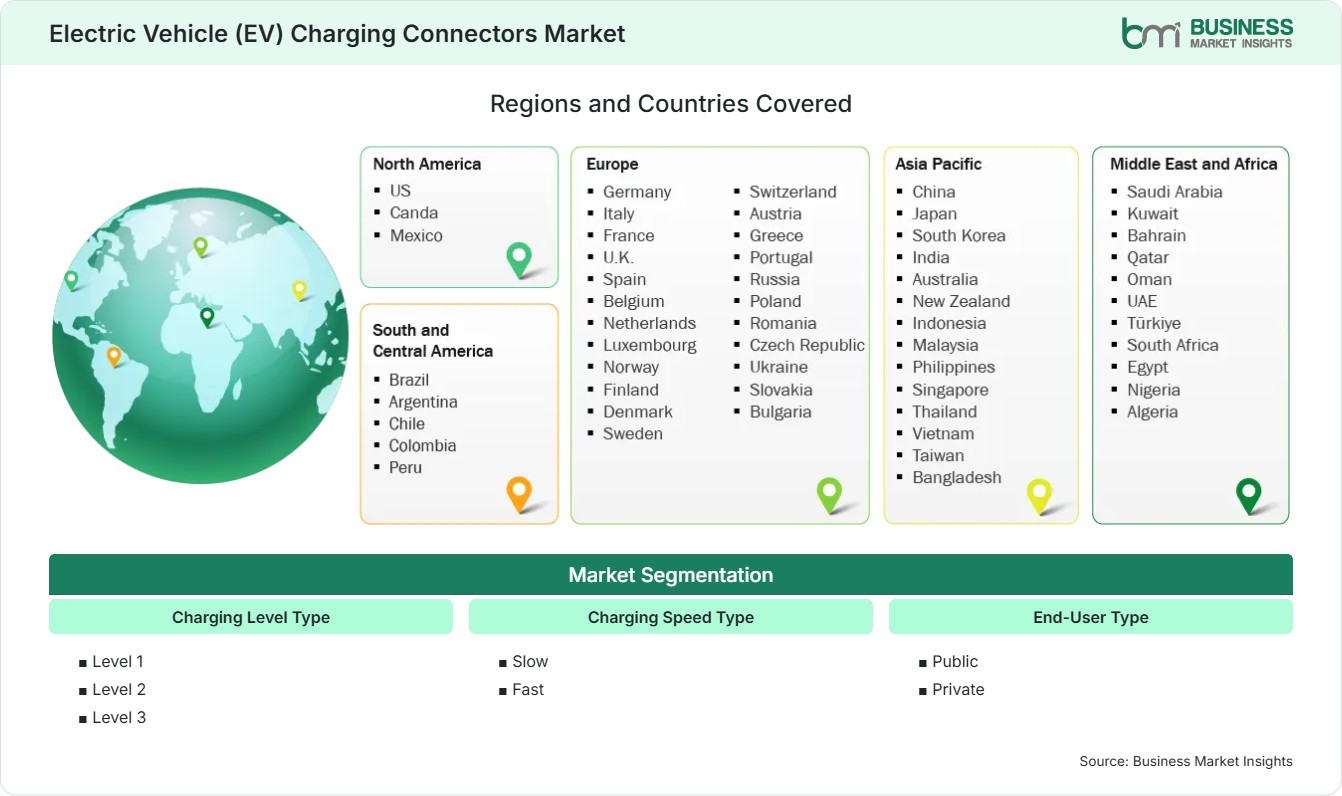
Global Market Geography
FREE PDF
Request your free sample
Request free sample
Segment Analysis

Electric Vehicle (EV) Charging Connectors Market Segmentation

Charging Level Type

Charging Level Type represents a core demand determinant, with Level 2 holding a 46%–50% Electric Vehicle Charging Connectors Market share in 2025 and expanding at a 19%–22% CAGR during 2026–2034. Level 1 remains important for low-power residential use, while Level 3 provides the fastest expansion as highway, fleet, and commercial charging requirements increase.

  • Level 1: Level 1 connectors serve low-power residential charging where installation simplicity and compatibility with standard electrical systems outweigh charging speed. Demand remains linked to entry-level EV ownership and overnight charging.
  • Level 2: Level 2 connectors support residential, workplace, commercial, and destination charging, balancing installation cost with useful charging speed. Broad vehicle compatibility and expanding building infrastructure sustain adoption.
  • Level 3: Level 3 connectors address high-power DC charging for highways, fleets, and commercial applications. Increasing battery capacity and shorter charging windows are accelerating investment in high-current, thermally managed interfaces.

Charging Speed Type

Charging Speed Type reflects the shift toward higher power delivery across charging networks. Fast charging represents a 42%–46% Electric Vehicle Charging Connectors Market share in 2025 and is projected to expand at a 24%–27% CAGR during 2026–2034. Slow charging remains relevant for homes, workplaces, and long-duration parking locations.

  • Slow: Slow charging connectors remain important for residential and workplace environments where vehicles remain parked for extended periods. Lower electrical requirements and simpler equipment maintain their relevance across developed charging ecosystems.
  • Fast: Fast charging connectors support highway, fleet, urban, and commercial charging where minimizing vehicle downtime is essential. High current, thermal management, durability, and ergonomic cable design increasingly influence product selection.

End-User Type

End-User Type divides demand between public and private infrastructure. Public charging holds a 55%–59% Electric Vehicle Charging Connectors Market share in 2025 and is modeled to grow at a 23%–26% CAGR during 2026–2034, supported by highway corridors, urban charging, fleet services, and infrastructure investment.

  • Public: Public charging connectors require high durability, weather resistance, secure locking, and frequent-cycle performance because charging stations experience intensive utilization across diverse vehicle types and operating environments.
  • Private: Private charging connectors serve homes, workplaces, residential buildings, and controlled fleet locations. Adoption benefits from convenient overnight charging, building electrification, energy management, and lower equipment complexity.
Market Forces

Electric Vehicle (EV) Charging Connectors Market Dynamics

Key Market Drivers

Accelerating EV Sales and Charging Infrastructure Deployment

Electric vehicle adoption is increasing the installed base of charging equipment that requires reliable physical interfaces. The IEA reported 21 million electric car sales globally in 2025, representing one-quarter of new car sales. Public charging points also exceeded five million globally after more than 1.3 million additions during 2024. These trends directly expand the installed base requiring vehicle inlets, charging plugs, cable assemblies, and replacement components. The resulting Electric Vehicle Charging Connectors Market growth is particularly strong where public networks shift toward higher utilization and faster charging.

Higher Voltage Architectures and Ultra-Fast Charging Requirements

The transition toward 800 V and higher vehicle architectures is increasing connector performance requirements across charging systems. High-power charging transfers greater current and creates additional thermal-management challenges, encouraging development of liquid-cooled cables, optimized contacts, temperature sensors, and lower-resistance interfaces. The IEA reported that ultra-fast public chargers rated at 150 kW or higher increased by more than 50% during 2024. These deployment patterns reinforce Electric Vehicle Charging Connectors Market trends toward higher current density and better thermal control.

Expansion of Fleet and Commercial Electrification

Commercial fleets will always achieve better connector utilization than many private charging applications, as vehicles return to a central depot, charge repeatedly, and operate on a very predictable schedule. Delivery vans, buses, taxis, logistics vehicles, and heavy goods vehicles all require charging equipment capable of repeated high-power operation with a predictable thermal and mechanical profile. Fleet operators are increasingly looking at connector downtime, serviceability, cable handling, mating durability and replacement availability as well as charger power when assessing the cost of ownership. The business case for premium connectors becomes stronger the more that connector downtime impacts vehicle utilization and delivery schedules.

Key Market Opportunities

Liquid-Cooled Connectors for High-Power Charging

High-power charging creates a direct opportunity for connector manufacturers to integrate cooling into cable and connector assemblies. Conventional conductors become heavier and more difficult to handle as current increases, whereas liquid-cooled systems can control conductor temperature while maintaining manageable cable dimensions. Phoenix Contact introduced charging solutions capable of megawatt-class power, while Sumitomo Electric introduced a 1,000 V connector cable supporting up to 400 kW. Such product developments indicate a commercially important transition toward engineered thermal solutions. Electric Vehicle Charging Connectors Market Forecasts therefore increasingly favor suppliers with proprietary high-power thermal-management capabilities.

Regional Manufacturing and Multi-Standard Product Platforms

Connector suppliers can reduce their supply chain exposure by building regional manufacturing and engineering capability right near their automotive and charging equipment customers. Multi-standard platforms enable manufacturers to serve markets that require Type 1, Type 2, CCS, NACS, GB/T, CHAdeMO, and the various high-power interfaces without having to create entirely separate production platforms. Modular contacts, housings, seals, and cable configurations can also reduce qualification times and improve manufacturing flexibility.

Software-Ready and Smart Connector Architectures

Charging connectors are increasingly being integrated with sensing and control functions rather than just acting as a passive electrical interface. They can incorporate temperature sensing, connector position sensing, locking confirmation, communications interfaces, and diagnostics to improve charging safety and equipment availability. The value of these functions increases as charging power and station utilization increase since they enable early detection of any thermal or mechanical anomalies which could otherwise lead to a service interruption. They can also be used to support predictive maintenance by providing condition information to the charging operator.

Market Restraints and Challenges

Complexity of Regional Charging Standards

Factor: The multitude of connector standards in operation across North America, Europe, China, Japan and elsewhere means that suppliers have to maintain distinct product architectures, certification routes, tooling and inventory. This leads to increased engineering spend and can in turn lead to reduced manufacturing economies of scale for the lower-volume regional variants. Impact: Suppliers serving global OEMs must qualify their products against a range of technical and regulatory requirements to ensure interoperability and consistent safety performance. Standard changes can also present inventory management issues when the OEMs are transitioning to new interfaces.

Thermal Management and Material Cost Pressure

Factor: Higher charging power leads to increased heat generation at the electrical contacts and conductors, which in turn requires more sophisticated materials, larger conductive paths, cooling systems, temperature sensors, and more complex cable construction. Copper, aluminum, engineered polymers, seals, cooling, etc., can all have a significant impact on the connector's BOM cost as performance requirements increase. Impact: High power connectors can be significantly more expensive in terms of bill of materials and will require more rigorous testing than a standard charging interface.

Company Analysis

Competitive Landscape

The competitive landscape reflects increasing differentiation through high-power connectivity, thermal management, regional manufacturing, automotive qualification, and multi-standard product portfolios. Electric Vehicle Charging Connectors Market analysis indicates that established connector manufacturers are strengthening their positions through product development, acquisitions, and specialized high-voltage solutions.

Company Name

Overview

Products and Services relevant to this market

TE Connectivity plc

Global connectivity supplier serving automotive, energy, transportation, and industrial applications with extensive engineering and manufacturing capabilities.

EV charging inlets, high-voltage connectors, terminals, cable assemblies, sensing technologies, and automotive connectivity solutions.

Aptiv PLC

Automotive technology company focused on electrical architecture, vehicle connectivity, power distribution, and advanced electrical systems.

Charging interfaces, high-voltage connectors, busbar solutions, cable assemblies, electrical distribution, and EV architecture components.

Amphenol Corporation

Diversified connector manufacturer with extensive transportation and high-power connectivity capabilities serving global automotive customers.

EV charging inlets, CCS and MCS solutions, high-voltage connectors, cable assemblies, battery connectors, and charging interfaces.

HUBER+SUHNER AG

Swiss connectivity specialist focused on high-performance electrical and optical systems for demanding transportation and infrastructure applications.

RADOX charging connectors, high-power charging cables, liquid-cooled systems, CCS interfaces, and high-performance connectivity solutions.

Phoenix Contact GmbH & Co. KG

Industrial technology company with established expertise in charging infrastructure, connectors, automation, and e-mobility systems.

CHARX charging connectors, CCS charging inlets, charging cables, high-power systems, and e-mobility connectivity technologies.

Molex, LLC

Global electronics and connectivity manufacturer supplying automotive customers with power, signal, and high-voltage interconnection solutions.

High-voltage automotive connectors, charging-related connectivity, terminals, cable systems, and e-mobility electrical solutions.

Rosenberger Hochfrequenztechnik GmbH & Co. KG

German connector specialist developing high-frequency and high-voltage connectivity for automotive and e-mobility applications.

High-voltage connectors, charging-related interfaces, battery connectors, automated assembly solutions, and e-mobility connectivity platforms.

Sumitomo Electric Industries, Ltd.

Japanese technology and automotive supplier with expertise in wiring, connectors, charging systems, and high-voltage vehicle architectures.

CHAdeMO charging connectors, high-power charging cable assemblies, V2H/V2X connectors, vehicle connectors, and high-voltage systems.

LEONI AG

Global provider of cables and wiring systems with strong capabilities in automotive electrification and high-voltage applications.

High-power charging cables, liquid-cooled charging systems, high-voltage cables, wiring systems, and EV electrical architectures.

JONHON Optronic Technology Co., Ltd.

Chinese interconnection specialist supplying high-voltage EV components and charging interfaces to automotive and infrastructure customers.

CCS1, CCS2, Type 1, Type 2, GB/T connectors, charging guns, vehicle inlets, high-voltage connectors, and harnesses.

Trust & Transparency

Research Methodology

The market analysis combines proprietary research with secondary data from government agencies, company disclosures, regulatory filings, industry databases and expert interviews. Market estimates are validated through data triangulation, cross-market benchmarking and analyst review.

View Full Research Methodology

Questions Answered

Frequently Asked Questions

How can connector manufacturers improve competitiveness?

Manufacturers can strengthen competitiveness through high-power thermal management, regional production, multi-standard platforms, automated manufacturing, engineering support, sensor integration, and durable cable designs. Long-term supply agreements with automotive OEMs and charging operators can further improve production visibility and customer retention.

What makes public charging connectors different from private charging connectors?

Public connectors generally require higher durability because they experience more frequent mating cycles, weather exposure, physical handling, and variable operating conditions. Private connectors typically operate in more controlled environments, allowing greater emphasis on convenience, installation simplicity, and residential electrical compatibility.

Why are Level 2 connectors important despite rapid DC charging growth?

Level 2 remains important because residential, workplace, destination, and fleet charging frequently involves vehicles parked for extended periods. Its lower infrastructure complexity and broad compatibility support sustained demand, particularly where overnight charging provides sufficient energy without requiring expensive high-power equipment.

How are high-power charging systems changing connector design?

The Electric Vehicle Charging Connectors Market Report highlights that High-power systems are increasing the need for larger conductive paths, improved contact materials, temperature sensing, liquid cooling, stronger locking systems, and lighter cable constructions. These features allow connectors to transfer higher current while maintaining manageable handling characteristics and reliable operation.

What is driving demand for EV charging connectors?

Demand is being driven by rising EV sales, expansion of public charging infrastructure, higher charging power, fleet electrification, and the transition toward 800 V vehicle architectures. Connector requirements are becoming more demanding as charging operators prioritize safety, uptime, thermal stability, and repeated-use durability.

Access the Full Electric Vehicle (EV) Charging Connectors Market Report

Get segment-level forecasts, regional estimates, competitive benchmarking, company profiles and downloadable Excel datasets.

Access the full Electric Vehicle (EV) Charging Connectors Market Report
350 pages PDF & Excel | 2026-11-10
Similar Research

Related Market Reports