
EV Charging Network Operations Support Services Market Outlook: Size, Share, Trends, Growth Analysis, Competitive Landscape & Forecast, 2026-2033

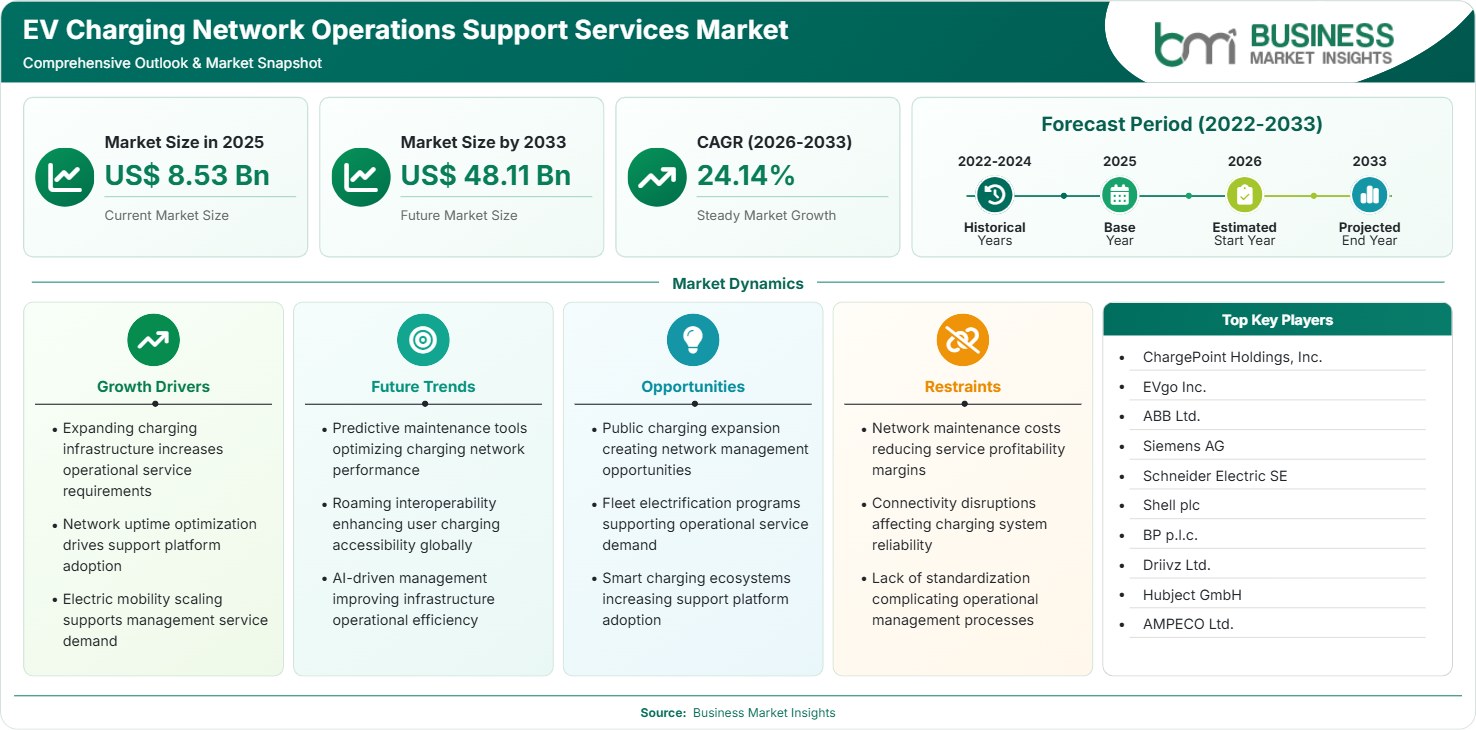
The EV Charging Network Operations Support Services Market size was valued at US$ 8.53 Billion in 2025 and is projected to reach US$ 48.11 Billion by 2033, growing at a CAGR of 24.14% during 2026–2033, driven by charger expansion, uptime requirements, software integration, fleet electrification, interoperability, and payment modernization.

Report Coverage
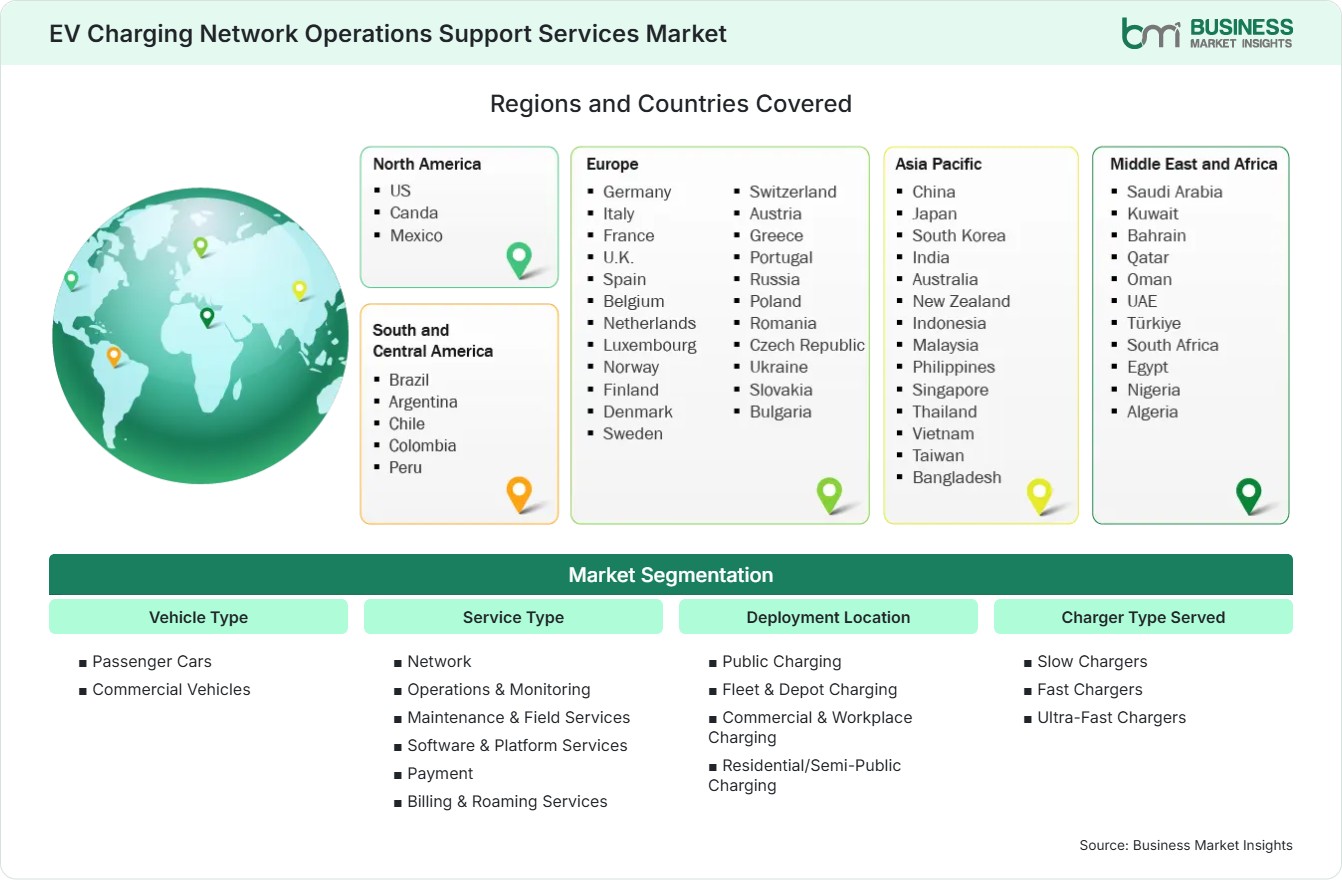
  • Vehicle Type: Passenger Cars, Commercial Vehicles
  • Service Type: Network, Operations & Monitoring, Maintenance & Field Services, Software & Platform Services, Payment, Billing & Roaming Services
  • Deployment Location: Public Charging, Fleet & Depot Charging, Commercial & Workplace Charging, Residential/Semi-Public Charging
  • Charger Type Served: Slow Chargers, Fast Chargers, Ultra-Fast Chargers
US$ 8.53 Bn Market size in 2025
US$ 48.11 Bn Market Size by 2033
24.14% CAGR, 2026 - 2033
2026-2033 Forecast Period

AI Overview

EV Charging Network Operations Support Services Market Summary

  • North America Region: North America holds an estimated 9%–12% EV Charging Network Operations Support Services Market share in 2025, growing at a 22%–25% CAGR during 2026–2033, supported by fleet electrification, fast-charging corridors, charger uptime programs, software integration, utility partnerships, and increasing demand for dependable network operations across fragmented charging estates. The US accounts for most regional demand, with commercial fleets, public fast charging, interoperability, and network-management software supporting a 21%–24% CAGR through 2033.
  • Fastest Growing Region: Rest of World represents an estimated 5%–8% share in 2025 and is expanding at a 28%–32% CAGR during 2026–2033, supported by emerging EV adoption, public infrastructure investment, government incentives, highway electrification, urban charging programs, and growing demand for outsourced operations, payment platforms, maintenance, roaming, and remote monitoring services.
  • Leading Segment: Passenger Cars represents an estimated 78%–82% share in 2025 and is advancing at a 23%–25% CAGR during 2026–2033, supported by expanding private ownership, public charging utilization, residential access gaps, charging interoperability, mobile payment adoption, vehicle connectivity, and increasing expectations for reliable charger availability and seamless digital charging experiences.
  • High Growth Segment: Ultra-Fast Chargers represents an estimated 16%–20% share in 2025 and is expanding at a 29%–32% CAGR during 2026–2033, driven by highway travel, larger battery packs, fleet turnaround requirements, higher charger utilization, premium charging locations, rising power ratings, grid-management requirements, and specialized preventive maintenance for high-power equipment.
  • Key Market Opportunity: Outsourced network operations can convert fragmented charger estates into managed digital infrastructure by combining remote diagnostics, predictive maintenance, payment orchestration, roaming, utilization analytics, energy optimization, cybersecurity, and field-service coordination for operators.
  • Major Market Players: ChargePoint Holdings, Inc.; EVgo Inc.; ABB Ltd.; Siemens AG; Schneider Electric SE; Shell plc; BP p.l.c.; Driivz Ltd.; Hubject GmbH; and AMPECO Ltd.
Strategic Insights

EV Charging Network Operations Support Services Market: Strategic Insights

EV Charging Network Operations Support Services Market Strategic Framework
FREE PDF
Request your free sample
Request free sample
Stakeholder View

Key Takeaways

  • The value chain is moving toward integrated lifecycle contracts covering monitoring, software, field maintenance, payments, roaming, customer support, and performance analytics rather than standalone charger servicing.
  • Fleet and depot environments provide a strong recurring-service opportunity because charging availability directly affects vehicle dispatch, route completion, asset utilization, and operating-cost control.
  • High-power charging is increasing the importance of thermal monitoring, power-quality management, remote diagnostics, preventive maintenance, firmware management, and rapid field intervention.
  • Asia Pacific offers substantial infrastructure-led opportunities because China represented more than 65% of global public charging points at the end of 2025, while India continues expanding its public charging base.
  • Partnerships between charging-network operators, automakers, retailers, utilities, software providers, and property owners are broadening the addressable service ecosystem, increasing demand for interoperable operational platforms.
  • Recurring software subscriptions and managed-service agreements can improve revenue visibility for technology providers while enabling charging operators to outsource specialized network functions.
Geographic Outlook

EV Charging Network Operations Support Services Market Regional Highlights

North America EV Charging Network Operations Support Services Market

North America held an estimated 9%–12% share of the EV Charging Network Operations Support Services Market in 2025, with growth of 22%–25% through 2033. Demand centers on public fast charging, fleet depots, retail charging, software management, and field services. US operators increasingly prioritize charger uptime, payment reliability, remote diagnostics, and network utilization. Canada is expanding corridors and commercial charging, while Mexico provides an emerging opportunity as EV imports and urban infrastructure develop. The regional service mix is shifting toward recurring managed operations rather than one-time deployment support.

  • Public networks are increasing investment in remote monitoring because charging sessions are growing faster than charger availability in several markets, creating stronger requirements for utilization analytics and operational intervention. ChargePoint reported 34% growth in enabled sessions and 16% port growth in 2026.
  • Fleet electrification is increasing demand for depot software, load management, scheduling, preventive maintenance, and integrated payment administration.
  • Retail and highway charging projects are creating recurring field-service requirements across geographically dispersed sites.
  • Interoperability between connector standards, roaming systems, vehicle platforms, and payment providers is increasing the need for centralized network-management layers.

US EV Charging Network Operations Support Services Market

The US accounted for an estimated 7%–9% of global demand in 2025 and is projected to grow by 21%–24% through 2033. Public fast charging, fleet depots, workplace infrastructure, and multifamily installations are expanding the service base. The IEA reported nearly 200,000 public charging points at the end of 2024 and more than 50,000 fast chargers, while policy implementation continues evolving.

  • ChargePoint-enabled charging sessions increased 34% over one year, demonstrating rising operational workloads and stronger requirements for capacity planning, network analytics, and service responsiveness.
  • EVgo ended 2025 with 5,100 operational stalls and 366 GWh of annual network throughput, illustrating the scale of recurring monitoring and maintenance requirements.
  • NACS adoption is increasing requirements for connector compatibility, software configuration, authentication, routing, and payment interoperability.

Europe EV Charging Network Operations Support Services Market

Europe EV Charging Network Operations Support Services Market accounted for an estimated 14%–17% share in 2025 and is expanding at 20%–23% through 2033. The region benefits from established public networks, strict emissions policies, interoperability requirements, and corridor charging mandates. Germany and France remain major service markets, while the Netherlands maintains extensive infrastructure. Spain and Italy offer comparatively faster expansion opportunities as charging density increases and operators modernize fragmented assets under evolving European requirements.

  • The EU public charging stock exceeded one million points in 2024 after growing more than 35%, increasing the need for monitoring, maintenance, payment, and network-optimization services.
  • Germany combines a large installed base with significant fleet, workplace, and highway requirements, supporting recurring technical service demand.
  • France is increasing ultra-fast infrastructure, with national plans and operator investment creating additional high-power maintenance opportunities.
  • Spain and Italy are expanding charging infrastructure from lower installed bases, creating opportunities for outsourced network operations and software deployment.

Asia Pacific EV Charging Network Operations Support Services Market

Asia Pacific held an estimated 65%–69% share in 2025 and is projected to grow at 24%–27% through 2033. China dominates regional infrastructure deployment, while India, Japan, South Korea, Southeast Asia, and Australia contribute diversified growth. China accounted for more than 65% of global public charging points at the end of 2025, creating a large installed base for software, monitoring, maintenance, payment, and energy-management services.

  • China added approximately 1.3 million public charging points during 2025, creating substantial requirements for remote diagnostics, software administration, payment integration, and field-service networks.
  • India provides a high-growth service opportunity as public charging infrastructure expands alongside electric mobility, urban charging programs, and commercial fleet electrification.
  • Japan combines established charging infrastructure with increasing requirements for interoperability, network optimization, and service modernization.
  • Southeast Asian markets are building charging ecosystems from comparatively smaller bases, increasing demand for scalable cloud platforms and outsourced operational capabilities.

Rest of World EV Charging Network Operations Support Services Market

South and Central America EV Charging Network Operations Support Services Market accounted for an estimated 3%–5% share in 2025 and is projected to expand by 29%–32% through 2033. Brazil leads regional development, while Mexico and Colombia are developing corridor and urban charging networks. Increasing EV imports, fleet electrification, and private infrastructure investment create opportunities for maintenance, network software, payment services, and remote operations. Brazil had more than 12,000 public charging points by December 2024.

The Middle East and Africa accounted for an estimated 2%–4% share in 2025 and are projected to grow by 28%–32% through 2033. Gulf markets are investing in premium charging corridors and destination infrastructure, while South Africa provides a developing base for commercial and public charging services. The comparatively low installed base creates opportunities for cloud-native platforms and outsourced operational models.

  • Brazil is expanding charging infrastructure rapidly, supporting demand for localized maintenance, roaming, payment processing, and network-management capabilities.
  • Colombia increased public charging infrastructure by 60% since 2022, indicating accelerating operational requirements as utilization expands.
  • Gulf markets are linking charging deployment with smart-city, tourism, fleet, and premium mobility programs.
  • Emerging markets favor scalable service platforms capable of supporting heterogeneous chargers and geographically dispersed sites.
Global Market Geography
FREE PDF
Request your free sample
Request free sample
Segment Analysis

EV Charging Network Operations Support Services Market Segmentation

Vehicle Type

Passenger Cars were expected to hold an EV Charging Network Operations Support Services Market share of 78%-82% in 2025, while Commercial Vehicles accounted for the remainder. Passenger car charging is positively affected by the rise in EVs and the expansion of public facilities, whereas commercial fleets have a repetitive use cycle. The segment is forecast to register a CAGR of 23%-25% from 2026 to 2033.

  • Passenger Cars: Residential, workplace, destination, and public charging require intuitive software, payment integration, availability information, roaming, remote diagnostics, and reliable customer support across diverse charging environments.
  • Commercial Vehicles: Fleet operators prioritize uptime, charging schedules, energy optimization, depot management, predictive maintenance, and centralized reporting because charger availability directly affects vehicle utilization and route economics.

Service Type

Service Type is moving towards recurring management services with the rise of and increased technical complexities of charging networks. Services such as Network, Operations, and Monitoring form the basis, but software and Platform services are becoming increasingly important. The segment is expected to grow by a CAGR of 24%–27% from 2026 to 2033.

  • Network, Operations & Monitoring: Centralized monitoring identifies outages, utilization changes, communication failures, and performance deviations, enabling operators to intervene remotely before problems become prolonged service interruptions.
  • Maintenance & Field Services: Preventive maintenance, corrective repairs, component replacement, inspection, and technician dispatch become increasingly important as installed charger fleets age and high-power equipment requires specialized expertise.
  • Software & Platform Services: Cloud platforms connect chargers, operators, utilities, drivers, and fleet managers through dashboards, APIs, asset management, smart charging, analytics, and automated workflows.
  • Payment, Billing & Roaming Services: Digital payment, tariff management, invoicing, roaming agreements, authentication, and settlement systems reduce transaction friction across fragmented charging ecosystems and improve interoperability.

Deployment Location

Public Charging represented the largest deployment environment in 2025, while fleet and depot applications provide strong recurring service intensity. The segment is projected to grow at 24%–27% CAGR during 2026–2033 of the EV Charging Network Operations Support Services Market as charging becomes distributed across commercial, residential, workplace, and transportation environments.

  • Public Charging: High utilization and geographically dispersed assets require continuous monitoring, payment administration, customer support, preventive maintenance, and rapid fault resolution to preserve network reliability.
  • Fleet & Depot Charging: Centralized charging enables sophisticated scheduling, energy optimization, load management, vehicle dispatch integration, and predictive maintenance for high-utilization commercial fleets.
  • Commercial & Workplace Charging: Employers, retailers, hotels, and commercial-property owners increasingly require access control, billing, utilization analytics, employee reimbursement, and remote network administration.
  • Residential/Semi-Public Charging: Multifamily properties and restricted-access sites require scalable authentication, tenant billing, load management, software updates, customer support, and integration with property-management systems.

Charger Type Served

Fast Chargers represented a major service category in 2025, while ultra-fast charging is developing the strongest operational requirements because higher power increases thermal, electrical, and uptime complexity. The segment is projected to grow at a 25%–30% CAGR during 2026–2033 of the EV Charging Network Operations Support Services Market.

  • Slow Chargers: Lower-power installations dominate many residential and workplace applications, creating demand for software management, access control, payment services, utilization reporting, and basic maintenance.
  • Fast Chargers: Higher utilization requires stronger remote monitoring, preventive maintenance, power-quality management, software diagnostics, connector inspection, payment reliability, and field-service coordination.
  • Ultra-Fast Chargers: High-power sites require specialized thermal monitoring, electrical inspection, firmware management, rapid fault response, energy optimization, and sophisticated uptime analytics to protect utilization and revenue.
Market Forces

EV Charging Network Operations Support Services Market Dynamics

Key Market Drivers

Expansion of Public and Commercial Charging Infrastructure

Public charging infrastructure exceeded 7 million points globally at the end of 2025, after nearly 1.8 million additions during the year. This expansion of the installed base increases the number of assets requiring software management, availability monitoring, preventive maintenance, billing, and field intervention. According to the IEA, public charging infrastructure is also becoming faster and thereby more complex from a technical perspective, in addition to being more extensive. Consequently, the EV Charging Network Operations Support Services Market growth is increasingly driven by life cycle needs rather than the mere installation of chargers.

Rising Charger Utilization and Uptime Requirements

Charging utilization is now a core business metric, as revenue depends on the use of charging facilities rather than merely on their installation. As seen in the 2026 network analysis by ChargePoint, there was a 34% increase in enabled sessions, compared to 16% in ports, indicating increasing pressure on utilization. In 2025, the company achieved 366 GWh of throughput on its network, representing a 32% year-on-year increase. This requires more predictive diagnostics, remote resets, technician dispatching, spare planning, and performance analysis. The EV Charging Network Operations Support Services Market trends focus on service-level agreements and uptime, since capacity needs to be monetized.

Interoperability, Digital Payments and Connected Charging

Ecosystems that charge EVs will comprise multiple hardware and software providers, vehicle brands, roaming operators, energy suppliers, payment systems, and asset owners. Standardization helps overcome fragmentation in terms of communications and digital authentication. The IEA lists interoperability, data standardization, reliable information availability, and payment capabilities as key elements of accessible charging. Connecting platforms can unify all information related to charger availability, tariffing, customer authentication, transactions, and roaming payments. With growing geographic and ownership diversification of charging networks, software providers have an opportunity to manage heterogeneous assets via APIs and cloud technology.

Key Market Opportunities

Managed Services for Fleet and Depot Electrification

Commercial fleets offer a compelling recurring-services option because charging reliability is directly tied to vehicle availability and dispatch economics. Fleets can delegate the management of their chargers, charging schedule optimization, energy management, maintenance, billing services, and data reporting to external service companies. The conditions within the depot also enable service platforms to synchronize their charging schedules with vehicles' route schedules, electricity rates, and grid capacity. With the growth of electric buses, delivery trucks, logistics fleets, and service vehicles, managed operations could be a separate operations layer similar to fleet-management software.

High-Power Charging Lifecycle Management

The rapid deployment drives the need for lifecycle services, including commissioning, diagnostics, temperature monitoring, connector inspection, firmware upgrades, electrical testing, and maintenance. According to the IEA, the number of ultra-fast chargers above 150 kW increased by more than 50% in 2024 worldwide. The increase in power leads to higher charging efficiency, but it also increases the consequences of downtime in the machinery. Distinguishing factors of service providers include predictive analysis, technician certifications, spare parts supply chain, remote diagnostics, and uptime guarantees. EV Charging Network Operations Support Services Market forecasts the roadmap to premium managed service agreements.

Software Platforms for Distributed Charging Estates

The proliferation of chargers into multifamily, office, retail, highway, fleet, and public sites results in a fractured operational system. Software solutions may streamline asset management, user authentication, tariff setting, payments, reporting, energy management, roaming, and maintenance. ChargePoint's strategy through 2026 is one example of the growing focus on software that helps manage chargers and integrate charging solutions across diverse customer settings. Companies with open APIs, multi-vendor capabilities, cybersecurity, and analytics services can cater to operators who wish to avoid maintaining a separate system for each deployment.

Market Restraints and Challenges

Fragmented Hardware and Software Ecosystems

Factor: Many charging networks comprise devices from various vendors, communication protocols, payment systems, firmware versions, and roaming agreements. Impact: Fragmentation increases the effort required to integrate the solution, complicates root cause analysis, and may increase operational costs for service providers. Network providers might have to manage multiple interfaces and specific workflows, making centralized operations less efficient. Moreover, compatibility issues will slow down the troubleshooting process, as they involve both hardware and software. This problem gets worse when networks purchase charging stations in various projects, and even when they start working internationally.

Grid Constraints and High-Power Infrastructure Complexity

Factor: Fast and ultra-fast chargers may require substantial electrical capacity, grid upgrades, site-level electricity management, and effective electrical power distribution. Impact: Limited grid connections may slow deployment, increase capital costs, and restrict the use of chargers in otherwise favorable locations. Equipment with high charging power requires specialized maintenance of the electrical power system, which adds to service difficulties. According to the IEA, insufficient network capacity is a constraint in dense cities, and increased charging power makes it necessary to implement smart charging technologies and integrate them with the network.

Company Analysis

Competitive Landscape

The EV Charging Network Operations Support Services Market analysis indicates that competition spans charge point operators, charging hardware companies, software specialists, energy companies, and interoperability providers. Differentiation increasingly depends on network scale, software depth, service responsiveness, charger compatibility, analytics, payment capabilities, and lifecycle support.

Company Name

Overview

Products and Services relevant to this market

ChargePoint Holdings, Inc.

Major charging technology provider serving public, commercial, fleet, workplace, and residential charging environments across multiple markets.

Charging hardware, cloud software, network management, monitoring, subscriptions, fleet solutions, payment capabilities, and operational analytics.

EVgo Inc.

US-focused public fast-charging network operator expanding high-power infrastructure and customer-facing digital charging services.

Network operations, fast charging, remote monitoring, payment, driver services, charging analytics, maintenance, and high-power site management.

ABB Ltd.

Global electrification technology company providing charging infrastructure and digital solutions for transport and energy applications.

EV charging hardware, connectivity, software, remote monitoring, service agreements, maintenance, energy management, and fleet charging solutions.

Siemens AG

Diversified technology company providing charging infrastructure and digital energy-management capabilities.

EV charging systems, software, fleet management, energy optimization, connectivity, maintenance, and infrastructure integration.

Schneider Electric SE

Energy-management specialist integrating EV charging with buildings, electrical systems, and distributed energy infrastructure.

Charging systems, energy management, monitoring, load management, building integration, software, and lifecycle services.

Shell plc

Global energy company operating charging infrastructure and digital services through its mobility and charging businesses.

Public charging, fleet charging, network operations, payment, energy management, roaming, customer services, and infrastructure maintenance.

BP p.l.c.

Energy company developing charging infrastructure and digital mobility services through its charging operations.

Fast charging, fleet solutions, site operations, digital charging services, energy management, payment, and maintenance support.

Driivz Ltd.

Charging software specialist focused on digital infrastructure for charge point operators and mobility providers.

Cloud charging management, smart charging, billing, roaming, customer management, monitoring, analytics, and operational workflows.

Hubject GmbH

An interoperability and e-mobility services provider connecting charging networks, mobility providers, and drivers.

eRoaming, Plug&Charge services, interoperability, network connectivity, digital authentication, and charging ecosystem integration.

AMPECO Ltd.

EV charging management software provider supporting operators, fleet businesses, utilities, and mobility companies.

Charging management platform, billing, payments, roaming, energy management, remote monitoring, analytics, and white-label digital services.

Trust & Transparency

Research Methodology

The market analysis combines proprietary research with secondary data from government agencies, company disclosures, regulatory filings, industry databases and expert interviews. Market estimates are validated through data triangulation, cross-market benchmarking and analyst review.

View Full Research Methodology

Questions Answered

Frequently Asked Questions

How are multifamily properties changing the charging-service demand?

Multifamily charging introduces operational requirements for tenant access, billing, load management, property management integration, customer support, and shared charger availability. These requirements make software and managed operations increasingly important for property owners.

What role does predictive maintenance play in charging networks?

Predictive maintenance uses equipment telemetry, historical fault patterns, utilization data, and diagnostic signals to identify potential failures before they cause prolonged outages. It can improve technician scheduling and reduce unnecessary physical interventions.

How does roaming affect charging-network operations?

Roaming allows drivers to access chargers outside their primary network while enabling commercial settlement between participating platforms. Effective roaming requires authentication, tariff exchange, transaction reconciliation, data exchange, and reliable interoperability.

Why does ultra-fast charging create different service requirements?

Ultra-fast equipment operates at higher electrical power and can require specialized thermal, electrical, connector, firmware, and power-quality monitoring. Failures can also create greater revenue losses because high-power sites are typically designed for high throughput.

Why are managed charging services becoming more important as networks expand?

As per the EV Charging Network Operations Support Services Market report, managed services reduce the operational burden of monitoring geographically dispersed chargers. They combine software diagnostics, field maintenance, payment administration, utilization analytics, customer support, and performance reporting into coordinated workflows.

Access the Full EV Charging Network Operations Support Services Market Report

Get segment-level forecasts, regional estimates, competitive benchmarking, company profiles and downloadable Excel datasets.

Access the full EV Charging Network Operations Support Services Market Report
350 pages PDF & Excel | 2026-10-12
Similar Research

Related Market Reports