Market Summary
Executive Summary and Global Market Analysis
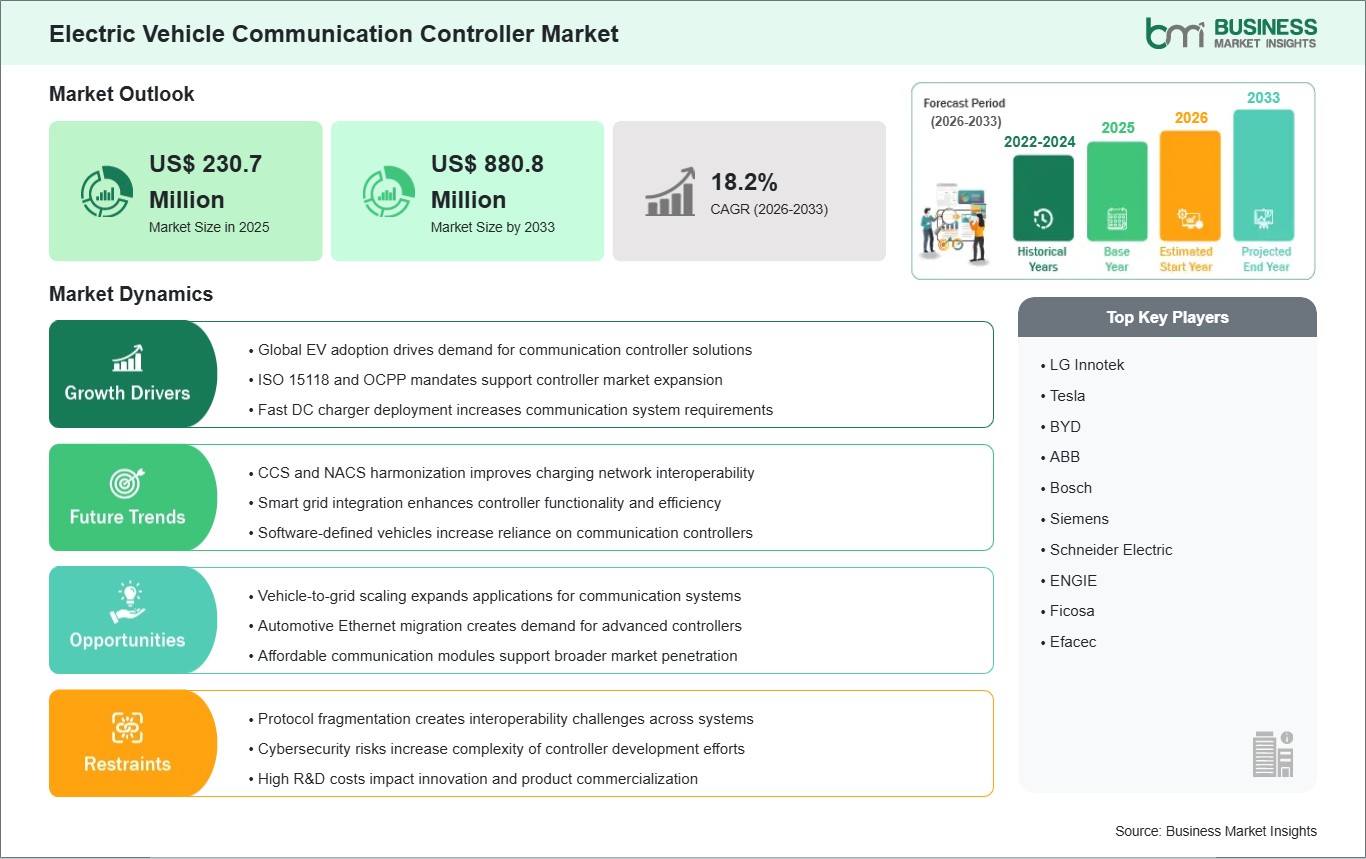
Electric vehicle communication controllers are electronic devices used for regulating the communication processes between electric vehicles and charging stations to provide for safe, reliable, and efficient charging services in the form of an industry-standard procedure. Their role has become increasingly important as electric mobility ecosystems evolve toward greater connectivity and interoperability.
With the rise in the number of electric vehicles around the globe, the demand for smooth communication between all participants in the electric mobility market will grow. Charging infrastructure providers and automotive manufacturers are focusing on seamless charging experiences, enhanced cybersecurity, and compliance with international communication standards.
Market demand varies according to charging methods, vehicle platforms, and communication architectures. Wired charging solutions maintain substantial adoption due to their established infrastructure base and broad compatibility across charging environments. Battery electric vehicles account for a significant share of communication controller integration because they depend entirely on charging infrastructure for energy replenishment. Advancements in wireless charging, smart charging management, and interoperability standards are further expanding application opportunities.
Companies are competing by developing new communication protocols, improving software, and adding smart energy management features. They are investing in technologies that allow for two-way charging, better interaction with the power grid, and smarter charging. The focus on connecting vehicles, making charging more efficient, and building digital energy systems is driving innovation and shaping the future of the market.
Segment Analysis
Electric Vehicle Communication Controller Market Segmentation
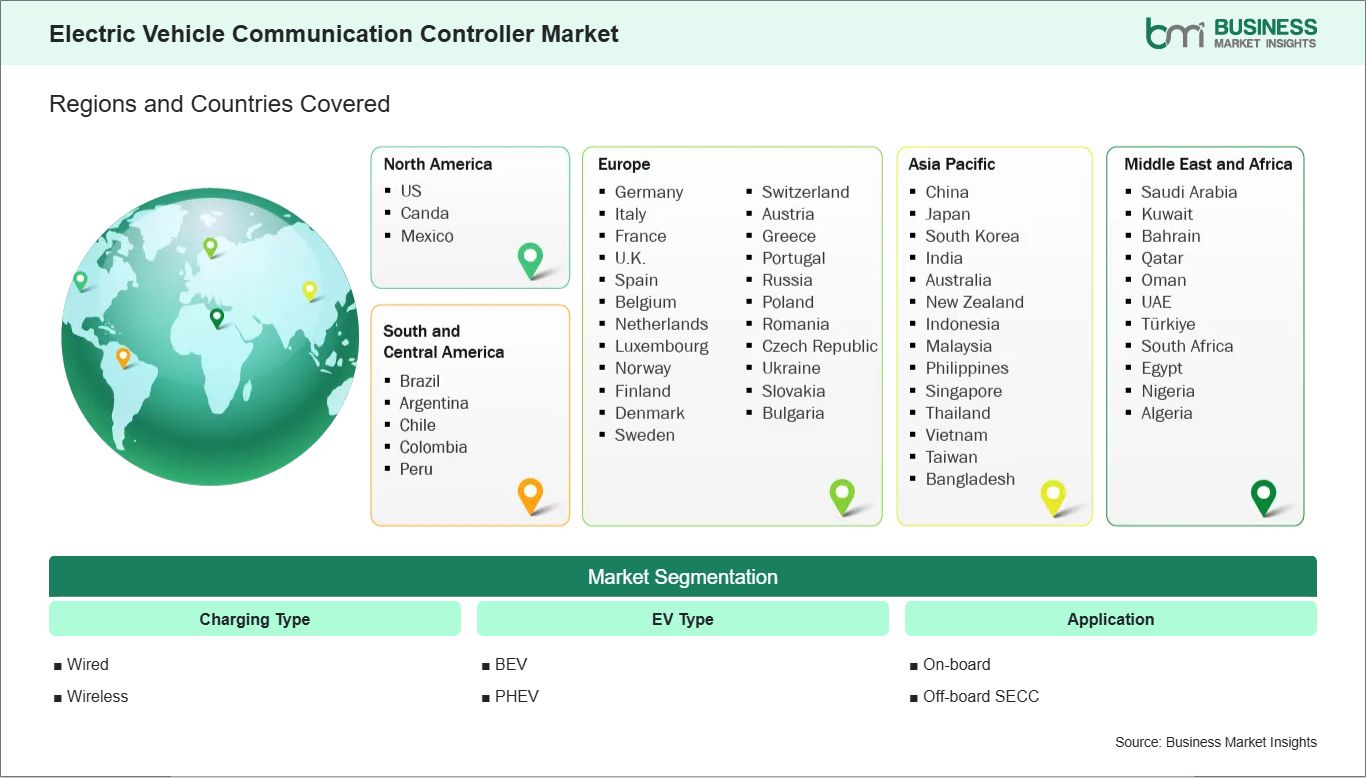
The electric vehicle communication controller market is segmented based on charging type, EV type, and application, reflecting the growing need for intelligent communication systems across electric vehicle charging infrastructure.
By Charging Type
- Wired: Established charging infrastructure and standardized communication protocols support widespread deployment.
- Wireless: Contactless charging capabilities enhance user convenience and support next-generation mobility solutions.
By EV Type
- BEV: Complete reliance on charging infrastructure drives extensive integration of communication controller technologies.
- PHEV: Hybrid charging requirements sustain demand for communication systems supporting multiple operating modes.
By Application
- On-board: Integrated vehicle communication functions enable seamless interaction with charging equipment and energy networks.
- Off-board SECC: Charging station communication management supports authentication, charging control, and interoperability requirements.
Market Forces
Electric Vehicle Communication Controller Market Drivers and Opportunities
Surge in EV adoption
As more electric vehicles are used for both personal and commercial transport, the need for communication controllers is rising quickly. With more vehicles connecting to different charging stations, it is important for charging systems and vehicle electronics to communicate well. Communication controllers make sure data is exchanged securely, charging is optimized, and new charging standards are met in all kinds of settings.
As charging networks grow, it is more important than ever for different systems to work together and manage energy smartly. Communication controllers help provide smooth charging and allow for features like remote monitoring and system checks. As more electric vehicles are used worldwide, these controllers are key to keeping charging reliable and efficient
Vehicle-to-grid scaling
The growth of vehicle-to-grid systems offers a big opportunity for advanced electric vehicle communication controllers. Two-way energy transfer needs advanced communication so vehicles and energy networks can share information instantly. Communication controllers help coordinate between charging stations, utility companies, and vehicles to manage energy flow efficiently.
In the future, vehicle-to-grid technology could turn electric vehicles into active parts of modern energy networks. Better communication systems will help with programs that balance energy demand, keep the grid stable, and manage energy from many sources. As more companies look into two-way charging, communication controllers will play a key role in building smart and connected energy systems.
Size and Share Analysis
Electric Vehicle Communication Controller Market Size and Share Analysis
The electric vehicle communication controller market is projected to grow from US$ 230.7 million in 2025 to US$ 880.8 million by 2033, registering a CAGR of 18.2% from 2026 to 2033.
By charging type, the wired segment accounts for a significant share due to its extensive infrastructure deployment, standardized communication frameworks, and broad compatibility across residential, commercial, and public charging environments. Established charging ecosystems continue to support strong integration of wired communication controller solutions.
By EV type, the BEV segment leads the market owing to its complete dependence on charging infrastructure and greater requirement for advanced charging communication capabilities. Rising deployment of battery electric vehicles across global markets has strengthened demand for reliable communication controllers supporting efficient charging operations.
Report Coverage
Electric Vehicle Communication Controller Market Report Coverage and Deliverables
The "Electric Vehicle Communication Controller Market Size and Forecast (2022-2033)" report provides a detailed analysis of the market covering below areas:
- Market size and forecast at global, regional, and country levels for all key market segments covered under the scope
- Market trends, along with market dynamics such as drivers, restraints, and key opportunities
- Market analysis covering key trends, global and regional frameworks, major players, regulations, and recent developments
- Industry landscape and competitive analysis covering market concentration, heat map analysis, prominent players, and recent developments
- Detailed company profiles, including SWOT analysis
Geographic Insights
Electric Vehicle Communication Controller Market Geographic Insights
The Electric Vehicle Communication Controller market shows diverse regional adoption patterns influenced by electric vehicle penetration, charging infrastructure development, regulatory frameworks, and smart grid modernization initiatives. Regional demand differs according to the pace of electrification and investments in connected mobility ecosystems.
The North American market continues to exhibit robust market dynamics because of the widespread adoption of electric vehicles, increased installation of public charging stations, and the rising importance of smart energy management. Advanced charger technology and grid upgrade initiatives will keep powering investments into communication controllers in the North American region.
Asia-Pacific is one of the important growth markets in the global landscape owing to massive manufacturing of electric cars, substantial growth in the charging infrastructure, and significant governmental support for electrified transport. The growth of connected transport systems is encouraging the adoption of intelligent communication solutions.
Europe continues to witness significant adoption due to its established charging infrastructure and aggressive goals for transitioning toward an electrified transportation system, along with investment in intelligent energy systems. Countries in emerging economies such as Africa, Latin America, and the Middle East are also beginning to experience enhanced deployment of EV charging facilities as infrastructure develops and governments work toward achieving cleaner forms of transportation and transitioning their energy systems toward sustainability.
Industry Activity
Recent Developments
The electric vehicle communication controller market is evaluated by gathering qualitative and quantitative data post primary and secondary research, which includes important corporate publications, association data, and databases. Recent developments and news in the market include:
- In April 2026, Vector Informatik GmbH announced that it expanded its CANoe Test Package EV to include advanced cybersecurity testing for charging communication. The validation software update allows EVCC and software developers to stress-test communication interfaces against potential malicious traffic, ensuring compliance with strict vehicle-to-grid (V2G) protection frameworks.
- In June 2026, Tata Motors announced a strategic collaboration with Chery Automobile to utilize Chery's EV technology platform for its upcoming Avinya premium electric vehicle range, accelerating product development and strengthening Tata Motors' position in the global electric vehicle market.
Trust & Transparency
Research Methodology
The market analysis combines proprietary research with secondary data from government agencies, company disclosures, regulatory filings, industry databases and expert interviews. Market estimates are validated through data triangulation, cross-market benchmarking and analyst
review.
View Full Research Methodology
Key Sources Referred:
Society of Automotive Engineers Institute of Electrical and Electronics Engineers (IEEE) European Automobile Manufacturers' Association (ACEA) Japan Automobile Manufacturers Association (JAMA) China Association of Automobile Manufacturers (CAAM) Indian Automotive Component Manufacturers Association (ACMA) International Energy Agency (IEA) Electric Drive Transportation Association (EDTA) International Road Transport Union (IRU) Company Websites Company Annual Reports Company Investor Presentations