
Electric Vehicle Charging Infrastructure Market Outlook: Size, Share, Trends, Growth Analysis, Competitive Landscape & Forecast, 2026-2033

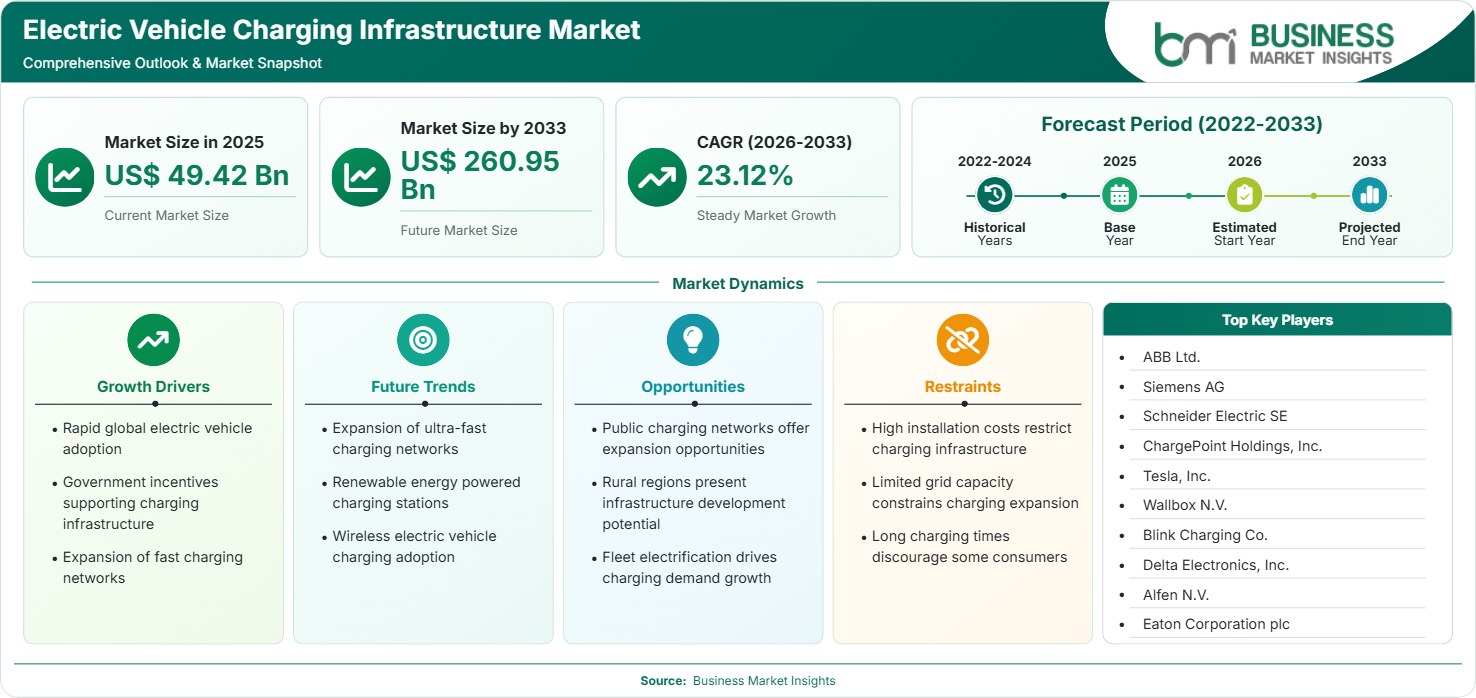
The Electric Vehicle Charging Infrastructure Market size was valued at US$ 49.42 Billion in 2025 and is projected to reach US$ 260.95 Billion by 2033, growing at a CAGR of 23.12% during 2026–2033, driven by EV adoption, fleet electrification, charging-speed upgrades, grid investment, smart energy management, and expanding public networks.

Report Coverage
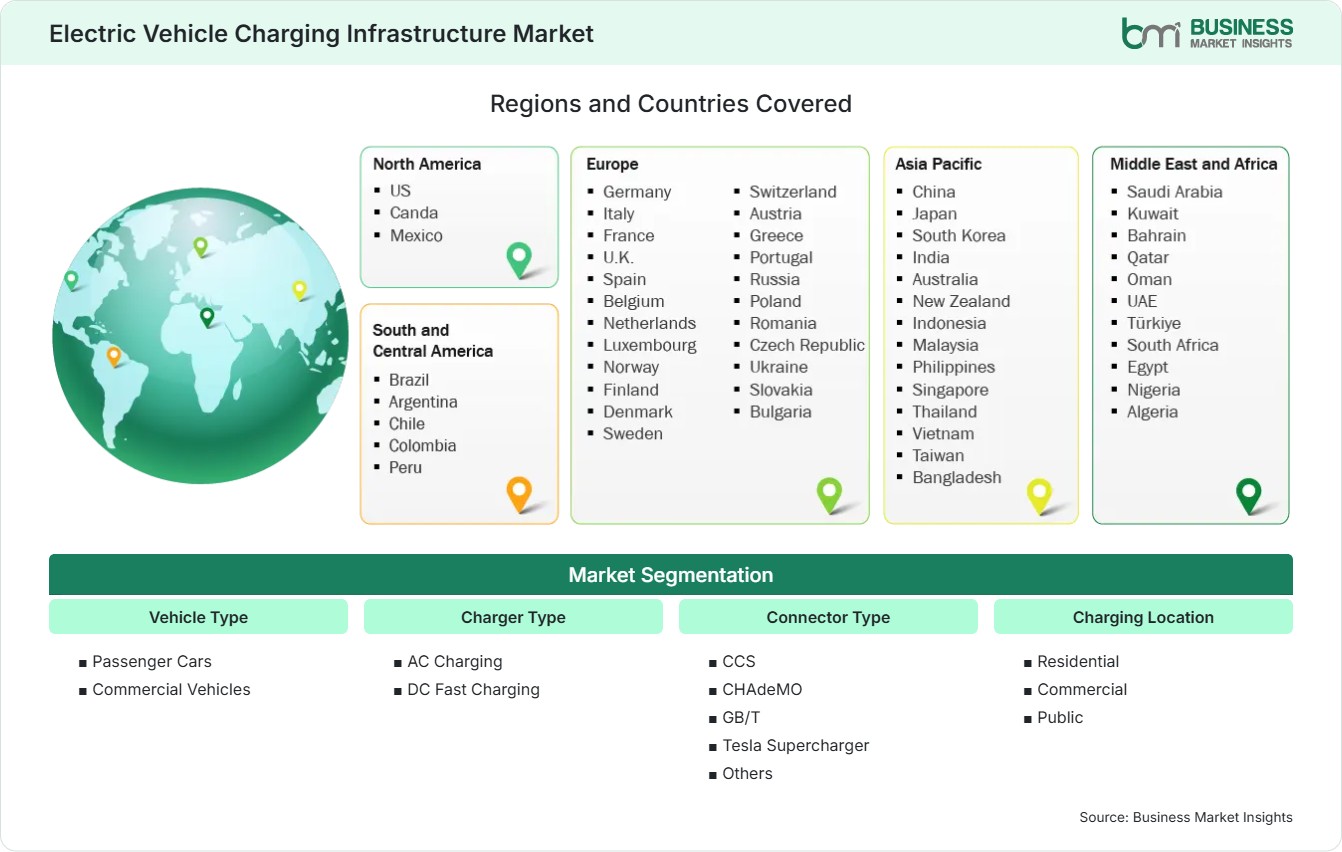
  • Vehicle Type: Passenger Cars, Commercial Vehicles
  • Charger Type: AC Charging, DC Fast Charging
  • Connector Type: CCS, CHAdeMO, GB/T, Tesla Supercharger, Others
  • Charging Location: Residential, Commercial, Public
  • Power Output: Slow, Fast, Ultra-fast
US$ 49.42 Bn Market size in 2025
US$ 260.95 Bn Market Size by 2033
23.12% CAGR, 2026 - 2033
2026-2033 Forecast Period

AI Overview

Electric Vehicle Charging Infrastructure Market Summary

  • North America Region: The North America region is responsible for an EV Charging Infrastructure Market share of 18%-21% in 2025 and will register a growth rate of 20%-22% CAGR between 2026 and 2033. This region is driven by fleet electrification, highway corridors, utilities investments, multifamily charging, workplace charging, and network software. The market for the USA region is growing at a 19%-21% CAGR.
  • Fastest Growing Region: Asia Pacific holds a market share of 47%–50% in 2025, growing at a CAGR of 25%–27% during 2026–2033, supported by dense urban EV adoption, manufacturing scale, charging standardization, fleet electrification, battery innovation, government programs, and infrastructure investment.
  • Leading Segment: DC Fast Charging holds a market share of 56%–59% in 2025, growing at a CAGR of 24%–26% during 2026–2033, supported by highway corridors, fleet depots, commercial applications, higher utilization, improved power electronics, and demand for shorter charging sessions.
  • High Growth Segment: Commercial Vehicles hold a market share of 18%–21% in 2025, growing at a CAGR of 27%–29% during 2026–2033, driven by logistics electrification, depot charging, predictable duty cycles, fleet economics, regulatory requirements, and high-power infrastructure.
  • Key Market Opportunity: High-power fleet depots, battery-integrated charging, smart load management, roaming platforms, and energy-as-a-service models can improve utilization while reducing grid constraints and infrastructure costs.
  • Major Market Players: ABB Ltd.; Siemens AG; Schneider Electric SE; ChargePoint Holdings, Inc.; Tesla, Inc.; Wallbox N.V.; Blink Charging Co.; Delta Electronics, Inc.; Alfen N.V.; Eaton Corporation plc.
Strategic Insights

Electric Vehicle Charging Infrastructure Market: Strategic Insights

Electric Vehicle Charging Infrastructure Market Strategic Framework
FREE PDF
Request your free sample
Request free sample
Stakeholder View

Key Takeaways

  • The value chain is extending itself from charger production to an integrated platform for electrical devices, connectivity, payment systems, maintenance, energy management, financing, and information provision.
  • Commercial vehicle fleets are especially appealing as there are opportunities for scheduling of charging, high utilization, energy consumption, and maintenance needs.
  • Technology development is shifting toward liquid cooling, modular power cabinets, dynamic power allocation, predictive maintenance, automated payments, and higher-duty-cycle charging architectures.
  • Asia Pacific offers the strongest infrastructure expansion opportunity because EV manufacturing, urban adoption, charging density, and government-backed deployment reinforce each other.
  • Investment is increasingly moving toward network software, managed charging, fleet partnerships, roaming, maintenance, and energy-management platforms capable of generating recurring revenues.
  • Control of grid connections, permits, land, and strategically located sites can become a competitive moat as high-power charging projects require substantial electrical infrastructure.
Geographic Outlook

Electric Vehicle Charging Infrastructure Market Regional Highlights

North America Electric Vehicle Charging Infrastructure Market

North America Electric Vehicle Charging Infrastructure Market represented 18%–21% of global revenue in 2025 and is modeled to expand at 20%–22% CAGR through 2033. The U.S. remains the main national market, and there are additional opportunities in Canada in terms of electrification efforts. More public chargers are now available, as well as workplace, multifamily, fleet, and destination chargers.

  • Highway charging continues to have strategic significance in that areas where there is no coverage become potential candidates for operators with access to high traffic volumes and enough electrical supply.
  • The deployment of multifamily housing is growing among those who do not have their own parking spaces to allow the installation of networked AC charging systems.
  • Electric vehicle fleet conversion will optimize the use of charging facilities since depot charging takes place at predictable intervals.
  • Utilities become more significant in determining the viability of a project.

US Electric Vehicle Charging Infrastructure Market

The US Electric Vehicle Charging Infrastructure Market accounted for 58%–62% of North American revenue in 2025 and is projected to grow at 19%–21% CAGR through 2033. Public infrastructure remains concentrated around metropolitan areas and major corridors, while multifamily properties, workplaces, and commercial fleets create incremental demand.

  • Fleet charging is fast becoming an important center of demand for logistics, delivery, transit, rental, and services, which value vehicle availability.
  • Multi-family charging is important to households without their own parking as well as providing possibilities for billing management and load balancing.
  • Software platforms are gaining importance through diagnostics, utilization analytics, payment integration, remote monitoring, and dynamic charging controls.

Europe Electric Vehicle Charging Infrastructure Market

Europe held a 23%–26% share in 2025 and is expected to expand at 21%–23% CAGR through 2033. Germany, France, and the Netherlands remain leading markets, while Spain, Italy, and the United Kingdom offer additional expansion potential. Germany and France combine large vehicle populations with infrastructure investment.


  • AFIR standards facilitate fast charging in highways while encouraging greater charging capacity on key European transport routes.
  • Germany is still one of the most attractive markets as vehicle quantities, industrial capabilities, electric vehicles fleet and highway infrastructure strengthen charging demand.
  • France presents great growth opportunities owing to its national charging strategies and further investments in high-power corridor infrastructure.
  • The Netherlands presents possibilities in smart charging, interoperability, software optimization and utilization management within existing infrastructure.

Asia Pacific Electric Vehicle Charging Infrastructure Market

Asia Pacific commanded a 47%–50% share in 2025 and is forecast to grow at 25%–27% CAGR through 2033. China leads regional scale, while India, South Korea, Japan, Indonesia, Thailand, and Vietnam provide substantial expansion opportunities. China accounted for more than 65% of global public charging points at the end of 2025.

  • China can leverage its advantages in dense urban EV usage, manufacture of chargers within the country, well-developed networks, and fast charging deployment.
  • India provides high growth opportunities based on urbanization, commercial fleets, government investment, and the expansion of passenger and commercial EV use.
  • South Korea is working on increasing the fast-charging network around demand hotspots along with energy management systems.
  • Japan holds long-term potential due to charging goals, automotive expertise, and infrastructure demands for highways.

Rest of World Electric Vehicle Charging Infrastructure Market

The regions of South America and Central America are emerging markets because of their small installed bases of charge stations, with Brazil being a prominent player in regional charging deployments, followed by Colombia and Mexico. By December 2024, Brazil had more than 12,000 public charging stations.

The Middle East and Africa offer selective growth opportunities driven by premium EVs, public transit, logistics, tourism, and energy diversification, particularly in the UAE, Saudi Arabia, and South Africa.

  • Brazil continues to be the dominant market in South America due to the number of vehicles, urbanization, and the development of the network.
  • Colombia and Mexico have high-growth potential due to the growth in public networks and the development of interoperable ecosystems for automotive, utility, and charging firms.
  • UAE is poised to leverage premium and destination charging owing to tourism, smart cities, and electric mobility.
  • South Africa provides emerging opportunities in metropolitan charging, commercial fleet charging, renewables, and highways connectivity.
Global Market Geography
FREE PDF
Request your free sample
Request free sample
Segment Analysis

Electric Vehicle Charging Infrastructure Market Segmentation

Vehicle Type

Passenger Cars lead the Electric Vehicle Charging Infrastructure Market with a 68%–72% share in 2025 and are projected to grow at a CAGR of 24.5%–27.0%. Commercial Vehicles are expected to witness faster growth at a CAGR of 28.0%–31.0%, driven by fleet electrification across logistics, buses, and delivery services. Passenger applications benefit from home and destination charging, while commercial deployments favor centralized, high-power, and software-managed charging infrastructure.

  • Passenger Cars: Residential, workplace, destination, and highway charging support adoption, with demand influenced by vehicle range, parking availability, affordability, convenience, and ownership patterns.
  • Commercial Vehicles: Fleet charging requires high utilization, depot optimization, uptime guarantees, scalable power systems, intelligent scheduling, and centralized energy management.

Charger Type

AC Charging leads the Market with a 60%–65% share in 2025 and is projected to grow at a CAGR of 23.0%–25.5%. Charger Type remains centered on AC Charging for residential and destination applications, while DC Fast Charging leads demand across corridors, fleets, and public locations in Electric Vehicle Charging Infrastructure Market.

  • AC Charging: Lower equipment costs and longer dwell times make AC charging suitable for homes, workplaces, apartments, hotels, offices, and commercial parking.
  • DC Fast Charging: DC fast charging is favored where vehicle downtime has measurable economic costs, including highways, fleets, transit depots, retail corridors, and public hubs.

Connector Type

CCS leads the Electric Vehicle Charging Infrastructure Market with a 40%–45% share in 2025 and is projected to grow at a CAGR of 24.0%–26.5%. Connector Type is influenced by regional vehicle fleets, regulations, interoperability policies, and network strategies. CCS remains important across Europe and North America, GB/T dominates China, and Tesla Supercharger infrastructure influences high-power public charging. 

  • CCS: CCS provides broad compatibility across major Western markets and benefits from established vehicle availability and extensive DC charging deployment.
  • CHAdeMO: CHAdeMO retains relevance among installed Japanese and legacy vehicle populations, although newer standards increasingly influence future deployment decisions.
  • GB/T: GB/T benefits from China’s large domestic EV fleet, established manufacturing ecosystem, and high-volume public charging infrastructure.
  • Tesla Supercharger: Tesla Supercharger combines high-power charging, route planning, vehicle connectivity, payment, and network operations within an expanding ecosystem.

Charging Location

Residential Charging leads the Electric Vehicle Charging Infrastructure Market with a 55%–60% share in 2025 and is projected to grow at a CAGR of 24.0%–26.0%. Charging Location divides demand among residential, commercial, and public environments. Residential installations benefit from predictable overnight dwell times, while commercial and public sites depend on accessibility and throughput. The market trends increasingly encompass multifamily properties, workplaces, retail centers, transport hubs, logistics depots, and highway corridors requiring differentiated hardware, pricing, and software models.

  • Residential: Residential charging remains preferred where dedicated parking exists because overnight dwell periods support lower-power equipment and household energy management.
  • Commercial: Commercial charging serves workplaces, hotels, retail centers, offices, and multifamily properties while supporting customer retention and property differentiation.
  • Public: Public networks serve drivers without home charging and long-distance travelers, increasing demand for uptime, rapid charging, transparent pricing, roaming, and strategic placement.

Power Output

Fast Charging leads the Market with a 45%–50% share in 2025 and is projected to grow at a CAGR of 25.0%–27.5%. Power Output is moving toward faster architectures as battery capacities increase and fleets prioritize shorter dwell times. Slow charging remains important for long-duration parking, Fast charging supports mainstream public applications, and Ultra-fast systems increasingly target highways and demanding commercial operations in Electric Vehicle Charging Infrastructure Market.

  • Slow: Slow charging suits overnight residential, workplace, and long-duration parking where lower infrastructure costs are more important than charging speed.
  • Fast: Fast charging serves public, commercial, and fleet applications requiring multiple daily charging sessions with manageable infrastructure requirements.
  • Ultra-fast: Ultra-fast charging targets high-throughput corridors and demanding fleets, requiring advanced power electronics, thermal management, and grid integration.

Component

Hardware leads the Market with a 70%–75% share in 2025 and is projected to grow at a CAGR of 23.0%–25.5%. Component demand is divided between physical hardware and recurring software capabilities. This transition increases the importance of connected platforms and service revenues as operators seek greater control over distributed charging assets and operating costs.

  • Hardware: Hardware includes chargers, power electronics, cables, connectors, switchgear, transformers, cooling systems, and electrical equipment required for reliable deployment.
  • Software: Software enables charger management, payments, diagnostics, fleet scheduling, energy optimization, roaming, utilization analytics, and remote operations.
Market Forces

Electric Vehicle Charging Infrastructure Market Dynamics

Key Market Drivers

Rising EV penetration increases infrastructure utilization

The use of electric cars is increasing the range of the charging market in terms of addressing needs in terms of capacity, reliability, and availability. Over 7 million public charging stations were available around the world at the end of 2025, with over 1.8 million more installed during that period. With increased EV density, the use of public charging locations becomes more efficient. Improved batteries allow for longer trips as well. These factors contribute positively to Electric Vehicle Charging Infrastructure Market growth as each additional EV needs reliable energy supply from residential, commercial, and public locations. The operators are now focusing on uptime, power reliability, software optimization, and site economics along with the installation of chargers.

Fast charging becomes a strategic infrastructure layer

Charging technology with higher voltage is affecting equipment structures as well as investment focus areas. Ultrafast charging units with 150 kW charging capacity and above help in shorter dwell time as well as increased capacity. Dynamic power management allows different vehicles to be charged effectively without having to fully utilize power in every charger. This is especially relevant in fleet operations. The Electric Vehicle Charging Infrastructure Market trends increasingly favor integrated systems combining hardware, software, maintenance, and energy management.

Policy and grid investment accelerate deployment

Infrastructure for electric vehicle (EV) charging is increasingly viewed in the context of the broader energy network. AFIR regulations in Europe favor the use of corridors, whereas government initiatives in Asia and elsewhere are focused on charging provision. Managed charging, energy storage, demand response, and grid planning have been integrated into infrastructure projects by utilities. Government policies help alleviate demand risks, but the efficiency of the electricity grid network will determine whether the projects are commercially viable in time. The developers must have foresight that includes factors like connectivity, locations, licensing, equipment, and finance. This changes the whole essence of competition in that manufacturers compete depending on their speed and efficiency of energy management.

Key Market Opportunities

Fleet depots create high-value charging ecosystems

This enables the placement of charging points where precise measurements can be made of when and how much energy the vehicles use, and of the related costs. Chargers can be scheduled by the depot manager using data from the route needs, cost structure, battery level, and available power at that time. Software will provide automatic load balancing and the requirement to install expensive infrastructure to match peak demand is avoided. Heavily used commercial trucks, buses, delivery vans, taxis, and fleet cars can create repeatable needs which will make the process more profitable. There is a bigger profit potential from commercial fleet electrification than simply selling chargers. These Electric Vehicle Charging Infrastructure Market Forecasts favor integrated depot solutions.

Battery storage unlocks constrained charging sites

Battery storage can make the project more viable when the grid connection does not provide sufficient capacity for instantaneous loads. With grid connection, energy storage, generation on-site and intelligent controls, peak load management will be possible while retaining charging capability. This solution can be applied to projects such as highway infrastructure, vehicle depot stations and businesses which may face costly electricity infrastructure upgrading or lengthy interconnection processes. Storage can enable charging to occur in off-peak times as per tariffs. The business potential is not only in charging revenues but in the energy optimization and grid services.

Software and managed services expand recurring revenue

Software has become an important point of differentiation due to the need of the operators to have visibility on utilization, failures, energy usage, billing, roaming, and maintenance. The cloud can monitor equipment remotely, schedule charging of the fleet, optimize power usage, and find idle sites. Managed-services make operations easy for building owners who lack charging knowledge. The biggest opportunities are available in multifamily housing, work places, retail buildings, and small fleet stations. Service providers can move their income from one-off equipment sales to subscription models, transaction income, energy management, and performance-based services.

Market Restraints and Challenges

Grid constraints and interconnection delays

Factor: Limited transformer capacity, distribution constraints, permitting complexity, and interconnection queues can delay high-power charging projects and increase development costs. Impact: Uncertainty about time frame, increased capital cost, and decreased charger capacity can impact the feasibility of the project. It is particularly the case when the projects involve highways, heavy-duty transport depots, and big public centers with significant power consumption. The use of battery backup and staged implementation can alleviate the stress on the power grid at the expense of more investments and complications.

Low utilization creates uneven asset economics

Factor: Charging demand varies by location, EV penetration, dwell time, pricing, competing networks, and local travel patterns. Impact: The low-utilization sites may not be able to make enough money to pay for electricity costs, maintenance, financing, software, and site expenses. This problem is important during initial deployment stages and low-density corridors. There are ways of overcoming this problem via staged deployment, dynamic pricing, retail co-location, anchor customers, and utilization tracking. More powerful charging technology leads to more efficiency, but also higher risk due to lack of demand. The investment decision must be made based on demand forecasting for individual sites and not just number of chargers in the network.

Company Analysis

Competitive Landscape

The Electric Vehicle Charging Infrastructure Market analysis indicates that competitive differentiation increasingly depends on system integration, software capability, power density, interoperability, service networks, and access to strategic locations. Established electrical-equipment companies compete alongside specialist charging providers, network operators, automotive ecosystems, and energy technology firms.

Company Name

Overview

Products and Services relevant to this market

ABB Ltd.

Global electrification and automation provider serving passenger, fleet, transit, and public charging applications.

Terra AC, Terra DC, high-power systems, fleet charging, energy management, software, and services.

Siemens AG

Technology company integrating charging infrastructure with electrical distribution, digitalization, and fleet management.

SICHARGE systems, depot solutions, load management, software, services, and fleet infrastructure.

Schneider Electric SE

Energy-management specialist combining charging with electrical infrastructure, automation, and building systems.

Schneider Charge, Charge Pro, energy management, load control, and electrical distribution solutions.

ChargePoint Holdings, Inc.

Specialist charging-network provider serving residential, workplace, commercial, fleet, and public applications.

AC and DC chargers, network software, fleet management, payments, roaming, and analytics.

Tesla, Inc.

Automotive and energy technology company operating an integrated high-speed charging ecosystem.

Supercharger hardware, network operations, vehicle integration, route planning, payment, and energy services.

Wallbox N.V.

Charging technology provider focused on connected residential, commercial, and public applications.

AC chargers, DC fast chargers, energy management, cloud software, load management, and fleet solutions.

Blink Charging Co.

Charging equipment and network operator offering owner-operated and service-based charging models.

AC and DC chargers, network management, energy management, public charging, and fleet solutions.

Delta Electronics, Inc.

Power and thermal management specialist serving passenger and commercial charging applications.

AC and DC chargers, high-power systems, charging cabinets, power electronics, and energy management.

Alfen N.V.

European energy technology company combining charging infrastructure with grid and storage capabilities.

EV charging equipment, smart charging, energy storage, grid integration, and management platforms.

Eaton Corporation plc

Power-management company integrating EV charging with electrical distribution and building systems.

EV charging equipment, electrical distribution, load management, energy management, and integrated solutions.

Trust & Transparency

Research Methodology

The market analysis combines proprietary research with secondary data from government agencies, company disclosures, regulatory filings, industry databases and expert interviews. Market estimates are validated through data triangulation, cross-market benchmarking and analyst review.

View Full Research Methodology

Questions Answered

Frequently Asked Questions

What should investors assess before funding a charging network?

Investors should evaluate utilization, grid capacity, permitting, charger reliability, customer concentration, electricity costs, hardware warranties, software economics, maintenance capability, and operating-model scalability.

What makes commercial fleet charging different from public charging?

Fleet charging operates around predictable routes, vehicle schedules, depot locations, and business-critical uptime.

How can operators reduce peak electricity costs?

Operators can use dynamic load management, scheduled charging, battery storage, onsite generation, and tariff-aware software.

Why is software becoming central to charging infrastructure?

Software connects chargers with payments, fleet schedules, energy prices, maintenance workflows, roaming platforms, and utility systems

What factors determine charging-site profitability?

As per Electric Vehicle Charging Infrastructure Market report, profitability depends on utilization, electricity tariffs, demand charges, equipment costs, maintenance, land economics, financing, and charging prices.

Access the Full Electric Vehicle Charging Infrastructure Market Report

Get segment-level forecasts, regional estimates, competitive benchmarking, company profiles and downloadable Excel datasets.

Access the full Electric Vehicle Charging Infrastructure Market Report
350 pages PDF & Excel | 2026-09-22
Similar Research

Related Market Reports