
Electric Vehicle AC Charger Market Outlook: Size, Share, Trends, Growth Analysis, Competitive Landscape & Forecast, 2026-2033

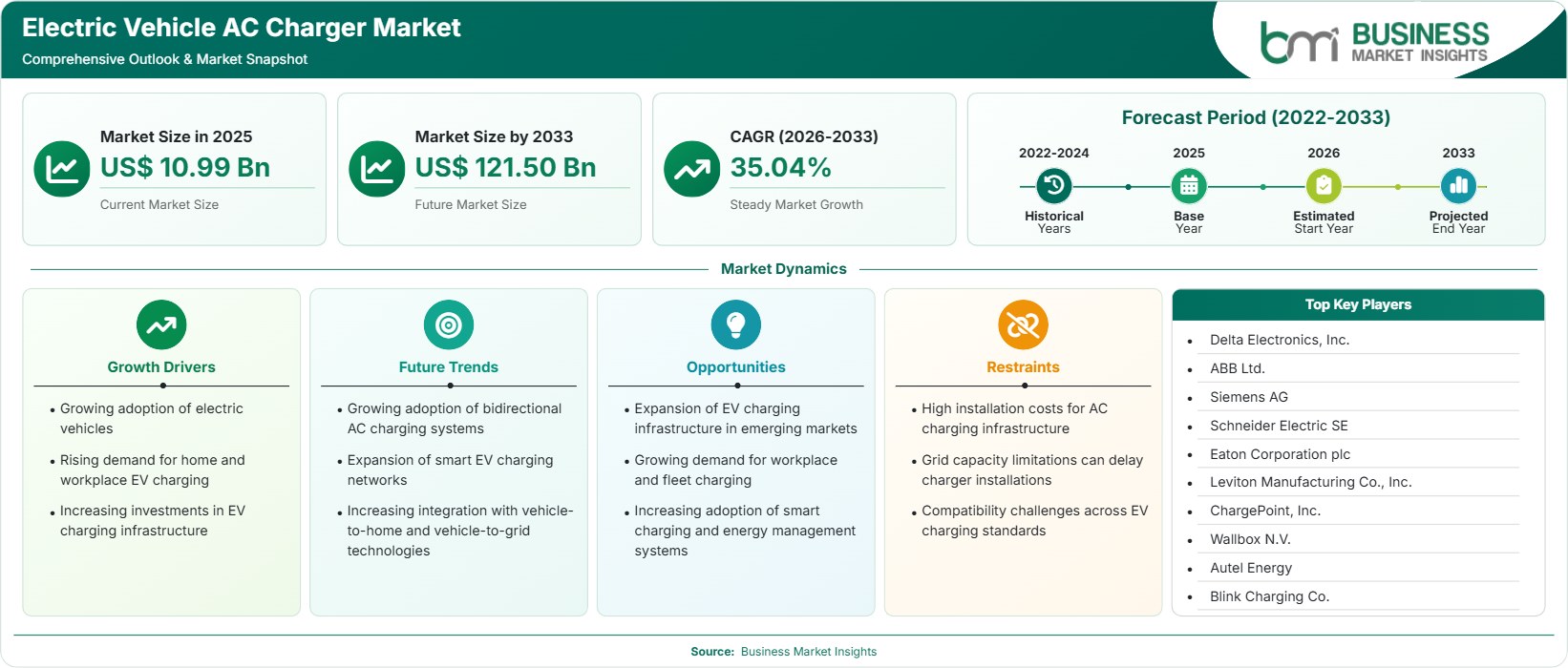
The Electric Vehicle AC Charger Market size was valued at US$ 10.99 Billion in 2025 and is projected to reach US$ 121.50 Billion by 2033, growing at a CAGR of 35.04% during 2026–2033. The market is experiencing rapid expansion due to growing adoption of electric vehicles, rising demand for home and workplace charging solutions, and increasing investments in EV charging infrastructure. Government incentives, fleet electrification initiatives, and advancements in smart charging technologies are further accelerating market growth across residential and commercial sectors.

Report Coverage
  • End-user: Residential Charging, Commercial Charging
  • Vehicle Type: BEV, PHEV
  • Product: Standard Charger, Fast Charger
US$ 10.99 Bn Market size in 2025
US$ 121.50 Bn Market Size by 2033
35.04% CAGR, 2026 - 2033
2026-2033 Forecast Period

01 AI Overview

Electric Vehicle AC Charger Market Summary

  • Asia Pacific represents a major market supported by strong EV adoption, government incentives, and expanding charging infrastructure deployment.
  • North America continues to witness substantial investments in residential and workplace charging solutions, supported by growing EV ownership.
  • Residential Charging accounts for a significant share of installations due to the convenience of home charging and increasing penetration of electric passenger vehicles.
  • BEV (Battery Electric Vehicle) remains the leading vehicle segment due to growing consumer preference for fully electric transportation solutions.
  • Standard Chargers continue to dominate the product segment owing to widespread deployment in homes, workplaces, and public parking facilities.
  • Key Companies: Delta Electronics, Inc., ABB Ltd., Siemens AG, Schneider Electric SE, Eaton Corporation plc, Leviton Manufacturing Co., Inc., ChargePoint, Inc., Wallbox N.V., Autel Energy, and Blink Charging Co.
02 Strategic Insights

Electric Vehicle AC Charger Market: Strategic Insights

Electric Vehicle AC Charger Market Strategic Framework
FREE PDF
Request your free sample
Request free sample
03 Stakeholder View

Key Takeaways

  • Increasing electric vehicle adoption worldwide is creating strong demand for accessible and cost-effective AC charging infrastructure across residential and commercial locations.
  • Residential charging remains the largest revenue-generating segment as EV owners continue to prefer convenient overnight charging at home.
  • Smart charging technologies, energy management solutions, and connected charging platforms are becoming key differentiators among market participants.
  • Asia Pacific presents substantial growth opportunities due to rapid EV adoption, supportive government policies, and expanding charging infrastructure investments.
  • Workplace charging and fleet electrification initiatives are creating new demand streams for commercial AC charging installations.
  • Integration of renewable energy sources and smart grid technologies is expected to enhance the efficiency and sustainability of future EV charging networks.
04 Geographic Outlook

Electric Vehicle AC Charger Market Regional Highlights

North America Electric Vehicle AC Charger Market

North America accounted for approximately 29%–32% share in 2025 and is projected to grow at a 34.0%–35.2% CAGR through 2033. Rising electric vehicle ownership, increasing residential charger installations, and government-supported infrastructure investments continue driving Electric Vehicle AC Charger Market growth. Utilities, charging network operators, and automotive manufacturers are actively investing in charging ecosystem expansion to support accelerating EV adoption and improve consumer charging accessibility.

  • Residential charging installations continue increasing due to rising EV sales and growing consumer preference for home charging convenience.
  • Public and workplace charging infrastructure investments are supporting broader EV adoption across urban and suburban areas.
  • Utilities are increasingly integrating smart charging technologies to support grid efficiency and energy management objectives.
  • Fleet electrification initiatives are creating new opportunities for commercial AC charging deployments.

US Electric Vehicle AC Charger Market

The United States accounts for approximately 83%–87% share within North America and is expected to expand at a 34.2%–35.5% CAGR during 2026–2033. Growth is fueled by increasing EV adoption, government incentives, and expansion of residential and workplace charging infrastructure. Strong investments by utilities, charging network providers, and automotive manufacturers continue supporting Electric Vehicle AC Charger Market development.

  • Home charging solutions remain the preferred charging option for a large share of EV owners.
  • Commercial property developers are increasingly installing EV charging facilities to attract consumers and tenants.
  • Smart charging solutions are gaining popularity due to energy management and scheduling capabilities.
  • Growing EV fleets are encouraging deployment of scalable charging infrastructure solutions.

Europe Electric Vehicle AC Charger Market

Europe represented approximately 31%–34% share in 2025 and is forecast to register a 34.7%–36.0% CAGR through 2033. Strong environmental regulations, ambitious electrification targets, and widespread EV adoption continue supporting Electric Vehicle AC Charger Market growth. Governments and private sector participants are actively investing in residential, workplace, and public charging infrastructure across the region.

  • EV adoption initiatives continue driving demand for reliable and widespread AC charging infrastructure.
  • Workplace charging installations are expanding across corporate facilities and commercial properties.
  • Smart energy management integration is becoming increasingly important for charging network operators.
  • Sustainability goals and emissions reduction strategies continue supporting charger deployment.

Asia Pacific Electric Vehicle AC Charger Market

Asia Pacific accounted for approximately 27%–30% Electric Vehicle AC Charger Market share in 2025 and is projected to witness the fastest growth at a 36.8%–38.2% CAGR through 2033. Rapid EV adoption, favorable government policies, and large-scale infrastructure investments continue accelerating market expansion. Growing urbanization and electrification initiatives are creating substantial demand for residential and commercial charging solutions.

  • China remains the largest regional market due to its extensive EV ecosystem and charging infrastructure investments.
  • India is witnessing growing charger deployment supported by national electrification initiatives.
  • Increasing apartment and commercial building installations are expanding charger accessibility.
  • Smart city development projects continue creating opportunities for EV charging providers.

Rest of World Electric Vehicle AC Charger Market

The Rest of World region accounted for approximately 6%–8% share in 2025 and is expected to grow at a 34.3%–35.6% CAGR through 2033. Increasing EV awareness, infrastructure modernization, and government support programs are driving demand across Latin America, the Middle East, and Africa. Market participants are focusing on expanding charging accessibility and supporting electric mobility adoption.

  • Governments are increasingly introducing incentives to encourage EV adoption and charging infrastructure deployment.
  • Commercial charging installations are growing across retail, hospitality, and transportation facilities.
  • Utility companies are exploring smart charging and grid integration opportunities.
  • Expanding EV availability continues supporting overall market development.
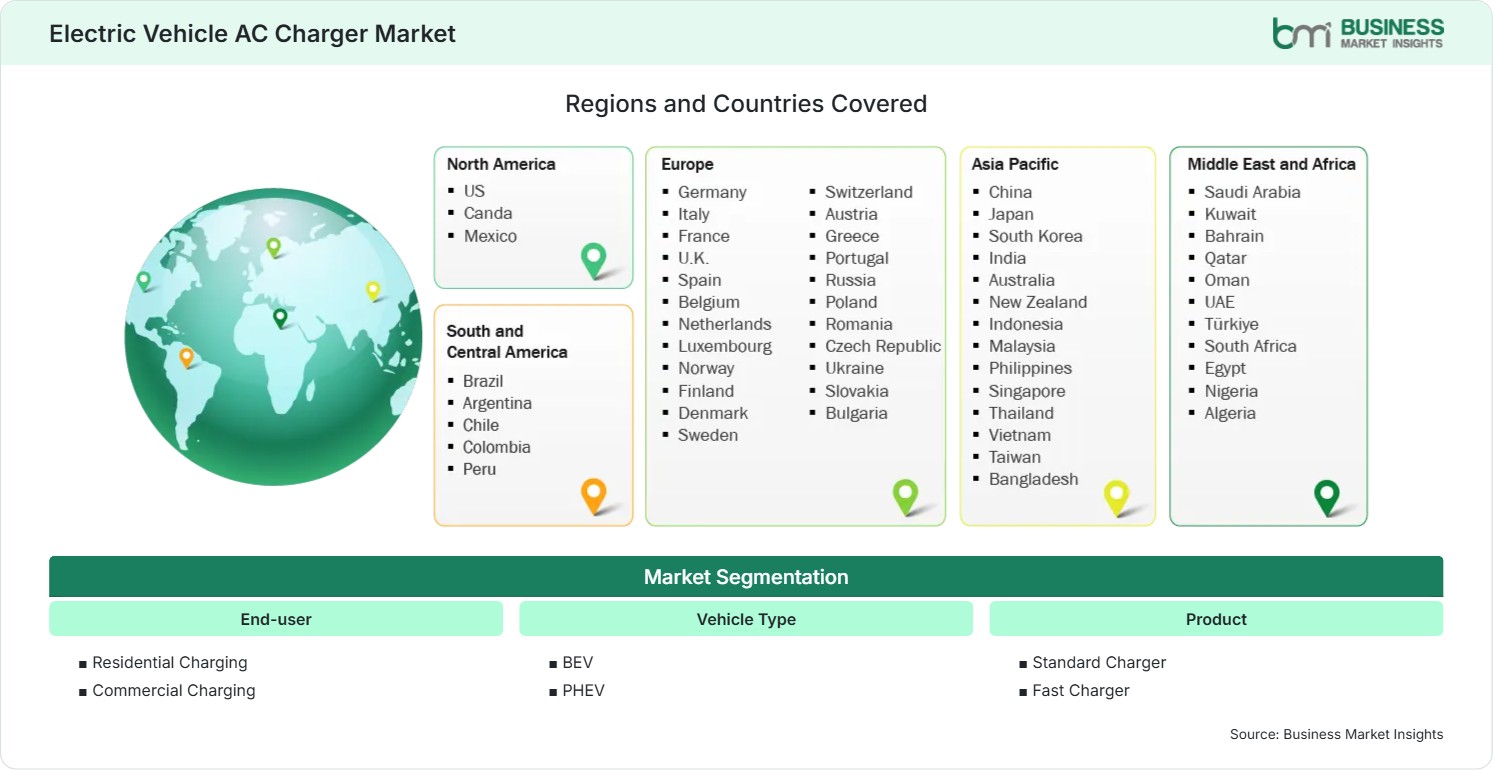
Global Market Geography
FREE PDF
Request your free sample
Request free sample
05 Segment Analysis

Electric Vehicle AC Charger Market Segmentation

End-user

The end-user segment is dominated by Residential Charging, accounting for approximately 61%–65% share in 2025 and projected to expand at a 35.8%–37.2% CAGR through 2033. The segment's growth is driven by rising electric vehicle ownership, convenience of overnight charging, lower charging costs compared to public infrastructure, and increasing availability of smart home charging solutions. Government incentives supporting residential charger installations are further accelerating Electric Vehicle AC Charger Market forecasts.

  • Residential Charging: The largest segment owing to increasing EV ownership, convenience of home charging, growing smart home integration, and expanding availability of affordable AC charging solutions.
  • Commercial Charging: Rapidly expanding due to increasing deployment across workplaces, retail centers, hotels, parking facilities, and fleet charging locations supporting growing EV adoption.

Vehicle Type

The vehicle type segment is led by BEV (Battery Electric Vehicle), accounting for approximately 72%–76% share in 2025 and expected to grow at a 36.0%–37.5% CAGR through 2033. Growing consumer preference for fully electric vehicles, expanding model availability, supportive government policies, and advancements in battery technologies continue supporting segment growth. Increasing investments in charging infrastructure further strengthen BEV adoption worldwide.

  • BEV: The dominant segment due to rising sales of fully electric vehicles, favorable regulatory policies, lower operating costs, and increasing charging infrastructure availability.
  • PHEV: Continues generating demand for AC charging solutions as consumers seek flexible transportation options combining electric and conventional driving capabilities.

Product

The product segment is dominated by Standard Chargers, accounting for approximately 67%–71% share in 2025 and projected to register a 34.6%–35.9% CAGR through 2033. Standard AC chargers remain widely utilized across residential and workplace charging environments because of their affordability, ease of installation, and suitability for daily charging requirements. Continued deployment across homes and commercial buildings supports segment leadership.

  • Standard Charger: The leading segment owing to lower installation costs, widespread compatibility, and strong suitability for residential and workplace charging applications.
  • Fast Charger: Demand is increasing due to growing requirements for reduced charging times across commercial locations, fleet operations, and high-utilization charging environments.
06 Market Forces

Electric Vehicle AC Charger Market Dynamics

Key Market Drivers

Growing Adoption of Electric Vehicles

The rapid increase in electric vehicle adoption worldwide remains one of the primary drivers supporting the electric vehicle AC charger market. Governments are implementing supportive policies, emissions reduction targets, tax incentives, and vehicle electrification programs to accelerate the transition toward sustainable transportation. Consumers are increasingly choosing electric vehicles due to lower operating costs, environmental benefits, and improvements in vehicle performance and driving range. As EV ownership continues expanding across residential and commercial segments, demand for reliable and accessible charging infrastructure is growing simultaneously. AC chargers play a critical role in enabling convenient daily charging and supporting broader EV ecosystem development, making them essential to the continued growth of electric mobility worldwide.

Rising Demand for Home and Workplace EV Charging

Charging options at home and work are playing an increasingly important role in EV purchasing decisions. Consumers prefer overnight home charging for EVs, while employers install workplace charging systems as part of their sustainability programs and employee benefits offerings. An AC charger is the most appropriate type of system to use at home or at the workplace due to its low cost, ease of installation, and ability to provide long-duration charging. The growing trend of urbanization and the increasing popularity of electric vehicles are prompting residential communities, office buildings, and commercial facilities to invest in charging stations.

Increasing Investments in EV Charging Infrastructure

The incorporation of charging stations in the private and public sectors is growing considerably as the government and other stakeholders work to ensure that transportation electrification objectives are achieved. Charging stations are being set up in residential, workplace, commercial, and public areas by utilities, car manufacturers, charging network providers, and property developers. The investment will contribute to ensuring that access to charging facilities is increased hence removing obstacles to adoption of EVs. In addition, the emergence of smarter and efficient ways of managing energy as well as charging has also been witnessed in recent years. AC charging infrastructure is therefore poised to be a critical part of the electric vehicle ecosystem worldwide.

Key Market Opportunities

Expansion of EV Charging Infrastructure in Emerging Markets

Emerging economies are increasingly investing in developing electric mobility ecosystems to reduce transport emissions, increase energy security, and develop sustainable urban areas. In Asia, Latin America, Middle East and parts of Africa, governments have been creating incentives, infrastructure development plans and frameworks which are designed to drive the use of electric vehicle charging stations. With the rapid uptake of electric vehicles, demand for efficient AC charging systems will continue to grow. Installations of such chargers will be done in residential areas, office complexes, public parking sites among others. Growth potential in emerging markets will be huge for charger companies and technologies developers.

Growing Demand for Workplace and Fleet Charging

Organizations are increasingly deploying EV charging stations at workplaces and fleet facilities to support employee vehicles and electrified transportation operations. Workplace charging is becoming an attractive benefit for employees while helping organizations achieve sustainability objectives and reduce carbon emissions. Fleet providers are also investing in charging infrastructure to facilitate the transition of delivery vans, fleet cars, and other corporate transportation vehicles to electric mobility. AC chargers are especially suited to workplaces and fleets where vehicles spend more time idle. With the rapid growth in the electrification of commercial transport worldwide, workplace and fleet charging installations are likely to be in high demand for AC chargers.

Increasing Adoption of Smart Charging and Energy Management Systems

The increasing digitization of electric vehicle charging stations creates many opportunities to implement smart AC chargers. Intelligent charging technologies include such features as remote monitoring, load balancing, user authentication, energy optimization, participation in demand response and the use of renewable energy sources. Many companies, organizations, and private consumers are now interested in adopting such charging technologies that would help them use electricity more efficiently and cut operational costs. As intelligent energy systems develop further, there will be an increased adoption of AC charging technology.

Market Restraints and Challenges

High Installation Costs for AC Charging Infrastructure

Factor: Establishing AC charging infrastructure often requires investments in electrical upgrades, wiring systems, charging hardware, installation services, permitting procedures, and grid connectivity improvements. Commercial deployments may involve additional costs related to site preparation, network integration, software management platforms, and ongoing maintenance.

Impact: Higher installation costs may deter the expansion of charging networks, especially for small businesses, homeowners, and cost-conscious consumers. Delays in decision-making may hinder the establishment of the charging network and limit its availability to EV drivers. Budgetary constraints may be one of the deterrents to the technology's penetration rate in developing countries.

Compatibility Challenges Across EV Charging Standards

Factor: The EV industry includes multiple charging standards, connector types, communication protocols, and vehicle-specific requirements that vary across regions and manufacturers. Ensuring interoperability among chargers, vehicles, and charging management systems often requires additional technical integration and compliance measures. Differences in charging requirements can create complexity for infrastructure providers and end users.

Impact: Compatibility challenges may increase installation complexity, operational costs, and end-user confusion regarding charging accessibility. Businesses deploying charging infrastructure must often accommodate multiple vehicle types and standards, increasing system requirements and investment needs. These interoperability concerns can slow infrastructure deployment and create barriers to seamless charging experiences. Addressing standardization and compatibility issues remains important for supporting long-term market expansion and consumer confidence in electric mobility solutions.

07 Company Analysis

Competitive Landscape

The competitive landscape is characterized by rapid innovation in smart charging technologies, energy management systems, connected charging platforms, and residential and commercial charging solutions. The Electric Vehicle AC Charger Market analysis indicates that leading companies are focusing on expanding charging networks, improving interoperability, integrating renewable energy capabilities, and developing intelligent charging solutions that enhance user experience and grid efficiency. Strategic partnerships with automakers, utilities, and infrastructure providers continue shaping market competition.

Company Name

Overview

Products and Services relevant to this market

Delta Electronics, Inc.

Global provider of power management and energy-efficient solutions with a strong presence in EV charging infrastructure.

AC EV chargers, smart charging systems, energy management solutions, residential chargers, and commercial charging equipment.

ABB Ltd.

Electrification and automation leader offering advanced EV charging technologies worldwide.

AC charging stations, connected charging solutions, energy monitoring systems, and EV infrastructure services.

Siemens AG

Technology company focused on smart infrastructure and sustainable mobility solutions.

EV charging equipment, smart charging software, building-integrated charging systems, and grid management solutions.

Schneider Electric SE

Energy management company delivering integrated EV charging and power distribution technologies.

Residential chargers, commercial charging stations, energy management platforms, and smart charging solutions.

Eaton Corporation plc

Power management company providing EV charging technologies and electrical infrastructure solutions.

AC EV chargers, charging management systems, electrical distribution solutions, and commercial charging equipment.

Leviton Manufacturing Co., Inc.

Electrical solutions provider with a broad portfolio of residential and commercial charging products.

Home EV chargers, commercial charging stations, connected charging systems, and smart energy solutions.

ChargePoint, Inc.

Leading EV charging network operator providing hardware, software, and charging services globally.

AC charging stations, charging network services, fleet charging solutions, and cloud-based charging management platforms.

Wallbox N.V.

Technology company specializing in smart EV charging and energy optimization solutions.

Smart AC chargers, energy management systems, residential charging equipment, and connected charging software.

Autel Energy

EV charging technology provider focused on intelligent and scalable charging infrastructure.

AC charging stations, smart charging solutions, commercial chargers, and charging management platforms.

Blink Charging Co.

Charging infrastructure company offering EV charging equipment and network services.

AC chargers, commercial charging solutions, charging network services, and fleet charging technologies.

10 Trust & Transparency

Research Methodology

The market analysis combines proprietary research with secondary data from government agencies, company disclosures, regulatory filings, industry databases and expert interviews. Market estimates are validated through data triangulation, cross-market benchmarking and analyst review.

View Full Research Methodology

11 Questions Answered

Frequently Asked Questions

What are the main challenges facing the Electric Vehicle AC Charger Market?

Key challenges include high installation costs for charging infrastructure and compatibility issues arising from differing charging standards, connectors, and communication protocols.

Which product segment holds the largest share?

Standard AC chargers account for the largest share because of their affordability, ease of installation, broad compatibility, and suitability for daily charging requirements.

Why are BEVs driving charger demand?

Battery Electric Vehicles rely entirely on electric charging infrastructure, creating significant demand for residential, workplace, and public charging solutions as EV adoption increases globally.

Which end-user segment dominates the Electric Vehicle AC Charger Market report?

Residential charging represents the largest market segment due to increasing EV ownership, convenience of home charging, and growing adoption of smart charging systems.

What is an EV AC charger?

An EV AC charger supplies alternating current to electric vehicles, allowing the vehicle's onboard charger to convert the electricity into direct current for battery charging. These chargers are commonly used in homes, workplaces, and commercial locations.

Access the Full Electric Vehicle AC Charger Market Report

Get segment-level forecasts, regional estimates, competitive benchmarking, company profiles and downloadable Excel datasets.

Access the full Electric Vehicle AC Charger Market Report
350 pages PDF & Excel | 2026-08-20