Market Summary
Executive Summary and Global Market Analysis
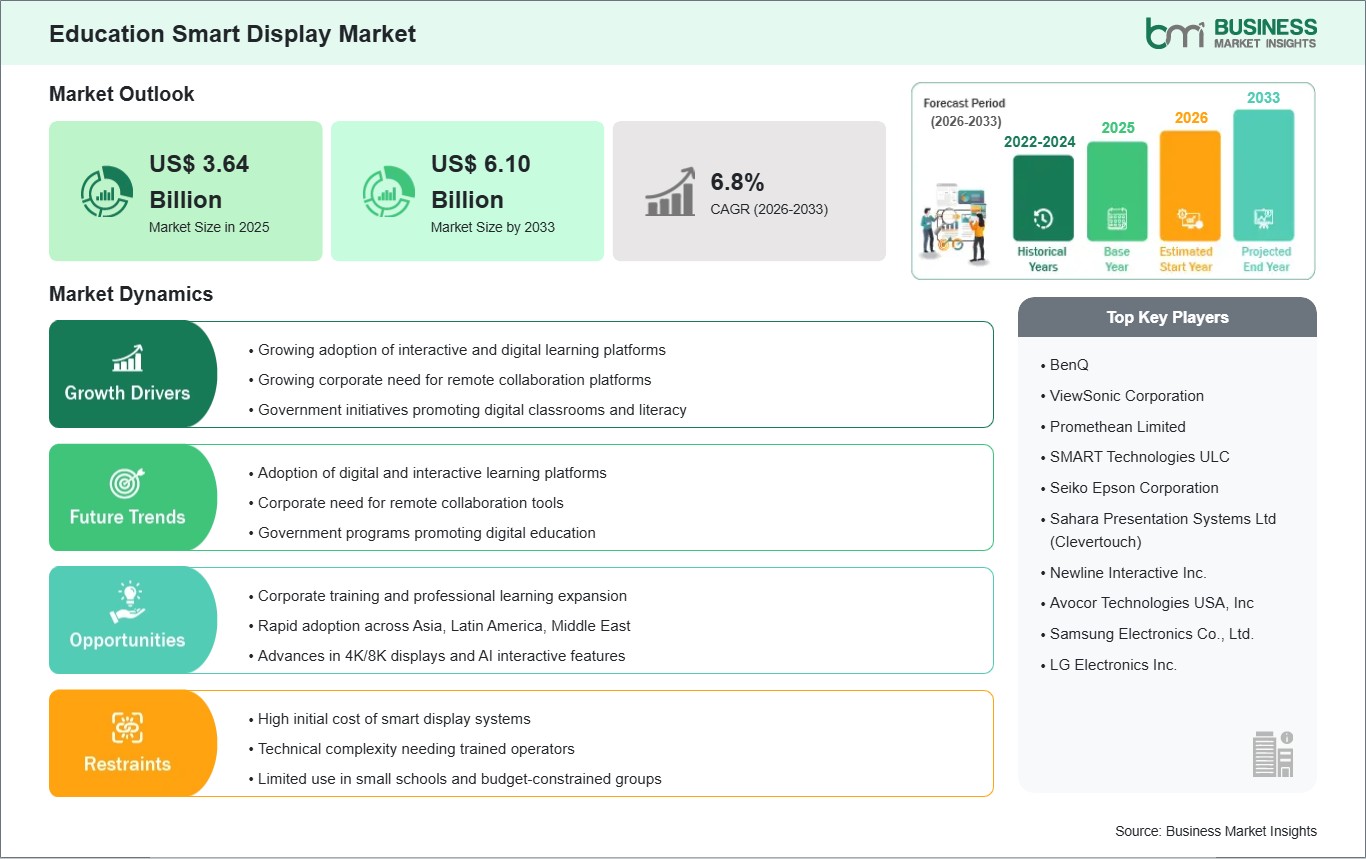
The global Education Smart Display market is witnessing robust growth driven by the increasing adoption of interactive and digital learning solutions across schools, universities, and corporate training centers. The growing demand for technology-enabled classrooms and remote learning tools has accelerated the adoption of smart displays that facilitate real-time collaboration, multimedia presentations, and e-learning integration. Corporate sectors are also adopting smart displays for workshops, virtual meetings, and professional development programs, further expanding the market. Technological advancements, such as high-resolution displays, LED/OLED panels, touchscreen interactivity, and wireless connectivity, are enhancing usability and performance. The market is characterized by investments in hybrid and remote learning infrastructure, particularly in North America and Europe, while emerging economies in Asia Pacific and Latin America are rapidly adopting smart displays due to government initiatives, digital literacy programs, and corporate infrastructure development. Overall, the market is expected to grow steadily as education and corporate sectors prioritize interactive, collaborative, and technology-enabled environments.
Segment Analysis
Education Smart Display Market Segmentation
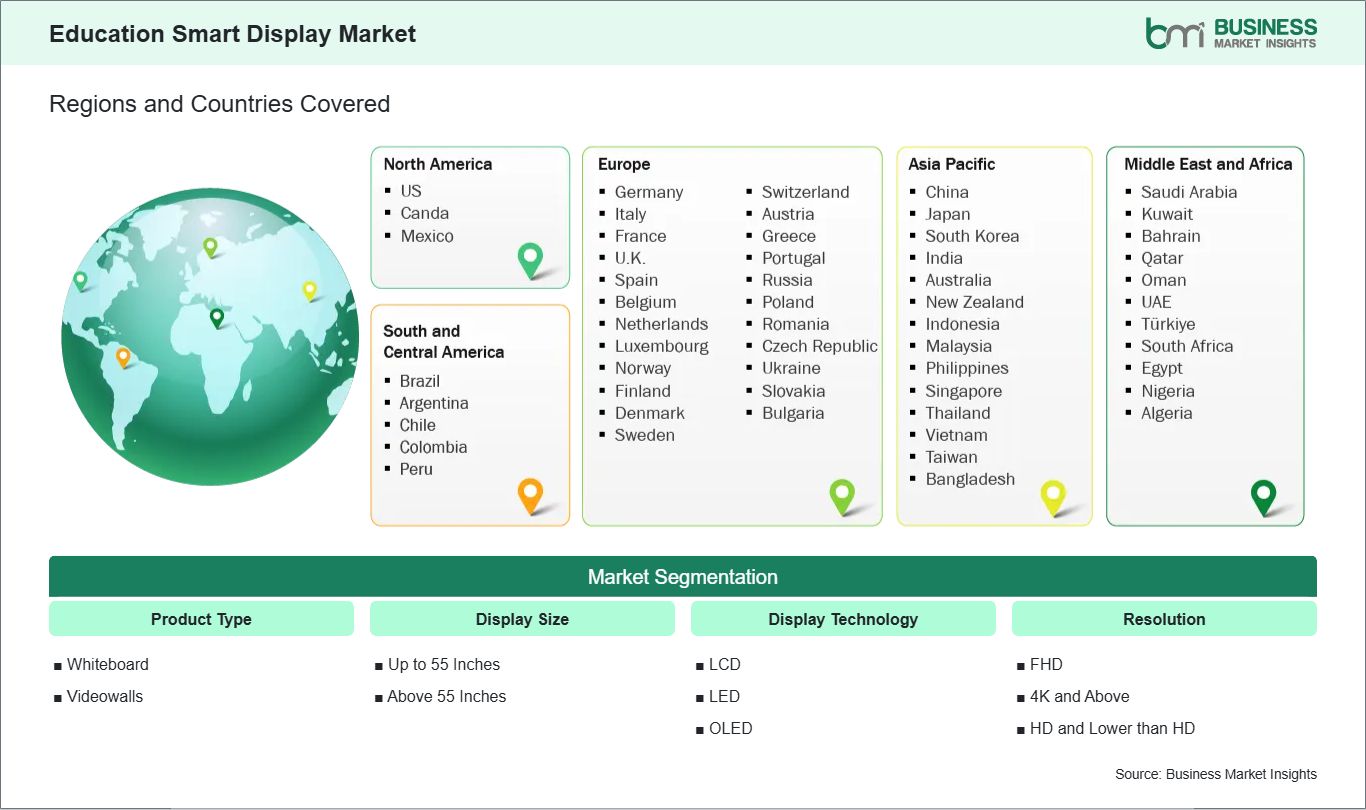
Key segments that contributed to the derivation of the Education Smart Display market analysis are product type, display size, display technology, resolution.
- Based on product type, the market is segmented into Whiteboards and Videowalls. Among these, the Whiteboard segment accounted for the largest share in 2025.
- Based on display size, the market is segmented into Up to 55 Inches and Above 55 Inches. Among these, the Up to 55 Inches segment held the largest share in 2025.
- Based on display technology, the market is segmented into LCD, LED, and OLED. Among these, the LCD segment dominated in 2025.
- Based on resolution, the market is segmented into FHD, 4K and Above, and HD/Lower than HD. Among these, the FHD segment accounted for the largest share in 2025.
Market Forces
Education Smart Display Market Drivers and Opportunities
Increasing Adoption of Interactive and Digital Learning in Education
The rising emphasis on digital transformation and interactive learning is a primary driver for the Education Smart Display market. Schools, colleges, and universities are increasingly adopting technology-enabled classrooms to enhance student engagement, collaboration, and overall learning outcomes. Smart displays facilitate interactive teaching by enabling real-time annotations, multimedia presentations, and integration with e-learning platforms. The growth of remote and hybrid learning models, accelerated by the COVID-19 pandemic, has further strengthened the need for high-quality, reliable display solutions. Additionally, government initiatives in several regions to modernize classrooms and promote digital literacy are boosting the adoption of smart display technology. Corporate training programs are also adopting smart displays for presentations, workshops, and remote collaboration, creating complementary growth. Overall, the convergence of educational modernization, government support, and digital learning trends is driving the demand for smart displays across global education and corporate sectors.
Expansion in Corporate Training and Emerging Markets
Corporate training and professional development programs present a significant growth opportunity for the Education Smart Display market. Organizations are increasingly relying on digital tools to conduct workshops, meetings, and training sessions across distributed teams. Smart displays enhance visual communication, collaboration, and engagement, making them essential for corporate offices, training centers, and co-working environments. Additionally, emerging markets in Asia Pacific, Latin America, and the Middle East are investing heavily in modernizing classrooms, office infrastructure, and training facilities, creating a new demand segment for smart displays. These regions are experiencing rapid urbanization, increased technology adoption, and growing awareness of interactive learning benefits. The combination of corporate adoption and emerging market investments provides substantial growth potential, particularly for high-resolution, energy-efficient, and portable smart display solutions. Manufacturers focusing on scalable, cost-effective, and technologically advanced displays are likely to capitalize on this expanding opportunity globally.
Size and Share Analysis
Education Smart Display Market Size and Share Analysis
Based on product type, the market is segmented into Whiteboards and Videowalls. Among these, the Whiteboard segment accounted for the largest share in 2025 due to its versatility, widespread adoption in classrooms, and cost-effectiveness for interactive teaching.
Based on display size, the market is segmented into Up to 55 Inches and Above 55 Inches. Among these, the Up to 55 Inches segment held the largest share in 2025 as it fits standard classroom and meeting room settings while being more affordable and easier to install.
Based on display technology, the market is segmented into LCD, LED, and OLED. Among these, the LCD segment dominated in 2025 due to its reliability, lower cost, and energy efficiency compared to other technologies.
Based on resolution, the market is segmented into FHD, 4K and Above, and HD/Lower than HD. Among these, the FHD segment accounted for the largest share in 2025 because it offers a balance of high-quality visuals and affordability for educational and corporate applications.
Report Coverage
Education Smart Display Market Report Coverage and Deliverables
The "Education Smart Display Market Size and Forecast (2022 - 2033)" report provides a detailed analysis of the market covering below areas:
- Education Smart Display market size and forecast at global, regional, and country levels for all the key market segments covered under the scope
- Education Smart Display market trends, as well as market dynamics such as drivers, restraints, and key opportunities
- Education Smart Display market analysis covering key market trends, global and regional framework, major players, regulations, and recent market developments
- Industry landscape and competition analysis covering market concentration, heat map analysis, prominent players, and recent developments for the Education Smart Display market
- Detailed company profiles, including SWOT analysis
Geographic Insights
Education Smart Display Market Geographic Insights
The geographical scope of the Education Smart Display market report is divided into five regions: North America, Asia Pacific, Europe, Middle East and Africa, and South and Central America. The Education Smart Display market in Asia Pacific is expected to grow significantly during the forecast period.
North America dominates the Education Smart Display market, led by the United States and Canada, where advanced digital infrastructure, government initiatives, and high adoption of interactive learning tools drive demand. The region benefits from widespread implementation of hybrid classrooms and corporate training programs, reinforcing its market share. Europe holds a substantial share, with countries like the UK, Germany, and France investing heavily in technology-enabled education and professional development solutions. Smart display adoption is supported by government policies promoting digital learning, corporate infrastructure modernization, and interactive teaching tools.
Asia Pacific is witnessing the fastest growth, driven by countries such as China, India, Japan, and Southeast Asia. Rapid urbanization, rising digital literacy, government programs for modern classrooms, and increased corporate adoption are fueling the demand for smart displays. South and Central America and the Middle East and Africa are emerging markets, experiencing gradual adoption as digital classroom infrastructure and corporate training programs expand. Overall, regional trends indicate strong global growth, driven by education modernization, corporate adoption, and technology integration initiatives.
Industry Activity
Recent Developments
The Education Smart Display market is evaluated by gathering qualitative and quantitative data post primary and secondary research, which includes important corporate publications, association data, and databases. A few of the key developments in the Education Smart Display market are:
- In June2025, SMART Technologies announced the launch of its new affordable interactive display board, the SMART Board GX Plus, at the International Society for Technology in Education (ISTE) 2025 event in San Antonio. The board is designed to provide modern learning experiences at an accessible price point for educational institutions navigating budget constraints. The SMART Board GX Plus supports multi‑user interactivity, seamless integration with Android, Google EDLA, and Microsoft software, and built‑in teaching tools to enhance classroom engagement. It also includes AI‑driven features such as quiz generation, text and shape recognition, and an “AI lens” for image identification and math problem solving, aimed at saving teachers time and improving lesson delivery. SMART Technologies emphasizes that the display offers high performance and greater energy efficiency compared to rival devices, making it an attractive option for schools seeking future‑ready technology without excessive costs.
Trust & Transparency
Research Methodology
The market analysis combines proprietary research with secondary data from government agencies, company disclosures, regulatory filings, industry databases and expert interviews. Market estimates are validated through data triangulation, cross-market benchmarking and analyst
review.
View Full Research Methodology
Key Sources Referred:
World Bank - Global Trade IndicatorsWorld Trade Organization (WTO)International Monetary Fund (IMF)International Trade Administration (ITA)Company websiteCompany annual reportsCompany investor presentations