
Drone Simulator Market Outlook: Size, Share, Trends, Growth Analysis, Competitive Landscape & Forecast, 2026-2033

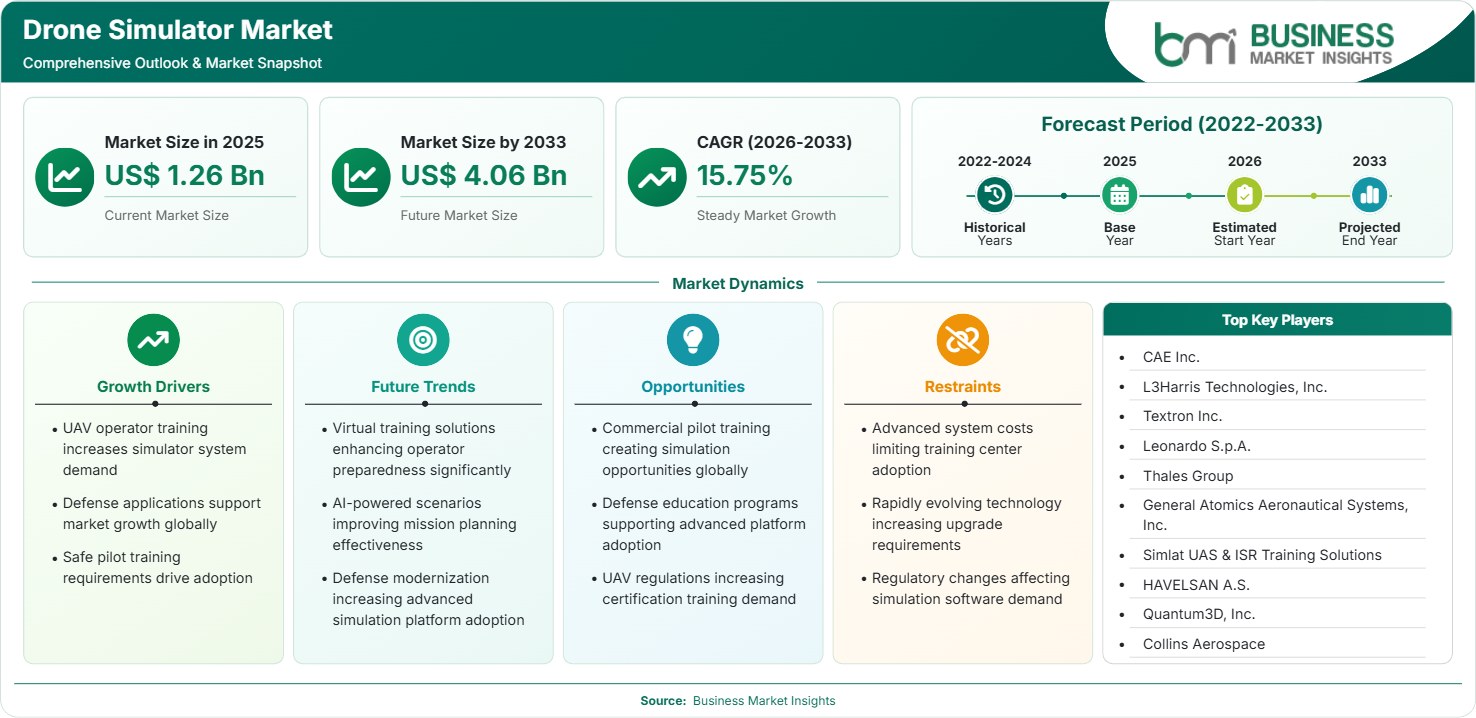
The Drone Simulator Market size was valued at US$ 1.26 Billion in 2025 and is projected to reach US$ 4.06 Billion by 2033, growing at a CAGR of 15.75% during 2026–2033, driven by expanding drone pilot training requirements, defense modernization programs, commercial UAV adoption, immersive simulation technologies, regulatory compliance needs, and increasing investments in AI-enabled virtual training environments.

Report Coverage
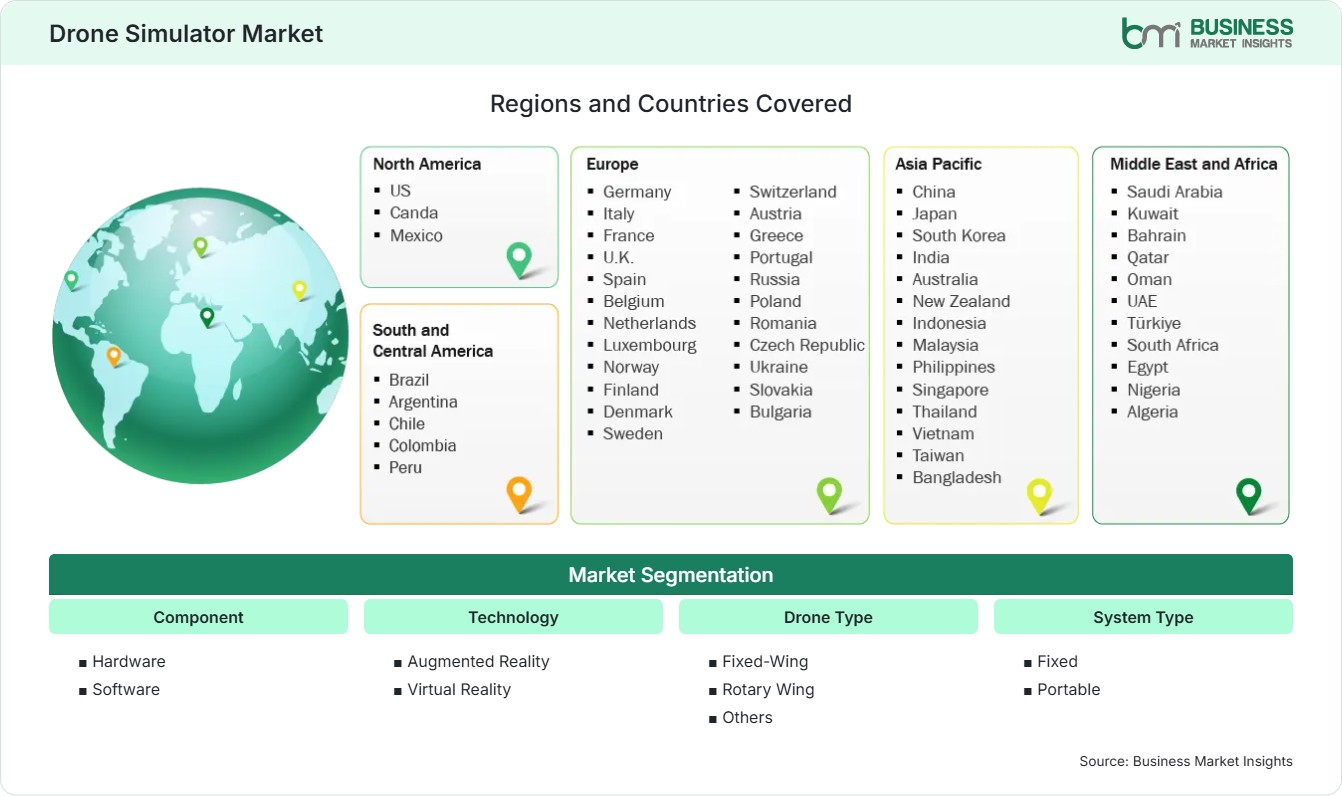
  • Component: Hardware, Software
  • Technology: Augmented Reality, Virtual Reality
  • Drone Type: Fixed-Wing, Rotary Wing, Others
  • System Type: Fixed, Portable
  • Application: Commercial, Military
US$ 1.26 Bn Market size in 2025
US$ 4.06 Bn Market Size by 2033
15.75% CAGR, 2026 - 2033
2026-2033 Forecast Period

AI Overview

Drone Simulator Market Summary

  • North America Region: North America holds a market share of 36%–39% in 2025, growing at a CAGR of 14.5%–15.5% during 2026–2033. Strong defense procurement, FAA-aligned training requirements, enterprise drone deployments, advanced simulation software adoption, growing beyond-visual-line-of-sight preparation, and rising investments in immersive pilot training platforms support continued expansion.
  • Fastest Growing Region: Asia Pacific accounts for a 24%–27% share in 2025 and is expected to grow at a 17.5%–18.8% CAGR during 2026–2033. Expanding drone manufacturing ecosystems, government-backed aviation initiatives, agricultural automation, smart city investments, military training demand, and greater accessibility of cost-efficient simulation tools accelerate regional momentum.
  • Leading Segment: Hardware represents 54%–58% of the Drone Simulator Market share in 2025 and advances at 14.5%–15.5% CAGR during 2026–2033. Demand remains supported by motion platforms, control stations, display systems, realistic cockpit environments, institutional procurement programs, and continuous upgrades enhancing operational readiness and pilot competency.
  • High Growth Segment: Virtual Reality captures a 31%–35% share in 2025 and grows at 18.0%–19.5% CAGR during 2026–2033. Wider deployment of immersive environments, realistic mission replication, lower field-training risks, enhanced trainee engagement, scalable instruction programs, and integration with AI-driven analytics contribute substantially to adoption.
  • Key Market Opportunity: Expansion of cloud-connected simulation ecosystems enables remote pilot certification, collaborative mission rehearsal, scalable enterprise training, recurring software revenue models, enhanced analytics capabilities, and wider accessibility across emerging commercial drone operators globally.
  • Major Market Players: CAE Inc., L3Harris Technologies, Inc., Textron Inc., Leonardo S.p.A., Thales Group, General Atomics Aeronautical Systems, Inc., Simlat UAS & ISR Training Solutions, HAVELSAN A.S., Quantum3D, Inc., Collins Aerospace.
Strategic Insights

Drone Simulator Market: Strategic Insights

Drone Simulator Market Strategic Framework
FREE PDF
Request your free sample
Request free sample
Stakeholder View

Key Takeaways

  • The value chain is increasingly software-driven, with training organizations, defense agencies, UAV manufacturers, hardware suppliers, and analytics providers all forming integrated ecosystems to provide ongoing pilot development throughout the lifecycle of operations rather than just at the point of certification.
  • Commercial deployments in the areas of logistics, infrastructure inspection, precision agriculture, energy asset monitoring, and public safety are all areas that make sense as potential areas for expansion. These are organizations that are looking for a scalable training environment to be able to train an ever-increasing number of pilots and autonomous system operators.
  • Innovation is moving from simple flight simulation to AI-assisted mission planning, adaptive learning pathways, synthetic environments, and digital twin integration. This enables training providers to replicate the complexity of real-world operations to a much greater degree of accuracy and efficiency.
  • Asia Pacific is a very attractive investment destination with drone manufacturing capacity expanding, government support in place, defense modernization underway, and a growing requirement for highly skilled UAV personnel in both the commercial and public sectors.
  • Strategic partnerships between simulator developers, UAV manufacturers and the defense organizations are on the increase. The market players are looking at acquisitions and joint ventures as a way of expanding the software capability, increasing the level of realism and, of course, extending the recurring revenue from the training services.
  • Regulatory alignment is becoming a real differentiator. The providers who can support the evolving pilot qualification requirements, the standardized training modules, and the compliance documentation are the ones that are going to end up with better long-term customer retention and more institutional contracts.
Geographic Outlook

Drone Simulator Market Regional Highlights

North America Drone Simulator Market

North America maintains leadership with a 36%–39% Drone Simulator Market share in 2025 and is projected to record a 14.5%–15.5% CAGR between 2026 and 2033. Regional demand is supported by extensive defense spending, mature commercial UAV deployment, and an established training infrastructure.

  • Defense agencies continue integrating advanced virtual training systems to reduce operational costs while improving pilot preparedness for increasingly sophisticated unmanned missions across surveillance, intelligence gathering, and tactical operations.
  • The commercial ecosystem is seeing real benefit from the expansion of applications in logistics, energy inspection, telecom, and public safety, which in turn generates a continuing need for scalable training environments and certification-based simulation.
  • Universities and aviation training organizations are integrating immersive learning technologies into their drone training programs to enhance their ability to develop the workforce and to encourage greater uptake by new entrants.
  • Software developers are increasingly looking at AI-powered training analytics which can assess pilot behavior, mission performance and the quality of decisions made. The aim is to improve the measurable outcomes of training.
  • Increasing interest in BLOS operations is driving investment in more sophisticated simulation environments that can replicate the regulatory, environmental, and operational complexities.

US Drone Simulator Market

The U.S. represents approximately 78%–82% of regional Drone Simulator Market revenue and is expected to expand at a 15.0%–16.0% CAGR through 2033. Demand stems from defense innovation programs, growing enterprise drone fleets, and increasing emphasis on operational safety.

  • Large-scale defense procurement programs create a constant requirement for mission-specific simulation systems to support the conduct of advanced UAS operations and to meet readiness requirements.
  • Enterprise drone adoption in the utility, infrastructure inspection and logistics sectors is generating demand for cost-effective pilot training solutions that have the ability to provide measurable performance assessment.
  • Tech vendors are now offering cloud-enabled training architectures which enable distributed learning, collaborative exercises and centralized performance management.
  • Research institutes are making a contribution to innovation in the area of navigation (autonomous), virtual environments and human-machine interaction (all of which are relevant to simulator applications).

Europe Drone Simulator Market

Europe accounts for 27%–30% of the Drone Simulator Market share in 2025 and is forecast to grow at a 14.8%–16.0% CAGR during 2026–2033. Regional expansion is supported by strong regulatory frameworks, rising defense collaboration, and increasing commercial drone deployments.

  • European defense organizations are increasingly focused on simulation-based readiness programs, which are intended to improve the efficiency of training and, at the same time, reduce the cost of equipment utilization.
  • Regulatory emphasis on operational safety and certification requirements has led to the widespread adoption of structured pilot training in the commercial arena.
  • Aerospace companies are forging partnerships with technology developers to provide improved simulation capability and mission-specific learning environments.
  • Germany has a strong industrial base and a very capable aerospace sector, which in turn provides it with a wealth of opportunities for technology deployment.
  • Poland has significant growth potential with defense procurement programs in full swing and increased investment in unmanned systems.

Asia Pacific Drone Simulator Market

Asia Pacific represents 24%–27% of the Drone Simulator Market share in 2025 and is anticipated to register the fastest regional expansion at a 17.5%–18.8% CAGR between 2026 and 2033. Regional growth is supported by expanding UAV manufacturing, strong government backing for unmanned systems, and increasing military modernization programs.

  • China has the capability to produce a huge number of UAVs, has very strong domestic demand, and is seeing a significant increase in the use of simulation platforms for defense, industrial, and public sector training.
  • India is in a strong phase of development with defense modernization, its indigenous drone programs, and a regulatory environment that is actively encouraging the wider adoption of professional pilot training environments.
  • Agriculture, mining, and infrastructure inspection applications are all growing rapidly, and this is generating a continuous demand for effective and scalable operator training solutions.
  • Governments throughout the region are increasingly backing domestic aerospace innovation initiatives aimed at building up technological self-sufficiency and workforce capability.
  • Cloud-based and VR-enabled training solutions are becoming increasingly attractive for educational organizations due to the lower cost of deployment and greater accessibility.

Rest of World Drone Simulator Market

The Rest of World region accounts for approximately 8%–10% Drone Simulator Market share in 2025 and is forecast to expand at a 15.8%–17.0% CAGR during 2026–2033. South and Central America benefit from growing agricultural drone deployments and public safety investments. Brazil remains the leading market within the subregion.

  • Brazil has the benefit of increasing adoption of precision agriculture, increasing use of commercial UAVs, and a growing requirement for training in relation to large-scale farming and environmental monitoring operations.
  • Public sector agencies across Latin America are looking at the use of simulation technologies to improve their disaster response preparedness, their ability to assess infrastructure and their security mission effectiveness.
  • Saudi Arabia is continuing its investment in defense modernization and in the development of advanced training infrastructure with a view to procuring sophisticated virtual learning and mission rehearsal systems.
  • The UAE has real growth potential via smart mobility, its technology-led economic diversification and the burgeoning commercial UAV market.
  • Cross-border security requirements and critical infrastructure protection programs are fuelling interest in realistic, mission-based training platforms across the region.
Global Market Geography
FREE PDF
Request your free sample
Request free sample
Segment Analysis

Drone Simulator Market Segmentation

Component

The component segment accounts for the largest revenue contribution within the industry, with a market share of 100% by definition of segmentation coverage. The Drone Simulator Market scope continues expanding with demand for realistic training environments, analytics tools, and scalable deployment capabilities.

  • Hardware: Hardware platforms provide realistic operator experiences through controllers, motion systems, displays, cockpit modules, and integrated peripherals. Demand remains closely linked to defense programs and institutional training facilities requiring high-fidelity simulation environments.
  • Software: Software solutions enable mission planning, training analytics, environmental modeling, performance assessment, and scenario customization. Cloud delivery models and AI-enabled capabilities increasingly support broader deployment across commercial and educational organizations.

Technology

Technology adoption is increasingly centered on immersive training experiences. This segment is expected to grow at a 16.0%–17.0% CAGR through 2033, supported by investments in augmented and virtual environments. The phrase Drone Simulator Market trends is increasingly associated with immersive simulation technologies capable of enhancing operational realism, reducing training risks, and improving pilot engagement. Broadening use cases across defense and commercial applications continue to accelerate penetration.

  • Augmented Reality: Augmented reality solutions overlay operational information onto training environments, improving situational awareness and enabling realistic mission rehearsals for surveillance, inspection, and navigation-related applications.
  • Virtual Reality: Virtual reality platforms create fully immersive environments that replicate complex operational scenarios, supporting advanced pilot development, decision-making exercises, and scalable remote training initiatives.

Drone Type

Demand varies according to platform architecture and end-use requirements. The Drone Simulator Market segment is projected to expand at a 15.0%–16.5% CAGR during the forecast period, reflecting growth across commercial and military applications. Fixed-wing systems maintain strong utilization in long-range missions, whereas rotary-wing platforms dominate shorter-range operational scenarios.

  • Fixed-Wing: Fixed-wing simulators focus on endurance missions, mapping operations, defense reconnaissance, and large-area monitoring activities where flight dynamics differ significantly from multirotor configurations.
  • Rotary Wing: Rotary-wing training systems support precise maneuvering, inspection tasks, public safety operations, and urban deployments requiring advanced hovering and navigation capabilities.

System Type

System configurations are evolving to support both permanent facilities and mobile deployment requirements. The Drone Simulator Market segment is forecast to achieve a 15.5%–16.5% CAGR through 2033, supported by growing demand from training institutions and defense organizations. Fixed installations continue to dominate high-fidelity applications, while portable solutions expand accessibility and cost efficiency for distributed learning programs.

  • Fixed: Fixed systems deliver comprehensive training capabilities through dedicated infrastructure, advanced visualization technologies, and extensive mission customization functionalities suited for institutional environments.
  • Portable: Portable platforms enable flexible deployment, field-based instruction, and lower implementation costs while allowing organizations to expand training access across geographically dispersed locations.

Application

Application demand reflects the broadening role of unmanned systems across defense and commercial operations. This Drone Simulator Market segment is expected to register a 15.8%–17.2% CAGR between 2026 and 2033, supported by increasing workforce development needs. Commercial users continue expanding training investments, while military organizations require advanced mission-specific simulation capabilities to enhance operational preparedness and readiness.

  • Commercial: Commercial users deploy simulation technologies for logistics, agriculture, infrastructure inspection, construction monitoring, telecommunications support, and public safety training requirements.
  • Military: Military organizations utilize advanced simulation platforms to improve mission readiness, tactical coordination, operational safety, and cost-effective preparation for increasingly sophisticated unmanned operations.
Market Forces

Drone Simulator Market Dynamics

Key Market Drivers

Expansion of Defense Drone Training Programs

Defense organizations across major economies are expanding unmanned aerial capabilities and increasing investment in simulation-led training environments. Military operators require advanced mission rehearsal platforms capable of replicating surveillance, reconnaissance, electronic warfare, and tactical deployment scenarios. Training efficiency gains and readiness improvements are encouraging institutional adoption worldwide. These developments continue supporting long-term Drone Simulator Market expansion and strengthening demand across defense-focused training ecosystems.

Growth in Commercial Drone Deployments

Commercial adoption of UAV technologies continues accelerating across logistics, agriculture, utilities, infrastructure inspection, telecommunications, and emergency services. As fleet sizes increase, organizations require scalable methods to train operators while maintaining safety and compliance standards. Drone Simulator Market growth is reinforced by enterprise requirements for cost-effective pilot development programs capable of reducing operational incidents. Simulation environments provide realistic flight experiences without exposing expensive equipment to unnecessary risks.

Advancement of Immersive Simulation Technologies

The rate of innovation in visualization technologies, physics engines, AI, and digital twin architectures is having a massive impact on training effectiveness. The modern platform can deliver a highly realistic environment with dynamic mission parameters and performance analytics that can actually improve the learning outcome. There's a real drive in the industry to provide immersive experiences that will in turn improve operator confidence and the quality of their decisions. The integration of VR, AR, and adaptive learning is all part of the move to create a more tailored and effective training experience.

Key Market Opportunities

Cloud-Based Training Ecosystems and Remote Certification

Cloud-native simulator architectures are creating new revenue opportunities by enabling organizations to deliver training across geographically distributed locations without requiring dedicated physical infrastructure. Training providers can serve larger pilot populations while reducing deployment and maintenance costs. The opportunity is particularly attractive in emerging drone markets where aviation training capacity remains limited. Drone Simulator Market Forecasts increasingly reflect adoption of subscription-based software models that generate recurring revenues and improve customer retention.

Growing Civil Aviation and Urban Air Mobility Applications

The evolution of urban air mobility concepts, drone delivery networks, emergency medical logistics, and smart city aviation is driving the need for new training requirements. The scenarios that will be encountered in these applications are complex and will require pilots and operators to be fully proficient in navigation, traffic management, and safety before they are ever allowed to operate in the real world. Simulation is the way to go in terms of preparing the workforce and meeting regulatory requirements.

Expansion Across Educational and Workforce Development Programs

Academic institutions, vocational academies, defense training schools, and technical workforce development centers are increasingly integrating unmanned aviation curricula into their programs. This creates a significant Drone Simulator Market opportunity for simulator providers to establish long-term customer relationships through educational deployments. Simulation platforms help institutions reduce training costs while delivering practical experience in safe learning environments. Demand is especially strong among countries seeking to build domestic aerospace capabilities and qualified UAV workforces.

Market Restraints and Challenges

High Initial Deployment Costs and Infrastructure Requirements

Factor: The more advanced the simulation platform, the more specialized the hardware, the visualization systems, the motion controls, the computing power, and the integration services required. Impact: This leads to a much higher capital outlay, which in turn can be a major barrier to adoption for SMEs, colleges and regional training providers with limited budgets. Procurement in the public sector can also be a major drag on the implementation timeline and can in itself delay the purchase decision. The long-term operating efficiencies are certainly attractive, but the capital expenditure barriers are very real.

Evolving Regulatory Frameworks and Technology Standardization Gaps

Factor: The regulatory environment around pilot certification, operational procedures, simulator qualification, and unmanned airspace is in a constant state of flux across the various jurisdictions. Impact: The technology providers are constantly having to ensure their product is compliant with the varying national regulations and customer requirements. A change in policy in one jurisdiction may well require a software change, a content change, and additional validation. The lack of global harmonization of standards can make an international deployment strategy very difficult and can lead to increased compliance costs.

Company Analysis

Competitive Landscape

The competitive environment remains characterized by a mix of aerospace defense leaders and specialist simulation technology providers. Current Drone Simulator Market analysis indicates that innovation, immersion capabilities, AI-powered training tools, and mission-specific customization remain key differentiators among market participants.

Company Name

Overview

Products and Services relevant to this market

CAE Inc.

Global simulation and training leader serving aviation and defense markets through advanced synthetic training technologies and operational readiness solutions.

UAV simulation platforms, mission rehearsal systems, immersive training environments, instructor support tools, and performance analytics solutions.

L3Harris Technologies, Inc.

Defense technology provider with extensive expertise in training, mission systems, intelligence, and aerospace simulation applications.

Drone training systems, mission simulation technologies, operational readiness software, and customized military training environments.

Textron Inc.

Aerospace and defense company supporting unmanned systems, training programs, and advanced aviation technologies globally.

UAV operator training, mission planning tools, simulation support systems, and integrated training services.

Leonardo S.p.A.

Multinational aerospace organization delivering defense electronics, aircraft technologies, and simulation-based learning systems.

Synthetic training systems, UAV mission simulators, immersive training platforms, and operational preparedness solutions.

Thales Group

Leading technology company serving aerospace, transportation, and defense sectors with advanced training capabilities.

Virtual training environments, mission simulation tools, defense-oriented UAV training systems, and analytics platforms.

General Atomics Aeronautical Systems, Inc.

Specialized unmanned aircraft manufacturer supporting military and security-focused aerial operations worldwide.

UAS operator training services, mission rehearsal platforms, drone simulation software, and readiness enhancement tools.

Simlat UAS & ISR Training Solutions

Dedicated provider focused on unmanned aviation and intelligence, surveillance, and reconnaissance simulation technologies.

UAV simulators, operator certification systems, mission scenario development, and training management software.

HAVELSAN A.S.

Defense technology specialist recognized for simulation, command systems, and training platform development.

Military drone simulators, immersive mission rehearsal systems, synthetic environments, and pilot assessment solutions.

Quantum3D, Inc.

Visualization and simulation company serving aerospace and defense customers through high-fidelity training technologies.

Image generation systems, simulation hardware, immersive visual environments, and UAV training infrastructure.

Collins Aerospace

Aerospace technology provider delivering connected ecosystems across commercial and defense aviation domains.

Simulation software, operator training technologies, advanced visualization platforms, and integrated learning solutions.

Trust & Transparency

Research Methodology

The market analysis combines proprietary research with secondary data from government agencies, company disclosures, regulatory filings, industry databases and expert interviews. Market estimates are validated through data triangulation, cross-market benchmarking and analyst review.

View Full Research Methodology

Questions Answered

Frequently Asked Questions

Why are educational institutions becoming important customers?

Universities and workforce development centers increasingly incorporate unmanned aviation training into academic programs, helping address skilled operator shortages and supporting broader adoption of professional drone technologies.

What does the Drone Simulator Market Report typically evaluate?

Drone Simulator Market Report examines market structure, technology evolution, competitive positioning, regional performance, segment prospects, investment trends, regulatory developments, and strategic opportunities affecting industry participants.

Which application category generates the strongest demand?

Military users currently account for substantial demand due to mission complexity, operational readiness requirements, and continuous investments in advanced training infrastructure supporting defense modernization initiatives.

How does virtual reality improve UAV training outcomes?

Virtual reality enables realistic mission environments, emergency scenario practice, enhanced pilot engagement, and repeatable training experiences without equipment damage risks, improving learning efficiency and operational confidence.

What factors are accelerating adoption of drone simulation platforms?

Organizations are increasing investments in virtual training because it lowers operational risk, reduces field training costs, improves pilot readiness, and supports compliance with evolving aviation safety standards across commercial and defense applications.

Access the Full Drone Simulator Market Report

Get segment-level forecasts, regional estimates, competitive benchmarking, company profiles and downloadable Excel datasets.

Access the full Drone Simulator Market Report
350 pages PDF & Excel | 2026-11-10
Similar Research

Related Market Reports