Anti Drone Market Regional Highlights
North America Anti Drone Market
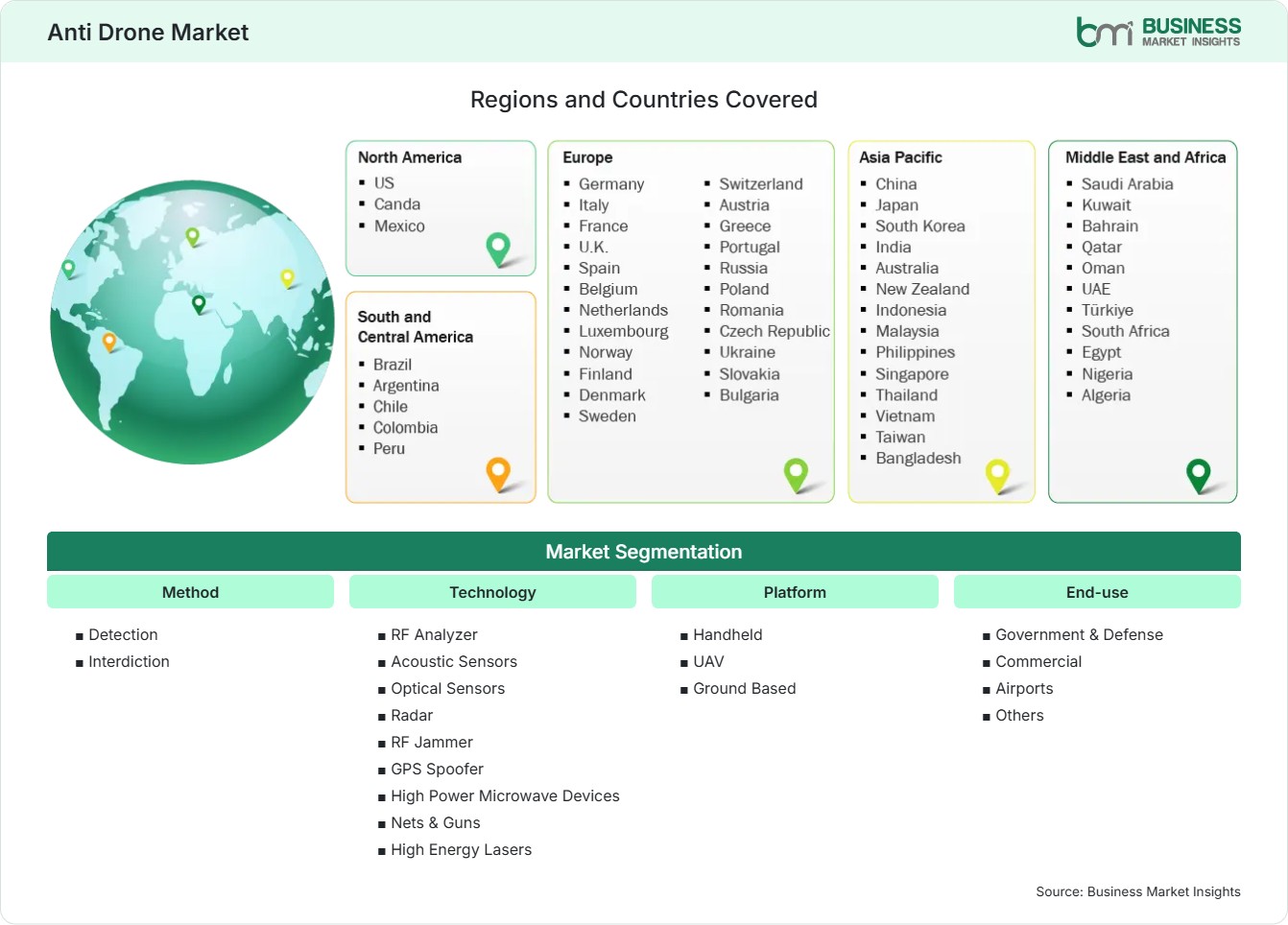
North America held approximately 32%–36% Anti Drone Market share in 2025 and is projected to grow at 19%–22% CAGR during 2026–2033. Procurement is supported by defense modernization, airport protection, critical infrastructure security, and increasing emphasis on layered counter-UAS architectures. The region benefits from mature radar, RF sensing, electronic warfare, artificial intelligence, and defense-system integration capabilities. U.S. programs remain the principal demand center, while Canada contributes through border surveillance and infrastructure-security requirements. Large defense contractors and specialist technology firms are increasingly combining sensors, software, and effectors into interoperable architectures.
- Defense agencies increasingly require layered systems capable of detecting low-observable drones before assigning kinetic or non-kinetic responses.
- Airport and critical-infrastructure operators are creating demand for fixed-site surveillance, RF analysis, optical confirmation, and centralized command software.
- U.S. procurement increasingly emphasizes modular architectures that can incorporate third-party sensors and effectors without replacing the entire system.
- Specialist companies are expanding alongside traditional defense contractors, increasing competition across RF detection, autonomous interception, electronic warfare, and directed-energy technologies.
US Anti Drone Market
The U.S. represented approximately 70%–74% of North American demand in 2025, with a 18%–21% CAGR during 2026–2033. Demand is supported by military base protection, homeland security, airport resilience, border surveillance, and the operational requirement to counter increasingly inexpensive drones. U.S. procurement also favors open architectures because threat signatures and mitigation technologies change faster than conventional acquisition cycles. Lockheed Martin demonstrated a modular C-UAS architecture incorporating AI-enabled detection, low-cost sensors, command-and-control, and multiple effectors during a 2025 company-funded exercise.
- Defense modernization programs are accelerating adoption of sensor fusion and automated target classification for simultaneous engagements.
- Commercial operators increasingly require systems that distinguish authorized drones from unauthorized aircraft while supporting documented escalation procedures.
- High-power microwave, reusable interceptors, and electronic warfare technologies are gaining attention because they can address multiple targets without relying exclusively on expendable munitions.
Europe Anti Drone Market
Europe accounted for approximately 25%–29% Anti Drone Market share in 2025, expanding at 20%–23% CAGR during 2026–2033. Germany, France, the United Kingdom, Italy, Poland, and the Nordic countries are important demand centers, while Poland and several Eastern European markets represent faster-growing procurement areas at approximately 24%–28% CAGR. Requirements emphasize battlefield protection, critical infrastructure, border surveillance, and integration with existing air-defense networks. Leonardo’s Falcon Shield architecture demonstrates the direction toward customizable multi-domain systems covering military, civil airspace, borders, and critical infrastructure.
- Germany is strengthening sovereign sensor and electronic-warfare capabilities, including integrated RF, radar, and electro-optical architectures.
- Poland and neighboring Eastern European markets are increasing attention to short-range air defense and counter-UAS capabilities.
- European procurement increasingly favors interoperable systems that can integrate existing national command networks and multiple effectors.
- Saab introduced Nimbrix in August 2025 as a dedicated C-UAS missile designed for small-drone threats, with a stated range of up to 5 km.
Asia Pacific Anti Drone Market
In the Asia Pacific region, market share was about 27%-31% in 2025 and is expected to grow at a CAGR of 24%-27% in 2026-2033, making it the fastest-growing regional market. Key countries in the region include China, Japan, South Korea, India, and Australia, with India, Australia, and South Korea, as well as certain parts of Southeast Asia, capable of generating a CAGR of about 26%-30%. Reasons for adoption include military modernization, border surveillance, maritime security, airport security, and local defense production capability.
- Australia is expanding portable and vehicle-mounted counter-UAS capabilities for defense and security applications.
- India is positioned for demand across border surveillance, military installations, airports, and critical infrastructure protection.
- Japan and South Korea emphasize advanced sensing, electronic warfare, radar, and integrated air-defense architectures.
- Southeast Asian governments are increasingly evaluating drone-security systems for ports, airports, military sites, and public infrastructure.
Rest of World Anti Drone Market
The anti drone market in South & Central America comprised a smaller but growing demand base in 2025, with Brazil, Colombia, Chile, and Mexico offering key applications in military, border, airport, and public security areas. Regional demand may grow at an approximately 18%-21% CAGR due to government investments in surveillance and enforcement of regulations against unauthorized drone use.
Demand in the Middle East and Africa is driven by the presence of military establishments, oil and gas installations, airports, borders, and critical infrastructure. Markets like Saudi Arabia, the UAE, Israel, and selected African countries may grow at approximately 20%-24% CAGR.
- Latin American procurement is increasingly directed toward portable and mobile systems suited to geographically dispersed security operations.
- Middle Eastern operators emphasize multi-layered protection around energy infrastructure, military installations, airports, and strategic facilities.
- Gulf countries are evaluating integrated architectures combining radar, electro-optical identification, RF sensing, and electronic countermeasures.
- African demand remains concentrated in military, border, airport, and critical-infrastructure applications where mobile deployment is operationally valuable.