
Anti Satellite (ASAT) Defense Technologies Market Outlook: Size, Share, Trends, Growth Analysis, Competitive Landscape & Forecast, 2026-2033

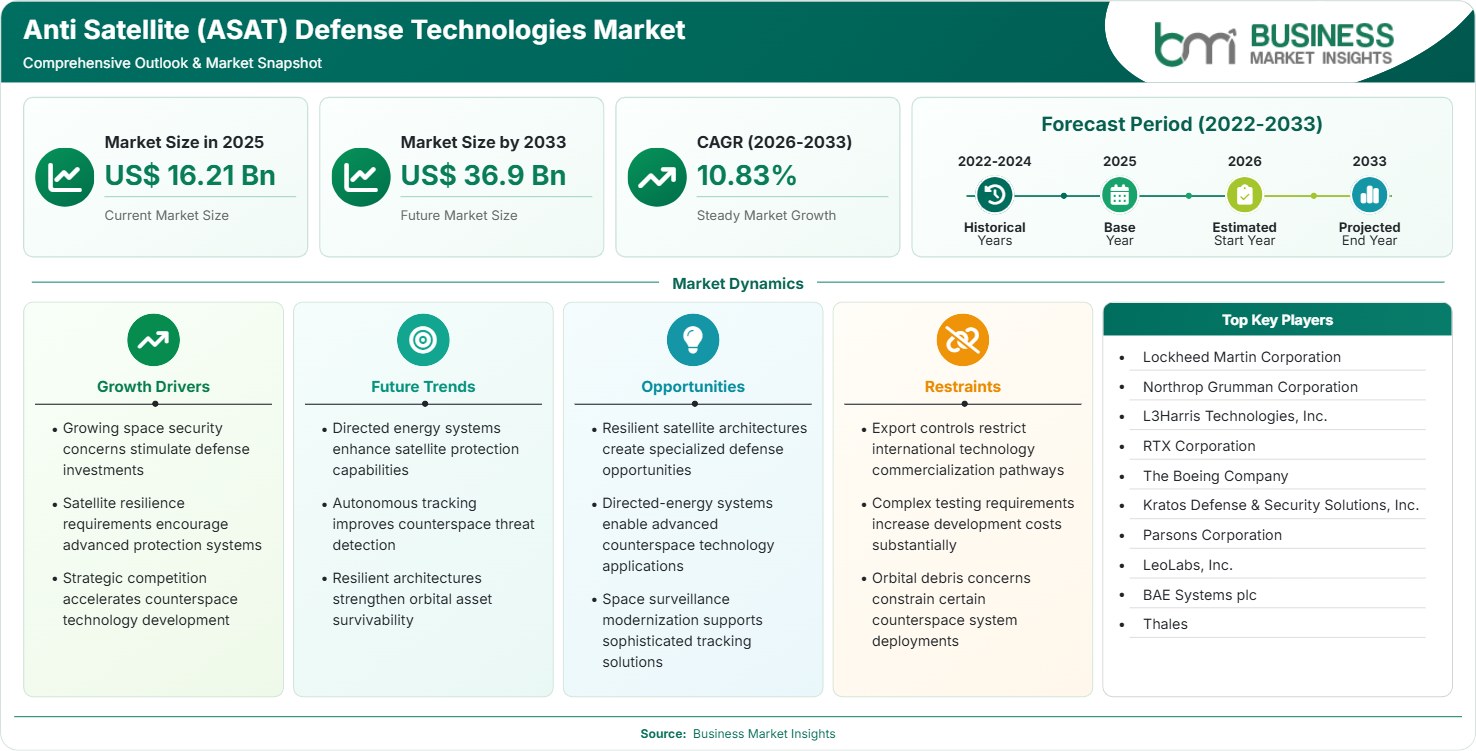
The Anti Satellite (ASAT) Defense Technologies Market size was valued at US$ 16.21 Billion in 2025 and is projected to reach US$ 36.9 Billion by 2033, growing at a CAGR of 10.83% during 2026–2033, driven by orbital surveillance, resilient architectures, threat tracking, electronic protection, and rising demand for space-based defense capabilities.

Report Coverage
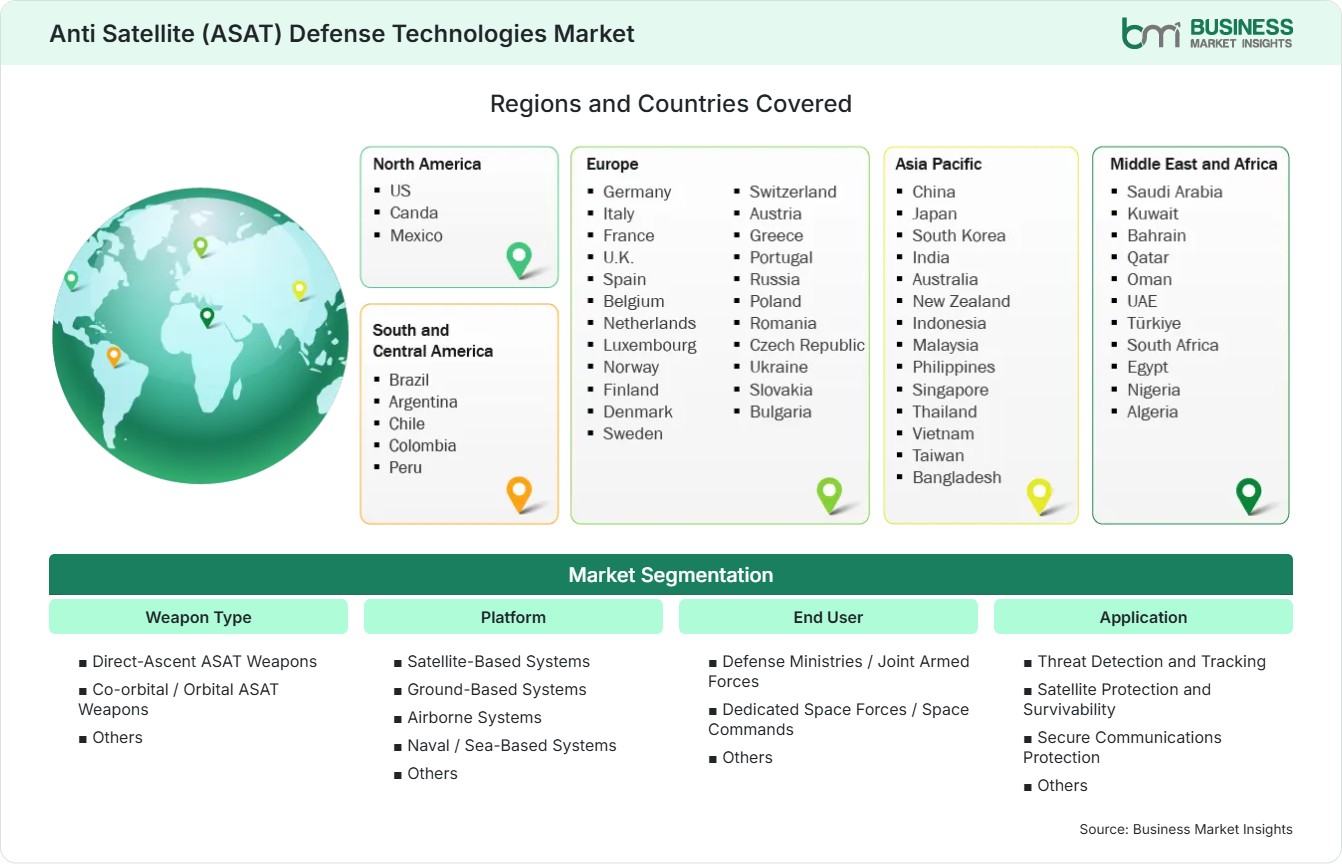
  • Weapon Type: Direct-Ascent ASAT Weapons, Co-orbital / Orbital ASAT Weapons, Others
  • Platform: Satellite-Based Systems, Ground-Based Systems, Airborne Systems, Naval / Sea-Based Systems, Others
  • End User: Defense Ministries / Joint Armed Forces, Dedicated Space Forces / Space Commands, Others
  • Application: Threat Detection and Tracking, Satellite Protection and Survivability, Secure Communications Protection, Others
US$ 16.21 Bn Market size in 2025
US$ 36.9 Bn Market Size by 2033
10.83% CAGR, 2026 - 2033
2026-2033 Forecast Period

AI Overview

Anti Satellite (ASAT) Defense Technologies Market Summary

  • North America Region: Holds a Anti Satellite Defense Technologies Market share of 42%–46% in 2025, growing with a CAGR of 10.1%–10.8%, influenced by defense modernization, proliferated constellations, missile tracking, resilient communications, and counterspace preparedness.
  • Fastest Growing Region: Asia Pacific holds a market share of 23%–27% in 2025, growing with a CAGR of 12.2%–13.1%, supported by military space programs, satellite modernization, regional security competition, indigenous launch capabilities, and expanding space surveillance investments.
  • Leading Segment: Ground-Based Systems holds a market share of 39%–43% in 2025, growing with a CAGR of 9.8%–10.5%, supported by mature radar infrastructure, scalable sensing, command networks, and persistent orbital monitoring.
  • High Growth Segment: Satellite-Based Systems holds a Anti Satellite Defense Technologies Market share of 24%–28% in 2025, growing with a CAGR of 13.4%–14.2%, driven by proliferated constellations, onboard sensing, multi-orbit coverage, resilient communications, and rapid threat characterization.
  • Key Market Opportunity: Integrated sensing, artificial intelligence, distributed satellite architectures, secure data links, and autonomous orbital monitoring create procurement opportunities as governments prioritize resilient space-domain awareness and rapid response.
  • Major Market Players: Lockheed Martin Corporation, Northrop Grumman Corporation, L3Harris Technologies, Inc., RTX Corporation, The Boeing Company, Kratos Defense & Security Solutions, Inc., Parsons Corporation, LeoLabs, Inc., BAE Systems plc, and Thales.
Strategic Insights

Anti Satellite (ASAT) Defense Technologies Market: Strategic Insights

Anti Satellite (ASAT) Defense Technologies Market Strategic Framework
FREE PDF
Request your free sample
Request free sample
Stakeholder View

Key Takeaways

  • The value chain is becoming increasingly software-defined, linking sensors, satellite buses, ground stations, command systems, data analytics, and secure communications rather than treating counterspace equipment as standalone hardware.
  • The highest upside lies in satellite-based sensing, distributed tracking, autonomous threat characterization, and resilient communications because these capabilities strengthen continuity when individual satellites, links, or ground nodes are disrupted.
  • Artificial intelligence is moving deeper into detection, classification, orbital prediction, anomaly identification, and sensor fusion. This favors suppliers capable of integrating machine learning with validated defense-grade command and control environments.
  • Asia Pacific presents an increasingly attractive investment geography as governments develop indigenous launch, satellite, radar, and space-surveillance capabilities while seeking greater strategic autonomy and reduced dependence on foreign infrastructure.
  • Procurement is increasingly favoring partnerships between prime contractors, specialized sensor companies, software providers, and commercial space firms. Recent contract activity indicates that government buyers are using distributed supplier ecosystems to accelerate innovation and deployment.
  • Survivability is becoming a system-level requirement covering maneuverability, redundancy, cyber protection, electromagnetic resilience, multi-orbit architecture, and rapid replenishment rather than relying exclusively on hardening individual spacecraft.
Geographic Outlook

Anti Satellite (ASAT) Defense Technologies Market Regional Highlights

North America Anti Satellite Defense Technologies Market

North America accounted for an estimated 42%–46% share in 2025 and is modeled to expand at 10.1%–10.8% CAGR through 2033. The region benefits from extensive defense budgets, mature radar networks, space commands, and established aerospace primes. The U.S. dominates regional procurement through integrated missile warning, tracking, satellite communications, and space-domain-awareness programs. The region’s Anti Satellite Defense Technologies Market share is reinforced by distributed architectures, while market growth is supported by persistent sensing and resilient command networks.

  • U.S. procurement increasingly emphasizes proliferated constellations, integrated sensors, and resilient communications. The Space Development Agency’s Tranche 3 Tracking Layer program demonstrates the scale of distributed missile-warning and tracking infrastructure being developed.
  • Canada contributes through NORAD modernization, space surveillance, communications, and allied interoperability. Procurement remains smaller than U.S. programs but benefits from shared continental defense requirements and increasing attention to orbital threat awareness.
  • Defense primes are integrating spacecraft, radar, infrared payloads, software, and command systems. This vertically coordinated model supports faster deployment and interoperability across terrestrial, airborne, naval, and orbital assets.
  • The regional supplier base increasingly combines established contractors with specialized commercial space companies, creating opportunities for radar analytics, orbital intelligence, autonomous tracking, cyber resilience, and software-defined mission operations.

US Anti Satellite Defense Technologies Market

The U.S. accounts for around 85%–89% of North America's market share in 2025 and is forecast to grow at a CAGR of 10.2%–10.9% through 2033. This is attributed to the institutionalization of Space Force, extensive procurement, and multi-domain integration. Companies like Lockheed Martin, L3Harris, Northrop Grumman, RTX, Boeing, Kratos, Parsons, and specialized suppliers operate in the sensing, tracking, ground infrastructure, and command systems sectors. The United States Anti Satellite Defense Technologies Market is the leading regional technology development market, where procurement will focus on distributed systems and continuous orbital control.

  • The U.S. Space Development Agency awarded four teams agreements worth approximately $3.5 billion for 72 Tracking Layer Tranche 3 satellites, strengthening distributed missile-warning and tracking capabilities.
  • L3Harris received a July 2026 contract to produce 18 Accelerated Missile Defense Tranche 3 satellites, reinforcing demand for space-based tracking and fire-control-quality sensing.
  • Lockheed Martin’s Space Fence contributes high-sensitivity orbital surveillance, demonstrating how ground-based sensing supports identification and tracking of objects associated with counterspace activity.

Europe Anti Satellite Defense Technologies Market

Europe held approximately 17%–21% of global demand in 2025 and is modeled to grow at 9.5%–10.4% CAGR of the Anti Satellite Defense Technologies Market through 2033. France, the United Kingdom, Germany, and Italy represent leading defense-space markets, while Poland and Nordic countries provide additional growth potential. European procurement increasingly emphasizes sovereign space situational awareness, secure communications, satellite protection, and multinational interoperability. France is a leading national capability center, while Germany and the United Kingdom are expanding military-space infrastructure and industrial participation.

  • France is positioned as a leading European market through military-space planning, sovereign surveillance capabilities, secure communications, and domestic aerospace expertise supporting resilient orbital operations.
  • The United Kingdom provides a strong growth base through Space Command development, intelligence capabilities, allied interoperability, and increasing investment in space-based communications and surveillance.
  • Germany and Italy offer opportunities in satellite systems, sensors, secure communications, and mission software, with industrial capabilities supporting European autonomy and multinational defense programs.
  • European demand increasingly favors defensive and resilient capabilities, including tracking, attribution, electronic protection, cyber resilience, and satellite survivability rather than relying primarily on offensive counterspace systems.

Asia Pacific Anti Satellite Defense Technologies Market

Asia Pacific held approximately 23%-27% market share of ASAT Defense Technologies Market in 2025 and is expected to experience a growth of 12.2%-13.1% CAGR till 2033. This region has been identified as the fastest-growing market for ASAT. The major contributors in the market include China, Japan, India, South Korea, and Australia. The reasons behind investments in the region include competitive strategies, an increase in the military satellite fleet, domestic launch capability, and a space surveillance system.

  • China represents a major regional capability center across orbital surveillance, satellite systems, electronic warfare, and counterspace research, although limited transparency makes commercial market sizing more difficult.
  • Japan is strengthening space-domain awareness and resilient satellite infrastructure while expanding cooperation with the United States, creating opportunities for advanced sensors, secure communications, and mission software.
  • India is developing greater space-defense autonomy through military space organizations, indigenous satellite capabilities, launch infrastructure, and private-sector participation across the broader space ecosystem.
  • Australia is emerging as a regional partner in space surveillance, communications, and allied interoperability, creating demand for distributed sensing and secure data-sharing architectures.

Rest of World Anti Satellite Defense Technologies Market

South and Central America together accounted for about 5%-7% of total global demand in 2025, while the Middle East and Africa together accounted for about 7%-9% of the Anti Satellite Defense Technologies Market. Total RoW demand is forecast to grow at an 8.4%-9.4% CAGR through 2033. Countries such as Israel, Saudi Arabia, the UAE, and Brazil offer more potential due to defense upgrade initiatives, satellite communication systems, surveillance operations, and national security measures.

  • Israel offers advanced capabilities in missile defense, intelligence, electronic warfare, and space systems, supporting demand for integrated sensing, tracking, communications protection, and threat characterization technologies.
  • Gulf states are investing in satellite communications, Earth observation, and sovereign space capabilities. These programs create demand for secure ground infrastructure, orbital monitoring, and resilient communications protection.
  • Brazil remains the strongest South American opportunity through national space infrastructure, satellite communications, remote sensing, and defense modernization, although procurement cycles remain comparatively longer.
  • African markets are developing from smaller bases, with opportunities concentrated in secure communications, satellite tracking, ground infrastructure, and partnerships rather than indigenous high-end counterspace weapon development.
Global Market Geography
FREE PDF
Request your free sample
Request free sample
Segment Analysis

Anti Satellite (ASAT) Defense Technologies Market Segmentation

Weapon Type

Weapon Type was the largest category of technologies in 2025, with Direct Ascent ASAT Weapons accounting for an estimated 44%–48% share of that category. This category of technologies is expected to grow at a CAGR of 9.4%–10.2% through 2033, driven by a focus on deterrence, surveillance, and counterspace readiness. The Anti Satellite Defense Technologies Market trends indicate a preference towards an architecture of detection and response.

  • Direct-Ascent ASAT Weapons: Direct-ascent systems remain strategically relevant because they can engage orbital targets from terrestrial launch platforms. Development priorities increasingly emphasize precision, tracking integration, mobility, and command-network connectivity.
  • Co-orbital / Orbital ASAT Weapons: Co-orbital concepts depend on rendezvous, proximity operations, propulsion, and orbital maneuvering. Their strategic relevance supports investment in spacecraft autonomy, proximity detection, navigation, and persistent orbital surveillance.
  • Others: Other capabilities include electronic warfare, cyber effects, directed energy, and non-kinetic counterspace measures. These approaches can disrupt or degrade space services without requiring physical destruction of orbital assets.

Platform

The platform was the most extensive deployment type in the year 2025. The Ground-Based Systems had a share of 39%–43% and were forecasted to record a CAGR of 9.8%–10.5% in the Anti Satellite Defense Technologies Market. Ground technology remains very important, as radars, optical sensors, control centers, and electronic systems provide continuous access to space-based information.

  • Satellite-Based Systems: Satellite platforms provide persistent orbital sensing, communications, threat characterization, and survivability functions. Proliferated constellations improve resilience by distributing sensing across multiple spacecraft and orbital planes.
  • Ground-Based Systems: Ground systems include radars, optical telescopes, command centers, electronic sensors, and data-processing infrastructure. Their established technology base supports continuous tracking, attribution, and mission control.
  • Airborne Systems: Airborne platforms extend sensing flexibility and can complement terrestrial radar networks. Their mobility supports regional coverage, rapid deployment, and detection missions where fixed infrastructure faces geographic constraints.
  • Naval / Sea-Based Systems: Naval systems integrate radar, electronic warfare, communications, and command capabilities with maritime operations. They provide mobile sensing and defensive coverage around strategically important fleets and maritime infrastructure.
  • Others: Other platforms encompass specialized mobile, experimental, and hybrid architectures. Their role is increasing where operators require flexible deployment, rapid repositioning, or integration with broader multi-domain defense networks.

End User

Defense Ministries / Joint Armed Forces accounted for an approximate 51%–55% of total consumer requirement in 2025 and will experience a projected CAGR growth rate of 9.7%–10.4% in the Anti Satellite Defense Technologies market. The procurement process is shifting toward programmatic efforts that span space, air, sea, cyberspace, and land. The creation of space commands is increasing rapidly, owing to dedicated organizations established to monitor activities from orbit.

  • Defense Ministries / Joint Armed Forces: These users procure integrated capabilities across military branches, prioritizing interoperability, secure command networks, threat detection, and protection of satellites supporting navigation, communications, and intelligence.
  • Dedicated Space Forces / Space Commands: Dedicated organizations concentrate expertise around orbital operations, space surveillance, satellite protection, and mission assurance. Their growth supports specialized software, sensors, training environments, and command systems.
  • Others: Other users include intelligence agencies, national security organizations, research institutions, and specialized government bodies. Their participation strengthens demand for data analytics, tracking services, and secure information-sharing systems.

Application

Threat Detection and Tracking accounted for 37% to 41% of application demand in 2025 and is expected to witness a CAGR of 11.2% to 12.0% through 2033 in the Anti-Satellite Defense Technologies Market. It is a basic requirement for any successful threat response to have custody, classification, attribution, and trajectory data.

  • Threat Detection and Tracking: Detection applications combine radar, optical, infrared, RF sensing, orbital analytics, and automated data fusion to identify anomalous behavior and improve warning time.
  • Satellite Protection and Survivability: Protection solutions emphasize maneuverability, redundancy, hardened systems, cyber resilience, electromagnetic protection, and distributed architectures designed to preserve mission continuity during hostile interference.
  • Secure Communications Protection: Communications protection integrates encryption, resilient links, frequency management, anti-jamming measures, and network redundancy to maintain command connectivity between satellites, ground assets, and deployed forces.
  • Others: Other applications include training, simulation, mission planning, attribution, debris monitoring, and operational analysis. These capabilities improve readiness and support decisions across increasingly complex orbital environments.
Market Forces

Anti Satellite (ASAT) Defense Technologies Market Dynamics

Key Market Drivers

Proliferated Satellite Architectures Increase Resilience

Distributed constellations are changing defense-space procurement by reducing dependence on individual high-value spacecraft. For instance, the Tranche 3 Tracking Layer of the Space Development Agency comprises 72 satellites distributed among four industrial teams. The proliferation will make the system reliable because the adversary would need to destroy several nodes rather than a single critical node. This architectural change will promote standardization of the bus and payload, modularization, digital manufacturing, and more frequent replacement cycles. These aspects are important for market development, as the acquisition strategy is now shifting towards persistent sensing and redundant communications. The Anti Satellite Defense Technologies Market trends include links between orbital resilience and fast replacement, autonomous mission control, and distributed processing. Suppliers that can produce multiple spacecraft quickly could benefit more than those focused on custom platforms.

Space-Domain Awareness Becomes a Core Defense Function

Orbital crowding heightens the need for precise tracking and characterization capability. Current defense capabilities rely on persistent control of satellites, space debris, maneuvering spacecraft, and threats in multiple orbits. Space Fence is described by Lockheed Martin as a highly sensitive search radar that supports space situational awareness within the U.S. Space Force. LeoLabs, on its part, is building its radar system to serve governments. The resulting demand goes beyond just sensors to include data fusion, orbit determination, anomaly detection, command systems, and secure information exchange. There is a growing need among governments for actionable intelligence over simple data observation, presenting an opportunity for vendors offering hardware and analytics.

Integrated Multi-Domain Defense Accelerates Procurement

Counterspace preparedness is becoming integrated with missile warning, electronic warfare, cyber defense, intelligence, surveillance, and secure communications. Awards were given to L3Harris by the Space Development Agency (2026) for 18 satellite trackers to support advanced detection and tracking of missile threats, illustrating the convergence of space sensing and broader defense systems architecture. The need for interoperable interface capabilities, a common command environment, secure communications, and sensor-to-shooter data links is increased by such convergence. It also makes prime contractors more relevant due to their ability to conduct system integration, while creating opportunities for niche suppliers of sensors, software, antennas, processors, and cyber protection.

Key Market Opportunities

AI-Enabled Orbital Intelligence and Automated Threat Characterization

Artificial intelligence can reduce analysts' burden by helping classify objects, detect anomalies in their maneuvering, correlate sensor detections, and prioritize potential threats. This is most evident in cases where AI is used alongside existing techniques in orbital mechanics, sensor integration, and human reasoning, rather than merely as another software layer on top of everything else. Analytics, mission software, and updates of threat models can become valuable sources of recurring income for vendors of anti-satellite technologies. Consequently, Anti Satellite Defense Technologies Market Forecasts must take into account the software component that accompanies physical defense systems. Governments, however, demand explainability, cybersecurity, verification, and controlled deployment, which puts vendors with defense-grade data management ahead of others. Orbital intelligence companies can enter the market through government contracts.

Distributed Ground and Space Sensor Networks

The expansion of distributed sensing creates opportunities for modular radars, optical systems, RF receivers, satellite payloads, and interoperable ground infrastructure. During the year 2025, LeoLabs reported contract awards exceeding $60 million, with 186% year-over-year growth in U.S. government contracts, reflecting growing government demand for persistent orbital intelligence. With a distributed sensor strategy, governments would be able to integrate exquisite sensors with fast-deployable ones, adding greater resilience and geographic spread. Government suppliers can stand out from their competitors by offering reduced deployment costs, mobile configurations, automatic calibration, secure data transmission, and interconnectivity with the government command-and-control network.

Satellite Servicing and Defensive Orbital Maneuvering

Technologies associated with satellite servicing present future opportunities for inspection, maneuvering, relocation, and managed deorbit. Firefly Aerospace has been awarded a contract by the Defense Innovation Unit and the Space Development Agency to conduct preliminary design for an Elytra deorbit mission in 2026, reflecting the government's desire to use orbiting satellite servicing in operations. These types of satellites may assist with debris removal, inspection, mission resilience, and the development of technologies related to proximity operations. Opportunities in the commercial realm include propulsion, navigation, automated rendezvous, robotics, mission software, and unique spacecraft buses.

Market Restraints and Challenges

High System Complexity and Procurement Costs

Factor: Complex counter-space architectures demand specialized sensors, propulsion systems, secure communication capabilities, high-speed computing, testing facilities, and skilled personnel, resulting in large expenses related to the development and integration process. Impact: Procurement processes may experience lengthy qualification periods, budget competition, and scheduling difficulties when governments try to incorporate various technologies into one system. The problem becomes even more difficult if requirements change, because the evolution of threats in orbit is much faster than defense acquisition cycles. Distributed architectures decrease reliance on individual space assets but increase the need for ground facilities and networks. Thus, suppliers should prove their abilities to demonstrate interoperability, cybersecurity, manufacturability, and performance simultaneously.

Orbital Debris and Escalation Risks Constrain Kinetic Systems

Factor: Kinetic engagements could produce material that would stay in orbit and could be harmful to other civilian, commercial, or military space vehicles. Impact: The use of kinetic counterspace options produces strategic, environmental, and diplomatic implications for the government, leading to increased interest in reversible, non-destructive, or defensive systems. Orbital debris already moves at very high speeds, making fragmentation even more complicated in the very crowded low Earth orbit. This factor favors investments in tracking, attribution, electronic protection, cyber hardening, maneuvering, and controlled servicing. Moreover, there emerges an increased need for international cooperation and responsible conduct in space. The vendors of non-kinetic defensive technology can profit from this situation.

Company Analysis

Competitive Landscape

The competitive environment combines traditional aerospace primes, missile-defense contractors, radar specialists, space-domain-awareness companies, and software-oriented mission providers. The Anti Satellite Defense Technologies Market analysis indicates that competitive advantage increasingly depends on integrated sensing, rapid production, secure communications, and mission software rather than individual hardware performance.

Company Name

Overview

Products and Services relevant to this market

Lockheed Martin Corporation

Major U.S. aerospace and defense prime with extensive space, missile-defense, radar, and national-security capabilities.

Space-based tracking satellites, missile warning, Space Fence, radar systems, command and control, resilient space architectures.

Northrop Grumman Corporation

Global aerospace and defense company active across strategic systems, space platforms, sensors, and advanced mission technologies.

Space vehicles, missile warning and tracking satellites, sensors, command systems, space payloads, defense electronics.

L3Harris Technologies, Inc.

Defense technology provider specializing in space systems, sensors, communications, missile warning, and surveillance architectures.

Tracking satellites, infrared payloads, space sensors, secure communications, missile-defense systems, mission electronics.

RTX Corporation

Diversified aerospace and defense company with Raytheon capabilities across sensors, missiles, radar, and space-based warning.

Infrared missile-warning sensors, radar, electronic warfare, missile-defense technologies, command systems, advanced sensing.

The Boeing Company

Major aerospace and defense contractor with extensive spacecraft, satellite, national-security, and military systems expertise.

Satellite platforms, space systems, command infrastructure, missile-defense technologies, secure communications, mission integration.

Kratos Defense & Security Solutions, Inc.

Defense technology specialist with strong capabilities in space-domain awareness, directed energy, ground systems, and advanced defense technologies.

Ground-based SDA systems, satellite ground infrastructure, space test systems, RF technologies, directed-energy solutions.

Parsons Corporation

Technology and engineering provider serving space, missile defense, intelligence, cyber, and command-and-control programs.

Space-domain awareness software, ground systems, mission engineering, analytics, secure architectures, space test infrastructure.

LeoLabs, Inc.

Specialist orbital-intelligence company providing radar-based tracking and data services for government and commercial customers.

Space surveillance radars, orbital intelligence, tracking, conjunction analysis, threat characterization, persistent monitoring.

BAE Systems plc

International defense company providing electronic warfare, intelligence, surveillance, space, and mission systems capabilities.

Electronic warfare, space electronics, sensing, secure communications, intelligence systems, mission software.

Thales

Global technology and defense group active in aerospace, space, radar, communications, cybersecurity, and surveillance systems.

Space surveillance, radar, secure communications, satellite systems, electronic protection, command and control.

Trust & Transparency

Research Methodology

The market analysis combines proprietary research with secondary data from government agencies, company disclosures, regulatory filings, industry databases and expert interviews. Market estimates are validated through data triangulation, cross-market benchmarking and analyst review.

View Full Research Methodology

Questions Answered

Frequently Asked Questions

What does an Anti Satellite Defense Technologies Market Report help decision-makers evaluate?

A Market Report helps organizations assess technology categories, regional demand, platform opportunities, end-user requirements, application priorities, competitive positioning, procurement trends, and investment areas across the evolving space-defense ecosystem.

How are commercial space companies affecting defense procurement?

Commercial companies are introducing faster development cycles, specialized sensors, orbital intelligence services, software-defined ground systems, and smaller spacecraft. Government agencies increasingly use contracts and demonstrations to incorporate these capabilities alongside established defense primes.

Which application offers strong future opportunities?

Threat detection and tracking offers strong opportunity because every defensive response depends on accurate orbital custody, classification, trajectory prediction, and attribution. Demand is expanding for sensor fusion, automated analytics, and secure data-sharing systems that convert observations into operational intelligence.

Why are satellite-based defense systems gaining importance?

Satellite-based systems provide persistent coverage across large geographic areas and multiple orbital regimes. Distributed constellations can also reduce dependence on individual spacecraft, improve redundancy, and support faster detection and characterization of maneuvering objects.

What technologies are shaping the Anti Satellite Defense Technologies Market?

Artificial intelligence, distributed satellite constellations, advanced radar, infrared sensing, electronic warfare, secure communications, autonomous orbital maneuvering, and integrated command systems are shaping technology development. The emphasis is moving toward resilient architectures that maintain detection and communications even when individual satellites, links, or ground nodes are disrupted.

Access the Full Anti Satellite (ASAT) Defense Technologies Market Report

Get segment-level forecasts, regional estimates, competitive benchmarking, company profiles and downloadable Excel datasets.

Access the full Anti Satellite (ASAT) Defense Technologies Market Report
350 pages PDF & Excel | 2026-09-22
Similar Research

Related Market Reports