
Drone Power Sources Market Outlook: Size, Share, Trends, Growth Analysis, Competitive Landscape & Forecast, 2026-2033

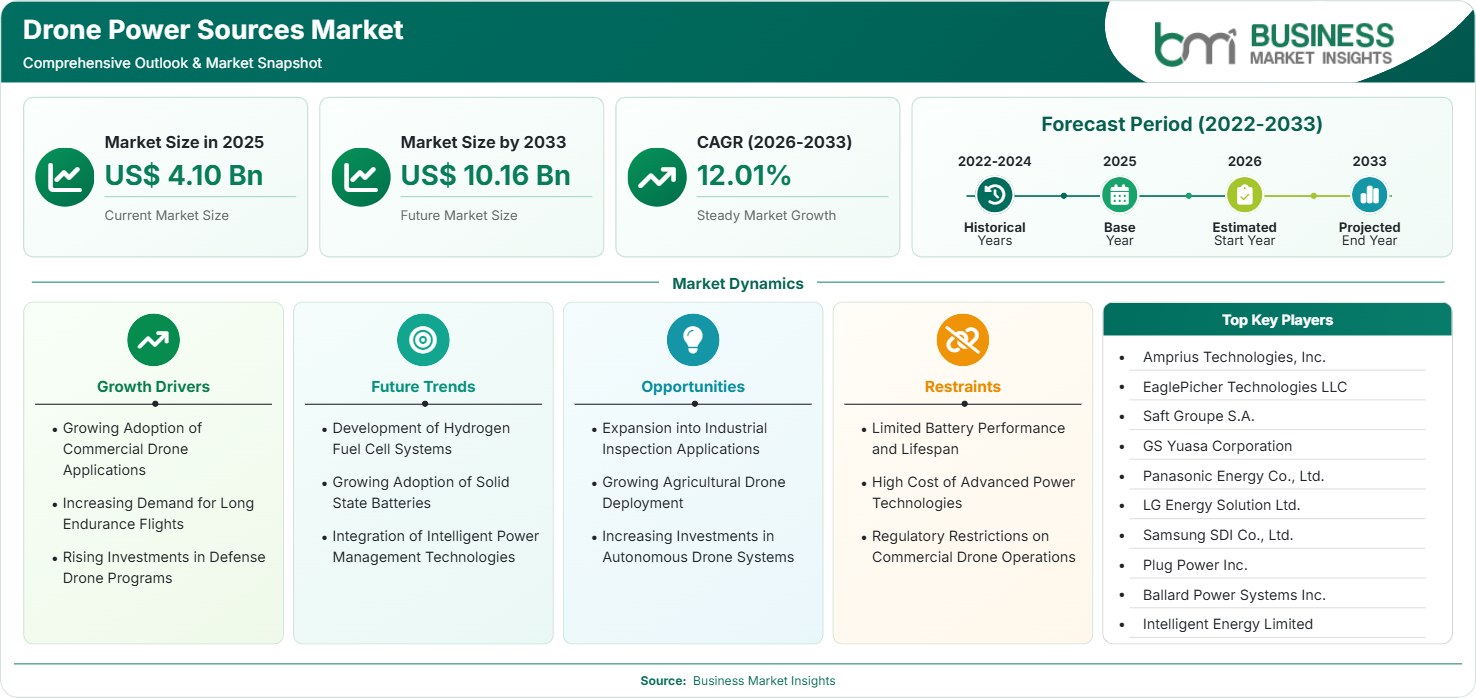
The Drone Power Sources Market size was valued at US$ 4.10 Billion in 2025 and is projected to reach US$ 10.16 Billion by 2033, growing at a CAGR of 12.01% during 2026–2033. Increasing commercial drone deployment, defense modernization programs, battery innovation, hydrogen fuel cell development, and expanding industrial inspection applications continue creating substantial growth opportunities across global drone ecosystems.

Report Coverage
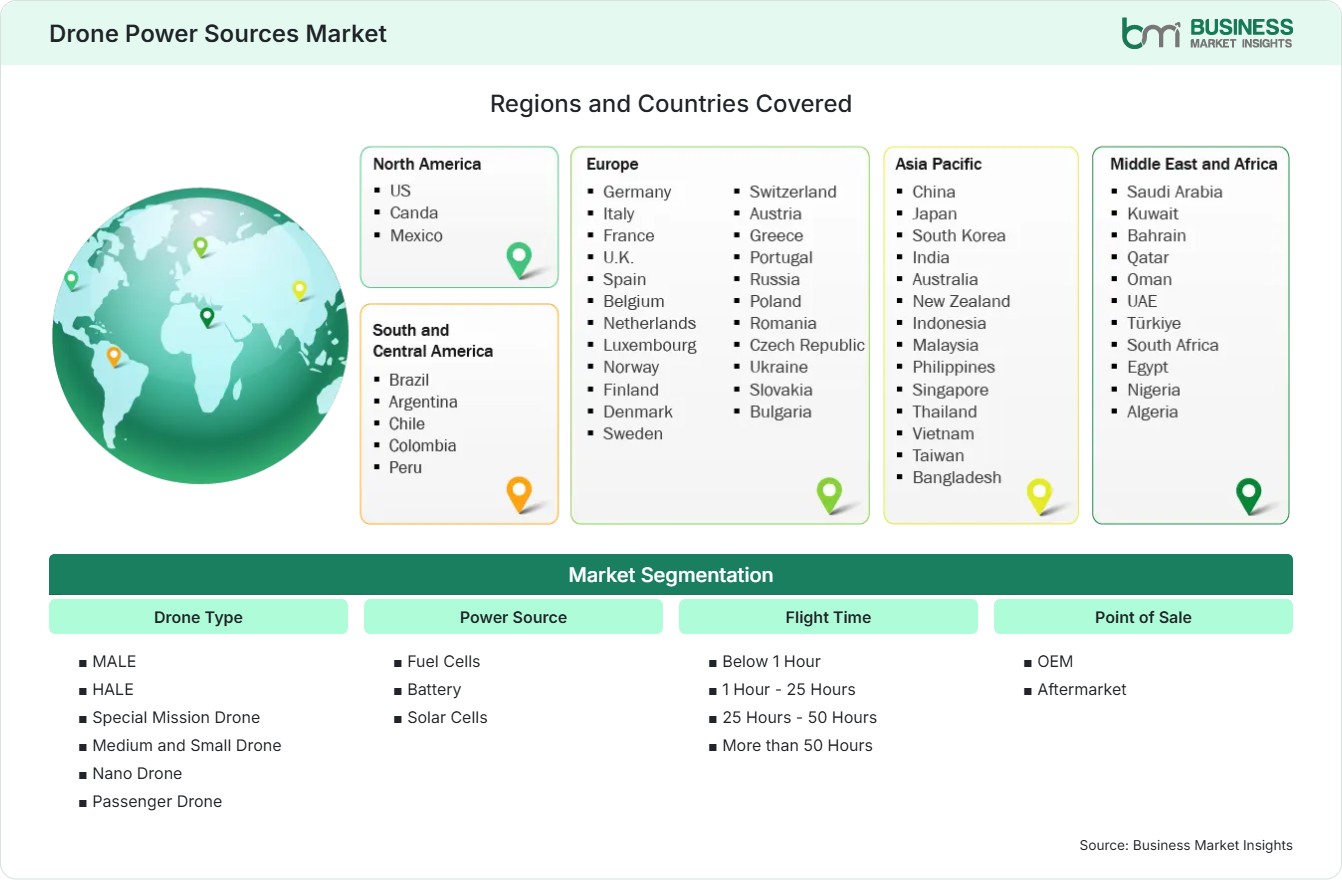
  • Drone Type: MALE, HALE, Special Mission Drone, Medium and Small Drone, Nano Drone, Passenger Drone
  • Power Source: Fuel Cells, Battery, Solar Cells
  • Flight Time: Below 1 Hour, 1 Hour - 25 Hours, 25 Hours - 50 Hours, More than 50 Hours
  • Point of Sale: OEM, Aftermarket
  • End User: Commercial, Military
US$ 4.10 Bn Market size in 2025
US$ 10.16 Bn Market Size by 2033
12.01% CAGR, 2026 - 2033
2026-2033 Forecast Period

AI Overview

Drone Power Sources Market Summary

  • North America Region: North America holds 36%–39% market share in 2025 and is projected to expand at a 11.5%–12.3% CAGR during 2026–2033. Defense modernization, commercial drone adoption, advanced battery manufacturing, and hydrogen fuel cell research continue accelerating regional investments and long-endurance platform development. The U.S. dominates regional demand through defense procurement and commercial drone innovation, advancing at approximately 11.8%–12.5% CAGR during 2026–2033.
  • Fastest Growing Region: Asia Pacific accounts for 25%–28% market share in 2025 while advancing at a 13.2%–14.1% CAGR through 2026–2033. Manufacturing expansion, government-backed UAV programs, smart agriculture initiatives, and domestic battery production continue strengthening regional competitiveness and technology commercialization.
  • Leading Segment: Battery represents 56%–59% market share in 2025 and is expected to expand at 11.8%–12.6% CAGR during 2026–2033. Continuous lithium battery improvements, cost efficiency, lightweight integration, and compatibility with commercial unmanned aircraft accelerate deployment across industrial and surveillance operations worldwide.
  • High Growth Segment: Fuel Cells account for 16%–19% market share in 2025 while recording a 14.8%–15.6% CAGR through 2026–2033. Growing hydrogen infrastructure investments, extended flight endurance requirements, and military demand support increasing commercialization across high-performance unmanned aerial platforms.
  • Key Market Opportunity: Expanding hydrogen-powered unmanned aircraft, AI-enabled energy management systems, advanced battery materials, and hybrid propulsion technologies create long-term opportunities for manufacturers serving commercial logistics, defense, emergency response, and infrastructure inspection missions globally.
  • Major Market Players: Amprius Technologies, Inc., EaglePicher Technologies LLC, Saft Groupe S.A., GS Yuasa Corporation, Panasonic Energy Co., Ltd., LG Energy Solution Ltd., Samsung SDI Co., Ltd., Plug Power Inc., Ballard Power Systems Inc., and Intelligent Energy Limited.
Strategic Insights

Drone Power Sources Market: Strategic Insights

Drone Power Sources Market Strategic Framework
FREE PDF
Request your free sample
Request free sample
Stakeholder View

Key Takeaways

  • The industry is shifting towards more vertically integrated supply chains, involving battery developers, hydrogen fuel cell developers, drone OEMs, and software providers in order to achieve optimum results in terms of power efficiency and longevity.
  • Commercial inspection, precision farming, logistics, and emergency services are currently the most promising growth segments due to increasing demands for improved endurance, increased charging speed, lower cost, and payload capacity.
  • The innovation trend is shifting from traditional lithium-ion solutions towards such areas as lithium-silicon batteries, solid-state batteries, hydrogen fuel cells, hybrid propulsion systems, and AI energy management systems.
  • Asia Pacific region presents the most encouraging investment opportunity owing to increased manufacturing capacity, support of government to make batteries domestically, increased industrial automation and use in agriculture, infrastructure inspection and surveillance purposes.
  • The investments are increasingly oriented towards strategic partnerships and development programs, expanding battery production, and developing hydrogen ecosystem as an alternative source of propulsion technology in drones.
Geographic Outlook

Drone Power Sources Market Regional Highlights

North America Drone Power Sources Market

North America accounts for 36%–39% of global revenue in 2025 while expanding at a 11.5%–12.3% CAGR through 2026–2033. The region maintains the largest Drone Power Sources Market share because of substantial defense spending, advanced battery manufacturing, commercial drone deployment, and continuous investment in hydrogen-powered aviation technologies.

  • Defense modernization programs continue supporting procurement of long-endurance unmanned systems requiring advanced lithium batteries, hydrogen fuel cells, and intelligent energy management technologies capable of improving operational efficiency across surveillance, reconnaissance, and tactical missions.
  • Commercial infrastructure inspection across energy, transportation, telecommunications, and utilities increasingly depends on high-performance power systems delivering longer endurance, faster recharge capability, and improved operational reliability under challenging environmental conditions.
  • Federal research funding accelerates commercialization of lightweight battery materials, silicon-anode technologies, and hydrogen propulsion platforms while strengthening domestic manufacturing capabilities and reducing dependence on imported battery components.
  • Expanding drone logistics, emergency response operations, and industrial automation continue increasing demand for scalable power technologies capable of supporting higher payloads, extended missions, and lower lifecycle operating costs.

US Drone Power Sources Market

The United States Drone Power Sources Market represents 79%–82% of North American revenue in 2025 while advancing at a 11.8%–12.5% CAGR through 2026–2033. Defense procurement, aerospace innovation, venture capital investment, and commercial drone deployments collectively reinforce the country's leadership in advanced drone propulsion technologies and battery innovation.

  • Department of Defense modernization programs continue accelerating demand for lightweight batteries and hydrogen fuel cells supporting intelligence, surveillance, reconnaissance, and autonomous mission requirements with improved endurance and operational resilience.
  • Commercial operators increasingly adopt advanced battery technologies for inspection, mapping, logistics, and emergency response, encouraging manufacturers to improve charging speed, energy density, and overall system safety.
  • Strong venture capital investment supports startups developing silicon-anode batteries, intelligent battery management software, and hybrid propulsion technologies capable of significantly extending operational flight duration.
  • Regulatory progress encouraging beyond-visual-line-of-sight operations creates additional opportunities for advanced power systems supporting commercial delivery services and large-scale industrial monitoring applications.

Europe Drone Power Sources Market

Europe contributes 25%–28% Drone Power Sources Market share during 2025 while recording a 11.7%–12.6% CAGR through 2026–2033. Germany leads regional deployment through aerospace manufacturing capabilities, while France demonstrates the fastest growth supported by hydrogen aviation initiatives and battery innovation investments.

  • European aerospace companies actively invest in hydrogen propulsion research, lightweight batteries, and hybrid power architectures supporting emission reduction objectives across unmanned aviation platforms.
  • Government-backed innovation funding strengthens regional manufacturing capacity while encouraging partnerships between battery developers, research institutes, and drone manufacturers for next-generation energy technologies.
  • Infrastructure inspection across railways, renewable energy facilities, and utilities creates consistent demand for long-endurance commercial drone operations requiring reliable power solutions.
  • Regional battery sustainability regulations encourage recycling innovation, lifecycle optimization, and environmentally responsible manufacturing practices throughout the drone value chain.

Asia Pacific Drone Power Sources Market

Asia Pacific Drone Power Sources Market represents 25%–28% of global revenue in 2025 and is projected to register the fastest regional CAGR of 13.2%–14.1% during 2026–2033. China remains the largest market due to its extensive drone manufacturing ecosystem, while India records the highest growth supported by government incentives, expanding domestic UAV production, agricultural modernization, and increasing defense procurement.

  • China continues expanding lithium battery manufacturing capacity and UAV production, creating strong demand for advanced energy storage technologies supporting commercial deliveries, industrial inspection, and aerial mapping applications.
  • India accelerates domestic drone manufacturing through production-linked incentive programs, agricultural drone adoption, infrastructure monitoring projects, and defense modernization initiatives requiring reliable high-performance power solutions.
  • Japan and South Korea invest heavily in next-generation battery chemistry, hydrogen fuel cell research, and autonomous aviation technologies to improve endurance, charging efficiency, and operational safety.
  • Precision agriculture, smart city development, mining inspection, and logistics automation continue increasing deployment of drones requiring lightweight batteries and efficient power management systems.

Rest of World Drone Power Sources Market

The Rest of World region accounts for 10%–13% Drone Power Sources Market share in 2025 while expanding at a 12.0%–12.9% CAGR through 2026–2033. South & Central America increasingly adopts drones for agricultural monitoring and mining inspections, whereas the Middle East and Africa strengthen investments in border surveillance, infrastructure security, and energy sector inspection supported by government modernization initiatives.

  • Brazil leads South & Central America through precision agriculture and mining applications, while Chile records faster adoption driven by mineral exploration and infrastructure inspection requirements.
  • Saudi Arabia and the United Arab Emirates continue investing in autonomous aviation, smart city projects, and defense modernization, supporting increased deployment of advanced drone propulsion technologies.
  • Energy infrastructure inspection across oil, gas, and renewable power facilities generates consistent demand for reliable long-endurance power solutions capable of operating in challenging environmental conditions.
  • Humanitarian operations, disaster management, and environmental monitoring across Africa encourage adoption of durable drone energy systems with improved operational efficiency and lower maintenance requirements.
Global Market Geography
FREE PDF
Request your free sample
Request free sample
Segment Analysis

Drone Power Sources Market Segmentation

Drone Type

Drone Type accounted for approximately 34%–37% market share in 2025 and is projected to grow at a 12.3%–13.1% CAGR through 2033. Demand continues expanding across commercial logistics, military surveillance, agriculture, and industrial inspection as manufacturers optimize aircraft configurations for improved endurance, payload capability, and operational efficiency. The Drone Power Sources Market scope continues broadening through diversified drone platforms serving specialized mission requirements.

  • MALE: Medium Altitude Long Endurance platforms increasingly utilize hydrogen fuel cells and advanced battery systems to support intelligence gathering, surveillance, and border security missions requiring extended operational endurance.
  • HALE: High Altitude Long Endurance drones require lightweight, high-energy-density propulsion systems enabling persistent surveillance, atmospheric research, and strategic reconnaissance across extended operational missions.
  • Special Mission Drone: Specialized emergency response, firefighting, environmental monitoring, and infrastructure inspection operations increasingly demand customized power systems capable of supporting diverse payload configurations and mission durations.
  • Medium and Small Drone: Industrial inspection, mapping, logistics, and precision agriculture continue driving widespread adoption of compact drones utilizing efficient lithium battery technologies for reliable daily commercial operations.
  • Nano Drone: Defense, indoor inspection, and tactical reconnaissance applications encourage development of miniature high-performance batteries delivering improved maneuverability, operational flexibility, and compact energy storage.
  • Passenger Drone: Urban air mobility development stimulates investment in scalable propulsion technologies capable of delivering enhanced safety, higher energy density, and efficient power management for future passenger operations.

Power Source

Power Source represented approximately 56%–59% market share in 2025 and is anticipated to expand at a 12.0%–12.8% CAGR through 2033. Continuous improvements in battery chemistry, hydrogen storage, lightweight materials, and solar-assisted energy harvesting support broader commercial adoption across diverse unmanned aviation missions.

  • Fuel Cells: Hydrogen fuel cell adoption increases where extended endurance, low emissions, and rapid refueling are essential for defense, infrastructure inspection, maritime surveillance, and beyond-visual-line-of-sight operations.
  • Battery: Lithium-ion and lithium-silicon batteries remain the preferred solution because of high efficiency, declining manufacturing costs, rapid charging improvements, and compatibility with most commercial drone platforms.
  • Solar Cells: Solar-assisted power systems increasingly complement hybrid propulsion configurations for persistent surveillance, environmental monitoring, and scientific research requiring prolonged operational endurance.

Flight Time

Flight Time contributes approximately 19%–22% market share in 2025 and is projected to register a 12.4%–13.2% CAGR through 2033. Advancements in lightweight batteries, intelligent energy management, and hydrogen fuel technologies continue enabling longer missions while improving payload capacity and operational efficiency.

  • Below 1 Hour: Widely deployed for photography, mapping, infrastructure inspection, and recreational operations where lightweight batteries provide economical and efficient short-duration flights.
  • 1 Hour - 25 Hours: Industrial inspections, agriculture, surveillance, and logistics increasingly utilize medium-endurance platforms balancing payload capability, operational flexibility, and overall cost efficiency.
  • 25 Hours - 50 Hours: Long-range surveillance, environmental monitoring, and military reconnaissance rely on hybrid propulsion and fuel cell technologies delivering significantly extended operational endurance.
  • More than 50 Hours: Strategic defense, maritime patrol, and scientific research missions demand advanced hydrogen fuel cell systems and highly efficient energy management architectures supporting continuous flight operations.

Point of Sale

Point of Sale accounted for nearly 14%–17% Drone Power Sources Market share in 2025 while expanding at a 11.8%–12.6% CAGR through 2033. Growing commercial fleets, maintenance requirements, and modernization programs continue supporting balanced demand across both original equipment manufacturers and replacement component suppliers.

  • OEM: Original equipment manufacturers increasingly integrate advanced battery technologies and intelligent power management systems during aircraft production to maximize endurance, reliability, and lifecycle performance.
  • Aftermarket: Fleet expansion drives replacement demand for batteries, fuel cells, charging equipment, and maintenance services as operators seek improved efficiency and lower operating costs.

End User

End User generated approximately 28%–31% market share in 2025 and is forecast to achieve a 12.5%–13.3% CAGR through 2033. Commercial adoption accelerates across agriculture, logistics, utilities, and infrastructure inspection, while defense organizations continue investing in high-endurance unmanned platforms supporting intelligence and surveillance missions.

  • Commercial: Agriculture, construction, logistics, energy inspection, emergency response, and environmental monitoring continue expanding deployment of drones requiring lightweight, efficient, and rapidly rechargeable power solutions.
  • Military: Defense organizations increasingly procure advanced battery and hydrogen fuel cell technologies supporting intelligence gathering, surveillance, border protection, electronic warfare, and extended tactical reconnaissance operations.
Market Forces

Drone Power Sources Market Dynamics

Key Market Drivers

Growing Adoption of Commercial Drone Applications

Commercial drone deployment continues expanding across precision agriculture, infrastructure inspection, logistics, mining, utilities, and emergency response. Drone Power Sources Market growth demand for propulsion systems that are lightweight and energy efficient, allowing longer missions and reduced maintenance. The combination of regulatory permission for commercial drones, reduction in battery costs, and high energy density helps in expanding the fleet globally. Smart battery management systems improve efficiency, charging capabilities, and life span of batteries, resulting in maximum asset utilization.

Increasing Demand for Long Endurance Flights

Rising needs for extended flight times have been leading to increased investment in the fields of hydrogen fuel cells, lithium silicon batteries, hybrid propulsion systems, and intelligent energy management. Government departments, environment monitoring bodies, surveillance bodies of ships, and industrial inspection firms need drones that can fly for long periods of time. Improvements in lightweight materials, efficient propulsion, and thermal management allow longer flight time with heavier loads.

Rising Investments in Defense Drone Programs

Defence modernization programs throughout North America, Europe, Asia Pacific, and the Middle East keep on escalating the purchase of unmanned aircraft systems. Significant investments are made by governments for surveillance, border security, reconnaissance missions, and unmanned flight missions that require dependable power sources. Government funding and research and development programs hasten the process of developing new generation batteries and hydrogen fuel cell technology and hybrid power plants.

Key Market Opportunities

Expansion into Industrial Inspection Applications

Industrial asset owners increasingly deploy drones to inspect power transmission networks, pipelines, telecommunications towers, offshore platforms, railways, and renewable energy facilities. These systems need reliable power systems which are able to accommodate prolonged flight operations, self-navigating drones, and high-grade cameras. Drone Power Sources Market Forecast suggests further development in the field of batteries, hydrogen fuel cells, and artificial intelligence based power management due to the growing scope of digitalization in the industrial sector.

Growing Agricultural Drone Deployment

Precision agriculture will emerge as an important opportunity as drones are gaining popularity among farmers to conduct activities such as crop monitoring, spraying pesticides, analyzing irrigation needs, and yield optimization. The increased flight duration, rapid charging capability, and lighter batteries enhance efficiency and cut down labor costs. The government policies backing digital agriculture, along with food security measures and sustainable farming practices, keep promoting advanced drone power technology.

Increasing Investments in Autonomous Drone Systems

Autonomous drone ecosystems are becoming increasingly prevalent in logistics, military, emergency services, and smart cities. Efficient energy storage solutions are required for autonomous navigation, self-charging capabilities, and fleet management of such systems, which need to function autonomously. Increasing capital investment in these fields from aerospace companies, defense contractors, and technology companies is providing ample business prospects for battery makers, hydrogen fuel cell developers, and energy management system vendors.

Market Restraints and Challenges

Limited Battery Performance and Lifespan

Factor: Despite continuous improvements, battery energy density, charging duration, thermal stability, and lifecycle limitations remain major technical constraints, particularly for heavy payload and long-endurance missions.

Impact: The disadvantages have an impact on the flexibility of operation, make replacement more frequent, raise the cost of maintenance, and limit the use in challenging commercial and military environments. Battery manufacturers invest in new battery types such as silicon-anode batteries, solid-state batteries, and improved thermal systems.

High Cost of Advanced Power Technologies

Factor: Hydrogen fuel cells, next-generation batteries, lightweight composite materials, and advanced power electronics require substantial research investment, specialized manufacturing, and rigorous certification processes.

Impact: High cost of manufacturing causes delay in the process of commercialization, especially for small-scale manufacturers and companies that have small budgets. Issues related to the supply chain, high price of raw materials, and certification add to the cost of owning a drone.

Company Analysis

Competitive Landscape

The competitive environment reflects continuous innovation, strategic partnerships, and manufacturing expansion as companies strengthen their Drone Power Sources Market analysis through high-performance battery technologies, hydrogen fuel cells, and advanced energy management systems.

Company Name

Overview

Products and Services Relevant to this Market

Amprius Technologies, Inc.

Develops high-energy-density silicon-anode lithium batteries for aerospace and unmanned systems requiring extended endurance.

Silicon-anode batteries, aviation battery cells, lightweight energy storage solutions, advanced battery technologies for commercial and defense drones.

EaglePicher Technologies LLC

Manufactures mission-critical batteries serving aerospace, defense, and government applications worldwide.

Lithium batteries, custom battery packs, aerospace energy storage systems, military-grade drone batteries.

Saft Groupe S.A.

Global provider of advanced battery technologies for aviation, defense, transportation, and industrial applications.

Lithium-ion batteries, aviation battery systems, intelligent battery management solutions, aerospace energy technologies.

GS Yuasa Corporation

Leading Japanese battery manufacturer supplying advanced rechargeable batteries for transportation and industrial markets.

Lithium-ion batteries, rechargeable energy storage systems, aerospace batteries, drone battery technologies.

Panasonic Energy Co., Ltd.

Develops high-performance rechargeable batteries supporting advanced mobility and unmanned aerial applications.

Lithium-ion battery cells, energy storage solutions, battery management technologies, aviation battery products.

LG Energy Solution Ltd.

Global battery manufacturer investing in high-energy-density technologies for next-generation mobility applications.

Advanced lithium batteries, battery modules, energy storage platforms, commercial drone battery solutions.

Samsung SDI Co., Ltd.

Produces premium rechargeable batteries emphasizing safety, energy density, and long operational life.

Lithium battery cells, intelligent battery systems, aviation energy storage technologies, industrial batteries.

Plug Power Inc.

Develops hydrogen fuel cell technologies supporting zero-emission transportation and industrial equipment.

Hydrogen fuel cells, hydrogen infrastructure, clean energy systems, drone propulsion technologies.

Ballard Power Systems Inc.

Specializes in proton exchange membrane fuel cell technologies for transportation and aerospace sectors.

Fuel cell stacks, hydrogen propulsion systems, clean aviation power technologies, unmanned aircraft energy solutions.

Intelligent Energy Limited

Focuses on lightweight hydrogen fuel cell systems optimized for long-endurance unmanned aircraft.

Hydrogen fuel cells, UAV propulsion systems, lightweight aviation energy technologies, integrated fuel cell solutions.

Trust & Transparency

Research Methodology

The market analysis combines proprietary research with secondary data from government agencies, company disclosures, regulatory filings, industry databases and expert interviews. Market estimates are validated through data triangulation, cross-market benchmarking and analyst review.

View Full Research Methodology

Questions Answered

Frequently Asked Questions

What are the biggest challenges facing the market?

Battery energy density limitations, high costs associated with advanced fuel cell technologies, certification requirements, supply chain constraints, and raw material price volatility remain major challenges affecting commercialization and large-scale deployment of next-generation drone power systems.

How are hydrogen fuel cells influencing the Drone Power Sources Market Report?

Hydrogen fuel cells are enabling significantly longer flight endurance, faster refueling, and lower emissions compared with conventional battery-only systems. Their adoption is increasing across defense, maritime surveillance, industrial inspection, and long-range commercial drone applications.

Which region is expected to experience the fastest growth?

Asia Pacific is projected to register the highest growth during the forecast period, supported by expanding drone manufacturing, government-backed UAV initiatives, domestic battery production, defense investments, and increasing adoption across agriculture, logistics, and infrastructure inspection applications.

Which power source segment holds the largest market share?

Battery-based power systems account for the largest market share because they offer cost efficiency, proven reliability, high energy efficiency, and compatibility with most commercial drone platforms. Continuous improvements in lithium-ion and lithium-silicon battery technologies further strengthen their market position.

What is driving demand for drone power sources worldwide?

Growing commercial drone deployment, defense modernization, industrial inspection, precision agriculture, and logistics automation are increasing demand for advanced batteries and hydrogen fuel cells. Improvements in energy density, charging speed, and lightweight materials further accelerate adoption across multiple industries.

Access the Full Drone Power Sources Market Report

Get segment-level forecasts, regional estimates, competitive benchmarking, company profiles and downloadable Excel datasets.

Access the full Drone Power Sources Market Report
350 pages PDF & Excel | 2026-08-21
Similar Research

Related Market Reports