
Drone Defence Systems Market Outlook: Size, Share, Trends, Growth Analysis, Competitive Landscape & Forecast, 2026-2033

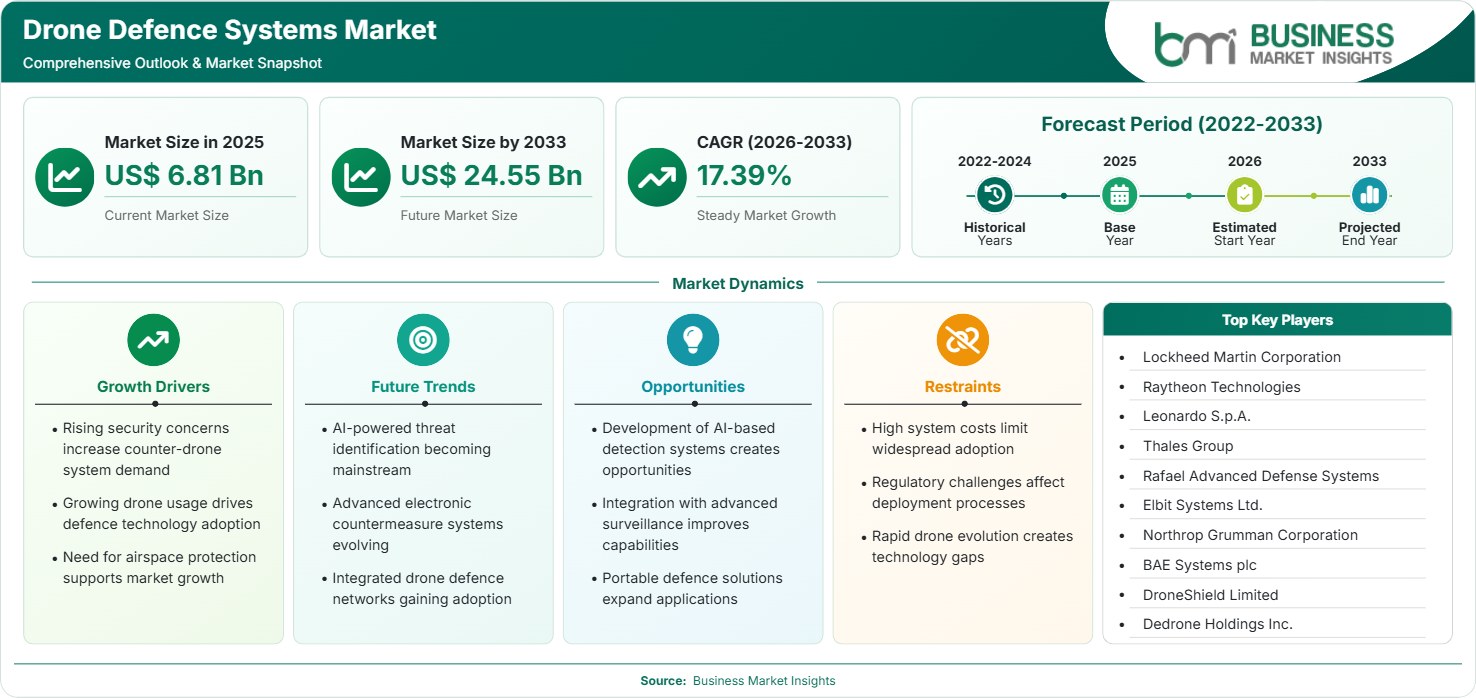
The Drone Defence Systems Market size was valued at US$ 6.81 billion in 2025 and is projected to reach US$ 24.55 billion by 2033, growing at a CAGR of 17.39% during 2026–2033. Rising security concerns, expanding drone deployment, increasing airspace protection requirements, and demand for integrated detection capabilities are supporting market expansion.

Report Coverage
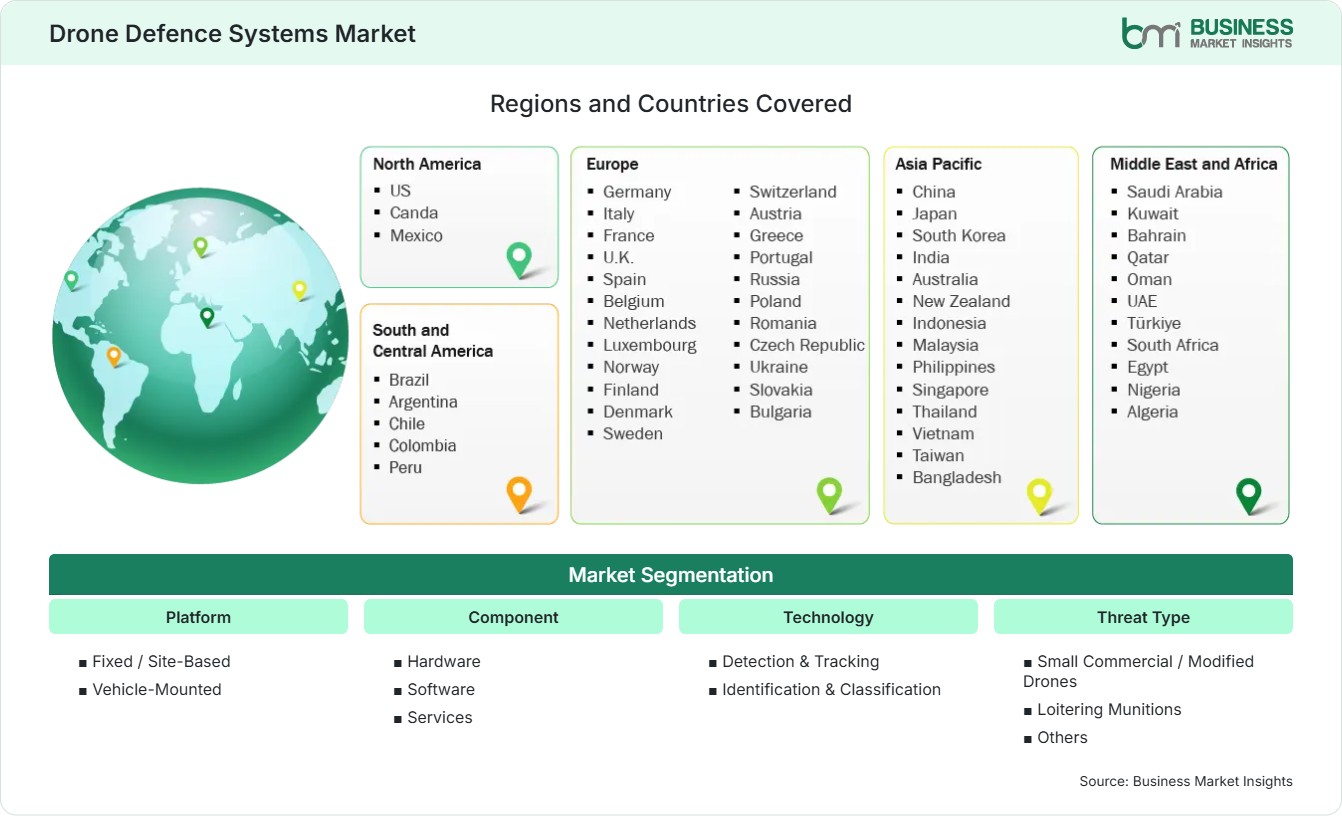
  • Platform: Fixed / Site-Based, Vehicle-Mounted
  • Component: Hardware, Software, Services
  • Technology: Detection & Tracking, Identification & Classification
  • Threat Type: Small Commercial / Modified Drones, Loitering Munitions, Others
  • Application: Battlefield / Tactical Force Protection, Airbase & Military Installation Protection
US$ 6.81 Bn Market size in 2025
US$ 24.55 Bn Market Size by 2033
17.39% CAGR, 2026 - 2033
2026-2033 Forecast Period

AI Overview

Drone Defence Systems Market Summary

  • North America Region: North America holds 31%–34% Drone Defence Systems Market share in 2025 and is expected to expand at a CAGR of 16.2%–17.2% during 2026–2033. Rising security requirements, military modernization, critical infrastructure protection, advanced surveillance integration, and demand for scalable counter-drone technologies support regional expansion. The U.S. contributes the majority of regional demand with a CAGR of 16.5%–17.5%, supported by defense procurement, infrastructure protection, border monitoring, and increasing requirements for controlled airspace.
  • Fastest Growing Region: Asia Pacific represents 34%–37% market share in 2025 and is projected to register a CAGR of 19.0%–20.0%, supported by defense modernization, expanding drone usage, border protection requirements, critical infrastructure development, military installation security, and increasing adoption of integrated surveillance technologies.
  • Leading Segment: Fixed / Site-Based platforms account for 46%–49% market share in 2025 and are expected to grow at a CAGR of 16.8%–17.8%, driven by persistent airspace monitoring requirements, military installation protection, critical infrastructure security, airport protection, and demand for continuously operating detection architectures.
  • High Growth Segment: Detection & Tracking captures 52%–55% market share in 2025 and is projected to achieve a CAGR of 17.1%–18.1%, supported by increasing requirements for early threat awareness, continuous monitoring, sensor integration, accurate tracking, improved situational awareness, and centralized security management.
  • Key Market Opportunity: Integration of artificial intelligence, advanced surveillance, sensor fusion, portable platforms, and software-based command systems is creating opportunities for suppliers to improve detection accuracy, operational flexibility, and scalable airspace protection.
  • Major Market Players: Lockheed Martin Corporation, Raytheon Technologies, Leonardo S.p.A., Thales Group, Rafael Advanced Defense Systems, Elbit Systems Ltd., Northrop Grumman Corporation, BAE Systems plc, DroneShield Limited, and Dedrone Holdings Inc.
Strategic Insights

Drone Defence Systems Market: Strategic Insights

Drone Defence Systems Market Strategic Framework
FREE PDF
Request your free sample
Request free sample
Stakeholder View

Key Takeaways

  • Integrated protection architectures are becoming more important as customers move beyond individual detection devices and seek connected systems combining sensors, software, communications, monitoring, and command capabilities.
  • Detection and tracking represents a major growth opportunity because security organizations require continuous awareness of low-altitude airspace before determining appropriate identification, monitoring, or response actions.
  • Artificial intelligence, sensor fusion, automated classification, and software-based alert management are influencing product development as suppliers seek to improve monitoring efficiency and reduce unnecessary security alerts.
  • Asia Pacific offers a compelling expansion opportunity due to defense modernization, infrastructure development, border monitoring, growing drone activity, and increasing requirements for military and critical infrastructure protection.
  • Strategic partnerships between defense contractors, sensor manufacturers, software developers, and specialized counter-drone companies can improve system integration and support larger multi-technology procurement programs.
Geographic Outlook

Drone Defence Systems Market Regional Highlights

North America Drone Defence Systems Market

North America accounted for 31%–34% Drone Defence Systems Market share in 2025 and is expected to grow at a CAGR of 16.2%–17.2% during 2026–2033. Regional demand is supported by defense modernization, critical infrastructure protection, border monitoring, airport security, and increasing deployment of unmanned aircraft. The United States remains the leading contributor due to extensive defense requirements, large infrastructure networks, and growing demand for integrated detection and monitoring technologies across military and civilian security applications.

  • Defense organizations are increasing investment in layered counter-drone architectures that combine multiple sensing technologies, centralized monitoring, and flexible deployment capabilities for protected facilities.
  • Critical infrastructure operators are evaluating airspace monitoring solutions for energy, transportation, communications, industrial, and strategically important facilities requiring continuous security awareness.
  • Software integration is becoming increasingly important as customers seek centralized alert management, sensor coordination, data visualization, and improved operational visibility across distributed locations.
  • Mobile and vehicle-mounted systems provide additional opportunities for temporary protection requirements, border operations, mobile security missions, and sites where permanent infrastructure is unsuitable.

US Drone Defence Systems Market

The United States contributes 82%–85% of North American demand and is projected to register a CAGR of 16.5%–17.5% during 2026–2033. The market benefits from defense procurement, military installation protection, critical infrastructure security, border monitoring, and airport protection requirements. Demand is increasingly directed toward integrated systems combining detection, tracking, identification, software management, communications, and surveillance capabilities.

  • Military facilities are increasing emphasis on persistent low-altitude airspace awareness, supporting demand for systems that can combine multiple detection and identification capabilities.
  • Critical infrastructure protection is creating opportunities for scalable technologies capable of integrating with existing surveillance, access control, and security management infrastructure.
  • Portable systems are gaining attention for temporary events, mobile security operations, distributed sites, and locations requiring rapid deployment without extensive permanent construction.
  • Defense and security organizations are increasingly evaluating lifecycle support, interoperability, upgradeability, and system integration when selecting counter-drone technologies for long-term deployment.

Europe Drone Defence Systems Market

Europe represents 23%–26% Drone Defence Systems Market share in 2025 and is anticipated to grow at a CAGR of 15.3%–16.3% during 2026–2033. Germany remains an important market due to defense technology capabilities, while France, the United Kingdom, and Italy contribute through military, infrastructure, and security applications. Poland represents a comparatively high-growth opportunity as security modernization and infrastructure protection requirements increase.

  • European defense organizations are evaluating layered systems capable of combining detection, identification, tracking, monitoring, and command functions within established security architectures.
  • Military installation protection remains an important application as customers seek persistent monitoring and scalable systems capable of addressing changing airspace security requirements.
  • Germany and France provide strong technology and defense opportunities, while Poland offers comparatively faster expansion potential from modernization and security investment requirements.
  • The United Kingdom provides opportunities across defense, public security, infrastructure protection, airports, and specialized monitoring applications requiring flexible deployment.

Asia Pacific Drone Defence Systems Market

Asia Pacific holds 34%–37% Drone Defence Systems Market share in 2025 and is projected to achieve the highest 19.0%–20.0% CAGR during 2026–2033. China represents a major regional market because of its extensive defense and technology ecosystem, while India demonstrates strong growth through security modernization and infrastructure development. Japan, South Korea, and Australia also provide important opportunities.

  • Rising defense modernization programs are supporting demand for integrated detection and tracking technologies across military installations and strategic operating environments.
  • India represents a strong growth market as security modernization, increasing drone activity, and infrastructure expansion create requirements for scalable monitoring solutions.
  • Japan, South Korea, and Australia provide opportunities for technologically advanced systems emphasizing interoperability, persistent surveillance, sensor integration, and centralized security management.

Rest of World Drone Defence Systems Market

The Rest of World region accounts for 6%–9% Drone Defence Systems Market share in 2025 and is expected to expand at a CAGR of 17.0%–18.0% during 2026–2033. South and Central American markets are developing opportunities through airport security, energy infrastructure protection, border monitoring, industrial facilities, and public security applications. Brazil represents a leading regional market, while Chile and Colombia provide additional opportunities as infrastructure and security requirements develop.

Middle Eastern and African markets are increasingly evaluating counter-drone technologies for military installations, energy infrastructure, borders, airports, strategic facilities, and public-security environments. Saudi Arabia and the United Arab Emirates represent important Middle Eastern markets, while South Africa provides a notable African opportunity.

  • Energy infrastructure operators are evaluating systems capable of providing continuous airspace awareness across geographically distributed facilities and strategically important assets.
  • Border security requirements support demand for vehicle-mounted and portable platforms capable of operating across large areas without relying entirely on permanent installations.
  • Gulf markets provide opportunities for integrated surveillance and detection technologies at strategic facilities, transportation locations, military sites, and high-value infrastructure.
  • South American customers are evaluating scalable solutions that balance protection requirements with deployment costs, maintenance needs, interoperability, and compatibility with existing security systems.
Global Market Geography
FREE PDF
Request your free sample
Request free sample
Segment Analysis

Drone Defence Systems Market Segmentation

Platform

The Platform segment is influenced by differences in site requirements, deployment conditions, security priorities, and infrastructure availability. Fixed / Site-Based platforms accounted for 46%–49% Drone Defence Systems Market share in 2025 and are expected to grow at a CAGR of 16.8%–17.8% during 2026–2033. Persistent monitoring requirements, military installation protection, critical infrastructure security, and airport applications support adoption, while mobile platforms address flexible and temporary protection needs.

  • Fixed / Site-Based: Dominates deployment where continuous monitoring is required at military installations, airports, critical infrastructure, strategic facilities, and other permanently protected locations.
  • Vehicle-Mounted: Supports mobile security operations, border monitoring, temporary deployments, military missions, and geographically distributed protection requirements requiring rapid relocation.

Component

The Component segment includes physical equipment, software platforms, and supporting services required to establish, operate, and maintain counter-drone systems. Hardware accounted for 50%–53% market share in 2025 and is projected to grow at a CAGR of 16.0%–17.0% during 2026–2033. Increasing system complexity is strengthening demand for integrated software and lifecycle services alongside detection and monitoring equipment.

  • Hardware: Includes sensing equipment, processing units, communications equipment, and supporting infrastructure required for drone detection, tracking, identification, and monitoring.
  • Software: Enables sensor coordination, alert management, data processing, visualization, object classification, centralized monitoring, and integration across connected security architectures.
  • Services: Includes installation, system integration, training, maintenance, technical support, upgrades, site assessment, and lifecycle management supporting long-term operational performance.

Technology

The Technology segment is driven by increasing requirements for reliable detection, continuous tracking, accurate identification, and improved situational awareness. Detection & Tracking represented 52%–55% market share in 2025 and is expected to grow at a CAGR of 17.1%–18.1% during 2026–2033. Customers increasingly favor systems capable of combining complementary sensing technologies to improve coverage and monitoring performance.

  • Detection & Tracking: Provides foundational airspace awareness by identifying potential airborne objects and continuously monitoring movement around protected locations.
  • Identification & Classification: Helps distinguish authorized and unauthorized objects, improves alert quality, and supports security personnel in prioritizing relevant events.

Threat Type

The Threat Type segment is shaped by the increasing diversity of unmanned platforms operating across commercial, recreational, industrial, and defense environments. Small Commercial / Modified Drones represented 48%–51% market share in 2025 and are projected to grow at a CAGR of 16.9%–17.9% during 2026–2033. Security organizations are increasingly seeking adaptable systems capable of addressing multiple drone configurations and operating behaviors.

  • Small Commercial / Modified Drones: Represents a broad threat category because commercially available aircraft can be adapted for unauthorized surveillance, disruption, security-sensitive activity, or other controlled-airspace concerns.
  • Loitering Munitions: Creates specialized defense requirements because these systems combine unmanned flight characteristics with heightened security concerns around military and strategic operating environments.

Application

The Application segment is influenced by the security sensitivity of protected locations and the operational requirements of different end users. Battlefield / Tactical Force Protection accounted for 41%–44% market share in 2025 and is projected to grow at a CAGR of 18.1%–19.1% during 2026–2033. Military installation protection also represents an important opportunity because permanent sites require continuous monitoring and integrated security architectures.

  • Battlefield / Tactical Force Protection: Supports mobile and adaptable systems designed for changing operational conditions, distributed deployment requirements, and protection of personnel and equipment.
  • Airbase & Military Installation Protection: Requires persistent monitoring and integrated security management around sensitive facilities, supporting fixed systems and centralized command capabilities.

End User

The End User segment is shaped by differing security priorities, procurement structures, operating environments, and infrastructure requirements. Military Forces represented 45%–48% market share in 2025 and are projected to grow at a CAGR of 17.6%–18.6% during 2026–2033. Critical infrastructure and homeland security users provide additional opportunities as organizations expand airspace monitoring across sensitive civilian and strategic locations.

  • Military Forces: Remain the dominant user group because military installations and operational environments require scalable detection, tracking, identification, and integrated protection capabilities.
  • Critical Infrastructure: Includes energy, transportation, communications, industrial, and strategically important facilities requiring continuous monitoring and protection against unauthorized drone activity.
  • Homeland Security & Law Enforcement: Supports applications involving public safety, border monitoring, airports, major events, and other environments requiring controlled low-altitude airspace.
Market Forces

Drone Defence Systems Market Dynamics

Key Market Drivers

Rising security concerns increase counter-drone system demand

Growing security concerns surrounding unauthorized drone activity are increasing demand for technologies capable of detecting and monitoring low-altitude airspace around sensitive locations. The expanding availability of commercial drones is also increasing the range of platforms that security organizations must consider when developing protection strategies. These conditions are supporting Drone Defence Systems Market growth as customers prioritize detection coverage, tracking accuracy, classification capabilities, and flexible deployment.

Growing drone usage drives defence technology adoption

The expanding use of drones across commercial, industrial, recreational, agricultural, logistics, and defense environments is increasing the number of locations where controlled airspace monitoring is required. Security organizations must differentiate legitimate drone operations from unauthorized activity, creating demand for systems capable of detecting, tracking, identifying, and classifying airborne objects. This requirement is shaping Drone Defence Systems Market trends, with customers increasingly evaluating sensor integration, software intelligence, monitoring accuracy, interoperability, and deployment flexibility.

Need for airspace protection supports market growth

The requirement to protect controlled airspace is expanding across military facilities, airports, critical infrastructure, borders, industrial locations, and public environments. Unauthorized drone operations can create security and operational concerns, encouraging organizations to establish dedicated detection and monitoring capabilities. Buyers increasingly prefer systems that can integrate into existing surveillance and security infrastructure instead of operating independently.

Key Market Opportunities

Development of AI-based detection systems creates opportunities

Artificial intelligence and advanced analytics can improve the ability of counter-drone systems to process large quantities of sensor information, classify airborne objects, identify patterns, and prioritize potentially relevant events. This creates opportunities for suppliers to develop software platforms capable of reducing manual monitoring requirements while improving operational efficiency. Applications extend beyond military environments into airports, industrial facilities, energy assets, public venues, and other sensitive locations. Drone Defence Systems Market Forecasts indicate that software-enabled architectures can become increasingly important as customers seek better management of multiple sensors and geographically distributed security systems.

Integration with advanced surveillance improves capabilities

Integration of counter-drone systems with wider surveillance infrastructure would help in enhancing visibility and minimizing fragmentation. By integrating detection devices with camera equipment, radar technology, communication networks, access control, and security platform systems, operators can gain a better understanding of potential problems. This will create new market possibilities for vendors who can offer solutions that will enable interoperability within various types of equipment environment. The possibility is especially significant for large installations where there already exists a considerable investment in the surveillance infrastructure.

Portable defence solutions expand applications

Portable counter-drone technologies can help meet security needs in situations where fixed infrastructure is inappropriate, unfeasible, or not needed. Temporary military installations, big events, emergency response scenarios, borders, scattered sites, and varying security situations may necessitate protection that can move along with the evolving demands of the mission. This gives rise to chances for equipment manufacturers to create mobile systems that balance detection efficiency with portability and operability.

Market Restraints and Challenges

High system costs limit widespread adoption

Factor: Integrated counter-drone solutions can require several sensing technologies, processing infrastructure, communications equipment, software, installation resources, technical training, and ongoing maintenance, resulting in considerable initial and lifecycle expenditure. Impact: High system costs can restrict adoption among smaller organizations, private infrastructure operators, municipalities, and customers with constrained security budgets. Buyers may therefore prefer modular architectures that allow capabilities to be introduced progressively rather than requiring complete infrastructure at the initial deployment stage.

Regulatory challenges affect deployment processes

Factor: Counter-drone deployment can involve aviation requirements, communications rules, privacy considerations, security permissions, and restrictions governing the operation of detection or response technologies in specific locations. Impact: Regulatory complexity can delay procurement, complicate deployment planning, and require customers to modify system configurations according to local requirements. The challenge can be particularly relevant around airports, populated locations, telecommunications infrastructure, and other regulated environments.

Company Analysis

Competitive Landscape

The competitive environment is shaped by defense technology capabilities, sensing technologies, software development, surveillance integration, system engineering, and customer-specific deployment requirements. Drone Defence Systems Market analysis indicates that leading companies are increasingly competing through integrated architectures rather than individual detection products.

Company Name

Overview

Products and Services relevant to this market

Lockheed Martin Corporation

Global defense technology company with capabilities across aerospace, sensors, surveillance, mission systems, communications, and integrated defense technologies for demanding security environments.

Defense sensing, surveillance systems, command and control technologies, communications, mission systems, integrated security solutions, and system engineering capabilities.

Raytheon Technologies

Diversified aerospace and defense technology provider with capabilities spanning sensing, surveillance, radar, command technologies, and integrated defense applications.

Radar, sensing, surveillance, command and control technologies, integrated defense systems, communications, and supporting technical services.

Leonardo S.p.A.

Aerospace and defense technology company supplying electronics, sensors, surveillance technologies, security systems, and integrated solutions across military and civil environments.

Radar, electronic systems, surveillance technologies, sensors, command systems, communications, and integrated defense solutions.

Thales Group

Technology and defense company providing digital systems, communications, aerospace technologies, surveillance, cybersecurity, and integrated security capabilities.

Radar, surveillance, communications, command systems, cybersecurity, identification technologies, and integrated security platforms.

Rafael Advanced Defense Systems

Defense technology company focused on advanced sensing, protection, surveillance, precision technologies, and integrated solutions for military and security applications.

Detection systems, surveillance technologies, sensors, command capabilities, protection systems, and integrated defense solutions.

Elbit Systems Ltd.

Defense electronics company developing integrated technologies for surveillance, intelligence, communications, command, and operational awareness across defense environments.

Electro-optical systems, surveillance technologies, sensors, communications, command systems, intelligence technologies, and integrated security solutions.

Northrop Grumman Corporation

Aerospace and defense technology company with expertise in autonomous systems, sensors, surveillance, communications, data processing, and integrated mission solutions.

Sensors, surveillance, command and control systems, autonomous technologies, communications, data processing, and integrated defense capabilities.

BAE Systems plc

Defense and security company supplying electronic systems, intelligence technologies, surveillance capabilities, mission systems, and security solutions.

Electronic systems, surveillance, sensors, command technologies, communications, mission systems, and integrated defense solutions.

DroneShield Limited

Specialized counter-drone technology company focused on drone detection, identification, monitoring, and protection solutions for defense, government, and security users.

Counter-drone detection systems, radio-frequency technologies, portable solutions, integrated monitoring platforms, software, and technical support services.

Dedrone Holdings Inc.

Specialized airspace security technology provider focused on drone detection, identification, monitoring, and centralized management for protected locations.

Drone detection platforms, RF sensing, camera integration, software analytics, airspace monitoring, command interfaces, and security management technologies.

Trust & Transparency

Research Methodology

The market analysis combines proprietary research with secondary data from government agencies, company disclosures, regulatory filings, industry databases and expert interviews. Market estimates are validated through data triangulation, cross-market benchmarking and analyst review.

View Full Research Methodology

Questions Answered

Frequently Asked Questions

What information is covered in the Drone Defence Systems Market Report?

The Market Report covers market dynamics, regional insights, platform segmentation, component analysis, technology developments, threat categories, applications, end-user opportunities, competitive positioning, growth drivers, market opportunities, restraints, and strategic considerations affecting future industry development.

Which region offers strong growth opportunities for manufacturers?

Asia Pacific offers strong opportunities due to defense modernization, expanding drone activity, infrastructure development, border security requirements, military installation protection, and increasing demand for integrated surveillance and airspace monitoring technologies.

How are advanced technologies affecting counter-drone development?

Artificial intelligence, sensor fusion, advanced surveillance, software analytics, automated classification, centralized monitoring, and integrated command systems are improving the ability of security organizations to manage large volumes of airspace information and respond more efficiently to potential security events.

Which platform segment dominates the drone defence systems industry?

Fixed / Site-Based platforms represent the leading segment because permanent military installations, airports, critical infrastructure, and strategic facilities require continuous monitoring and dedicated protection capabilities.

What factors are influencing demand for drone defence systems?

Demand is increasing due to expanding drone usage, rising security concerns, requirements for controlled airspace, military installation protection, critical infrastructure security, border monitoring, airport protection, and the need for reliable detection and tracking capabilities.

Access the Full Drone Defence Systems Market Report

Get segment-level forecasts, regional estimates, competitive benchmarking, company profiles and downloadable Excel datasets.

Access the full Drone Defence Systems Market Report
350 pages PDF & Excel | 2026-08-19
Similar Research

Related Market Reports