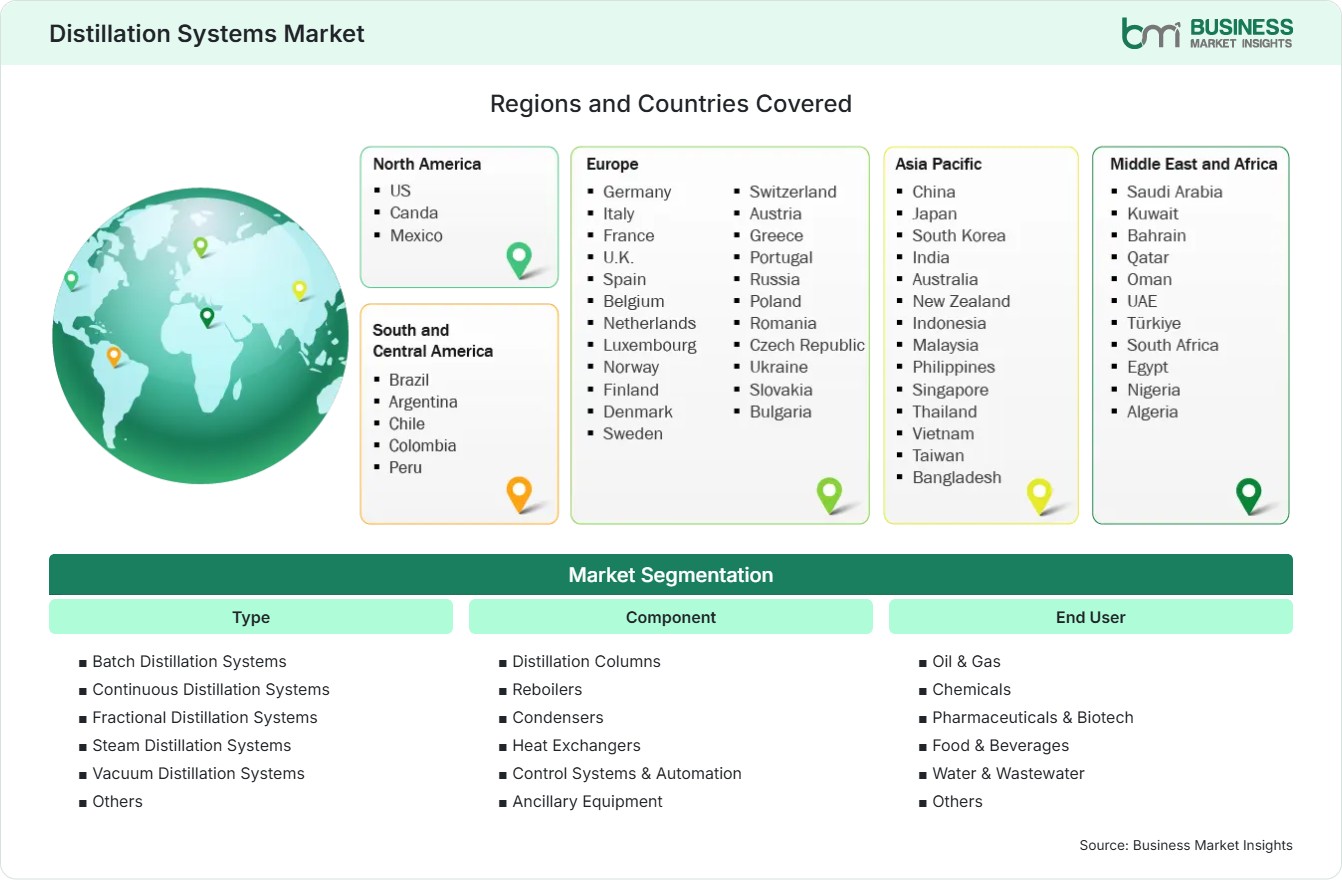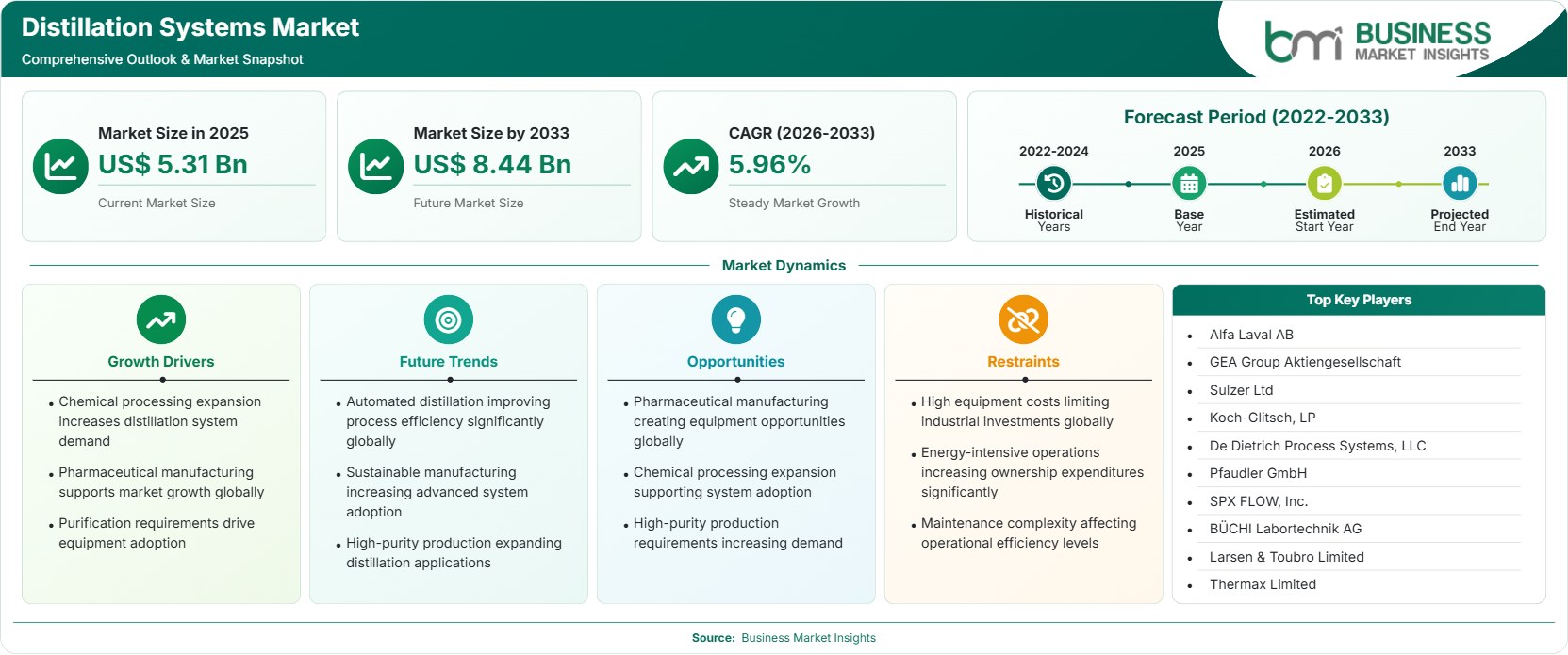
Distillation Systems Market Regional Highlights
North America Distillation Systems Market
North America is projected to account for 25%–29% of the total Distillation Systems Market income by 2025, with a growth rate of 5.2%–6.0% between 2026 - 2033. Modernization of refineries, the manufacture of specialty chemicals and pharmaceuticals, and solvent recovery drive demand. Energy efficiency, reliability, and compatibility with legacy systems have emerged as important factors during procurement. The installed base in the region facilitates replacement applications in addition to capacity addition. Solutions that provide process audit, engineering, and maintenance capabilities help meet customer needs without making big greenfield investments.
- Refinery operators require dependable fractionation and vacuum systems for feedstock processing, product separation, and capacity optimization. Retrofit opportunities arise when equipment limitations restrict throughput or increase energy consumption during changing feedstock conditions.
- Chemical producers need flexible separation equipment for specialty intermediates, solvents, and higher-purity products. Equipment specifications depend on corrosion resistance, vapor-liquid equilibrium, process safety, and the ability to maintain product consistency across different operating campaigns.
- Pharmaceutical manufacturers prioritize cleanable equipment, validated operating procedures, and traceable process conditions. Distillation suppliers can differentiate through hygienic design, automation, documentation, and service support that reduces qualification burdens during equipment installation or modification.
- Energy optimization is becoming a practical procurement criterion. Heat recovery, improved packing, and advanced control can reduce utility demand, particularly in plants where distillation represents a substantial share of thermal processing requirements.
US Distillation Systems Market
The United States Distillation Systems Market is projected to account for 75%–82% of North American revenue by 2025, growing at a CAGR of 5.3%–6.1% during the forecast period of 2026–2033. A strong refining base, well-developed petrochemical hubs, and sophisticated pharmaceutical manufacturing processes drive demand for fresh installations and replacements. There is an assessment of the feasibility of upgrades to renewable fuel distillation, solvent recovery, and specialty chemical processing. Projecting is based on plant load, utility prices, maintenance cost reductions, and technical integration possibilities.
- Refining and petrochemical facilities require high-capacity columns, condensers, and reboilers. Engineering improvements that increase throughput without extensive shutdowns can offer a compelling alternative to full unit replacement.
- Pharmaceutical and biotechnology operations need reliable purification and solvent handling. Vendors with documented engineering practices and responsive technical services can help customers address stringent process requirements and minimize commissioning delays.
- Renewable fuel processing and industrial recycling create opportunities for specialized separation systems. Equipment selection depends on feedstock variability, impurity profiles, recovery rates, and the economics of converting recovered materials into saleable products.
- Digital process monitoring can improve operating consistency by identifying temperature, pressure, and flow deviations. Adoption is strongest where measurable performance gains justify integration costs and where plant teams can use operational data effectively.
Europe Distillation Systems Market
Europe Distillation Systems Market is expected to capture 22% - 26% of the global market value in 2025 and witness a CAGR of 4.8% - 5.7% between 2026 - 2033. The strong presence of the chemical and pharmaceutical sectors results in a high installed base, while energy efficiency and sustainable manufacturing drive modernization initiatives. Germany, France, Italy, and the United Kingdom are still important industrial markets. Growth rates in Germany are forecast at around 4.8% - 5.8%, while Spain and selected manufacturing facilities in Central Europe are projected to grow by 5.2% - 6.3%.
- Germany benefits from a strong process engineering ecosystem and extensive chemical manufacturing. Demand centers on precision separation, equipment reliability, heat recovery, and modernization of production assets serving specialty and industrial chemical customers.
- France offers opportunities in pharmaceuticals, chemicals, food processing, and industrial utilities. Procurement increasingly considers process validation, product quality, and energy performance, especially where equipment operates under tightly controlled manufacturing conditions.
- Italy's specialty manufacturing and food processing sectors require systems tailored to product characteristics and plant scale. Modular designs can help manufacturers manage limited space, production changes, and maintenance requirements.
- Spain and Central European markets provide opportunities through industrial investment and plant upgrades. Suppliers with local service capabilities can address project delivery, commissioning, and ongoing support requirements across diverse customer facilities.
- Environmental and energy performance considerations strengthen the case for retrofit projects. Equipment providers can compete through improved thermal integration, reduced solvent losses, and engineering solutions that extend existing asset life.
Asia Pacific Distillation Systems Market
Asia Pacific is estimated to account for 32%–36% of the global Distillation Systems Market revenue in 2025, with a CAGR of 6.5%–7.5% during 2026–2033. China and India are major demand centers because of their chemical, refining, pharmaceutical, and industrial manufacturing bases. Japan and South Korea contribute through sophisticated chemical production and high-specification processing. India is estimated to grow at 7.0%–8.0%, while China could expand at 6.2%–7.2%, reflecting different combinations of new capacity, modernization, and process technology requirements.
- China combines large-scale refining and chemical production with demand for higher-value specialty materials. Procurement favors equipment capable of handling high throughput, reliable continuous operation, and increasingly demanding product specifications.
- India offers opportunities in active pharmaceutical ingredients, bulk chemicals, renewable fuels, and food processing. Domestic manufacturing expansion increases the need for dependable separation systems, while local engineering and service support can influence supplier selection.
- Japan emphasizes precision processing, operational efficiency, and reliable equipment performance. Replacement demand and specialized applications can favor suppliers offering advanced instrumentation, high-quality fabrication, and close integration with plant control systems.
- South Korea's chemical and refining industries require technically advanced equipment for large integrated facilities. Buyers evaluate thermal efficiency, maintenance access, and operating stability across complex production processes.
- Southeast Asian economies present opportunities in food processing, palm oil derivatives, chemicals, and industrial water management. Modular installations and regional service partnerships can help suppliers address varied investment capacity and project complexity.
Rest of World Distillation Systems Market
The Latin America distillation systems market will account for 7% - 9% of global revenues by 2025, while the Middle East & Africa region is likely to account for about 8% - 11%. The combined market could be valued at a CAGR of 5.8% - 7.0% in 2026-2033 driven by refineries' upgradation, investments in petrochemical plants, food processing activities, and infrastructural developments. Some key Latin American markets are Brazil and Mexico, whereas key Gulf countries are Saudi Arabia and the UAE.
South America, particularly Brazil, is well-suited to provide opportunities in the biofuels and food processing sectors for ethanol separation and process purification applications. Mexico benefits from refinery, chemical, and manufacturing activities. Throughout the Middle East, there will be opportunities for large-scale projects involving integrated refining and petrochemicals that require large-capacity machinery. The African market is somewhat selective, and where there is downstream processing, mining chemicals, pharmaceuticals, and water-related applications, there are also investment opportunities.
- Brazil's ethanol and agricultural processing industries require distillation equipment designed for feedstock variation, recovery efficiency, and continuous operation. Suppliers with relevant process experience can serve both new projects and plant improvement programs.
- Mexico's industrial base supports demand from refining, chemicals, and manufacturing. Project feasibility depends on investment timing, plant utilization, energy costs, and the availability of technical support throughout commissioning and operation.
- Saudi Arabia and the United Arab Emirates continue to develop downstream processing capabilities. Large projects favor suppliers that can manage complex engineering requirements, delivery coordination, materials specifications, and long-term equipment support.
- South Africa and selected African industrial markets offer demand from chemicals, mining-related processing, food manufacturing, and pharmaceutical production. Project scale and financing conditions often determine whether customers select modular or customized systems.
- Regional water and wastewater projects can create niche opportunities for thermal separation and recovery technologies. Suppliers must assess feedwater quality, energy availability, maintenance capability, and operating costs before selecting an appropriate configuration.